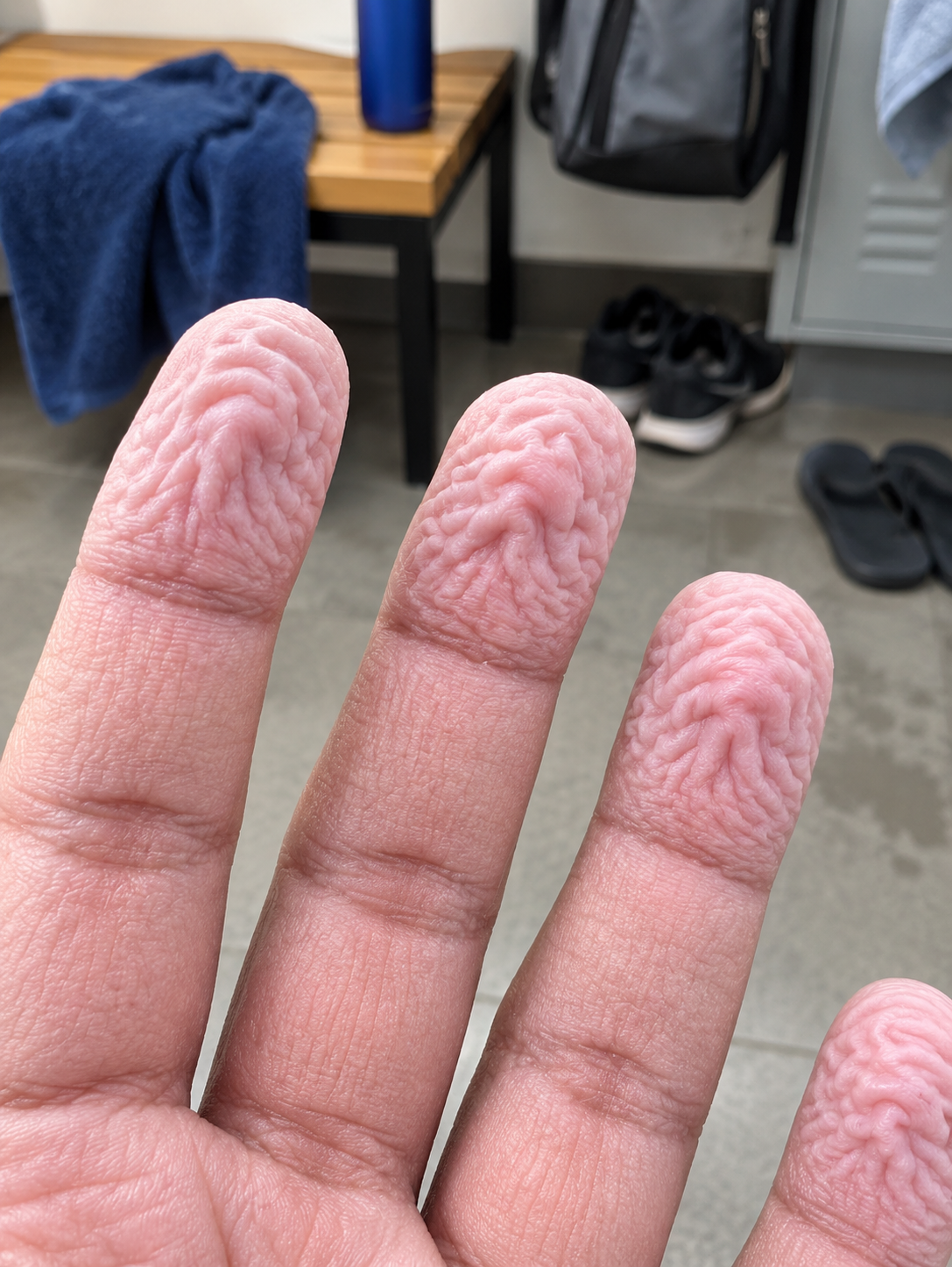
Wrinkled Fingers After Water Exposure are so common that most people barely notice them. Spend several minutes washing dishes, swimming, taking a bath, or enjoying a long shower, and the smooth skin on your fingertips can suddenly develop deep grooves that resemble tiny prunes.
For most people, this reaction is completely normal. It does not mean that your skin has become dehydrated, your circulation has suddenly failed, or your body is showing signs of a serious disease. Instead, modern research shows that ordinary water-induced wrinkling involves an active response from the nervous system and blood vessels beneath the skin.
However, not every case looks the same. Extremely fast or excessive wrinkling, especially when it comes with white bumps, swelling, burning, itching, or pain, can occasionally point to a rare condition called aquagenic wrinkling of the palms.
I remember looking down at my hands after a long round of dishwashing and noticing how dramatically my fingertips had changed. Within a short time, the smooth pads of my fingers had developed deep lines, yet everything returned to normal after my hands dried. That ordinary experience made me curious about what actually causes the effect. The answer turned out to be more interesting than the old explanation that skin simply “soaks up” water. Understanding Wrinkled Fingers After Water Exposure shows how nerves, blood vessels, sweat glands, and the outer layers of the skin interact in ways we rarely notice.
Why Wrinkled Fingers After Water Exposure Happen
Your Nervous System Helps Create the Wrinkles
For many years, people commonly explained wrinkled fingertips as a simple result of skin absorbing water. According to that idea, the outer layer swelled like a sponge while deeper layers stayed the same size, creating folds.
Water does affect the outer skin barrier, so absorption still plays some role in what happens at the surface. However, researchers discovered that the dramatic wrinkling of fingers and toes also depends on functioning nerves and blood vessels.
When the hands remain in water, the autonomic nervous system triggers blood vessels beneath the skin to constrict. As those vessels narrow, the volume of tissue beneath the surface decreases. The overlying skin then forms the familiar ridges and grooves that we call pruning.
This finding explains why nerve damage can reduce or eliminate normal water-induced wrinkling in affected areas. In other words, Wrinkled Fingers After Water Exposure involve more than passive swelling.
The autonomic nervous system controls many processes that happen without conscious effort. It helps regulate sweating, heart rate, blood pressure, and blood-vessel diameter. You do not decide to make your fingertips wrinkle any more than you consciously tell your pupils to change size.
Researchers continue to investigate the exact sequence of events. Nevertheless, the evidence supports an active physiological response rather than the simple “skin sponge” explanation that many people learned growing up.
Do Wrinkles Really Help Us Grip Wet Objects?
One popular explanation suggests that finger wrinkles act like drainage channels. The grooves may help move water away from the contact surface, potentially improving grip on wet objects.
Researchers have proposed that this feature could have offered an evolutionary advantage when humans or their ancestors handled wet plants, tools, rocks, or food. The comparison to tire treads sounds intuitive because both structures create channels that can move water away from a surface.
However, scientists have not completely settled this question. Some experiments have reported better handling of wet objects with wrinkled fingers, while other studies have found little or no measurable advantage.
Therefore, it is better to describe improved wet grip as a scientific hypothesis rather than an established reason that finger wrinkling evolved.
The fact that the response requires the nervous system still makes it biologically fascinating. Your fingers do not simply become waterlogged at random.
In most people, Wrinkled Fingers After Water Exposure begin after several minutes of immersion and gradually disappear once the hands dry.
Cleveland Clinic notes that the effect commonly develops after only a few minutes in wet conditions and involves the palms, fingertips, and soles of the feet.
Normal wrinkling should not hurt. You might notice tightness after a long bath, especially if soaps or hot water have dried the skin, but ordinary pruning itself usually causes no major discomfort.
When Wrinkled Fingers May Be More Than Normal Pruning
Aquagenic Wrinkling Can Happen Very Quickly
A rare skin condition called aquagenic wrinkling of the palms causes an exaggerated reaction to water. Doctors also use names such as aquagenic palmoplantar keratoderma or aquagenic acrokeratoderma.
Unlike ordinary Wrinkled Fingers After Water Exposure, which generally develop after longer immersion, aquagenic wrinkling can appear within only a few minutes.
DermNet reports that normal physiological wrinkling often takes around 11 minutes of water exposure, while aquagenic wrinkling may appear after approximately three minutes.
The appearance can also look different from ordinary pruning.
People may develop prominent white or translucent bumps, swollen-looking skin, or sharply exaggerated creases across the palms. Some people describe tightness, burning, itching, or pain.
The changes usually fade after the hands dry, often within 10 to 60 minutes.
Aquagenic wrinkling typically affects both palms, although the severity can vary. The soles can occasionally become involved as well.
Researchers do not completely understand why the condition develops. Current theories involve abnormal movement of salt and water through skin cells, sweat-gland activity, and proteins that regulate water transport.
If your hands wrinkle unusually fast every time they touch water, particularly when swelling or discomfort accompanies the reaction, discussing the pattern with a dermatologist can help determine whether the response is ordinary or excessive.
Why Doctors Sometimes Ask About Cystic Fibrosis
Aquagenic wrinkling has an important association with cystic fibrosis, which explains why dermatologists take unusually fast, severe palm wrinkling seriously.
Cystic fibrosis results from changes in the CFTR gene, which affects chloride and salt transport across cells. Sweat in people with cystic fibrosis contains unusually high levels of salt, and these changes may influence how water moves through the skin of the palms.
A medical review reports that aquagenic wrinkling occurs much more frequently in people with cystic fibrosis and can also appear in some carriers of CFTR gene variants.
DermNet similarly states that the condition shows a strong association with cystic fibrosis and CF carrier status.
However, this association does not mean that everyone whose fingers wrinkle quickly has cystic fibrosis.
Aquagenic wrinkling can also occur without an identifiable cause. Researchers have reported associations with excessive sweating, atopic dermatitis, Raynaud disease, and certain medications.
Some medications linked to cases include aspirin, certain nonsteroidal anti-inflammatory medicines, and a few other drugs that may influence water or electrolyte transport in the skin.
That is why diagnosis depends on the whole clinical picture rather than one symptom.
A dermatologist may examine the hands after brief water exposure and ask about family history, breathing symptoms, digestive problems, medications, excessive sweating, and other health factors.
If the findings strongly suggest aquagenic wrinkling, a clinician may consider additional testing depending on the person’s history and risk factors.
Other Reasons Your Hands May Look Different Around Water
Dry Skin, Eczema, and Hot Water Can Make Wrinkles Look Worse
Not every dramatic-looking change after washing comes from aquagenic wrinkling.
Frequent handwashing, hot water, detergents, soaps, sanitizers, and household cleaners can weaken the skin barrier. The hands may then feel dry, rough, tight, or cracked after water exposure.
Dry skin can make normal creases appear deeper, which may give the impression that the fingers are wrinkling more aggressively than before.
People with hand eczema may also notice redness, scaling, itching, burning, or painful cracks. These features differ from ordinary temporary pruning.
Atopic dermatitis also appears among the conditions associated with aquagenic wrinkling, although most people with eczema do not develop the rare disorder.
Temperature matters as well. Very hot water can strip natural oils from the skin and worsen dryness.
Therefore, lukewarm water usually makes a better choice for routine washing if your hands become irritated easily.
Apply a fragrance-free moisturizer after washing if your skin feels dry. A thicker cream or ointment generally traps moisture more effectively than a thin lotion.
When cleaning for long periods, protective gloves can reduce exposure to detergents and other irritating substances.
These measures will not prevent normal Wrinkled Fingers After Water Exposure, because normal wrinkling involves the nervous system. However, they can reduce dryness and irritation that make the hands feel uncomfortable afterward.
One-Sided or Absent Wrinkling Can Occasionally Matter
Interestingly, doctors have also studied situations in which fingers do not wrinkle normally.
Because ordinary pruning involves autonomic nerves and blood-vessel constriction, differences between the two hands can sometimes provide information about nerve function.
Historically, clinicians even used water-induced skin wrinkling as one clue when evaluating certain nerve injuries.
That does not mean you should diagnose nerve damage by soaking your hands in a bowl of water.
Many harmless factors can affect how strongly one hand wrinkles compared with another. Water temperature, skin thickness, calluses, previous injuries, and the length of exposure can all change the appearance.
Still, a sudden difference between two hands deserves more attention if it comes with numbness, weakness, loss of sensation, unusual temperature changes, or other neurological symptoms.
Similarly, wrinkling without water exposure belongs to a different category altogether.
Skin naturally becomes more wrinkled with age as collagen, elastin, and moisture levels change. Dehydrated or dry skin can also temporarily make fine lines more noticeable.
Persistent swelling, color changes, sores, severe pain, or loss of sensation should not be blamed on normal water-induced wrinkling.
The key is context.
Normal Wrinkled Fingers After Water Exposure appear after soaking and gradually disappear afterward. Changes that persist, hurt, or occur without water deserve a closer look.
How to Know When to Seek Medical Advice
Normal Wrinkling Usually Needs No Treatment
If your fingertips wrinkle after a bath or washing dishes and return to normal after drying, you usually do not need to do anything.
This represents a normal physiological response in most people.
You do not need special supplements, detox treatments, circulation remedies, or medications to stop ordinary Wrinkled Fingers After Water Exposure.
Likewise, normal pruning does not by itself indicate dehydration.
Dehydration can affect skin appearance in other ways, but wrinkling that occurs specifically after immersing the fingers in water comes from a different mechanism.
You can make your hands more comfortable by using lukewarm rather than very hot water, choosing gentle cleansers, and moisturizing after repeated washing.
If detergents irritate your skin, wear suitable household gloves during cleaning or dishwashing.
People with aquagenic wrinkling may need different treatment. DermNet lists aluminum chloride antiperspirants as a common first-line approach because reducing sweat-gland activity can lessen symptoms.
Doctors may consider other therapies when symptoms persist, including treatment for associated excessive sweating.
Because some treatments can irritate the skin, it makes sense to seek medical guidance instead of treating suspected aquagenic wrinkling on your own.
These Patterns Deserve a Professional Evaluation
Consider speaking with a healthcare professional if your hands begin wrinkling dramatically within only a few minutes of touching water.
You should also mention white or translucent bumps, obvious swelling, persistent burning, itching, or pain.
These features more closely resemble aquagenic wrinkling than ordinary pruning.
A new pattern also deserves attention if you recently started a medication and the symptoms appeared afterward.
Tell your clinician about excessive sweating, eczema, circulation symptoms, or any family history that could help explain the changes.
Medical evaluation becomes more important when water exposure produces severe pain or when the skin fails to return to normal after drying.
Seek prompt care for signs of infection such as increasing redness, warmth, swelling, pus, or fever, especially if cracked skin provides an entry point for bacteria.
Neurological symptoms require a different approach. New weakness, numbness, loss of sensation, or major changes affecting only one hand should receive appropriate medical assessment.
The main lesson is simple: the wrinkles themselves rarely signal danger.
What matters is how quickly they appear, how dramatic they become, whether they hurt, and what other symptoms occur with them.
Understanding that distinction makes Wrinkled Fingers After Water Exposure much less mysterious.
Frequently Asked Questions
Why do my fingers wrinkle in water?
Water-induced finger wrinkling involves an active autonomic nervous system response. Nerves signal small blood vessels beneath the skin to constrict, reducing tissue volume and producing the familiar folds. Water absorption by the outer skin may contribute to the process, but it does not fully explain the effect.
Are wrinkled fingers after a shower a sign of dehydration?
Usually not. Wrinkling that develops after water exposure is a normal physiological response and does not, by itself, indicate dehydration. Dehydration can affect skin in other ways, but post-soaking fingertip pruning has a different mechanism.
How quickly should fingers normally wrinkle in water?
The timing varies between people and with water temperature, but ordinary wrinkling generally takes several minutes. DermNet describes normal physiological wrinkling at around 11 minutes of immersion, while aquagenic wrinkling may develop within approximately three minutes.
What is aquagenic wrinkling of the palms?
Aquagenic wrinkling is a rare condition in which palms develop unusually rapid, excessive wrinkles along with white or translucent bumps and swelling after brief water exposure. Burning, pain, itching, or tightness can also occur. It has a strong association with cystic fibrosis, although it can occur for other reasons.
Should I see a doctor about wrinkled fingers?
Ordinary painless wrinkling that disappears after drying usually needs no medical attention. Consider an evaluation if wrinkling happens extremely quickly, becomes painful or swollen, produces white bumps, persists unusually long, or occurs with numbness, weakness, significant skin changes, or other concerning symptoms.
Conclusion
Wrinkled Fingers After Water Exposure usually represent one of the body’s normal and surprisingly sophisticated responses to the environment.
Your fingertips do not simply swell because they behave like little sponges. Instead, the autonomic nervous system helps constrict small blood vessels beneath the skin, which contributes to the grooves that appear after your hands remain wet.
Researchers have proposed that the grooves may improve grip in wet conditions, although science has not conclusively established that evolutionary explanation.
For most people, the important point remains reassuring: normal pruning after bathing, swimming, or washing dishes does not indicate disease.
However, unusually rapid and excessive wrinkling tells a slightly different story.
Aquagenic wrinkling of the palms can appear after only a few minutes of water exposure and may produce swelling, pale bumps, burning, itching, or pain. The condition has a notable association with cystic fibrosis and CF carrier status, although other conditions, medications, or unknown causes can also contribute.
Dryness and eczema can also make hands look more deeply lined after washing, particularly when hot water and harsh cleansers damage the skin barrier.
Therefore, pay attention to the overall pattern rather than the wrinkles alone.
If your fingers wrinkle normally and recover as they dry, there is usually nothing to worry about.
If the response suddenly changes, appears within only a few minutes, becomes painful, produces swelling or white bumps, or comes with other neurological or skin symptoms, a medical professional can help determine the cause.
In most cases, Wrinkled Fingers After Water Exposure are not your skin warning you that something is wrong. They are simply a visible reminder of how actively your nervous system and skin adapt to the world around you.
More Blog
- Drinking Water on an Empty Stomach — What Science Actually Supports (No Hype, Just Facts)
- Waking Up Between 3 and 5 AM? It Might Be Your Soul Trying to Talk to You
- What a “Bleach” Patch on Your Underwear Really Means — And Why It’s Actually a Good Sign
- This Drink May Weaken Your Bones From The Inside — But Everyone Drinks It Anyway