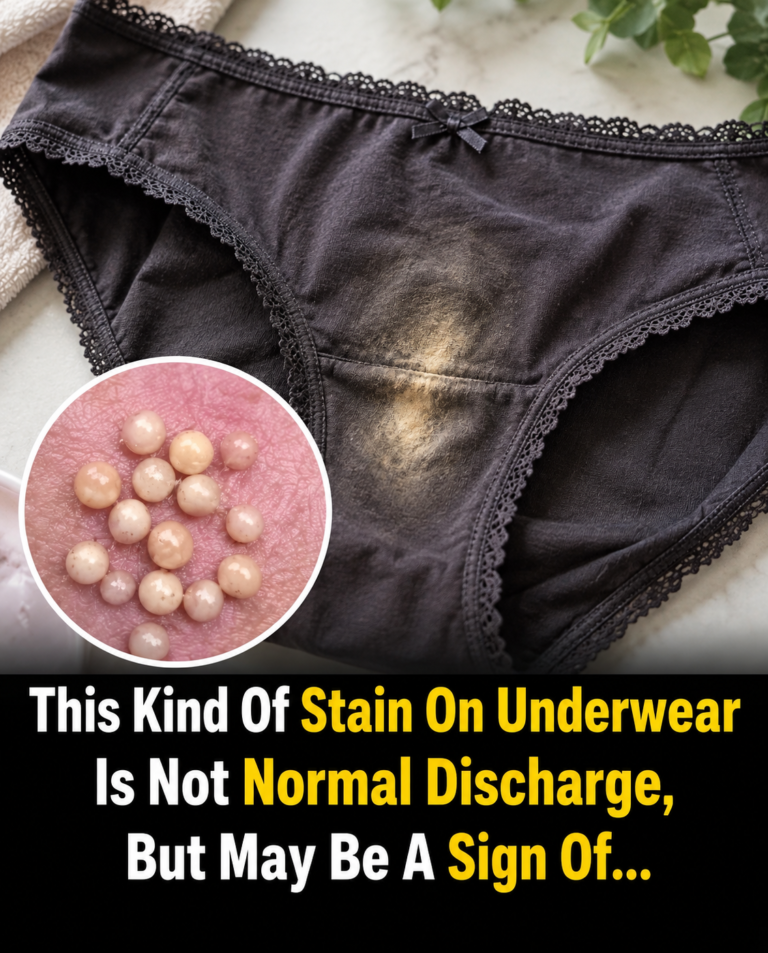
What a “Bleach” Patch on Your Underwear Really Means is usually much less alarming than it looks. If you have ever noticed a pale, faded, or slightly orange-looking area in the gusset of dark underwear, you may have wondered whether detergent, bleach, or your washing machine damaged the fabric.
In many cases, normal vaginal discharge can contribute to this kind of fading. The vagina normally maintains an acidic environment, and its secretions regularly come into contact with underwear. Depending on the fabric, dye, amount of discharge, and length of contact, the color may gradually lighten.
However, one important myth deserves correcting immediately. A bleach patch on your underwear is not a medical test, and it does not prove that your vagina is perfectly healthy. Normal discharge can contribute to fading, but laundry products, sweat, urine, menstrual fluid, fabric quality, and other factors can also change the color of underwear.
I remember first hearing someone describe these pale patches as proof that a woman’s body was “bleaching” her clothes. That explanation made the process sound almost chemical and dangerous. The reality is far less dramatic. Healthy vaginal secretions are naturally acidic, normal discharge is extremely common, and the amount and appearance of that discharge change throughout the menstrual cycle. Once you understand that, the mysterious faded spot becomes much easier to put into perspective.
The American College of Obstetricians and Gynecologists explains that normal vaginal discharge begins around puberty, consists mainly of water and microorganisms, and helps remove dead cells from the vagina. Normal discharge generally appears clear to white and does not have a strong odor.
Why a Bleach Patch on Your Underwear Can Happen
Your Vagina Naturally Maintains an Acidic Environment
The vagina normally maintains a slightly acidic pH. Cleveland Clinic describes a typical vaginal pH as roughly 3.8 to 4.5, although it can change with hormones, menstruation, sex, menopause, infection, and other factors.
This acidic environment serves an important biological purpose. Lactobacillus bacteria commonly form a major part of healthy vaginal flora and produce substances, including lactic acid, that help maintain that lower pH. The acidic environment makes it more difficult for some harmful microorganisms to overgrow.
That does not mean vaginal fluid works like household bleach. Household chlorine bleach is strongly alkaline, while vaginal secretions are acidic. They are chemically very different substances.
Still, repeated exposure to moisture and acidic secretions may affect some textile dyes over time. Dark underwear often makes subtle color changes especially noticeable. Depending on the dye, you might see a faded beige, orange, pinkish, or lighter patch rather than a pure white mark.
Therefore, when discussing What a “Bleach” Patch on Your Underwear Really Means, it is more accurate to describe the mark as possible fabric fading associated with normal secretions rather than literal bleaching.
The presence or absence of fading also tells you very little about health by itself. Some people produce more discharge than others, while certain fabrics and dyes simply show changes more easily.
Normal Vaginal Discharge Changes Throughout the Month
Vaginal discharge does not stay exactly the same every day. Hormonal changes throughout the menstrual cycle can affect its amount, thickness, and texture.
Around ovulation, discharge may become clearer, wetter, and more slippery. At other times, it may appear creamier or thicker. Pregnancy, hormonal contraception, sexual arousal, and changes in estrogen levels can also affect how much discharge you notice.
ACOG notes that normal vaginal discharge generally ranges from clear to white and should not have a strong or unpleasant odor. The volume and makeup can change throughout the menstrual cycle without indicating disease.
That means seeing moisture or dried discharge in underwear is usually part of normal physiology. In fact, vaginal discharge helps maintain the vaginal environment by carrying away dead cells and supporting a balanced microbial ecosystem.
A bleach patch on your underwear may therefore appear more noticeable during times when discharge increases. Someone who ovulates naturally may notice more moisture around mid-cycle, while another person may notice changes before a period.
At the same time, discharge varies greatly between individuals. One person may notice it every day, while another sees very little. Neither pattern automatically indicates a problem.
What Normal Discharge Looks Like and When It May Be Abnormal
Color, Texture, and Odor Matter More Than a Fabric Stain
The stain left on underwear is less useful medically than the discharge itself.
Normal vaginal discharge is often clear, white, or slightly off-white. It may look thin, slippery, creamy, sticky, or somewhat stretchy depending on hormones and timing in the menstrual cycle. It should generally not cause significant itching, burning, pain, or a strong unpleasant odor.
A dried discharge mark can look different from fresh discharge. Moisture evaporates, proteins and cells remain behind, and the fabric itself can alter the color you see. Therefore, a slightly yellowish dried mark does not automatically mean you have an infection.
More important changes include a strong fishy odor, gray discharge, green or yellow discharge, thick clumpy discharge accompanied by itching, or new symptoms such as burning or pelvic discomfort.
For example, the CDC lists thin white or gray discharge, a strong fish-like odor, itching, burning, and discomfort during urination among possible symptoms of bacterial vaginosis.
Trichomoniasis can also raise vaginal pH, while bacterial vaginosis commonly produces a pH above 4.5. However, pH alone cannot diagnose either condition. Clinicians combine symptoms, examination findings, microscopy, and laboratory testing when necessary.
So What a “Bleach” Patch on Your Underwear Really Means depends less on the patch itself and more on whether anything else has changed.
Why the Patch Is Not Proof of a “Perfectly Healthy” Vagina
Social media often takes a reassuring fact and pushes it too far.
It is true that healthy vaginal flora commonly produces an acidic environment. It is also reasonable that normal secretions may contribute to fabric fading. However, you cannot look at a pale spot in underwear and use it to measure vaginal pH.
A person with bacterial vaginosis could still have old faded underwear. Someone with completely normal vaginal health might never notice a stain at all. Different fabric dyes respond differently, and laundry conditions can create similar marks.
Hormones also change vaginal pH naturally. Cleveland Clinic notes that vaginal pH may become less acidic before menstruation and after menopause without automatically indicating infection. Semen and menstrual blood can temporarily affect pH as well.
Therefore, the better message is reassuring but realistic: a bleach patch on your underwear can be completely normal and is often nothing to worry about, but it should not be treated as proof that your vaginal microbiome is ideal.
Health cannot be diagnosed from underwear color.
Your symptoms, personal baseline, examination findings, and laboratory testing when appropriate provide much more meaningful information.
How to Support Vaginal Health Without Disrupting It
Skip Douches and Scented “Feminine Hygiene” Products
One of the most useful things to understand about vaginal health is that the vagina does not need internal cleaning.
Normal discharge already helps remove dead cells and maintain the vaginal environment. ACOG specifically advises against douches, vaginal deodorants, and similar products because they may irritate the area or disrupt the normal balance of organisms.
This becomes especially relevant when someone sees discharge or a bleach patch on underwear and assumes that something must be dirty.
Discharge is not dirt.
Trying to eliminate normal moisture with scented wipes, sprays, perfumes, or internal cleansing products can actually create irritation and alter the bacterial environment that helps protect the vagina.
For the external vulva, gentle care usually works best. Water may be enough for many people, while mild fragrance-free cleansers can be used externally if they do not cause irritation.
Breathable underwear can also help with comfort, especially for people who sweat heavily or experience frequent dampness. Changing out of wet exercise clothes promptly can reduce skin irritation.
However, no particular underwear material can guarantee freedom from vaginal infections. Choose clothing that feels comfortable and does not repeatedly irritate your skin.
Do Not Try to Correct Vaginal pH on Your Own
Because vaginal pH has become a popular wellness topic, products now promise to “balance,” “reset,” or “fix” it.
That language can make normal biological variation sound like a defect.
A healthy vagina generally maintains its own environment. If symptoms suggest bacterial vaginosis, candidiasis, trichomoniasis, or another condition, the correct approach is identifying the cause rather than blindly adding acids, probiotics, washes, or supplements.
Different infections behave differently. Bacterial vaginosis and trichomoniasis commonly raise vaginal pH, while vaginal yeast infections can occur without the same increase. Therefore, even home pH testing cannot tell you exactly which condition you have.
A healthcare professional may use pH as one piece of the diagnostic process, along with symptoms, microscopic examination, or molecular testing.
If you feel completely well and simply notice a bleach patch on your underwear, you usually do not need to start trying to change your vaginal pH.
Treat symptoms, not internet theories.
When Changes in Discharge Deserve Medical Attention
Watch for Changes From Your Personal Normal
Everyone has a slightly different baseline.
Some people normally produce noticeable discharge every day. Others see only small amounts occasionally. Because of that variation, a sudden change from your usual pattern matters more than comparing yourself with an arbitrary online description.
Contact a healthcare professional if discharge becomes strongly or unusually odorous, suddenly changes color or consistency, or appears together with persistent itching, burning, soreness, swelling, painful sex, pelvic pain, or painful urination. ACOG identifies changes in discharge color, odor, amount, or consistency as possible signs that something deserves evaluation.
Bleeding that is not expected from your menstrual cycle also deserves attention, especially if it persists.
Symptoms after a new sexual partner may warrant STI testing. Some sexually transmitted infections cause discharge, while others produce few or no symptoms. Testing decisions depend on age, sexual history, symptoms, pregnancy status, and individual risk.
Do not rely on whether your underwear looks “bleached” to decide whether you need testing.
A pale patch can coexist with completely normal health, and the absence of one does not protect you from infection.
Persistent Symptoms Are More Important Than Internet Rules
Online charts often try to assign a diagnosis to every discharge color. Real medicine is less simple.
Gray discharge with a fishy smell can suggest bacterial vaginosis. Thick white discharge with itching may fit candidiasis. Yellow-green discharge may occur with trichomoniasis. Yet none of those visual patterns alone provides a definitive diagnosis.
Other conditions can produce overlapping symptoms, and people can sometimes have more than one issue at the same time.
Therefore, persistent or uncomfortable symptoms deserve proper evaluation rather than repeated self-treatment with over-the-counter products.
This is especially important during pregnancy, when infections such as bacterial vaginosis may require treatment. The CDC notes that symptomatic BV during pregnancy deserves medical care because it has been associated with pregnancy complications such as premature birth and low birth weight.
The key distinction is simple.
A bleach patch on your underwear without symptoms is usually not a reason to panic.
A noticeable change in discharge combined with pain, irritation, strong odor, or other symptoms is a reason to pay attention.
Frequently Asked Questions
Why does my underwear sometimes look bleached in the crotch?
Normal vaginal discharge may contribute to fading in some fabrics because vaginal secretions are naturally acidic and remain in contact with the gusset. However, detergent, sweat, urine, fabric dye, and normal wear can also affect color. The stain alone cannot diagnose vaginal health.
Does bleached-looking underwear mean my vaginal pH is healthy?
Not necessarily. A typical vaginal pH is acidic, generally around 3.8 to 4.5 during much of the reproductive years, but you cannot determine your pH from underwear discoloration.
Is normal vaginal discharge supposed to happen every day?
It can. Some people notice normal discharge daily, while others notice it intermittently. Hormones, ovulation, pregnancy, contraception, and sexual arousal can change the amount and consistency.
What discharge colors should concern me?
A persistent change to gray, green, yellow, bloody, or unusually thick discharge deserves attention, particularly when it comes with strong odor, itching, burning, pelvic discomfort, or painful urination. Color alone does not provide a diagnosis.
Should I use vaginal washes or douches to prevent discharge stains?
No. Vaginal discharge is normal, and internal cleansing is unnecessary. ACOG advises against douches, deodorants, and similar products because they can cause irritation or disrupt the vaginal environment.
Conclusion
What a “Bleach” Patch on Your Underwear Really Means is usually reassuring.
Normal vaginal discharge is part of a healthy reproductive system. It helps remove cells from the vaginal lining and exists within an environment that is normally slightly acidic. Lactobacillus bacteria play an important role in maintaining that acidity.
That combination of moisture, acidity, fabric dyes, and repeated contact can sometimes leave pale or faded-looking marks in underwear.
But the stain is not a health certificate.
A bleach patch on your underwear does not prove that your pH is perfect, and its absence does not mean something is wrong. Fabric type, dye, detergent, sweat, urine, menstrual fluid, and individual discharge patterns can all influence what you see.
Instead of judging health by your underwear, pay attention to your normal pattern.
Clear or white discharge without a strong odor, itching, burning, or pain is generally normal. A sudden change in odor, color, consistency, or amount—especially when accompanied by discomfort—deserves medical attention.
You also do not need to scrub, perfume, douche, or “balance” a healthy vagina. In most cases, it manages its own environment remarkably well.
So if you pull on a favorite dark pair of underwear and notice another faded patch, there is usually no reason to feel embarrassed or alarmed.
Bodies produce moisture.
Fabrics fade.
And normal vaginal discharge is simply part of how the reproductive system works.
More Blog
- Drinking Water on an Empty Stomach — What Science Actually Supports (No Hype, Just Facts)
- Waking Up Between 3 and 5 AM? It Might Be Your Soul Trying to Talk to You
- This Drink May Weaken Your Bones From The Inside — But Everyone Drinks It Anyway
- One Month Before a Heart Attack: 7 Subtle Warning Signs Your Body May Send (And What to Do)