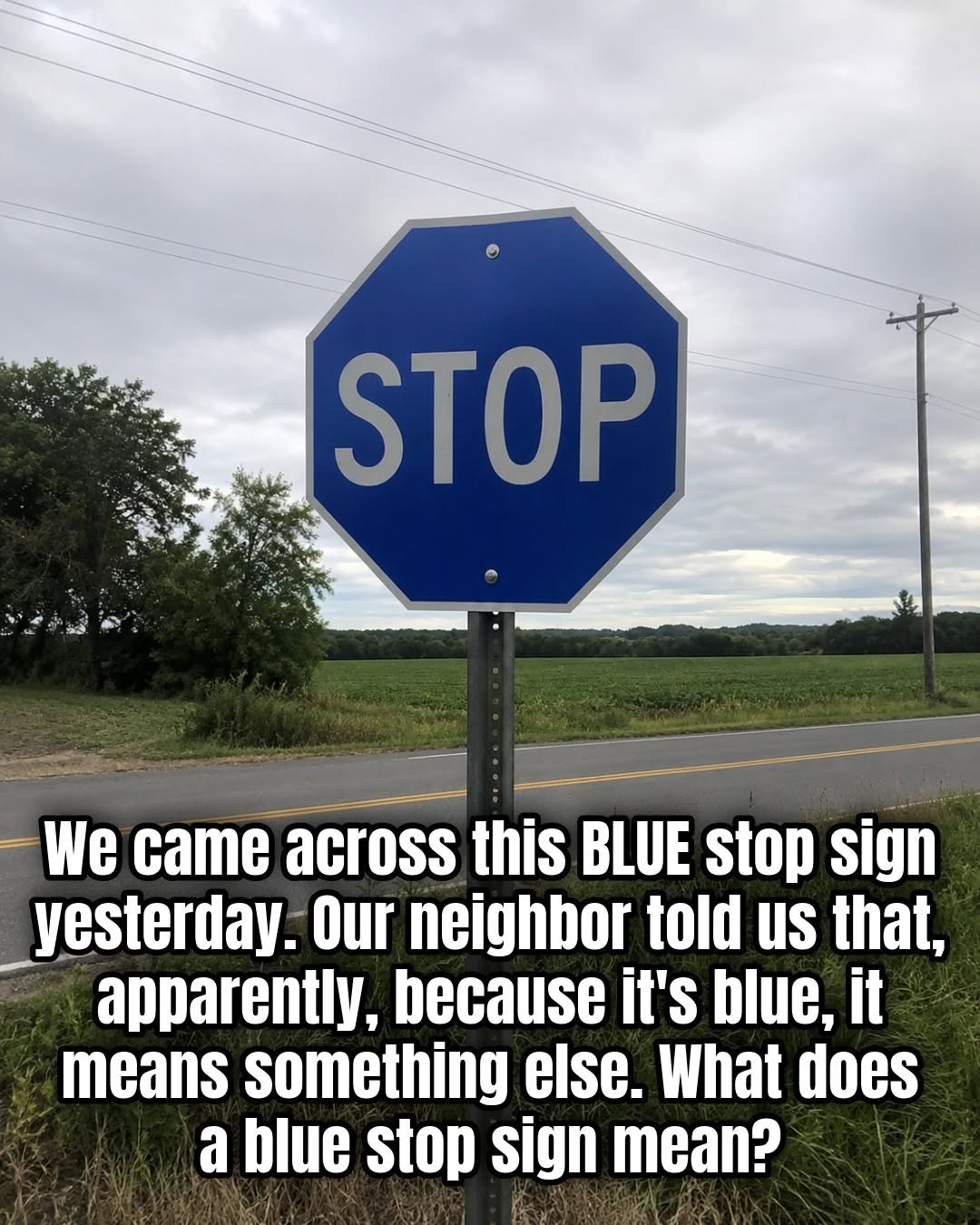
The Meaning Behind a Blue Stop Sign can seem surprisingly mysterious when you first encounter one. Most drivers instantly recognize the familiar red octagonal stop sign, so seeing the same shape painted blue naturally raises questions. Does it carry the same legal authority? Does blue identify a special traffic rule? Should drivers treat it differently?
In the United States, the answer usually depends on where the sign stands. Standard traffic-control rules specify red for official stop signs used on public roads. Therefore, a blue stop sign often appears on private property, where owners may install signs that resemble conventional traffic controls without following every standard used for public highways.
I once noticed a blue stop sign while traveling through a quiet residential development and immediately wondered whether someone had simply chosen the wrong color. The sign looked completely familiar except for its deep blue background. Later, I learned that unusual stop signs often appear on private roads, parking areas, campuses, and controlled properties. That small discovery changed the way I looked at signs outside ordinary streets. Now, whenever an unusual traffic marker catches my attention, I consider both its message and its location. Sometimes the surroundings explain an unusual sign better than the color alone ever could.
Why Blue Stop Signs Look So Unusual
The Familiar Red Stop Sign Standard
Drivers associate stopping with red for a good reason. In the United States, the Manual on Uniform Traffic Control Devices, commonly called the MUTCD, establishes uniform standards for traffic-control devices used on streets and highways.
A standard STOP sign uses an octagonal shape, a red background, and white lettering. Consequently, drivers can identify the command quickly even when visibility becomes difficult.
Consistency matters because drivers often have only seconds to recognize a sign and react. For example, someone approaching an unfamiliar intersection should not need to analyze several colors before understanding that the road requires a complete stop.
The distinctive octagonal shape also helps. Even when snow, dirt, fading, or another obstruction partially covers the face, drivers can often recognize the sign from its outline.
Furthermore, standardized colors allow different types of road signs to communicate information quickly. Red commonly communicates stopping or prohibition, while other colors serve different traffic-control functions.
Therefore, a blue octagonal sign that says STOP immediately stands apart. Although the words and shape look familiar, the color does not follow the normal appearance drivers expect from an official stop sign.
That difference provides the first important clue. Before assuming that a blue sign represents a new nationwide traffic rule, look carefully at where it appears.
Why Someone Might Install a Blue Stop Sign
A blue stop sign most commonly makes sense in a private setting. Property owners sometimes install traffic signs to organize vehicle movement even when the roads do not operate exactly like ordinary public streets.
For instance, you might encounter unusual signs in a private residential community, parking facility, industrial complex, large business property, recreational development, or institutional campus.
Property managers still need ways to tell drivers where to stop. However, they may choose custom colors to distinguish private traffic controls from government-installed signs.
Additionally, a community might use a particular color as part of its visual design. A private development may coordinate signs with architectural features, landscaping, or other property markers.
That design choice does not create a new universal meaning for blue. In other words, drivers should not assume that every blue stop sign represents the same special category.
Instead, its practical message remains easy to understand: the property owner wants approaching vehicles to stop.
For safety, drivers should respond cautiously. Even when a sign stands on private property, ignoring an obvious request to stop could create unnecessary danger.
Public Roads and Private Property Make a Difference
Official Traffic-Control Standards
Location plays a major role in understanding The Meaning Behind a Blue Stop Sign. On public roads in the United States, official traffic-control devices generally follow established standards so drivers receive consistent information from one place to another.
That uniform system improves safety. For example, a traveler can drive from one state to another and still recognize a STOP sign immediately.
Therefore, an official stop sign should not suddenly switch from red to blue simply because a local community prefers another color.
A blue octagon marked STOP would not conform to the normal MUTCD standard for an official STOP sign. As a result, seeing one on what appears to be a public roadway deserves closer attention.
However, drivers should never use an unusual color as an excuse to proceed recklessly through an intersection. Road conditions, other vehicles, pedestrians, and local circumstances still matter.
Furthermore, an unusual sign could result from a temporary situation, private-road arrangement, nonstandard installation, or another local circumstance that drivers cannot determine from inside a moving vehicle.
Therefore, safety should come first.
Slow down, check the intersection carefully, and respond appropriately to the conditions around you. If the sign clearly instructs drivers to stop, treating it cautiously makes much more sense than testing its legal status from behind the wheel.
Traffic Rules on Private Roads
Private property creates a different situation because property owners often control vehicle movement within their own spaces.
Imagine a large parking lot with several intersecting lanes. Without signs, drivers could easily approach those intersections at the same time. Therefore, the owner may install stop signs to create an orderly traffic pattern.
Similarly, gated communities may use traffic controls to reduce speeding and clarify right-of-way expectations.
A private property owner may also choose nonstandard colors. Consequently, you might encounter blue, green, or otherwise customized signs that would look unusual on a public highway.
Nevertheless, private property does not mean traffic safety stops mattering. Drivers still have a responsibility to avoid collisions and operate vehicles carefully.
Additionally, local laws can affect how traffic regulations apply to private roads and parking areas. The exact legal consequences of ignoring a privately installed sign can therefore vary according to jurisdiction, road status, property arrangements, and surrounding circumstances.
So, avoid making broad assumptions about enforcement from color alone.
Instead, treat the sign as useful information about the intended traffic pattern. If a blue STOP sign marks an intersection inside a parking area or private community, stopping provides a simple and sensible way to reduce risk.
How Drivers Should Respond to a Blue Stop Sign
Put Safety Before the Color
When you encounter an unfamiliar traffic sign, caution provides the safest response.
First, reduce your speed as you approach. Next, look for pedestrians, bicycles, vehicles, driveways, gates, and intersecting traffic. Then, determine whether stopping allows you to proceed safely.
A blue stop sign still communicates a clear instruction through its word and octagonal shape. Therefore, following that instruction usually offers the most predictable response for everyone nearby.
Suppose two vehicles approach a private intersection from different directions. One driver sees the blue sign but decides that its unusual color makes it meaningless. Meanwhile, the other driver assumes vehicles facing the sign will stop.
That misunderstanding can create a collision.
By contrast, stopping eliminates much of that uncertainty.
Additionally, children and pedestrians may appear in residential communities or parking areas. Delivery vehicles may enter unexpectedly. Golf carts, bicycles, maintenance equipment, and other slow-moving vehicles can also cross private roads.
Therefore, focusing exclusively on whether a sign technically matches federal standards misses the larger safety issue.
Traffic controls exist primarily to organize movement and reduce conflicts. Even when private owners install them, they can still communicate valuable information.
Look at the Surroundings
Context can reveal a great deal about The Meaning Behind a Blue Stop Sign.
Start by identifying the type of road. Does it appear to be a city street, state highway, gated-community road, parking lane, campus drive, or private access road?
Next, look for supporting clues. Gates, guard stations, private-property notices, community signs, parking structures, and building entrances can indicate that you have entered privately managed property.
Also, examine nearby traffic signs. If several signs share unusual colors or customized designs, the property owner may use a coordinated private signage system.
However, never become so focused on analyzing the sign that you stop paying attention to traffic.
When conditions remain unclear, choose the safer action. Stop, observe the intersection, and proceed when safe.
Furthermore, remember that sign color alone cannot answer every legal question. States and municipalities may have different rules concerning private roads, parking facilities, gated communities, and enforcement.
If you regularly travel through a location with unusual traffic controls and need a definitive legal interpretation, consult the relevant state or local transportation authority.
That approach provides much more reliable information than assuming every blue stop sign has exactly the same legal status.
Common Misconceptions About Blue Stop Signs
Blue Does Not Create a Secret Traffic Rule
One of the easiest mistakes involves assuming that blue represents a hidden or specialized nationwide stopping rule.
It does not.
There is no general American traffic rule that transforms a blue STOP sign into a special category comparable to the standard red STOP sign.
Instead, unusual coloration commonly suggests that the sign belongs to a nonstandard or private traffic-control system.
Likewise, blue does not automatically mean that only certain drivers must stop. It does not universally indicate rules for emergency vehicles, residents, commercial vehicles, or visitors.
The surrounding property may establish its own procedures, of course. However, those procedures should come from posted instructions or applicable rules rather than assumptions about the color blue.
Drivers should also avoid confusing blue stop signs with other legitimate blue traffic signs.
Blue appears on certain roadway signs that provide motorist services or other information. Therefore, blue itself certainly has recognized uses within transportation signage. However, that fact does not make blue the standard background for an official STOP sign.
Understanding that distinction prevents unnecessary confusion.
Essentially, shape, wording, color, placement, and location work together. You should consider all of those features rather than relying on a single characteristic.
Unusual Does Not Mean You Should Ignore It
Another misconception says that drivers can simply ignore a blue stop sign because it differs from the familiar red standard.
That approach creates unnecessary risk.
Even if a privately installed sign does not carry the same regulatory status as a standard public-road traffic sign, it can still communicate an important safety instruction.
For example, a property manager may place the sign at an intersection with poor visibility. Buildings, landscaping, parked vehicles, walls, or fences might block a driver’s view of approaching traffic.
Therefore, stopping may protect you from a hazard that you cannot initially see.
Similarly, the property may experience heavy pedestrian activity. Shopping areas, apartment complexes, campuses, and recreational properties often mix vehicles with people walking through the same space.
Following posted instructions helps everyone behave more predictably.
Moreover, an accident does not become harmless simply because it happens on private property. Drivers still need to operate responsibly.
So, when you see an unusual stop sign, avoid turning the situation into a roadside legal experiment. Reduce speed, stop when appropriate, check carefully, and continue safely.
The sign’s blue color may make it interesting, but safe driving remains the priority.
Frequently Asked Questions
What does a blue stop sign mean?
A blue stop sign generally tells drivers to stop, but its unusual color often indicates that it belongs to a private or nonstandard traffic-control system rather than the standard system used for official STOP signs on public roads in the United States. Its exact legal significance can depend on the location and jurisdiction.
Are official stop signs supposed to be red?
Yes. Standard STOP signs used under U.S. traffic-control standards have a red background, white border, white STOP lettering, and an octagonal shape. This consistent design helps drivers recognize them quickly.
Where might I see a blue stop sign?
You may encounter one on private roads, inside residential developments, parking facilities, campuses, business properties, recreational areas, or other privately managed locations. However, circumstances vary, so drivers should consider the surrounding environment.
Should I stop at a blue stop sign?
Stopping represents the safest practical response when the sign clearly tells approaching traffic to stop. Even on private property, the sign may protect drivers and pedestrians at a hazardous intersection. You should also follow any applicable local traffic laws and property rules.
Does every blue stop sign have the same meaning?
No. The color does not establish one universal special meaning for every blue stop sign. Property owners may use customized signs for different reasons. Therefore, location, posted instructions, road ownership, and local laws can all affect how you should interpret a particular sign.
Conclusion
The Meaning Behind a Blue Stop Sign becomes much less mysterious once you consider where the sign appears. In the United States, the familiar red octagon serves as the standard design for official STOP signs. Therefore, a blue version usually signals a nonstandard installation, particularly when it appears on private property.
Private communities, parking areas, campuses, and other controlled properties may use customized signs to organize traffic. Although their appearance differs from standard public-road signs, their basic message remains easy to understand: stop before proceeding.
Most importantly, drivers should not allow an unusual color to distract them from safe driving. Slow down, observe your surroundings, watch for pedestrians and vehicles, and proceed only when conditions allow.
Finally, remember that legal rules can vary by jurisdiction and by the status of the roadway. When you need a definitive answer about a particular sign, local transportation or law-enforcement authorities can clarify the rules that apply there.
A blue stop sign may be unusual, but the safest response remains wonderfully familiar: approach carefully, stop, look, and continue when it is safe.
More Blog
- Drinking Water on an Empty Stomach — What Science Actually Supports (No Hype, Just Facts)
- Waking Up Between 3 and 5 AM? It Might Be Your Soul Trying to Talk to You
- What a “Bleach” Patch on Your Underwear Really Means — And Why It’s Actually a Good Sign
- This Drink May Weaken Your Bones From The Inside — But Everyone Drinks It Anyway