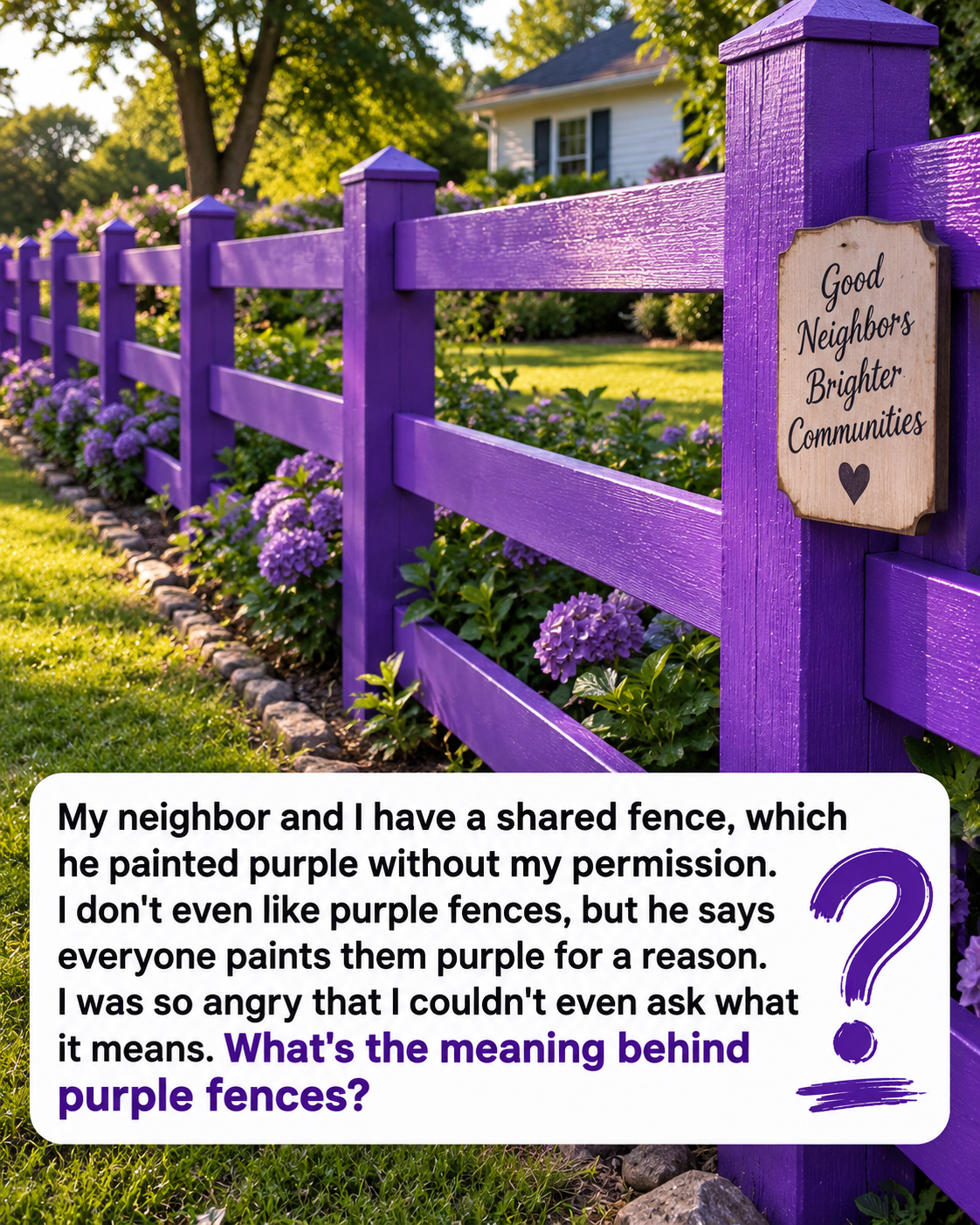
If You Spot a Painted Purple Fence, This Is What It Means may sound like the beginning of an obscure outdoor mystery. You are walking beside a country road, hiking near farmland, or exploring a wooded area when you notice a bright purple stripe painted across a fence post or tree. At first, it may look like a survey mark, trail blaze, or simply an unusual decorating choice.
In many parts of the United States, however, that purple mark carries an important message: private property ahead, and entry may be prohibited. Several states legally recognize purple paint as a method for landowners to give notice against trespassing, although the exact meaning, dimensions, spacing, and legal effect vary from state to state. A 2023 Connecticut legislative research report found that approximately 20 states had purple-paint or similar posting laws, with some states using other colors instead.
I first found the idea surprising because I had always associated “No Trespassing” with metal signs nailed to fence posts. A streak of paint seemed far too simple to carry legal significance. Yet once you understand how quickly signs can disappear from large rural properties, the system makes sense. Paint cannot easily blow away, fall from a tree, or vanish because someone removed the sign. More importantly, recognizing the mark can prevent an innocent hike or shortcut from turning into a confrontation or trespassing problem.
So, If You Spot a Painted Purple Fence, This Is What It Means in many jurisdictions: pay attention, assume you may be approaching posted private land, and do not continue across the boundary unless you know you have permission. However, the details matter much more than viral posts usually admit.
Why Purple Paint Can Mean No Trespassing
How Purple Paint Became a Property-Boundary Signal
Landowners have traditionally used signs, fences, and verbal warnings to tell people that private property is off-limits. However, maintaining signs across hundreds of acres can become difficult. Weather damages them, vegetation hides them, and people sometimes remove them.
Purple paint offers a durable alternative. Depending on the state, properly placed purple markings can serve as legally recognized notice that entry is restricted. Indiana, for example, allows correctly applied purple paint to carry the same legal effect as a “No Trespassing” sign. Purdue Extension notes that Indiana’s law took effect in 2018 and was designed partly to give property owners an easier alternative to repeatedly replacing damaged or missing signs.
Pennsylvania also recognizes purple paint as a method of posting private property. The Pennsylvania Game Commission explains that qualifying marks notify people that private land is posted against trespassing.
Texas takes a similar approach. The Texas State Law Library explains that state trespass law allows landowners to use purple paint as one form of notice, provided the markings meet specific requirements.
Therefore, If You Spot a Painted Purple Fence, This Is What It Means cannot be reduced to a decorative color choice when you are in an area where these laws apply. The safest interpretation is that someone is intentionally marking a boundary.
Why Purple Was Chosen
Purple works well because it stands out against many natural backgrounds. Trees, fence posts, grasses, and soil usually feature browns, greens, grays, and other earth tones, so a vivid purple stripe can be noticeable from a distance.
It also avoids confusion with some colors already associated with other outdoor uses. Orange frequently appears in hunting safety equipment, while trail systems, forestry operations, utilities, and survey crews may use several other bright colors. Purple consequently developed as a recognizable posting color in numerous states.
However, purple does not carry the same universal legal meaning everywhere in the country. Some states use different colors. The Connecticut General Assembly’s Office of Legislative Research noted in 2023 that Arizona used orange in a comparable system, Maryland used bright blue, and Virginia allowed designated colors under state rules.
That variation makes one rule especially useful: never assume that paint colors mean exactly the same thing when crossing state lines. If You Spot a Painted Purple Fence, This Is What It Means in one jurisdiction may differ from the precise legal effect somewhere else.
Still, recognizing purple paint as a potential property warning can prevent problems. When you see repeated purple markings near a boundary, do not treat them like ordinary trail markers unless reliable signage or official information tells you otherwise.
What the Purple Marks Are Supposed to Look Like
Size, Height, and Spacing Vary by State
A random splash of purple paint does not necessarily satisfy a state’s legal posting requirements. Most purple-paint laws specify how landowners must apply the marks so approaching people can recognize them.
Texas provides a good example. Purple lines used as trespass notice must generally be vertical, at least eight inches long and one inch wide. The bottom must sit between three and five feet above the ground. The marks must also remain clearly visible and appear no more than 100 feet apart on forest land or 1,000 feet apart on other land.
Pennsylvania uses similar dimensions but different spacing. Its law calls for vertical purple lines at least eight inches long and one inch wide, with the bottom between three and five feet above ground. Marks must remain readily visible and generally sit no more than 100 feet apart.
South Carolina uses yet another version. State guidance describes vertical purple marks at least eight inches long and two inches wide, with the bottom positioned between three and six feet above the ground or normal water surface. The markings must be placed on permanent objects no more than 100 yards apart.
So If You Spot a Painted Purple Fence, This Is What It Means should never imply one nationwide stripe specification. The overall concept travels across state lines, but the legal measurements do not.
Purple Paint May Apply Differently to Hunting and General Entry
Another detail often lost in viral explanations involves what activity the law actually regulates. Some statutes address general trespassing, while others focus more specifically on hunting, fishing, or trapping.
North Carolina illustrates the distinction. Its Wildlife Resources Commission explains that purple paint can post land under the state’s Landowner Protection Act, with marked property requiring written permission for hunting, fishing, or trapping. The agency specifies vertical lines at least eight inches long, positioned three to five feet above the base of a tree or post and placed no more than 100 yards apart.
North Carolina’s statute also expressly allows owners or lessees to place identifying purple paint marks on trees or posts around posted areas.
Pennsylvania, meanwhile, incorporates qualifying purple marks into its broader defiant-trespass law.
Consequently, If You Spot a Painted Purple Fence, This Is What It Means depends partly on where you stand and what you intend to do. A hunter, hiker, angler, photographer, or person taking a shortcut may face different statutory language depending on the state.
From a practical safety standpoint, however, the response remains straightforward. If repeated purple marks clearly define property that you do not own and you lack permission to enter, turn around rather than trying to interpret the law from the trail.
What You Should Do When You See Purple Paint
Stop Before Crossing the Boundary
When If You Spot a Painted Purple Fence, This Is What It Means applies where you are traveling, the best response is simple: do not cross the marked boundary without permission.
That advice matters especially in rural areas. A fence may surround livestock, agricultural equipment, active hunting land, timber operations, or a private residence that you cannot see from the road. Entering without permission can create safety problems in addition to legal ones.
Do not assume that an open gate means public access. Likewise, a worn footpath through a fence does not automatically create permission to use private property. Other people may have crossed illegally, or the path may exist for the landowner’s own use.
If you are hiking and lose the trail, retrace your route instead of continuing through posted land. If GPS directions send you across a private road, look for a legal alternative rather than assuming your navigation app grants access.
The same applies when retrieving something that crossed the boundary. A dog, ball, drone, or other object does not automatically give you unrestricted permission to enter someone else’s land. Local laws can contain special exceptions, but those rules vary, so contacting the property owner or authorities can provide a safer approach.
Do Not Remove, Cover, or Ignore the Marks
Purple paint may seem less official than a professionally printed sign, but in states that recognize it, properly applied markings can carry legal significance.
Illinois agricultural guidance, for example, explains that its purple-paint law gives landowners an alternative method of marking trees or posts and states that purple paint functions like a “No Trespassing” sign under applicable law.
Therefore, do not scrape paint away, cover it, paint over it, or remove marked posts. Even apart from trespass rules, damaging another person’s property creates an entirely separate problem.
You should also avoid arguing that you did not see a traditional sign if the state recognizes another form of legal notice. Purple-paint systems exist precisely because written signs are not always necessary under those laws.
At the same time, If You Spot a Painted Purple Fence, This Is What It Means should not encourage panic. Purple paint does not automatically mean that someone intends to confront or harm trespassers. It primarily communicates a boundary and the landowner’s intention to restrict access.
Respecting the mark solves most of the problem. Stop, identify another route, and leave the private property undisturbed.
What Purple Paint Does Not Mean
It Is Not a Universal Warning of Immediate Physical Danger
Internet posts sometimes make purple paint sound ominous, as though crossing the line means walking into an area filled with traps, armed guards, or another immediate danger.
That framing goes too far.
Purple paint generally communicates property restrictions in jurisdictions that recognize the system. It does not mean a person who accidentally notices the mark faces an immediate physical threat.
The sensible reason to turn around is that the mark may indicate private, posted land. Respecting property boundaries reduces the risk of trespassing, unexpected encounters, livestock problems, or entering an area where activities such as hunting or farm operations may occur.
Similarly, a purple stripe does not grant landowners unlimited authority over anyone who crosses it. Property rights and trespass laws operate within state and federal law.
So while If You Spot a Painted Purple Fence, This Is What It Means deserves attention, readers should interpret the message as “do not enter without authorization,” not as a mysterious coded threat.
It Does Not Mean the Same Thing in Every State
The biggest mistake in many purple-paint articles involves presenting the rule as a single nationwide law. No such universal U.S. rule exists.
A 2023 legislative review estimated that about 20 states had purple-paint or comparable paint-posting laws at that time. It also documented differences in approved colors and statutory requirements.
Even among states that use purple, details differ significantly. Texas distinguishes between forest and non-forest spacing. Pennsylvania uses its own dimensions and spacing. South Carolina permits different height and width measurements, while North Carolina’s wildlife rules emphasize permission for hunting, fishing, and trapping.
Local exceptions can exist as well. Pennsylvania’s Game Commission, for example, states that its purple-paint provision does not apply in Philadelphia and Allegheny counties.
Therefore, If You Spot a Painted Purple Fence, This Is What It Means should always come with one final qualification: check the law where you actually are.
When in doubt, respect the boundary anyway. You lose little by choosing another route, while entering private land without permission can create unnecessary legal and safety complications.
Frequently Asked Questions
Does purple paint always mean “No Trespassing”?
No. Purple paint has legal significance in many states, but there is no single nationwide rule. Some states recognize purple markings as trespass notice, while others use different colors or have different posting systems. State and local law determine the exact effect.
What should I do if I see purple paint while hiking?
Stop before crossing the apparent boundary and determine whether you are still on an authorized trail or public land. If the markings appear to indicate private property and you lack permission, turn around and retrace your route rather than continuing.
Why use paint instead of No Trespassing signs?
Paint lasts longer than many signs and cannot easily blow down or be removed. Indiana’s Purdue Extension specifically notes that lost, vandalized, and weather-damaged signs helped motivate the usefulness of purple paint as an alternative form of notice.
How large does a purple stripe need to be?
The answer depends on the state. Texas generally requires an eight-inch-by-one-inch vertical stripe positioned three to five feet above the ground, while South Carolina calls for an eight-inch-by-two-inch mark positioned three to six feet above the ground or normal water level. Always check the relevant state law.
Can I enter purple-marked property if there is no written sign?
Not necessarily. In states where qualifying purple paint constitutes legal notice, a separate written “No Trespassing” sign may not be required. Indiana and Pennsylvania, for example, recognize properly applied purple markings as forms of trespass notice.
Conclusion
If You Spot a Painted Purple Fence, This Is What It Means is ultimately much simpler than the mysterious headlines suggest. In many U.S. states, purple paint on trees, fence posts, or other approved boundary markers serves as a legally recognized warning that the land is private or that entry is restricted.
The exact rules are not universal. States establish their own requirements for stripe dimensions, height, spacing, visibility, and the activities covered by the law. Some states also use colors other than purple, while others do not rely on a comparable paint-posting system at all.
That means you should not memorize one set of measurements and assume it applies everywhere. Instead, remember the practical message.
When you see repeated purple stripes marking the edge of land you do not own, treat them seriously.
Do not climb the fence.
Do not continue down the private path simply because there is no metal sign.
Do not assume a GPS route, hiking app, or worn trail overrides the property boundary.
Instead, stop and find another route unless you know you have permission.
If You Spot a Painted Purple Fence, This Is What It Means in the places that recognize purple-paint laws: someone has taken deliberate steps to tell approaching visitors that the property is restricted. Respecting that message protects the landowner’s rights, keeps you on the right side of local trespass rules, and helps prevent unnecessary confrontations.
A little purple paint can carry a surprisingly important message. Once you know what it may mean, it becomes one outdoor marker you should never casually ignore.
More Blog
- Drinking Water on an Empty Stomach — What Science Actually Supports (No Hype, Just Facts)
- Waking Up Between 3 and 5 AM? It Might Be Your Soul Trying to Talk to You
- What a “Bleach” Patch on Your Underwear Really Means — And Why It’s Actually a Good Sign
- This Drink May Weaken Your Bones From The Inside — But Everyone Drinks It Anyway