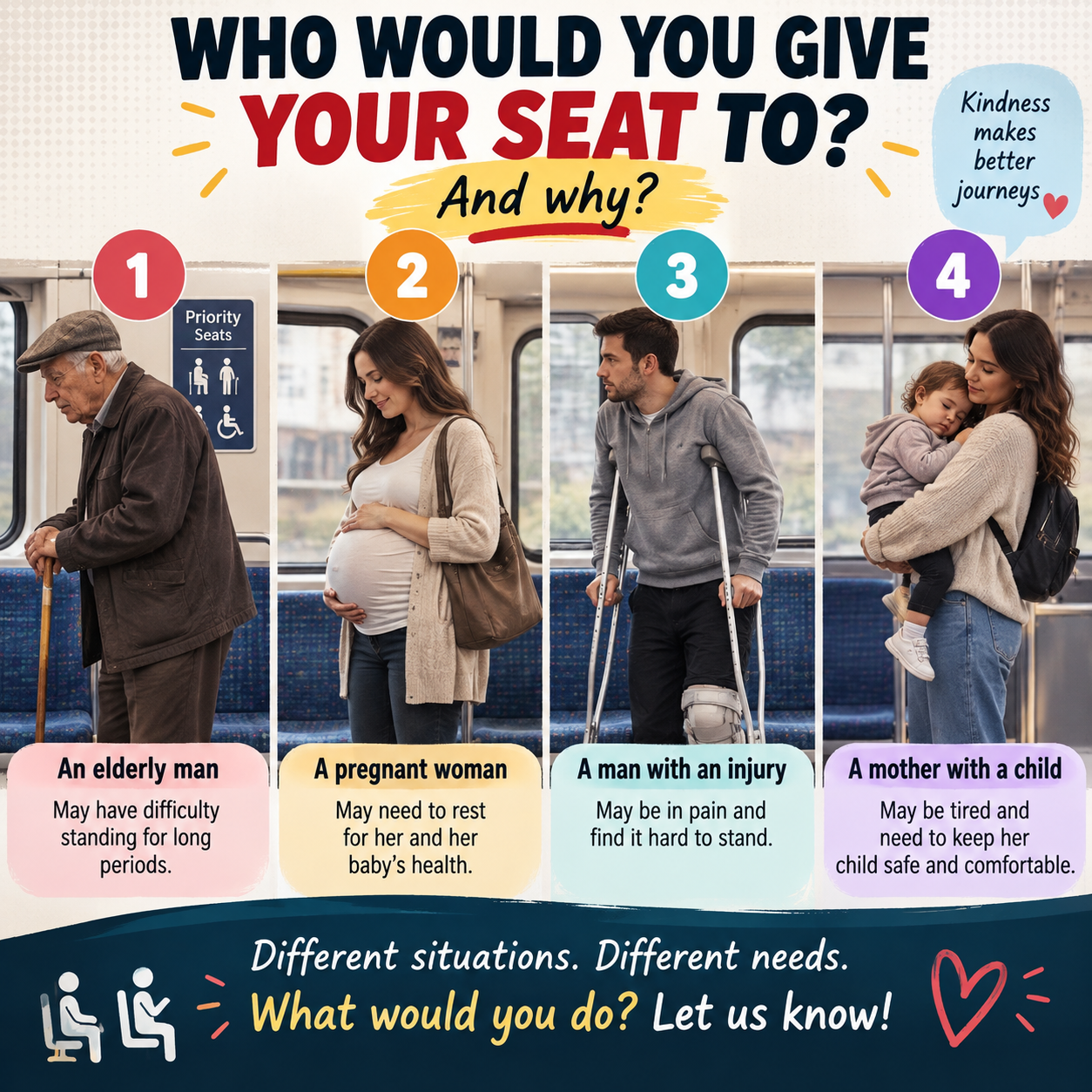
Who Would You Give Your Seat To, and Why? sounds like a simple question, but it becomes surprisingly difficult once you imagine the situation clearly. A crowded bus has only one empty seat, and four people nearby may all need it for different reasons: an older adult with a cane, a pregnant woman, a person using crutches, and a parent carrying a small child.
The dilemma spreads easily on social media because it forces people to weigh different kinds of need. Age suggests vulnerability. Pregnancy can affect balance and stamina. Crutches point to an obvious mobility challenge. Carrying a child adds responsibility for another person’s safety.
There is no universal answer that works in every real-life situation. The best choice depends on who is struggling most in that moment. Still, the question remains useful because it encourages people to think about empathy, attention, and how quickly we judge need from appearance.
I remember seeing a version of this dilemma and changing my answer several times. At first, the elderly passenger seemed like the obvious choice. Then I thought about how difficult it would be to balance on crutches during a sudden stop. After that, the parent holding a child seemed just as vulnerable. That is what makes the scenario interesting. It is not really testing whether someone can identify the “correct” person. It is testing whether they notice that several people may deserve help at once.
Why This Seat Dilemma Creates So Much Debate
Every Person Has a Legitimate Reason to Sit
Who Would You Give Your Seat To, and Why? becomes difficult because each person in the scenario presents a different kind of need. None of the four choices feels unreasonable.
An elderly person may have weaker balance, reduced muscle strength, or joint problems. A sudden movement on a bus could therefore increase the risk of falling. Even when an older adult appears independent, standing for a long time may still be physically demanding.
A pregnant passenger may also experience fatigue, dizziness, nausea, lower-back discomfort, or changes in balance. As pregnancy progresses, standing on a moving vehicle can become more difficult. That is why many public transportation systems provide priority seating for pregnant passengers.
A person using crutches has one of the clearest visible mobility limitations. Keeping balance while holding crutches on a moving bus can feel extremely difficult and potentially painful. If the person is recovering from an injury, standing could also place additional strain on the affected leg.
Meanwhile, a parent holding a baby or small child carries another layer of responsibility. Losing balance could affect both the adult and the child. Therefore, that situation can create a safety concern that goes beyond simple comfort.
The Question Tests Priorities More Than Morality
People often treat viral dilemmas like hidden personality tests. Someone who chooses the older passenger may be described as respectful, while someone who chooses the injured passenger may be called practical. Those interpretations can be entertaining, but they oversimplify the situation.
A seat choice does not reveal a complete moral character. People may prioritize different risks based on their own experiences. Someone who once cared for an aging parent may notice the elderly passenger first, while someone recovering from a leg injury may immediately understand the difficulty of standing on crutches.
Cultural expectations also influence these judgments. Some communities strongly emphasize helping older adults, while others focus more heavily on pregnancy, disability, or caregiving responsibilities.
The more useful question is not “Which answer proves you are kind?” Instead, ask, “What information am I using to judge who needs help most right now?”
That shift makes the dilemma less about winning an argument and more about awareness. In real life, kindness often begins with noticing rather than categorizing.
Who Might Need the Seat Most in That Moment?
The Elderly Passenger, Pregnant Woman, and Injured Rider
Choosing the elderly passenger makes sense when balance and fall risk appear to be the biggest concern. An older adult using a cane may have difficulty reacting quickly when a bus brakes or turns. Offering a seat can therefore reduce both discomfort and injury risk.
The pregnant passenger may deserve priority in a different situation. Pregnancy affects each person differently, and some women experience severe fatigue, dizziness, pelvic pain, or balance problems. A person who looks physically comfortable may still be having a difficult day.
The passenger using crutches may have the most obvious mobility challenge. Crutches usually indicate that standing and weight-bearing are already limited. If the vehicle is crowded, the person may have fewer ways to brace themselves safely during sudden movement.
This is where Who Would You Give Your Seat To, and Why? becomes impossible to solve from a still image alone. A picture can show a cane, a pregnant belly, or crutches, but it cannot reveal pain level, dizziness, fatigue, hidden medical conditions, or how long each person has been standing.
The best real-world decision may come from observing who appears least stable or most uncomfortable. That requires attention rather than a rigid rule.
The Parent Carrying a Child and the Question of Shared Risk
A parent carrying a baby or small child creates a different type of concern. The adult is not only maintaining their own balance but also protecting someone else who cannot stabilize themselves independently.
A sudden stop can become especially risky when both hands are occupied with a child, bags, or other belongings. Sitting can make it easier to secure the child and reduce the chance of falling.
However, a parent may sometimes be physically capable of standing comfortably, while another passenger may face a more urgent mobility problem. That is why context matters so much.
Instead of trying to rank everyone permanently, a better approach involves assessing immediate safety. Who is least able to remain steady? Who appears to be in pain? Who is carrying the greatest fall risk?
The answer can change from one ride to another. Even the same person may need the seat on one day and feel comfortable standing on another.
That flexibility reflects real empathy much better than a fixed hierarchy.
What This Dilemma Reveals About Empathy and Social Responsibility
Empathy Starts With Paying Attention
Who Would You Give Your Seat To, and Why? works because it forces people to notice the needs of strangers. In crowded public spaces, it is easy to focus on a phone, a conversation, or the desire to keep a hard-won seat.
Empathy interrupts that habit. It asks us to look up and notice who may be struggling.
That does not require mind-reading. Someone may show obvious signs of discomfort, such as shifting weight, gripping a pole tightly, or struggling to balance. Small observations can help people decide when an offer would be useful.
Importantly, offering a seat does not mean forcing someone to accept it. A person may politely decline because they feel fine or because sitting and standing repeatedly is difficult for them.
A simple offer respects both need and autonomy. It communicates, “I noticed you may need help,” without assuming that the person is weak or incapable.
That approach can make public spaces feel more cooperative. Small gestures reduce the sense that everyone must compete individually for comfort and safety.
Hidden Disabilities Complicate Simple Assumptions
One of the biggest limitations of visual dilemmas is that they focus only on visible need. In real life, many disabilities and health conditions are not obvious.
A younger passenger who looks healthy may have chronic pain, a heart condition, balance problems, recent surgery, neurological symptoms, or another condition that makes standing difficult. That person may need the seat more than someone whose need appears visually obvious.
This is why people should be cautious about judging seated passengers. Someone may not “look disabled” and may still have a legitimate reason to remain seated.
Likewise, priority seating works best when people treat it as a flexible system rather than an invitation to shame strangers. Visible need matters, but invisible need matters too.
Who Would You Give Your Seat To, and Why? becomes much more meaningful when it expands beyond four illustrated characters. The real lesson is that need can appear in many forms.
A culture of empathy works better when people make room for that uncertainty. Instead of demanding proof, offer help when you can and avoid assuming the worst about people who cannot.
A Better Way to Think About the “One Seat” Problem
Safety Should Usually Come Before Social Expectations
When only one seat is available, immediate physical safety provides a useful guide. The person at greatest risk of falling, worsening an injury, or struggling to balance may deserve priority in that moment.
That could be the older adult, but not always. It could be the pregnant passenger, the injured person, the parent carrying a child, or someone else entirely.
This approach avoids turning courtesy into a rigid ranking system. Age, pregnancy, injury, disability, and caregiving all matter, but none automatically overrides every other circumstance.
You can also look for practical solutions beyond the single seat. Perhaps another passenger can move. Maybe someone can help hold a bag so another person can balance more safely. In some situations, several people standing up can solve the dilemma entirely.
That possibility exposes the biggest weakness in the viral question. It assumes only one person must choose compassion.
Real communities work better when several people respond. If two or three able-bodied passengers offer their seats, the competition disappears.
Therefore, the best answer to Who Would You Give Your Seat To, and Why? may sometimes be: “I would stand, and I would hope others would notice too.”
Kindness Works Best Without Performance
Public acts of kindness do not need to become moral performances. Offering a seat quietly can be more respectful than making a dramatic display of sacrifice.
The person receiving help also should not feel pressured to explain their condition. A short question such as “Would you like to sit?” usually does enough.
If they decline, accept the answer. The goal is to offer support, not to prove that your judgment was correct.
This matters because unwanted assumptions can feel uncomfortable. An older person may not want to be treated as fragile, while a pregnant person may prefer standing for a short trip. Someone with crutches may need a specific position rather than the available seat.
Respectful kindness leaves room for choice.
In that sense, the viral dilemma contains a deeper lesson. Empathy is not only about noticing need. It also involves responding in a way that preserves another person’s dignity.
That combination of awareness, action, and respect matters more than choosing the “correct” character in an online image.
Frequently Asked Questions
Who should get the seat first on a crowded bus?
There is no universal order that works in every situation. A useful approach is to prioritize the person who appears to face the greatest immediate difficulty or safety risk while standing. That may involve age, pregnancy, injury, disability, or caregiving responsibilities.
Should an elderly person always get priority?
Older adults often benefit from priority seating because balance and fall risk can increase with age. However, context still matters. Another passenger may have a more urgent injury, severe dizziness, or an invisible disability.
Should someone on crutches automatically get the seat?
A person using crutches often has a strong need because standing on a moving vehicle can be difficult and unsafe. Still, the best choice depends on the full situation and whether someone else faces a greater immediate risk.
What about people with invisible disabilities?
Invisible disabilities can make standing painful, exhausting, or unsafe even when someone looks healthy. For that reason, passengers should avoid assuming that a seated person does not need the seat simply because their condition is not visible.
What is the best response if several people need a seat?
Offer your own seat if you can, then look for other practical solutions. Another passenger may also be willing to stand, or someone may be able to help with bags or provide support. Shared responsibility usually works better than forcing several people to compete for one seat.
Conclusion
Who Would You Give Your Seat To, and Why? continues to spark debate because every answer can sound reasonable. An elderly person may face a greater fall risk, a pregnant passenger may struggle with fatigue or balance, a person on crutches may have an obvious mobility problem, and a parent carrying a child may need to protect two people at once.
That is exactly why the dilemma has no perfect universal answer. Real need depends on context, and a still image cannot show pain, dizziness, hidden disabilities, fatigue, or individual medical conditions.
The strongest lesson is not about ranking strangers. It is about awareness.
Look up. Notice who appears uncomfortable or unstable. Offer help when you can. Respect the answer if someone declines.
Most importantly, remember that public kindness works best as a shared responsibility. If several people are able to stand, several people can offer. Nobody should have to compete for compassion.
So, who would you give your seat to, and why? Your answer may reveal what kind of need you notice first, but the more important question is whether you are willing to notice at all.
More Blog
- Drinking Water on an Empty Stomach — What Science Actually Supports (No Hype, Just Facts)
- Waking Up Between 3 and 5 AM? It Might Be Your Soul Trying to Talk to You
- What a “Bleach” Patch on Your Underwear Really Means — And Why It’s Actually a Good Sign
- This Drink May Weaken Your Bones From The Inside — But Everyone Drinks It Anyway