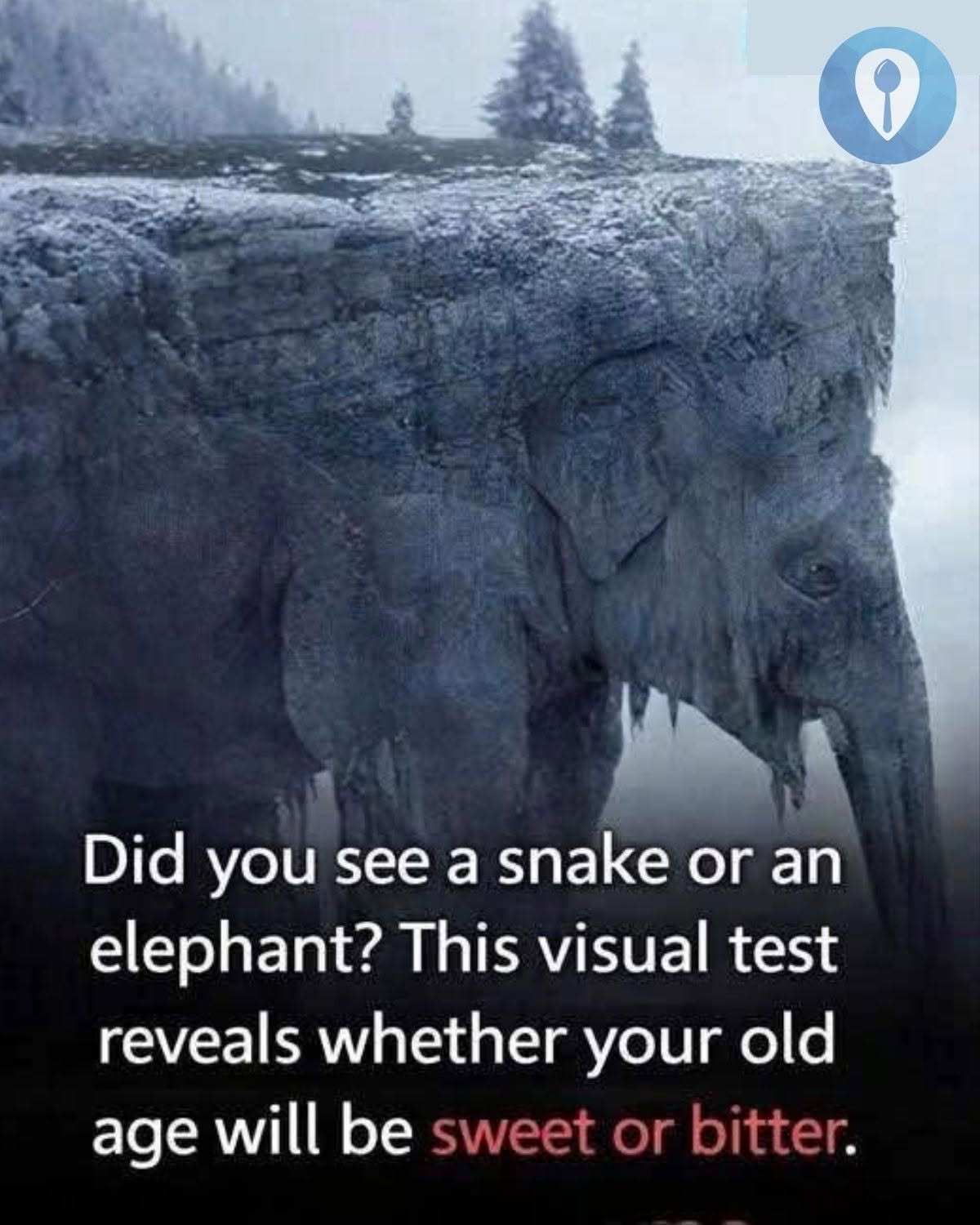
A fascinating optical illusion is making the rounds online, leaving people debating what they see first—and what it might say about their personality.
At first glance, the image appears to show a frozen rocky cliff covered in ice and snow. But look closer, and another image begins to emerge.
Some people immediately notice a snake-like shape stretching across the icy landscape, while others instantly recognize the profile of an elephant carved into the frozen rock.
The challenge is simple:
What did you see first—the snake or the elephant?
Many versions of this viral personality test claim that your first impression can reveal hidden traits about your character and even offer clues about how you approach life as you grow older.
Let’s explore what this illusion reveals about perception, personality, and the fascinating ways our brains process visual information.
The Illusion That Has Captivated Social Media
The image plays on the brain’s tendency to interpret visual information quickly. Depending on which details your eyes focus on first, your mind may construct a completely different picture than someone else’s.
How Ambiguous Images Work
| Process | What Happens |
|---|---|
| Initial perception | Your brain quickly scans for familiar patterns |
| Pattern recognition | It matches visual input to stored memories (snakes, elephants, rocks) |
| Interpretation | Your brain settles on the most familiar or relevant pattern |
| Alternative view | With effort, you can often see the other image |
While there is no scientific evidence that these images can predict your future, they are fascinating because they demonstrate how differently people process the same information.
Key Insight: What you see first isn’t about right or wrong—it’s about how your brain prioritizes visual information based on experience, attention, and cognitive style.
If You Saw the Snake First
According to the popular interpretation of the illusion, people who notice the snake first tend to be:
Personality Traits (According to the Test)
| Trait | Description |
| Analytical | Detail-oriented; notices small elements before the big picture |
| Strategic | Approaches problems methodically; plans ahead |
| Alert | Heightened awareness of surroundings; cautious by nature |
| Logical | Prefers facts and data over emotions when making decisions |
| Quick-thinking | Processes information rapidly; makes fast judgments |
What It Might Mean
Supporters of the test suggest that snake-first viewers often prefer logic over emotion and enjoy solving problems before others even recognize them.
They are said to approach life’s challenges strategically and rarely overlook important details.
Strengths Associated with This View
- Excellent problem-solving abilities
- Strong attention to detail
- Adaptability during changing situations
- Independence in decision-making
Potential Challenges
- May overanalyze situations
- Could miss the bigger picture by focusing on details
- May appear skeptical or cautious to others
Symbolic Meaning of the Snake
In many cultures, snakes represent:
- Transformation
- Wisdom
- Healing
- Renewal
- Personal growth
Seeing the snake first may symbolize openness to change and self-development.
If You Saw the Elephant First
People who immediately recognize the elephant are often described as:
Personality Traits (According to the Test)
| Trait | Description |
| Big-picture thinker | Sees overall patterns before details |
| Patient | Takes time to process information |
| Empathetic | Considers emotions and relationships |
| Stable | Values consistency and long-term planning |
| Wise | Draws on experience and intuition |
What It Might Mean
According to the interpretation, elephant-first viewers tend to see beyond immediate obstacles and are more likely to take a calm, measured approach when making important decisions.
They often value stability, wisdom, and meaningful relationships.
Strengths Associated with This View
- Strategic long-term vision
- Strong emotional intelligence
- Patience under pressure
- Excellent memory and recall
Potential Challenges
- May overlook important details
- Could respond slowly to urgent situations
- May struggle with rapid change
Symbolic Meaning of the Elephant
Across many cultures, elephants symbolize:
- Strength
- Wisdom
- Loyalty
- Prosperity
- Good fortune
Seeing the elephant first may suggest a preference for stability, community, and enduring relationships.
Why Optical Illusions Fascinate Us
Visual puzzles remain popular because they challenge our assumptions about how perception works.
Our brains constantly filter and organize enormous amounts of information. When presented with an ambiguous image, the brain must decide which interpretation makes the most sense.
The Science of Perception
| Factor | How It Influences What You See |
| Past experiences | Your brain matches images to familiar patterns |
| Cultural background | Symbols and animals may carry different meanings |
| Current mood | Emotional state can influence interpretation |
| Attention style | Some focus on details, others on the whole picture |
| Expectations | Suggestions influence what you notice |
| Visual acuity | Eyesight and processing speed vary among individuals |
This explains why two people can look at the same image and arrive at completely different conclusions.
Types of Optical Illusions
| Type | Example | How It Works |
| Ambiguous Illusions | Snake/Elephant, Duck/Rabbit | Multiple valid interpretations |
| Distorting Illusions | Müller-Lyer lines | Alters perception of size or distance |
| Paradox Illusions | Penrose Triangle | Creates impossible objects |
| Fiction Illusions | Mirages | Perceived differently among observers |
Neuroscience Note
When you view an illusion, different brain regions compete to interpret the image.
The visual cortex processes incoming information while higher-level cognitive areas attempt to assign meaning.
This competition creates the famous “flip-flop” effect that allows people to switch between seeing a snake and an elephant.
Can an Illusion Really Predict Your Future?
The Short Answer: No.
Psychologists generally agree that viral optical illusions are entertaining and can reveal interesting aspects of perception, but they cannot accurately predict:
- Your future
- Your destiny
- Your personality type
- Your long-term life outcomes
What Science Says
| Claim | Scientific Consensus |
| Illusions reveal personality | Limited evidence |
| First impression predicts future | No scientific basis |
| Snake vs. elephant determines life path | Entertainment only |
| Visual puzzles assess cognition | Some research support |
Why These Tests Stay Popular
- Encourage self-reflection
- Spark conversations
- Offer entertainment
- Satisfy curiosity
- Create social engagement
While they aren’t predictive tools, they remain enjoyable thought experiments.
The Real Meaning Behind the Challenge
Whether you spotted the snake or the elephant first, the illusion highlights something remarkable:
Two people can observe the exact same image and walk away with completely different interpretations.
That difference doesn’t determine whether your future will be successful or difficult.
Instead, it demonstrates the flexibility and creativity of the human mind.
What This Teaches Us
| Lesson | Application |
| Perspective matters | Different viewpoints can both be valid |
| Assumptions limit us | What seems obvious may not be obvious to others |
| Communication is important | Understanding requires effort |
| Curiosity opens doors | Asking questions builds connection |
| Humility creates wisdom | No one sees everything |
Practical Takeaways
In Relationships
- Ask how others see a situation.
- Listen before assuming.
At Work
- Seek diverse perspectives.
- Consider multiple interpretations.
In Learning
- Challenge your assumptions.
- Explore alternative viewpoints.
In Personal Growth
- Recognize that first impressions aren’t always complete.
A Philosophical Perspective
The snake-elephant illusion can serve as a metaphor for life itself.
Two people can experience the same event and interpret it entirely differently.
Neither perspective is necessarily wrong.
Understanding this reality is one of the foundations of empathy.
Try This: Can You See Both?
If you saw the snake first, try to find the elephant.
If you saw the elephant first, look again for the snake.
Tips for Seeing the Alternative Image
| Strategy | How to Apply It |
| Relax your gaze | Avoid focusing too intensely |
| Shift your attention | Examine different areas |
| Change viewing angle | Rotate or tilt the image |
| Step back | Gain a broader perspective |
| Move closer | Focus on smaller details |
| Cover sections | Force reinterpretation |
| Blink rapidly | Reset visual processing |
| Take a short break | Return with fresh eyes |
Neuroplasticity Note
The ability to switch between interpretations demonstrates cognitive flexibility.
This skill is associated with creativity, adaptability, and problem-solving ability.
Frequently Asked Questions
What if I can’t see either image clearly?
Image quality, screen size, lighting, and individual visual processing differences can all affect perception.
Is one answer better than the other?
No. Neither seeing the snake nor the elephant is superior.
Can my answer change over time?
Yes. Mood, fatigue, environment, and experience can influence what you notice first.
Are optical illusions used in psychology?
Yes. Researchers use them to study attention, memory, perception, and cognition.
Do children perceive illusions differently?
Often yes. Children’s visual systems and pattern-recognition abilities continue developing throughout childhood.
What if I see something completely different?
That’s perfectly possible and can be an interesting reflection of unique perceptual processing.
Do these tests have scientific validity?
As demonstrations of perception: yes.
As personality or future-prediction tools: no.
A Compassionate Closing Thought
If you’re reading this because you’re curious about what you saw—or wondering what it says about you—remember:
- Your perception is valid.
- A single image does not define your personality.
- Differences in perception are natural and valuable.
- Curiosity is something worth celebrating.
This illusion isn’t really about snakes or elephants.
It’s about perspective.
It’s about recognizing that people can view the same reality through different lenses.
And it’s about appreciating the incredible flexibility of the human mind.
Whether you saw the snake, the elephant, or both, you’ve experienced one of the most remarkable aspects of being human:
The ability to perceive, interpret, and find meaning.
The Bottom Line
The snake-or-elephant optical illusion is a fascinating example of how perception varies from person to person.
Remember:
- What you see first reflects perception, not destiny.
- Optical illusions demonstrate how the brain processes ambiguity.
- These tests are entertaining, not predictive.
- Different viewpoints enrich understanding.
- Seeing multiple interpretations reflects cognitive flexibility.
You don’t need an optical illusion to tell you who you are.
But if a simple image inspires curiosity, conversation, and wonder, that’s something worth appreciating.
What did you see first—the snake or the elephant?
More Blog
- Drinking Water on an Empty Stomach — What Science Actually Supports (No Hype, Just Facts)
- Waking Up Between 3 and 5 AM? It Might Be Your Soul Trying to Talk to You
- What a “Bleach” Patch on Your Underwear Really Means — And Why It’s Actually a Good Sign
- This Drink May Weaken Your Bones From The Inside — But Everyone Drinks It Anyway