Have you ever stood in front of a mirror and noticed that your knees or ankles don’t line up exactly the way you expected?
Maybe your ankles touch while your knees remain apart. Maybe your knees come together while your ankles stay separated. Or perhaps your legs look relatively straight from the hips down.
These differences are often described as leg-alignment patterns, and they can vary considerably from one person to another.
The important thing to know is this:
Leg shape alone is not a diagnosis.
Your appearance can be influenced by genetics, bone structure, muscle development, posture, foot position, previous injuries, and normal anatomical variation.
What matters most is whether the alignment is painful, changing, asymmetric, or interfering with movement.
What Does Leg Alignment Mean?
Leg alignment refers to how the bones and joints of the lower body line up while standing and moving.
The main structures involved include:
- Hips
- Femurs, or thigh bones
- Knees
- Tibias, or shin bones
- Ankles
- Feet
No two bodies are perfectly identical, and small differences from side to side are common.
One knee may sit slightly farther inward.
One foot may naturally point outward.
One calf may be more developed than the other.
These differences don’t automatically indicate a problem.
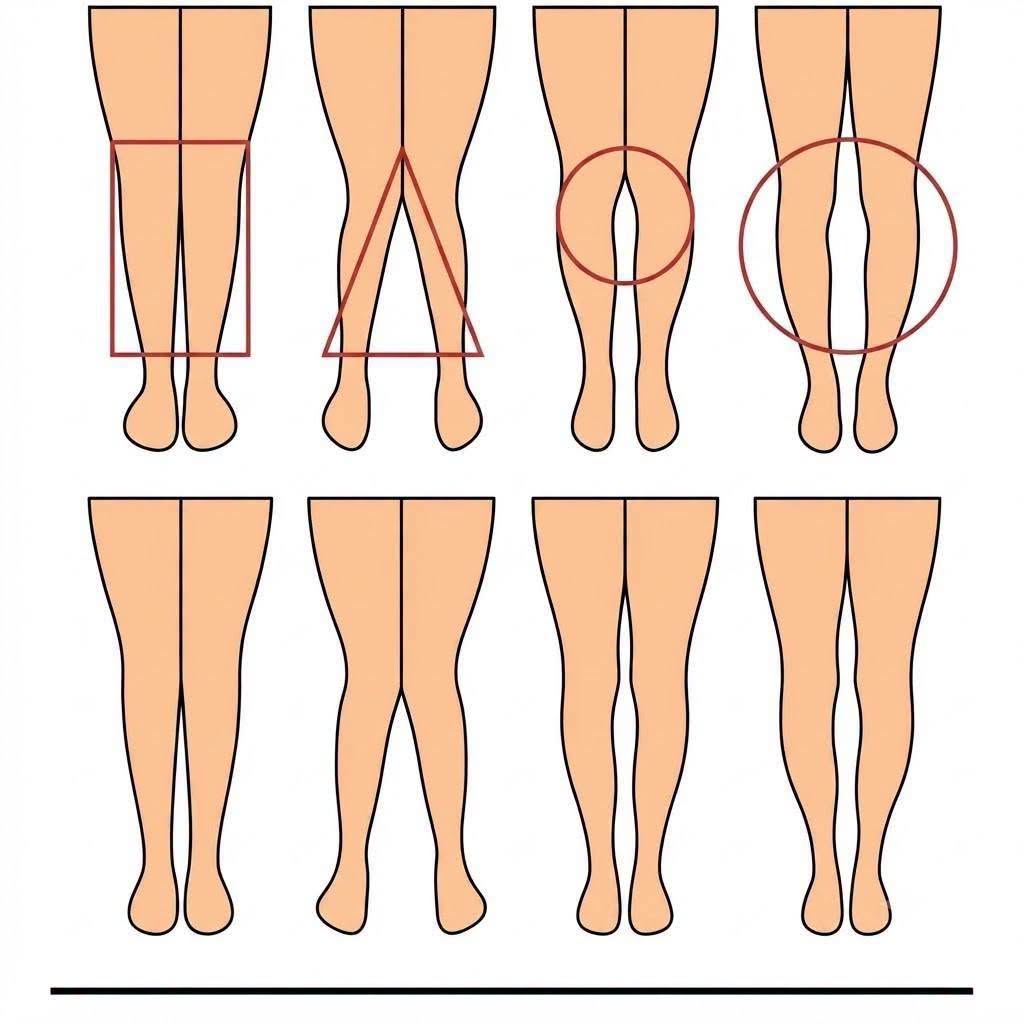
1. Relatively Straight Leg Alignment
Some people have legs that appear fairly straight when standing naturally.
The knees and ankles line up without a dramatic inward or outward angle.
This can be perfectly normal, but it’s important not to treat “straight-looking” legs as the only healthy shape.
Healthy people can have noticeably different leg alignments.
2. Bow Legs: Genu Varum
When the ankles are together but the knees remain farther apart, the legs may have a bowed appearance.
The medical term is genu varum.
A mild degree of bowing can be part of normal childhood development, especially in infants and toddlers.
In adults, bow-legged alignment may simply reflect long-standing anatomy, but new or progressively worsening bowing can sometimes be associated with:
- Previous fractures
- Arthritis
- Certain bone disorders
- Abnormal growth patterns
- Metabolic bone conditions
The appearance alone doesn’t determine whether treatment is needed.
Symptoms and progression matter much more.
3. Knock Knees: Genu Valgum
The opposite pattern is called genu valgum, commonly known as knock knees.
Here, the knees come closer together while the ankles remain apart.
Like bowing, this pattern can be normal during certain stages of childhood.
Many children naturally move through different leg-alignment phases as their skeleton develops.
In adults, mild knock-knee alignment may cause no problems at all.
More pronounced alignment can sometimes affect how forces move through the knees, hips, and ankles, but it doesn’t automatically mean someone will develop arthritis or pain.
Your Feet Can Change How Your Legs Look
Leg alignment isn’t just about the knees.
Foot position can change the appearance of the entire lower limb.
For example, the way the foot rolls inward or outward can influence how the shin and knee rotate.
That’s why a professional assessment may look at how someone:
- Stands
- Walks
- Squats
- Runs
- Steps up and down
- Balances on one leg
A photograph taken from the front doesn’t reveal the whole story.
Posture Matters Too
Try standing normally and looking at your legs.
Now shift all your weight onto one side.
Rotate your feet outward.
Lock your knees.
Slightly bend them.
Your legs may appear surprisingly different each time.
That means a single photo or social-media diagram shouldn’t be used to diagnose your alignment.
Body position can dramatically change what you’re seeing.
Muscle Shape Can Affect Appearance
Not every visible curve or gap comes from bone structure.
Your quadriceps, hamstrings, calves, and gluteal muscles all contribute to the shape of your legs.
Someone who runs, cycles, dances, lifts weights, or plays sports may develop muscle patterns that make the legs look very different from those of someone with a different activity level.
So appearance alone doesn’t tell you whether the bones themselves are unusually aligned.
Genetics Plays a Major Role
If several members of your family have similar-looking legs, inherited anatomy may be part of the explanation.
Genetics can influence:
- Hip structure
- Knee angle
- Lower-leg shape
- Foot position
- Height and proportions
This is one reason comparing yourself with someone else’s body isn’t particularly useful.
Natural anatomical variation is extremely common.
Your Legs Can Change With Age
Leg alignment isn’t necessarily fixed throughout life.
Children often go through predictable developmental changes as their bones grow.
Later in adulthood, changes can occur because of:
- Arthritis
- Previous injuries
- Changes in muscle strength
- Joint degeneration
- Bone disorders
- Changes in gait
A leg shape you’ve had since childhood is very different from one that suddenly develops at age 50.
Timing matters.
Pain Matters More Than Appearance
You can have visibly unusual alignment and feel completely fine.
You can also have legs that look perfectly straight and still experience significant knee or hip pain.
That’s why symptoms are often more important than appearance.
Consider medical evaluation if you have:
- Persistent knee pain
- Hip or ankle pain
- Recurrent swelling
- Difficulty walking
- Reduced range of motion
- Frequent giving way or instability
- A noticeable change in your gait
- New weakness
Can Exercise Straighten Bow Legs or Knock Knees?
This is an area where online claims can become misleading.
Exercise can improve:
- Strength
- Balance
- Joint control
- Mobility
- Movement patterns
- Muscle symmetry
But exercise does not usually reshape adult bones.
If an adult has genuine skeletal bowing or knock-knee alignment, a few corrective exercises are unlikely to permanently “straighten” the bones.
That doesn’t mean exercise is useless.
Strengthening the hips, thighs, calves, and core can improve how the legs function and may reduce symptoms in some people.
The key is setting realistic expectations.
Strengthening Can Still Be Helpful
Depending on the individual, a physical therapist may focus on muscles such as:
- Quadriceps
- Hamstrings
- Gluteal muscles
- Hip abductors
- Calves
- Core
The goal is often to improve movement and reduce stress on irritated joints.
Exercise programs should be tailored to symptoms rather than chosen solely based on a photo of someone’s leg shape.
When Should Leg Alignment Be Checked?
Professional evaluation is especially useful when the change is new, worsening, or causing symptoms.
Pay attention to:
Sudden Changes
A leg that recently started looking noticeably different deserves more attention than a lifelong variation.
Progressive Changes
Alignment that becomes more pronounced over months or years may warrant evaluation.
Significant Asymmetry
Small left-right differences are common.
A major new difference between the legs is less typical.
Persistent Pain
Recurring pain around the knees, hips, ankles, or feet is worth investigating.
Swelling or Stiffness
Repeated swelling or loss of joint motion deserves medical attention.
Difficulty Walking
Changes in gait, balance, or mobility can indicate a functional problem even if the visual difference seems small.
Previous Injury
If alignment changed after a fracture or major knee or ligament injury, it should be assessed.
What Does a Professional Evaluation Involve?
A clinician or physical therapist may look at:
- Standing posture
- Walking pattern
- Hip rotation
- Knee stability
- Ankle position
- Foot posture
- Muscle strength
- Joint mobility
- Leg length
If necessary, imaging such as an X-ray may be used to assess the bones more precisely.
The purpose isn’t to decide whether your legs look aesthetically “perfect.”
It’s to determine whether the alignment is affecting function or reflecting an underlying condition.
Don’t Let Social Media Diagnose Your Legs
Online graphics often divide legs into a few simple categories and then attach dramatic health claims to each one.
You may see posts suggesting that a particular leg shape proves you have:
- Poor circulation
- Hormonal problems
- Vitamin deficiencies
- Arthritis
- Weak muscles
- Serious disease
Those conclusions cannot reliably be made from leg shape alone.
A meaningful health assessment requires much more information.
A Better Way to Evaluate Your Legs
Instead of asking, “Do my legs look normal?”, consider these questions:
- Have they always looked this way?
- Are both sides reasonably similar?
- Do they hurt?
- Are the joints swollen?
- Can you walk normally?
- Has your balance changed?
- Has the shape become more noticeable recently?
- Did anything change after an injury?
These questions are far more useful than comparing yourself with an online diagram.
The Bottom Line
Leg shape varies naturally from person to person.
Some people have relatively straight alignment. Others have bow-legged or knock-kneed patterns. Foot posture, muscle development, genetics, and the way you stand can all change how your legs appear.
Appearance alone doesn’t tell you whether something is wrong.
A lifelong leg shape that causes no pain and doesn’t interfere with movement is often simply part of your anatomy.
What deserves more attention is change.
If your leg alignment suddenly worsens, becomes significantly asymmetric, or is accompanied by pain, swelling, stiffness, weakness, or difficulty walking, that’s when professional evaluation becomes worthwhile.
Your legs don’t need to match an idealized picture.
They need to be comfortable, stable, and functional.
More Blog
- Drinking Water on an Empty Stomach — What Science Actually Supports (No Hype, Just Facts)
- Waking Up Between 3 and 5 AM? It Might Be Your Soul Trying to Talk to You
- What a “Bleach” Patch on Your Underwear Really Means — And Why It’s Actually a Good Sign
- This Drink May Weaken Your Bones From The Inside — But Everyone Drinks It Anyway