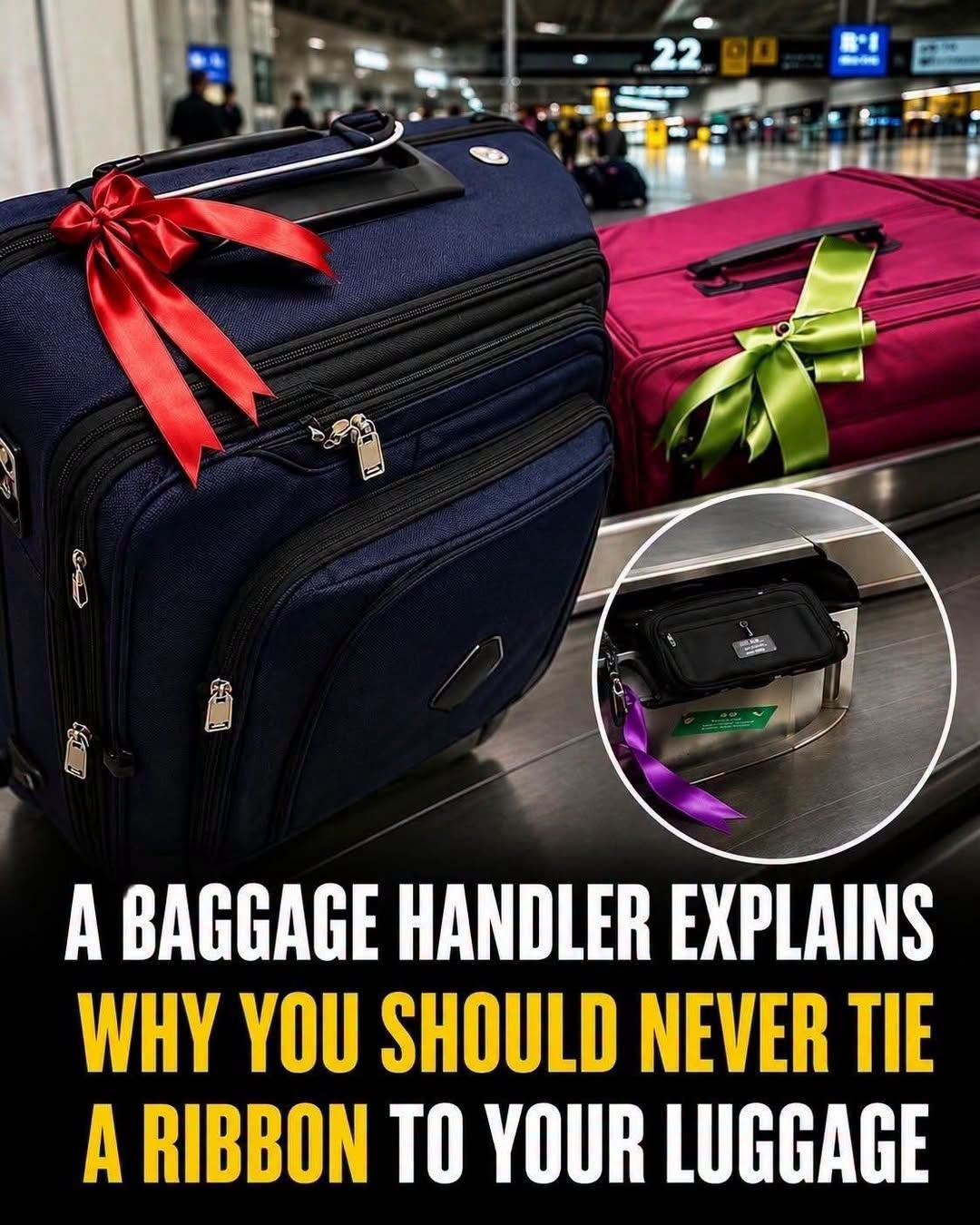
A bright ribbon tied around a suitcase handle seems like a clever travel trick.
It makes your bag easier to spot on a crowded carousel, helps distinguish it from dozens of nearly identical black suitcases, and can reduce the chance of grabbing the wrong luggage.
But some baggage-handling professionals warn that loose ribbons, straps, cords, and decorative accessories can create problems when checked bags move through airport systems.
The concern is not that ribbons are universally banned.
The issue is much simpler: checked luggage passes through conveyors, scanners, rollers, sorting equipment, loading carts, and other machinery. Anything loose or dangling from the outside of a suitcase has a greater chance of snagging, tearing off, or interfering with handling.
Why Travelers Use Ribbons in the First Place
The idea makes perfect sense.
Baggage carousels are often filled with suitcases that look almost identical:
- Black hard-shell cases
- Dark blue fabric luggage
- Gray carry-ons
- Similar shapes and sizes
A red, yellow, or blue ribbon can make your suitcase instantly recognizable.
That can be genuinely useful.
The problem is not the color or personalization itself.
It’s how the accessory is attached.
Checked Bags Go Through More Than Most Travelers Realize
After you hand over your suitcase at check-in, it can travel through an extensive baggage-handling network before reaching the aircraft.
Depending on the airport, the bag may be:
- Weighed
- Security-screened
- Scanned
- Routed through conveyors
- Sorted automatically
- Sent through chutes
- Loaded onto carts
- Transferred to the aircraft
- Unloaded and sorted again after landing
If your itinerary includes a connecting flight, this process can happen multiple times.
This is why airport baggage is best kept relatively streamlined.
Why Dangling Ribbons Can Be a Problem
A tightly secured, very short ribbon is less likely to cause trouble than one with long loose ends.
The concern is primarily with accessories that can flap, loop, or hang away from the suitcase.
They can potentially catch on:
- Conveyor components
- Rollers
- Other luggage
- Cart equipment
- Handling machinery
Even if the suitcase itself continues moving normally, the ribbon may tear off.
That means the very marker you were relying on to identify your bag could disappear before it reaches baggage claim.
The Same Warning Applies to Other Loose Accessories
Ribbons aren’t unique.
Similar problems can occur with:
- Long luggage straps
- Loose cords
- Decorative chains
- Hanging keychains
- Oversized tags
- Unsecured backpack straps
- Loose drawstrings
If an accessory can swing freely away from the bag, it is more vulnerable during handling.
Keep the Airline Baggage Tag Clear
The most important exterior label on a checked suitcase is the airline’s baggage tag.
That tag tells the baggage system where your suitcase needs to go.
Modern baggage tags generally contain machine-readable information such as barcodes and, at some airports or airlines, other tracking technology.
Whatever decoration you add should never cover, twist around, or interfere with the official baggage tag.
Your ribbon helps you recognize your bag.
The airline tag helps the airport route it.
The second job is much more important.
Remove Old Airline Tags Before Flying Again
One useful piece of travel advice is to remove outdated baggage labels and stickers before checking your suitcase.
Old tags may contain barcodes or routing information from previous journeys.
Modern systems are designed to read the current tag, but keeping unnecessary old labels on your bag adds clutter and can make identification less straightforward.
Before each trip, remove old:
- Baggage tags
- Barcode stickers
- Transfer labels
Keep only what is relevant to your current journey.
Better Ways to Make Your Suitcase Easy to Recognize
You don’t have to settle for an anonymous black suitcase.
There are safer ways to personalize luggage without adding long dangling material.
Use a Distinctive Luggage Tag
Choose a sturdy tag that stays close to the suitcase.
Avoid excessively long attachment loops.
Choose a Unique Color
Bright or unusual luggage is much easier to recognize.
Colors such as red, turquoise, yellow, green, or patterned finishes can stand out immediately.
Add a Durable Sticker
A well-adhered luggage sticker can provide quick visual identification without dangling from the bag.
Use a Properly Fitted Luggage Strap
A purpose-built suitcase strap can add both visibility and security.
It should fit tightly around the luggage without loose ends.
Add a Small Fixed Marker
A compact marker secured tightly to a handle may provide the same identification benefit as a ribbon with less risk of snagging.
What About Luggage Straps?
Luggage straps can be useful when properly fitted.
They may:
- Make your suitcase easier to identify
- Help hold it closed
- Provide backup protection if a zipper fails
But a strap should fit snugly.
A long loose end hanging from a strap creates the same basic problem as a ribbon.
If you use one, choose a model specifically designed for travel luggage and secure it correctly.
Put Your Contact Information Inside the Suitcase Too
Exterior labels can be damaged or lost.
That’s why it’s smart to place identification inside your checked bag as well.
Include:
- Your name
- Phone number
- Email address
Some travelers also include their destination hotel or temporary contact information.
For privacy reasons, you do not necessarily need to display your full home address prominently on the outside of the bag.
An internal contact card provides a useful backup if external tags become detached.
Take a Photo Before Checking Your Bag
This is one of the simplest and most useful habits for checked luggage.
Before handing your suitcase over, take a quick photo.
Capture:
- The full suitcase
- Its color
- Brand or logo
- Distinctive markings
- Existing scratches or damage
You may also want a separate photo of the airline baggage receipt or tracking number.
If the bag is delayed, a recent image can help airline staff identify it.
It also makes describing your luggage much easier than trying to remember every detail after a long flight.
Why Black Luggage Causes So Much Confusion
Black remains one of the most popular suitcase colors because it is practical and doesn’t show dirt easily.
Unfortunately, that also means baggage claim can look like an endless parade of identical black rectangles.
If you already own black luggage, personalization is sensible.
Just choose something secure.
A fixed sticker, distinctive tag, or snug strap may work better than a long ribbon.
A Ribbon Does Not Automatically Make Your Bag Get Lost
It’s important not to turn sensible baggage advice into a frightening travel myth.
A ribbon attached to your suitcase does not automatically mean:
- Your luggage will be rejected
- Your luggage will be lost
- The baggage scanner will fail
- Airport workers will remove the bag
Many travelers use small decorations without problems.
The practical recommendation is simply to minimize anything that could snag or interfere with automated handling.
Should You Wrap Your Suitcase?
Some airports offer protective luggage-wrapping services using plastic film.
Wrapping can help contain loose zippers or protect the exterior from scratches, but it also has drawbacks.
Security personnel may need to open checked luggage for inspection, and the wrapping may therefore be cut.
Plastic wrapping also creates additional waste.
If you are mainly concerned about a zipper opening, a securely fitted reusable luggage strap may be a more practical option.
What About Backpack Straps?
Backpacks deserve special attention because they often have many hanging straps.
If you’re checking a backpack, tighten and secure loose shoulder straps and compression straps as much as possible.
Some travelers place trekking backpacks inside dedicated travel covers or duffels when checking them.
Loose backpack straps can be more likely to catch than the smooth exterior of a conventional suitcase.
What Happens If Your Bag Doesn’t Arrive?
If your suitcase is missing from the carousel, report it before leaving the airport.
Go to the airline’s baggage service desk and provide:
- Your baggage receipt
- Flight details
- Contact information
- A description of the suitcase
- A photo, if available
A description such as:
“Medium black hard-shell suitcase with a white sticker near the handle and a green luggage tag”
is much more useful than simply saying:
“It’s a black suitcase.”
Smart Checked-Baggage Preparation
Before handing over a suitcase, do a quick inspection.
Make sure:
- All zippers are fully closed
- Loose straps are secured
- Nothing fragile is hanging externally
- The airline baggage tag is visible
- Old airline labels are removed
- Your identifying details are inside the bag
- The suitcase isn’t dangerously overfilled
- You have taken a photo
These steps take only a minute but can make your luggage easier to handle and easier to recover if something goes wrong.
Is It Safe to Put a Tracking Device in Checked Luggage?
Many travelers now use small Bluetooth or network-based trackers inside their suitcases.
These can help indicate where a bag was last detected and may be useful when luggage is delayed.
Rules can vary depending on the device and battery type, so travelers should follow current airline and aviation-security requirements.
The important distinction is that a tracking device is generally kept inside the suitcase, where it doesn’t interfere with conveyors or scanners.
Should You Still Use a Ribbon?
If you love your luggage ribbon, the answer doesn’t necessarily have to be no.
Consider whether it is:
- Very short
- Tightly secured
- Unable to form a loose loop
- Away from the baggage tag
- Unlikely to snag
A long bow with trailing ends is less practical for checked luggage than a compact, securely attached marker.
For carry-on luggage that stays with you, the concern is much smaller because your bag isn’t passing through the same automated checked-baggage system.
The Bottom Line
Tying a ribbon to your suitcase isn’t inherently forbidden or guaranteed to cause trouble.
The warning from baggage-handling professionals is really about loose exterior items.
Checked bags pass through complicated systems of conveyors, scanners, rollers, carts, and sorting equipment. Long ribbons, cords, straps, and other dangling accessories can snag, fall off, or potentially interfere with normal handling.
You can still make your suitcase easy to recognize.
Use:
- A distinctive color
- A secure luggage tag
- A fixed sticker
- A properly fitted luggage strap
- A compact marker
And remember the travel habits that matter even more: remove old baggage labels, keep the current airline tag unobstructed, place your contact information inside the suitcase, and photograph the bag before checking it.
When your suitcase is traveling through an airport without you, simple, secure, and easy to identify is usually the best combination.
More Blog
- Drinking Water on an Empty Stomach — What Science Actually Supports (No Hype, Just Facts)
- Waking Up Between 3 and 5 AM? It Might Be Your Soul Trying to Talk to You
- What a “Bleach” Patch on Your Underwear Really Means — And Why It’s Actually a Good Sign
- This Drink May Weaken Your Bones From The Inside — But Everyone Drinks It Anyway