Most people don’t spend much time thinking about toilet design. As long as the fixture works properly, flushes efficiently, and remains relatively easy to clean, it rarely becomes a topic of conversation. Yet every so often, someone encounters a toilet that looks noticeably different from the models commonly found in modern homes.
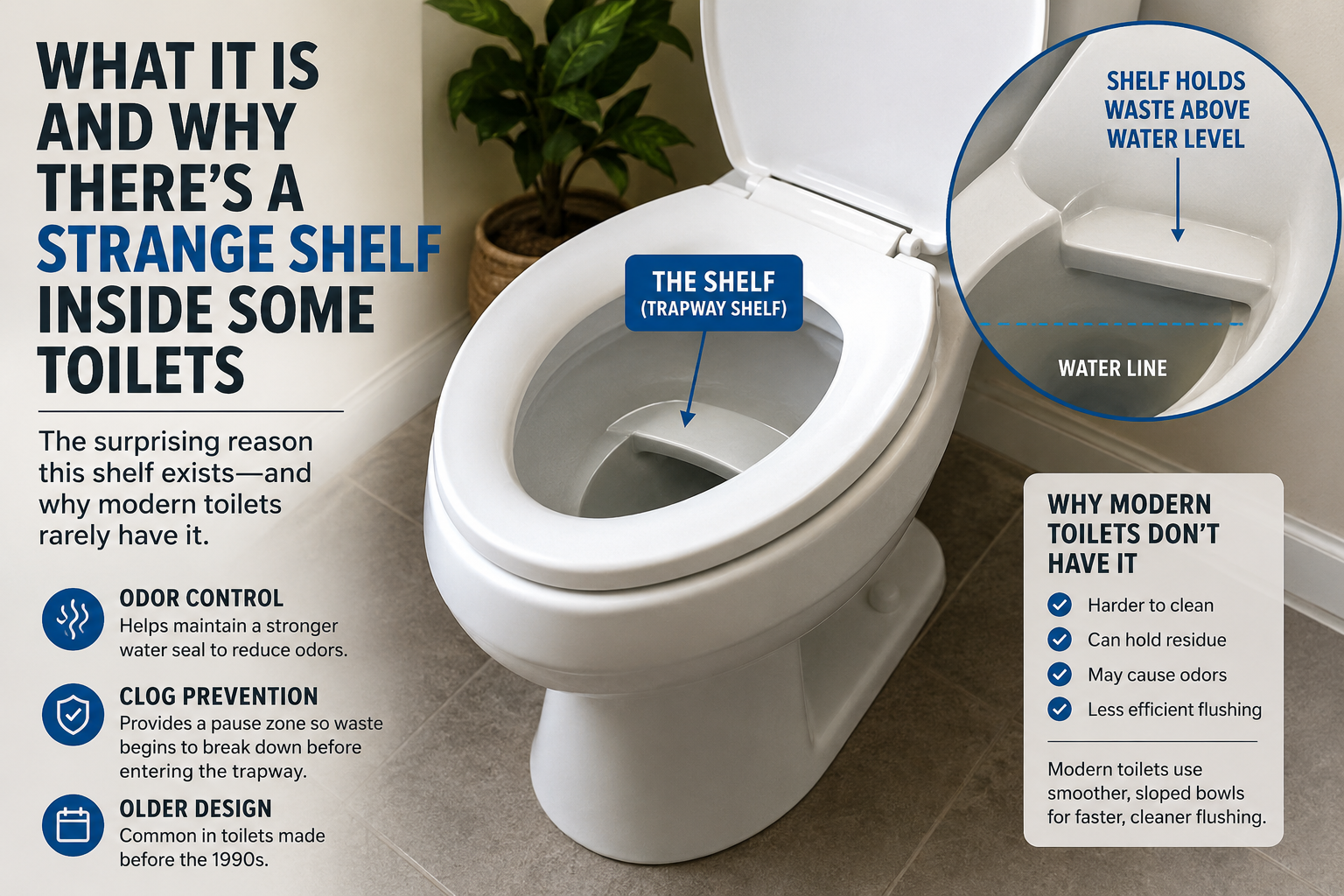
One of the most surprising features people notice is a flat ledge or shelf located inside the toilet bowl. At first glance, it appears unusual, outdated, or even poorly designed. Many assume it must be a manufacturing defect or a sign that something is wrong with the toilet itself.
In reality, that strange shelf is a deliberate engineering feature with a fascinating history.
Known as a “toilet shelf,” “washout shelf,” or sometimes associated with reverse-trap toilet designs, this feature was once considered an innovative solution to several plumbing challenges. Although modern toilets have largely moved away from the design, shelf toilets continue to exist in certain countries, older homes, and some commercial buildings.
Understanding why these shelves were created provides an interesting glimpse into the evolution of plumbing technology and the changing priorities of bathroom design.
The Curious Feature Hidden Inside the Bowl
If you’ve never seen one before, a shelf toilet can be surprising.
Unlike modern toilets, where waste typically drops directly into a pool of water, a shelf toilet contains a flat ceramic platform positioned above the water level. Waste initially lands on this shelf rather than falling immediately into the water below.
Only after flushing does everything move through the trapway and into the drainage system.
For many people encountering this design for the first time, the reaction is often confusion.
Why would engineers intentionally create a toilet that appears to hold waste temporarily rather than allowing it to disappear immediately?
The answer lies in the practical needs and technological limitations of an earlier era.
The History of Shelf Toilets
To understand shelf toilets, it’s helpful to look at the history of indoor plumbing.
Modern plumbing systems evolved gradually throughout the nineteenth and twentieth centuries. Early toilet designs varied significantly from country to country and even from manufacturer to manufacturer.
Engineers continually experimented with different bowl shapes, trapways, water levels, and flushing mechanisms in an effort to solve common problems such as:
- Odor control
- Water conservation
- Clogging
- Splashing
- Ease of maintenance
- Manufacturing costs
Shelf toilets emerged as one proposed solution to several of these challenges.
They became especially popular in parts of Europe, including Germany, Austria, and the Netherlands, where they remained common for decades.
In many regions, shelf-style bowls became the standard household toilet design, and generations grew up using them without considering them unusual.
Meanwhile, North America increasingly adopted siphonic toilet systems that emphasized rapid waste removal and higher water levels.
As a result, many Americans today are surprised when they encounter shelf toilets while traveling abroad.
Why Engineers Created the Shelf
The shelf was not an accident.
It served several intentional purposes.
Odor Management
One of the primary goals was controlling odors.
Earlier plumbing systems often lacked the powerful flushing mechanisms available today. Engineers worried about unpleasant smells escaping from the drainage system and entering the bathroom.
The shelf design worked alongside the toilet’s water seal to reduce odor movement.
By controlling how waste interacted with the trapway before flushing, manufacturers believed they could improve odor containment between flushes.
At the time, this represented a practical engineering solution.
Inspection Purposes
Another reason for the shelf involved health monitoring.
Before modern medical testing became widely available, physicians sometimes recommended visual inspection of stool as a way to identify potential health concerns.
The shelf design made observation easier because waste remained visible before flushing.
People could notice unusual colors, signs of blood, parasites, or other abnormalities that might indicate digestive or medical problems.
Although this purpose may seem unusual today, it was considered a legitimate benefit for many years.
Reduced Splashback
One feature frequently appreciated by users was the reduction of splashback.
Because waste landed on a ceramic platform rather than directly into standing water, there was less chance of water splashing upward.
This characteristic remains one reason some people still prefer shelf toilets despite their declining popularity.
How Shelf Toilets Actually Work
The mechanics behind a shelf toilet are relatively simple.
When the toilet is used, waste lands on the ceramic shelf located above the water line.
The water remains below the shelf rather than directly beneath the user.
Once the flush lever is activated, water enters the bowl and pushes waste off the shelf and into the trapway.
The waste then travels through the plumbing system in much the same way as it would in a conventional toilet.
While the process sounds straightforward, it relies heavily on proper bowl geometry and sufficient water flow.
Manufacturers spent years refining these designs to improve reliability and flushing performance.
Advantages of Shelf Toilets
Although modern designs have become more common, shelf toilets offered several genuine benefits.
Less Splashing
One of the most frequently cited advantages is reduced splashback.
Many users appreciate avoiding direct contact with toilet water during use.
This feature alone has earned shelf toilets a loyal following in certain regions.
Easier Health Observation
As previously mentioned, the shelf allows easy inspection of waste.
For individuals monitoring digestive disorders or medical conditions, this can be useful.
Even today, healthcare professionals sometimes recommend paying attention to changes in stool appearance.
Historical Water Efficiency
Some shelf designs operated effectively with relatively small amounts of water compared with older toilet systems.
In regions concerned about water consumption, this characteristic made them attractive.
Familiarity
People who grow up using shelf toilets often find them perfectly normal.
Bathroom habits are strongly influenced by experience, and many users see no reason to change a system that works reliably.
The Disadvantages That Led to Their Decline
Despite their benefits, shelf toilets also have significant drawbacks.
These disadvantages ultimately contributed to their decline in popularity.
Cleaning Challenges
Perhaps the biggest complaint involves cleaning.
Because waste remains on the shelf until flushing occurs, residue can accumulate more easily than in modern bowl designs.
This often requires additional brushing and more frequent cleaning.
Many users consider this inconvenience a major drawback.
Stronger Odors
Ironically, although shelf toilets were partly intended to improve odor management, some users report stronger immediate odors because waste remains exposed above the water level until flushing.
Modern siphonic designs often submerge waste more quickly, helping contain odors.
Visual Discomfort
Many people simply prefer not to see waste remain visible after use.
Contemporary expectations prioritize immediate removal and concealment.
The shelf design conflicts with these expectations.
Incomplete Flushes
Some older shelf toilets required multiple flushes to clear waste completely.
This could increase water usage and frustrate users.
Modern flushing technologies have largely solved these issues through improved engineering.
Why Modern Toilets Use Different Designs
Toilet technology has advanced dramatically over the past several decades.
Manufacturers now have access to:
- Better ceramics
- More efficient trapways
- Computer-aided engineering
- Pressure-assisted systems
- Water-saving flush mechanisms
- Improved bowl coatings
These innovations allow modern toilets to achieve goals that older shelf designs attempted to address.
Today’s siphonic and wash-down toilets generally provide:
- Faster waste removal
- Better cleaning performance
- Improved hygiene perception
- Lower maintenance requirements
- Greater consumer satisfaction
As a result, shelf toilets have gradually become less common in newly constructed homes.
Where Shelf Toilets Are Still Found Today
Although less common than they once were, shelf toilets have not disappeared entirely.
They remain in use in several European countries and occasionally appear in:
- Older apartment buildings
- Historic homes
- Public facilities
- Renovated properties
- Specialty plumbing installations
Travelers sometimes encounter them unexpectedly and become curious about their purpose.
In some regions, homeowners continue purchasing shelf toilets because they prefer the traditional design.
Manufacturers still produce limited numbers to serve these markets.
Cultural Differences in Bathroom Design
Toilets may seem universal, but bathroom preferences vary significantly around the world.
Different cultures prioritize different features.
Some value:
- Water efficiency
- Ease of cleaning
- Reduced splashing
- Compact size
- Advanced technology
- Bidet functionality
These priorities influence local plumbing standards and consumer expectations.
The shelf toilet serves as an excellent example of how engineering solutions evolve according to regional preferences and historical circumstances.
What seems strange in one country may be completely normal in another.
The Evolution of Everyday Objects
The story of the toilet shelf highlights an important reality about technology.
Even the most ordinary objects continue evolving over time.
Items we use every day often contain decades—or even centuries—of engineering improvements.
Each design reflects the priorities, limitations, and innovations of its era.
The shelf toilet emerged because engineers sought practical solutions to real-world challenges. While modern technology eventually produced alternatives that many people prefer, the original concept represented thoughtful problem-solving rather than poor design.
Looking back at these older fixtures helps us appreciate how far plumbing technology has progressed.
Final Thoughts
That strange shelf inside certain toilets is not a mistake, a defect, or a manufacturing oversight. It is a deliberate feature rooted in the history of plumbing engineering.
Designed to address concerns such as odor management, health observation, and splash reduction, shelf toilets once served an important role in homes across parts of Europe and elsewhere. Although modern designs have largely replaced them, they remain an interesting reminder that even familiar household objects have histories shaped by changing technologies and human needs.
The next time you encounter a toilet with a mysterious ledge inside the bowl, you’ll know exactly what you’re looking at: a small but fascinating piece of plumbing history.
Far from being strange, it’s evidence of how engineers continuously adapt everyday designs in pursuit of comfort, hygiene, efficiency, and practicality. What appears unusual today was once considered an innovative solution—and that makes the humble toilet shelf far more interesting than most people realize.
More Blog
- Drinking Water on an Empty Stomach — What Science Actually Supports (No Hype, Just Facts)
- Waking Up Between 3 and 5 AM? It Might Be Your Soul Trying to Talk to You
- What a “Bleach” Patch on Your Underwear Really Means — And Why It’s Actually a Good Sign
- This Drink May Weaken Your Bones From The Inside — But Everyone Drinks It Anyway