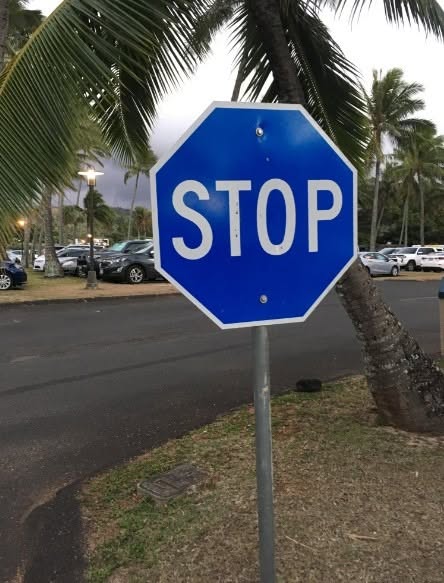
What Does a Blue Stop Sign Mean? If you have ever spotted a blue octagonal sign with the word STOP on it, the sight probably felt strangely familiar and completely wrong at the same time. Drivers in the United States expect stop signs to be red, so a blue version naturally raises questions.
In most cases, a blue stop sign appears on private property, such as a parking lot, gated community, business campus, resort, or private road. However, it does not match the standard design for an official STOP sign under current federal traffic-control standards. The Federal Highway Administration assigns red to stop or prohibition signs, while blue generally serves other purposes.
That distinction matters. Still, the safest response behind the wheel remains simple: if a blue octagonal sign clearly tells you to stop, stop, check for other road users, and proceed carefully.
I remember turning into a large private development during a road trip and seeing what looked like a normal stop sign from a distance. As I approached, however, I realized that the entire sign was blue. For a moment, I wondered whether it represented some unfamiliar traffic rule. I stopped anyway, then noticed that every intersection inside the property used the same design. Later, I learned that the color separated those privately installed signs from standard public-road traffic controls. Since then, I have treated unusual road signs cautiously instead of assuming an unfamiliar color means I can ignore the instruction.
What Does a Blue Stop Sign Mean on the Road?
Why a Blue Stop Sign Looks So Unusual
A standard STOP sign in the United States has one of the most recognizable designs on the road.
It uses an octagonal shape, a red background, a white border, and white lettering. The current Manual on Uniform Traffic Control Devices, commonly called the MUTCD, identifies the official R1-1 STOP sign and shows it as a red octagon. The manual also assigns red to stop and prohibition messages.
Therefore, a blue version immediately stands out.
So, What Does a Blue Stop Sign Mean? Usually, it means that a property owner or private organization wants drivers to stop at a particular point but has chosen a nonstandard color for the sign.
You may encounter one in a private residential development, condominium complex, apartment community, industrial property, business campus, large parking area, or other privately managed roadway.
However, location makes a major difference.
The Federal Highway Administration states that the MUTCD establishes national standards for traffic control devices on streets, highways, and site roadways open to public travel. Therefore, simply calling a road “private” does not automatically mean that standard traffic-control requirements never apply.
Moreover, a sign’s legal effect can depend on state and local law, whether the roadway remains open to general public travel, how authorities adopted the sign, and other circumstances.
Consequently, drivers should avoid assuming that every unusual sign lacks legal importance.
Does Blue Have an Official Traffic-Sign Meaning?
Yes, blue already has recognized uses within the American traffic-sign system, but stopping is not its standard general meaning.
Federal guidance traditionally uses blue for traveler services and related information. Examples can include signs directing motorists toward gas, food, lodging, hospitals, or other services.
Meanwhile, red carries the general meaning of stop or prohibition.
That color system helps drivers understand signs quickly.
You often process a sign’s shape and color before you consciously read its wording. For example, an octagon strongly signals STOP because road users learn that shape from the beginning of driver education.
Likewise, red immediately reinforces the message.
A blue octagon therefore combines two different visual signals. Its shape says one thing while its color belongs to another category.
Still, you should not treat that inconsistency as permission to drive through it.
If a sign clearly says STOP and another vehicle, cyclist, pedestrian, or golf cart could cross your path, stopping provides the safest response.
In addition, property owners can establish driving rules on their premises. Therefore, ignoring posted instructions can create safety problems even when the sign does not function exactly like a standard public-road STOP sign.
Why Would Someone Install a Blue Stop Sign?
Private Properties Often Use Their Own Designs
You will most likely encounter a blue stop sign away from an ordinary government-maintained street.
Some private communities and organizations deliberately choose distinctive sign colors because they want signs that match an architectural theme or property design.
For instance, a community may use blue, brown, green, or another coordinated color on street signs and directional markers.
Occasionally, that design choice extends to stop signs.
However, visual consistency within a property does not transform a blue octagon into the federally standardized STOP sign design.
The official STOP sign remains red.
When asking What Does a Blue Stop Sign Mean?, therefore, consider where you saw it.
If you drove into a gated neighborhood and suddenly found blue STOP signs at every intersection, the signs probably represent internal traffic-control instructions established by that property.
Similarly, private resorts, campuses, parking facilities, industrial complexes, and recreational developments may install nonstandard signs.
Yet the rules can become more complicated when private property allows regular public traffic.
The FHWA explains that MUTCD standards apply not only to conventional streets and highways but also to certain site roadways open to public travel.
Therefore, ownership alone does not answer every legal question.
Why Private Signs Sometimes Use Different Colors
Property owners may choose blue stop signs for several practical or aesthetic reasons.
First, they may want drivers to recognize that the road system belongs to a private development rather than the surrounding municipality.
Second, designers may choose colors that match signs throughout a community.
Third, older developments sometimes retain signs installed under local practices that differ from modern standards.
Finally, some signs may simply come from decorative suppliers rather than manufacturers of compliant public-road traffic equipment.
Regardless of the reason, the unusual color attracts attention.
Ironically, that extra attention may encourage motorists to notice the sign.
However, unusual design can also create confusion. Traffic-control standards exist partly because predictable colors and shapes let drivers recognize commands quickly.
Therefore, standardized red STOP signs provide an important advantage: almost every driver understands them instantly.
A blue version requires extra interpretation.
If you encounter one, focus on the wording and conditions around you. If the sign says STOP, treat the intersection cautiously rather than debating its color while moving through it.
Do You Legally Have to Stop at a Blue Stop Sign?
Public Roads and Private Roads Can Follow Different Rules
This question requires more nuance than a simple yes or no.
On a standard public roadway in the United States, an official STOP sign should follow the applicable traffic-control standards. Under the MUTCD, the STOP sign uses the familiar red octagonal design.
Therefore, a blue STOP sign would not represent the normal standard installation.
However, private-property enforcement varies.
State statutes differ, and some jurisdictions extend certain traffic laws to private roads, shopping centers, parking areas, or other locations open to public travel. Property owners may also establish rules that drivers agree to follow while using the premises.
As a result, you should not rely on a broad claim that “private stop signs are never enforceable.”
That claim can be wrong.
For example, a publicly accessible shopping center can present different legal considerations from a closed private driveway. Current legal summaries note that enforceability can depend heavily on whether private property remains open to public vehicular travel and on the relevant state rules.
Therefore, What Does a Blue Stop Sign Mean? From a practical driving perspective, it means you should slow down, stop where directed, and check the intersection.
Even if a particular sign would not support the same traffic citation as an official municipal STOP sign, ignoring it could still contribute to a crash or other liability.
Why Stopping Is Usually the Sensible Choice
Suppose you enter a private neighborhood and approach a blue octagonal STOP sign.
You could spend several seconds wondering whether local police could issue a citation.
Or you could simply stop.
The second option makes considerably more sense.
A stop takes only a few moments. Meanwhile, the sign probably stands there because vehicles, pedestrians, cyclists, or other road users cross nearby.
Therefore, stopping protects you regardless of the exact regulatory status.
Come to a complete stop where visibility allows you to check for conflicts. Look left and right, watch for pedestrians, and proceed only when conditions permit.
Do not assume that other drivers understand the sign in the same way you do. Someone approaching from another direction may stop unexpectedly, continue through, or hesitate.
Consequently, unusual traffic-control situations deserve more caution, not less.
The same principle applies whenever you encounter faded, damaged, temporary, or unfamiliar signage.
Drive according to the safest reasonable interpretation while remaining aware of surrounding traffic.
How Blue Stop Signs Differ From Official Red Signs
Shape Matters, but Color Matters Too
Traffic signs communicate through several features at once.
Shape provides one layer of information.
Color provides another.
Words and symbols add additional meaning.
For STOP signs, the octagon creates one of the strongest shape associations in driving. Even when snow, dirt, or darkness obscures some lettering, drivers can often recognize the command from the outline.
However, color reinforces that identification.
The Federal Highway Administration specifically identifies red with stop and prohibition messages. Meanwhile, federal guidance places blue in other categories, including motorist-service information.
Therefore, a blue octagonal sign containing the word STOP uses the expected shape but an unexpected color.
That difference explains why motorists notice these signs so quickly.
An official public-road STOP sign follows a standardized appearance for good reason. Consistency gives drivers less information to process while approaching an intersection.
So, if you wonder What Does a Blue Stop Sign Mean?, remember this simple distinction: the word and shape communicate a stop instruction, while the blue background shows that the sign does not follow the ordinary standardized color of an official STOP sign.
What to Do When You See One
When a blue stop sign appears ahead, follow a straightforward safety routine.
First, reduce your speed early.
Next, prepare to stop completely.
Then, check for crossing vehicles, bicycles, pedestrians, children, and other road users.
After the path becomes clear, proceed cautiously.
This approach works especially well in private developments because those areas can contain unusual traffic patterns.
For example, golf carts may share roadways in some communities. Parking-lot intersections may lack lane markings. Pedestrians may cross outside marked crosswalks. Delivery vehicles may stop suddenly.
Therefore, the blue STOP sign might mark a location where extra attention truly matters.
Additionally, never assume an unusual sign gives you automatic right-of-way after you stop.
Observe the entire intersection.
If another driver arrived first, normal courtesy and applicable right-of-way principles still matter.
Likewise, if conditions remain unclear, waiting another moment generally creates less risk than rushing forward.
The goal is not simply to satisfy the sign.
The goal is to avoid a collision.
Frequently Asked Questions
What Does a Blue Stop Sign Mean?
A blue stop sign generally communicates that drivers should stop, but it does not match the standard federal design for an official STOP sign in the United States. You most commonly encounter blue STOP signs on private property or privately managed roads. However, legal requirements can vary by location.
Are blue stop signs legal?
A property owner can display signs on private property, but whether a blue STOP sign functions as an enforceable traffic-control device depends on the road, jurisdiction, public access, and applicable laws. On roads governed by standard MUTCD traffic-control requirements, the official STOP sign design uses a red background.
Can police ticket you for running a blue stop sign?
Possibly, depending on the jurisdiction and circumstances. Private-property traffic enforcement varies significantly. Some laws apply to roads or parking areas open to public travel, while others distinguish more sharply between public and private property. Therefore, never assume that an unusual sign automatically has no legal effect.
Why aren’t official stop signs blue?
Federal traffic-control standards associate red with stop and prohibition. Blue has other traffic-sign uses, especially for services and related guidance. Standardized colors help drivers recognize sign meanings quickly.
Should I stop when I see a blue stop sign?
Yes, stopping is the safest practical response when the sign clearly instructs you to STOP. Even when its legal status differs from that of a standard red sign, the sign likely marks an intersection or location where the property owner wants drivers to check for conflicting traffic.
Conclusion
So, What Does a Blue Stop Sign Mean?
In the United States, it usually represents a privately installed instruction to stop rather than the standard design of an official public-road STOP sign.
Official STOP signs use the familiar red octagonal design. Federal traffic-control standards assign red to stop and prohibition, while blue normally serves other traffic-sign functions.
However, that does not mean you should ignore a blue STOP sign.
Private roads, parking areas, gated communities, campuses, and other properties can have their own traffic-management systems. Furthermore, laws governing private roads differ by jurisdiction, particularly when those roads remain open to public travel.
Therefore, the safest rule remains simple.
When you see an octagonal sign telling you to STOP, stop.
Check for traffic and pedestrians. Then proceed carefully.
A few seconds of caution matter far more than proving whether an unusual blue sign carries the same technical status as the red one at the next intersection.
WP Recipe Maker JSON Import
{
  "title": "What Does a Blue Stop Sign Mean? The Truth Behind This Unusual Road Sign",
  "summary": "A practical guide explaining why blue stop signs appear, how they differ from standard red STOP signs, where drivers commonly encounter them, and why stopping remains the safest response.",
  "notes": "This is an informational road-safety guide rather than a food recipe. Blue STOP signs are nonstandard compared with the familiar red STOP sign used under U.S. federal traffic-control standards. Legal enforceability on private property varies by jurisdiction and roadway status.",
  "ingredients_flat": [
    {
      "amount": "1",
      "unit": "",
      "name": "blue octagonal STOP sign"
    },
    {
      "amount": "1",
      "unit": "",
      "name": "private or nonstandard roadway setting"
    },
    {
      "amount": "1",
      "unit": "",
      "name": "careful driver"
    }
  ],
  "instructions_flat": [
    {
      "name": "Step 1",
      "text": "Reduce your speed when approaching a blue sign that clearly displays the word STOP.",
      "summary": "",
      "image_url": ""
    },
    {
      "name": "Step 2",
      "text": "Come to a complete stop rather than assuming the unusual color makes the instruction irrelevant.",
      "summary": "",
      "image_url": ""
    },
    {
      "name": "Step 3",
      "text": "Check carefully for crossing vehicles, bicycles, pedestrians, golf carts, and other road users.",
      "summary": "",
      "image_url": ""
    },
    {
      "name": "Step 4",
      "text": "Determine whether the sign appears on private property, a gated development, parking area, business campus, or another privately managed road.",
      "summary": "",
      "image_url": ""
    },
    {
      "name": "Step 5",
      "text": "Remember that the official U.S. STOP sign uses a red octagonal design, while a blue version does not match the standard STOP sign color.",
      "summary": "",
      "image_url": ""
    },
    {
      "name": "Step 6",
      "text": "Do not assume that a private-property sign can never carry legal consequences because enforcement varies by jurisdiction and roadway access.",
      "summary": "",
      "image_url": ""
    },
    {
      "name": "Step 7",
      "text": "Proceed only after the intersection becomes clear and it is safe to continue.",
      "summary": "",
      "image_url": ""
    }
  ],
  "equipment": [
    {
      "name": "Vehicle",
      "notes": ""
    },
    {
      "name": "Driver awareness",
      "notes": ""
    },
    {
      "name": "Clear view of the intersection",
      "notes": ""
    }
  ],
  "nutrition": {
    "calories": "0",
    "carbohydrates": "0 g",
    "protein": "0 g",
    "fat": "0 g",
    "saturated_fat": "0 g",
    "polyunsaturated_fat": "0 g",
    "monounsaturated_fat": "0 g",
    "trans_fat": "0 g",
    "cholesterol": "0 mg",
    "sodium": "0 mg",
    "potassium": "0 mg",
    "fiber": "0 g",
    "sugar": "0 g",
    "vitamin_a": "0",
    "vitamin_c": "0",
    "calcium": "0",
    "iron": "0"
  },
  "tags": {
    "course": ["Driving Guide"],
    "cuisine": ["American"],
    "keyword": ["What Does a Blue Stop Sign Mean", "blue stop sign", "unusual road signs", "private road stop sign"]
  }
}
SEO Output
Focus Keyword
What Does a Blue Stop Sign Mean
SEO Title
What Does a Blue Stop Sign Mean? The Truth About This Road Sign
Meta Description
What Does a Blue Stop Sign Mean? Learn why these unusual signs appear, where you may see them, and whether drivers should stop.
Expert SEO Title
What Does a Blue Stop Sign Mean? 5 Surprising Facts
Midjourney Prompt
Realistic roadside photography of an unusual blue octagonal stop sign with bold white STOP lettering at a quiet private residential intersection, clean suburban road, manicured landscaping, parked vehicle approaching cautiously in the distance, sign clearly visible as main focal point, natural late-afternoon daylight, realistic metal texture and reflective surface, intriguing but believable traffic scene, highly detailed professional photography, vertical composition, clean uncluttered background, sign positioned in lower two-thirds, generous negative space at top for text overlay suitable for Pinterest pins –v 6 –ar 2:3
More Blog
- Drinking Water on an Empty Stomach — What Science Actually Supports (No Hype, Just Facts)
- Waking Up Between 3 and 5 AM? It Might Be Your Soul Trying to Talk to You
- What a “Bleach” Patch on Your Underwear Really Means — And Why It’s Actually a Good Sign
- This Drink May Weaken Your Bones From The Inside — But Everyone Drinks It Anyway