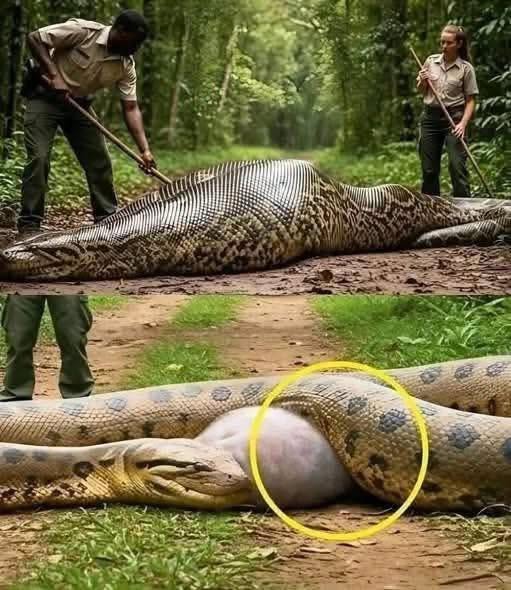
Photographs of a giant snake with an enormous bulge in its body can attract attention almost instantly. The images often appear with dramatic headlines claiming that rangers cut the animal open and discovered something unbelievable inside.
Such stories combine mystery, danger, and the raw power of nature. However, many provide few details that readers can verify. They may omit the location, date, species, names of the wildlife officers, and identity of the swallowed animal. Some even describe a python as an anaconda or merge several unrelated events into one sensational account.
A large swelling in a snake’s body can indeed mean that it recently swallowed substantial prey. Yet that does not automatically explain why the snake died, whether anyone opened it, or what the prey was.
Understanding how large constrictors feed offers a much more interesting explanation than an unsupported viral caption. These animals have evolved flexible skulls, powerful muscles, specialized organs, and slow digestive systems that allow them to consume prey far wider than their own heads.
How Giant Snakes Swallow Such Large Animals
Their jaws do not simply “unhinge”
People often say that snakes dislocate or unhinge their jaws before swallowing prey. That familiar description is misleading.
A snake’s lower jaw consists of two separate halves connected at the front by flexible tissue. Unlike the rigid lower jaw of a human, these halves can move with a degree of independence.
The skull also contains several mobile bones and elastic ligaments. Together, those structures allow the mouth to open extremely wide and gradually move over prey.
The snake does not swallow a large animal in one quick gulp. Instead, it alternates movements on either side of its jaw, slowly pulling its head forward while moving the prey deeper into the throat.
This process can make the snake appear as though it is stretching around the animal.
Research into snake evolution has shown that their flexible skulls became part of a highly specialized feeding system that allowed them to consume difficult prey and occupy an extraordinary range of ecological niches.
Their bodies stretch around the meal
A snake’s skin, ribs, muscles, and connective tissues can expand considerably.
Its ribs do not connect to a breastbone in the same restrictive way that human ribs do. Therefore, the body wall can widen as prey moves through the digestive tract.
The result is the striking bulge commonly seen in photographs. The shape may preserve the rough outline of the swallowed animal, especially before digestion advances.
A large constrictor may consume mammals, birds, reptiles, fish, or other animals, depending on its species and habitat.
Large anacondas commonly hunt in or near water. Their prey may include fish, turtles, birds, capybaras, caimans, and other animals available in wetland ecosystems.
Large pythons occupy different regions of the world and may consume deer, pigs, birds, monitor lizards, and other mammals or reptiles.
These snakes normally select prey they can overpower and swallow. However, an unusually large meal creates substantial physical demands.
Anaconda or Python? Why the Difference Matters
Anacondas live naturally in South America
Anacondas belong to the boa family and live in tropical South America.
The green anaconda is the largest species by weight, although other snakes may grow longer. It has a thick, muscular body and spends much of its time in rivers, swamps, marshes, and flooded forests.
Water supports the animal’s heavy body and allows it to approach prey quietly. Its eyes and nostrils sit high on its head, helping it remain mostly submerged while watching its surroundings.
Anacondas give birth to live young rather than laying eggs. They kill prey by constriction and generally swallow it headfirst.
Because they live in remote, densely vegetated wetlands, many dramatic stories about them remain difficult to confirm. This environment also makes exaggerated claims seem plausible to audiences unfamiliar with the region.
Pythons live in Africa, Asia, and Australia
Pythons form a separate group of constrictors found naturally in Africa, Asia, and Australia.
Some species have also established invasive populations elsewhere. Burmese pythons, for example, have become a serious ecological problem in the Florida Everglades after escaped or released animals reproduced in the wild.
Verified cases involving large swollen snakes often concern pythons rather than anacondas.
In 2005, wildlife officials documented a dead Burmese python in Florida that had attempted to consume an alligator. Both animals died, and the python’s body ruptured. Reuters later reported that an alligator was believed to have been dead before the snake tried to swallow it.
In another documented Florida case, researchers found a large python containing a recently consumed 76-pound deer.
These real events may help explain why vague social-media stories about “anacondas” feel believable. However, one verified python incident does not prove an unrelated claim about an anaconda.
Can a Meal Actually Kill a Snake?
Oversized prey creates several risks
Large constrictors evolved to handle substantial prey, so an impressive bulge does not necessarily mean that anything went wrong.
After a major meal, the snake may remain inactive for a long period while digestion proceeds. Its metabolism increases dramatically, and the digestive organs work at an unusually intense level.
However, an exceptionally large or awkwardly shaped animal can create complications.
Possible dangers include:
- Physical injury during the struggle
- Wounds caused by horns, hooves, claws, teeth, or shells
- Damage to internal organs
- Difficulty moving or escaping danger
- Regurgitation
- Infection following injury
- Overheating or environmental stress
- Rupture of weakened tissue
The prey may also remain alive briefly after swallowing begins, depending on how effectively the snake subdued it. A struggling animal can injure the mouth, throat, or digestive tract.
Even so, people should not assume that every dead snake with a bulge died because it “ate too much.” Disease, poisoning, trauma, deliberate killing, vehicles, parasites, habitat disturbance, or other causes may have contributed.
Only a veterinary examination or wildlife necropsy could establish the actual cause of death.
Digestion requires substantial energy
Snakes can go long periods without eating, but digestion becomes remarkably intense after a large meal.
The stomach produces strong acids and enzymes that break down soft tissues. Bones, fur, feathers, hooves, and other resistant material take longer or may pass through the digestive system as waste.
Body temperature strongly affects this process because snakes rely on external heat. A meal may digest more slowly when environmental conditions become too cold.
At the same time, excessive heat can create additional stress. The snake must find a suitable place where it can digest without becoming dangerously hot, exposed, or vulnerable.
During this period, its swollen body limits speed and flexibility. Predators, humans, vehicles, or environmental hazards may pose greater threats than they would to an unfed snake.
Why Wildlife Officers Sometimes Examine Dead Snakes
A necropsy can answer scientific questions
A necropsy is the animal equivalent of a human autopsy. Wildlife veterinarians and biologists may perform one to determine why an animal died.
During the examination, specialists may study:
- Stomach contents
- Internal injuries
- Disease
- Parasites
- Reproductive status
- Toxic exposure
- Body condition
- Signs of human involvement
Identifying stomach contents can also help scientists understand what invasive snakes eat and how they affect native wildlife.
Museum researchers have long used the stomach contents of preserved specimens to study snake diets. Such data have helped scientists examine how snakes evolved into specialized predators.
However, trained professionals carry out legitimate examinations under controlled conditions. Bystanders should never cut open a snake simply out of curiosity.
A snake that appears dead may still react reflexively, and its mouth can remain dangerous. The carcass may also contain bacteria, parasites, or decomposing tissue.
Rangers do not normally perform dramatic roadside dissections
Viral stories often describe rangers immediately cutting open a giant snake on a forest path as a crowd watches.
That image may create suspense, but it does not necessarily reflect standard wildlife procedure.
Professionals may first document the location, photograph the animal, assess the scene, identify the species, and determine whether the carcass should move to an appropriate facility.
A roadside examination might occur under unusual circumstances, but a credible report should identify the agency involved and explain why officials chose that approach.
Without those details, readers cannot know whether the story describes an actual wildlife investigation, an old video taken out of context, or invented narration added to unrelated footage.
Real Cases Can Become Misleading Viral Stories
A documented python case involved a human victim
In March 2017, villagers in Indonesia found a missing farmer inside a reticulated python.
The verified case occurred in West Sulawesi. Local residents discovered the swollen snake near the man’s belongings and opened it, revealing the victim. Reuters reported the victim’s identity, location, age, and circumstances.
This incident was tragic and highly unusual. It involved a python, not an anaconda, and villagers rather than an unspecified group of forest rangers.
Videos and images from verified cases such as this one often reappear years later with altered captions. A post may change the species, location, people involved, or contents of the snake to create a new mystery.
Therefore, a dramatic image alone cannot verify a headline.
Another case involved a python and an alligator
The 2005 Florida incident involving a Burmese python and an alligator also became widely circulated.
Images showed the dead python with the alligator’s body protruding from it. Wildlife specialists believed that the alligator had already died before the snake attempted to consume it. The python also died during the event.
Over time, some social posts simplified the event into a claim that the prey “exploded” the snake or that the animals fought inside its body.
The documented account was more cautious. It established what officials observed but did not support every dramatic explanation added later.
This illustrates how unusual wildlife photographs can gradually collect fictional details as different pages repost them.
How to Evaluate a Viral Wildlife Claim
Look for basic identifying information
A trustworthy wildlife report should answer several basic questions:
- Where did the event occur?
- When did it happen?
- Which species was involved?
- Who discovered the animal?
- Which wildlife agency investigated?
- What did officials actually find?
- Did experts determine a cause of death?
- Are the photographs or videos credited?
The source article provides none of those essential details. It describes a “large, recently swallowed animal” but never identifies that animal.
It also claims that swallowing the prey “likely led” to the snake’s death without citing a veterinarian, necropsy, ranger, or scientific report.
That conclusion remains speculation.
Reverse-image context matters
Images can circulate for years under different descriptions.
A photograph presented as a recent anaconda discovery may actually show:
- A python from another country
- An old scientific examination
- An invasive-species removal
- A staged scene
- A dead snake killed by people
- An unrelated animal photographed from a misleading angle
Readers should compare the image with reports from wildlife agencies and established news organizations before sharing the claim.
A dramatic headline should receive more scrutiny, not less.
Notice when the story avoids specific facts
Fabricated or heavily embellished stories often rely on phrases such as:
- “Experts were shocked”
- “No one could believe what they found”
- “The truth left everyone silent”
- “What happened next stunned the world”
These phrases produce emotion while avoiding verifiable information.
A credible report normally gives the factual discovery first. It does not force readers to continue through several vague paragraphs before naming the animal or event.
Why Giant Constrictors Still Deserve Respect
They play important ecological roles
Large snakes often trigger fear, but they serve important functions in healthy ecosystems.
They help regulate populations of rodents, birds, reptiles, and other animals. They also become prey or scavenged food at different stages of life.
Removing large predators can alter ecological relationships in unexpected ways.
At the same time, introduced constrictors can become destructive when they establish themselves outside their natural range. Burmese pythons in Florida have preyed on many native animals and created major management challenges.
Reuters has reported that invasive pythons in the Everglades consume a broad range of wildlife, from small mammals to large birds and deer.
The ecological impact depends on where the snake lives, whether it belongs there, and how its population interacts with native species.
Safe distance protects people and animals
Anyone who encounters a large snake should keep a safe distance.
Do not touch, corner, feed, strike, or attempt to move it. Even a nonvenomous constrictor can bite defensively and cause significant injury.
A recently fed snake may move slowly, but that does not make it harmless. Disturbance can also force it to regurgitate its meal, which places severe stress on the animal.
Contact local wildlife authorities when a snake creates an immediate safety concern or appears injured. Trained personnel can identify and handle it using appropriate equipment.
Never open or handle a snake carcass without professional authorization.
Frequently Asked Questions
Can an anaconda swallow a large animal whole?
Yes. Large anacondas can consume substantial prey because their skulls, jaws, skin, ribs, and muscles allow extreme expansion. The size of possible prey depends on the individual snake.
Do snakes dislocate their jaws when eating?
No. Their jaws and skull bones connect through highly flexible joints and ligaments. This anatomy allows wide opening and independent movement without the jaw simply becoming dislocated.
Can prey cause a snake’s death?
It can happen, particularly when prey injures the snake or creates digestive complications. However, the cause of death cannot be determined from a bulge alone.
Was the animal in the viral article really an anaconda?
The source does not provide enough evidence to verify the species. Several widely documented swollen-snake incidents involved pythons rather than anacondas.
What did the rangers supposedly find?
The source only says that they found a large, recently swallowed animal. It does not identify the animal or provide evidence from a ranger, agency, photograph, or investigation.
Should someone cut open a dead snake to identify its meal?
No. Wildlife professionals should handle carcasses and perform necropsies. A snake may still display reflexive movement, while the body can expose people to bites, bacteria, parasites, or decomposing tissue.
Conclusion
A giant snake with a swollen body can offer a remarkable example of natural adaptation. Large constrictors possess flexible skulls, expanding bodies, and powerful digestive systems that allow them to swallow prey that appears impossibly large.
However, unusual images also create ideal conditions for misinformation.
The source story does not identify the snake conclusively, name the swallowed animal, locate the event, cite the rangers, or provide a professional cause of death. Its dramatic conclusion therefore remains unverified.
Real cases show that pythons and other large constrictors sometimes consume deer, alligators, and, in extremely rare circumstances, humans. Those incidents become credible because reports provide names, locations, dates, agencies, and supporting evidence.
The most responsible response to a mysterious wildlife image is curiosity combined with caution. Nature already provides extraordinary stories. It does not need invented details to make them fascinating.
More Blog
- Drinking Water on an Empty Stomach — What Science Actually Supports (No Hype, Just Facts)
- Waking Up Between 3 and 5 AM? It Might Be Your Soul Trying to Talk to You
- What a “Bleach” Patch on Your Underwear Really Means — And Why It’s Actually a Good Sign
- This Drink May Weaken Your Bones From The Inside — But Everyone Drinks It Anyway