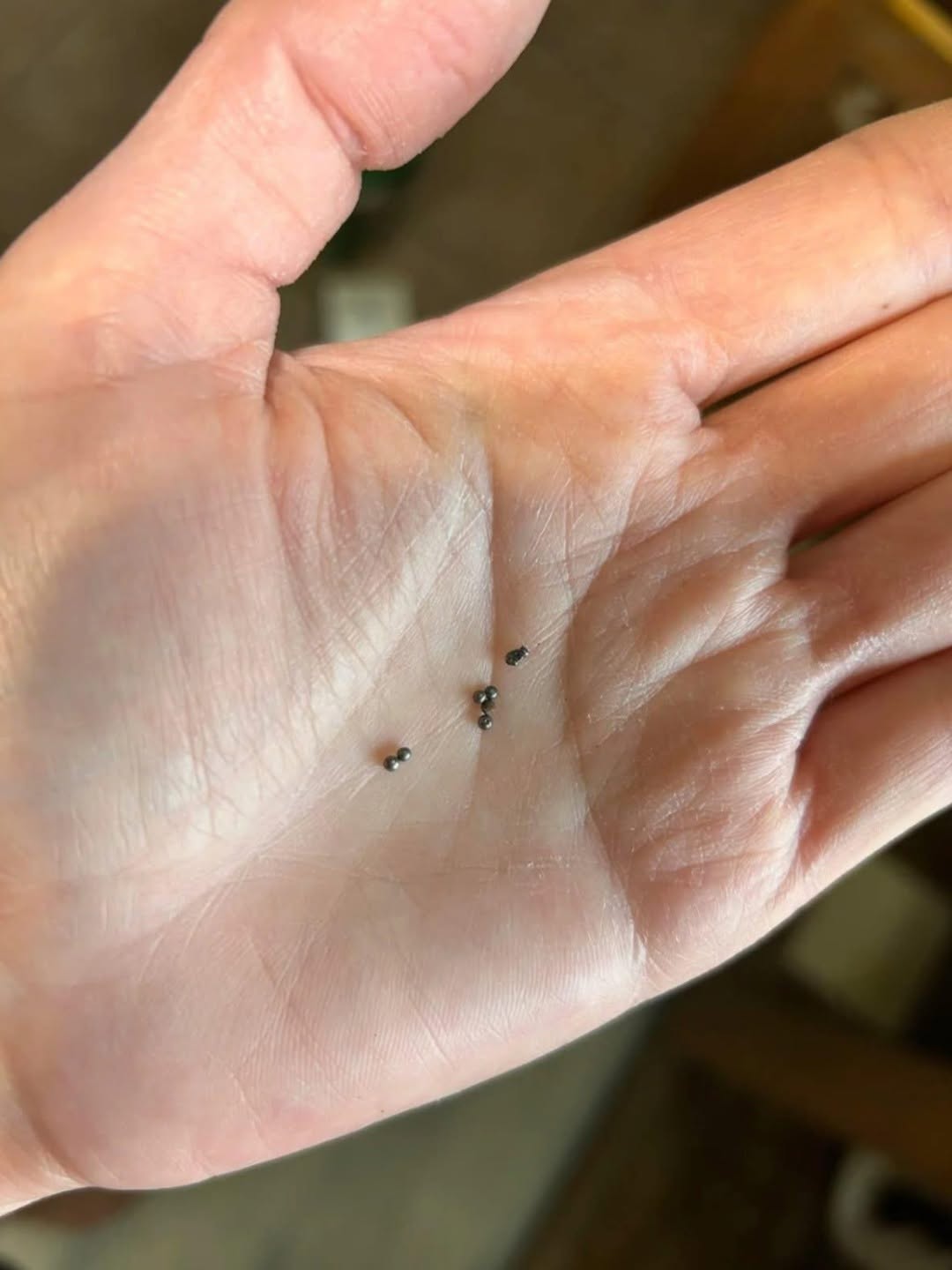
Finding a handful of small metal balls scattered underneath your kitchen sink can be surprisingly confusing. They may look like ball bearings, BBs, or tiny steel beads—and if you don’t remember putting anything like that in the cabinet, their appearance can seem mysterious.
Fortunately, there are several ordinary household explanations. One possibility, especially if you have a pull-out or pull-down kitchen faucet, involves the mechanism that helps retract the faucet hose.
🔍 Start With Your Pull-Out Faucet
Many pull-down and pull-out faucets have a flexible hose extending beneath the sink.
When you pull the sprayer from the faucet, that hose moves upward through the fixture. When you return the sprayer, a weight attached to the hose helps pull it back down so the sprayer seats properly.
Look underneath your sink and find the hose leading to the faucet head. Somewhere along it, you may see a rounded, cylindrical, or clamp-style weight.
If that component has broken or opened, material from inside it could potentially have escaped.
However, not every faucet weight contains loose metal balls. Designs vary considerably by manufacturer; many are simply solid or enclosed weights. So metal balls shouldn’t automatically be attributed to the faucet without inspecting it.
🧩 Signs the Faucet Weight May Be the Source
Check whether the faucet sprayer has recently started behaving differently.
A damaged, detached, or missing counterweight may cause the pull-out hose to:
- Retract slowly or incompletely
- Hang underneath the sink
- Require manual pushing to return the sprayer
- Feel noticeably different when pulled
- Catch on plumbing or objects inside the cabinet
If these symptoms appeared around the same time as the metal balls, inspecting the hose mechanism is a sensible first step.
🛠️ What Should You Do?
First, remove everything stored underneath the sink so you can clearly see the plumbing and faucet components.
Follow the retractable hose from the faucet downward. Look for a weight attached around it and check for cracks, separation, missing pieces, or a loose attachment.
Also inspect the hose itself for abrasion, kinks, or leaks.
If the weight is damaged, identify the faucet manufacturer and model before ordering a replacement. Faucet weights aren’t necessarily interchangeable, and the correct size and position help the hose retract properly.
💧 Check for Water While You’re There
Finding something unusual underneath the sink is also a good opportunity to check for leaks.
Run the faucet normally and then extend and retract the sprayer several times while watching the cabinet underneath.
Look around the hose connections, shutoff valves, drain fittings, garbage disposal connections, and cabinet floor for droplets or moisture.
A damaged counterweight doesn’t normally cause a water leak by itself, but a retractable hose that has been rubbing against another component can eventually become damaged.
⚠️ Don’t Ignore Loose Metal Pieces
Collect the balls rather than leaving them scattered around the cabinet.
They’re a choking hazard for small children and pets, and loose metal pieces can roll into inaccessible areas.
If they’re rusty, use gloves while cleaning them up and wash your hands afterward.
What If You Don’t Have a Pull-Out Faucet?
Then the balls probably came from something else.
Check items stored in or around the cabinet. Small steel balls can originate from damaged drawer slides, lazy-Susan mechanisms, appliance components, old hardware, bearings, toys, or other mechanical objects.
Also examine nearby cabinet hardware. A failed ball-bearing drawer slide, for example, can release small steel bearings that subsequently roll into unexpected locations.
🔎 A Simple Way to Narrow It Down
The location and condition of the balls provide useful clues.
If they’re concentrated directly beneath the retractable faucet hose and a nearby component appears broken, the faucet mechanism becomes a strong suspect.
If they’re near a drawer or sliding cabinet mechanism instead, inspect its bearings.
And if you can’t find anything damaged, don’t start dismantling plumbing based solely on an internet photograph. Save a few of the pieces and have the faucet or cabinet hardware inspected if necessary.
The Bottom Line
Small metal balls underneath a kitchen sink aren’t automatically evidence of a plumbing emergency.
If you have a pull-out or pull-down faucet, inspect its retractable hose and counterweight first—but remember that faucet designs vary and many weights don’t contain loose steel balls.
Check nearby mechanical hardware as well, collect the loose pieces, and inspect the cabinet for leaks.
The most useful clue is usually simple: find the component that’s suddenly missing its bearings, broken, or no longer working the way it used to.
More Blog
- Drinking Water on an Empty Stomach — What Science Actually Supports (No Hype, Just Facts)
- Waking Up Between 3 and 5 AM? It Might Be Your Soul Trying to Talk to You
- What a “Bleach” Patch on Your Underwear Really Means — And Why It’s Actually a Good Sign
- This Drink May Weaken Your Bones From The Inside — But Everyone Drinks It Anyway