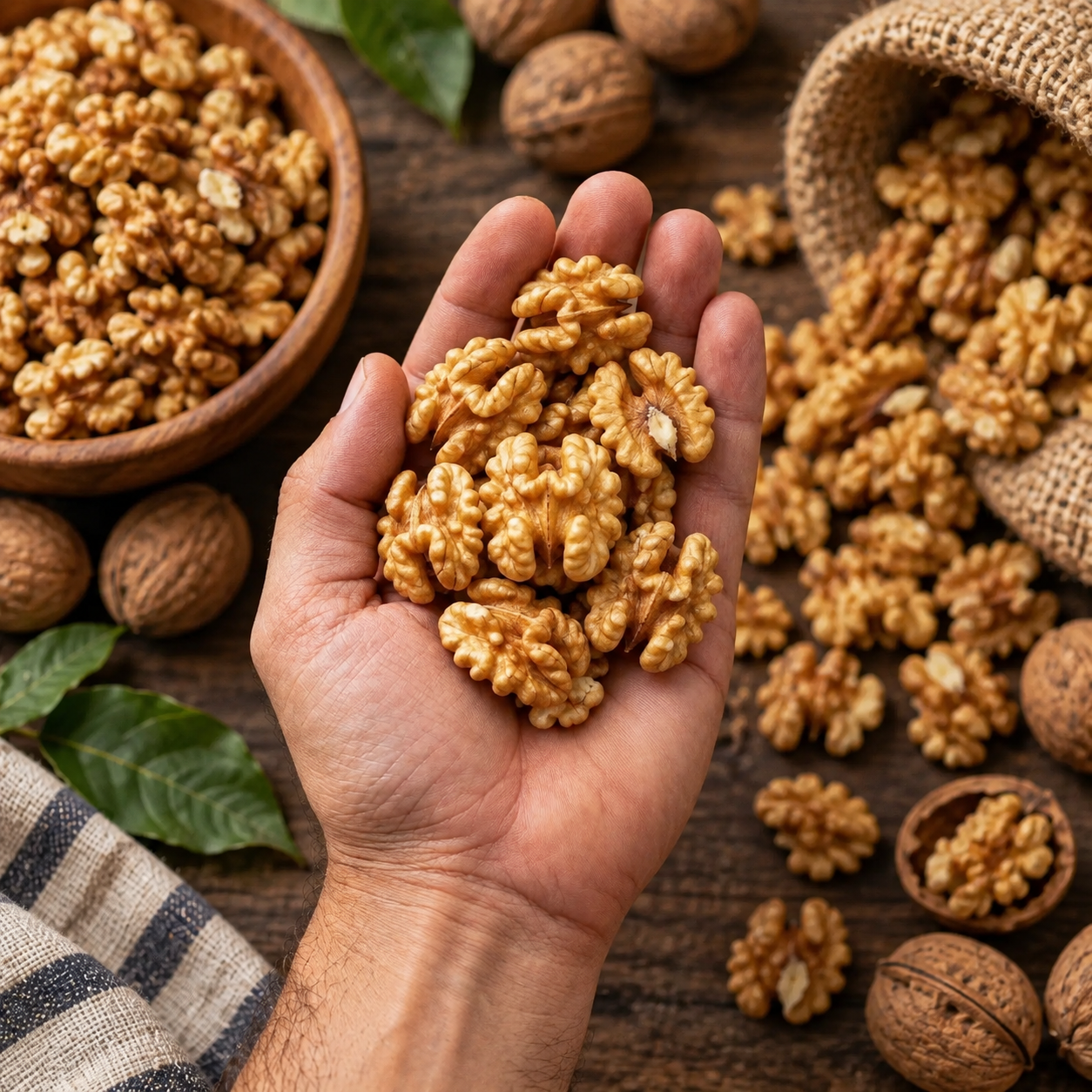
The Power of the Walnut: 5 Science-Backed Health Benefits comes from a surprisingly nutrient-dense food. Walnuts provide unsaturated fats, plant-based omega-3 fatty acids, fiber, protein, minerals, and polyphenols in a compact serving.
They have earned a reputation as “brain food,” partly because of their appearance and partly because researchers have studied them for cognition. However, walnuts may have stronger evidence for cardiovascular benefits than for dramatic improvements in memory or mental performance.
I used to think the best reason to eat walnuts was their omega-3 content. Then I realized their value comes from the entire package. They can replace foods high in saturated fat, provide fiber and plant protein, contribute alpha-linolenic acid, and add texture to meals without requiring complicated preparation. At the same time, they are calorie-dense, so portions still matter. A small handful can be useful; eating straight from a large bag without noticing the amount can add several hundred calories quickly.
The American Heart Association includes walnuts among heart-healthy nut choices and describes a typical nut serving as about 1 ounce, or a small handful. That amount works well as a practical daily portion for many adults.
Why Walnuts Stand Out Nutritionally
Their Unsaturated Fats Support a Heart-Healthy Eating Pattern
Walnuts contain a high proportion of polyunsaturated fat and relatively little saturated fat. That matters because replacing foods rich in saturated fat with unsaturated-fat foods is a central part of heart-healthy dietary guidance.
The American Heart Association recommends emphasizing nuts, legumes, fish, whole grains, fruits, vegetables, and unsaturated plant fats while limiting saturated fat and highly processed foods. Walnuts fit naturally into that pattern.
A 1-ounce serving contains about 185 calories and roughly 13 grams of polyunsaturated fat, according to nutrition values cited by the American Heart Association from USDA food-composition data. Therefore, walnuts deliver a concentrated amount of energy along with their healthy fats.
That calorie density is not automatically a problem. It simply means walnuts work best when they replace another snack or ingredient rather than being added mindlessly on top of everything else you already eat.
For example, replacing chips, cookies, processed meat, or a butter-heavy topping with walnuts can improve the overall fat quality of the meal. Adding a large handful of walnuts after an already calorie-dense meal creates a different nutritional effect.
Walnuts Provide a Useful Plant Source of Omega-3 ALA
Walnuts are especially notable for alpha-linolenic acid, or ALA, an essential plant-based omega-3 fatty acid. The body cannot make ALA, so it must come from food.
The American Heart Association identifies walnuts, flaxseed, soybean oil, and canola oil as dietary sources of ALA. Recommended daily ALA intake is about 1.6 grams for adult men and 1.1 grams for adult women, with higher needs during pregnancy and breastfeeding.
However, ALA is not identical to the EPA and DHA found in fatty fish. The body can convert small amounts of ALA into EPA and DHA, but that conversion is limited. Therefore, walnuts should not be treated as a complete substitute for marine omega-3 sources when someone eats fish.
That distinction matters because online articles often call walnuts “the best omega-3 food” without explaining which omega-3 they contain. They are an excellent plant source of ALA, but salmon, sardines, mackerel, and similar fish provide EPA and DHA directly.
Still, ALA contributes to a healthy dietary pattern and makes walnuts especially useful for people who want more plant-based sources of unsaturated fat.
The Strongest Evidence: Heart and Metabolic Health
Benefit 1: Walnuts Can Improve LDL and Total Cholesterol
Among the 5 Science-Backed Health Benefits of walnuts, improvement in blood lipids has some of the strongest clinical evidence.
A systematic review and meta-analysis of randomized controlled trials published in 2022 found that walnut consumption was associated with reductions in total cholesterol, LDL cholesterol, and triglycerides. Across the included trials, LDL fell by an average of about 5.7 mg/dL compared with control diets.
An earlier meta-analysis of 26 controlled trials reached a similar conclusion. Walnut-enriched diets reduced total cholesterol and LDL cholesterol without causing significant weight gain compared with control diets.
These findings do not mean walnuts act like cholesterol-lowering medication. The average changes are modest, and individual responses vary. However, even small improvements can contribute to cardiovascular risk reduction when combined with exercise, blood-pressure control, smoking avoidance, and an overall healthy diet.
The benefit may partly come from what walnuts replace. Swapping foods high in saturated fat for walnuts changes the type of fat in the diet, which can help improve LDL cholesterol.
Walnuts also contain fiber, phytosterols, polyphenols, and other compounds that may contribute to their cardiovascular effects. Researchers continue to study how these components interact.
Benefit 2: Walnuts May Support Blood Vessel Function
Healthy arteries need to expand and contract appropriately as blood-flow demands change. Researchers often study this ability using flow-mediated dilation, or FMD, a measure of endothelial function.
A 2024 systematic review and meta-analysis of randomized trials found that walnut consumption modestly improved FMD. The analysis included six trials with 250 participants and found an average increase of just under 1 percentage point.
That does not prove eating walnuts prevents heart attacks. FMD is a marker of vascular function rather than a direct clinical outcome.
Still, the result supports the broader evidence that walnuts can fit into a cardiovascular-friendly diet. Their unsaturated fats and bioactive compounds may help support the endothelium, which lines blood vessels.
It is also important to avoid turning one food into a medical treatment. Someone with high cholesterol, hypertension, diabetes, or established heart disease should not rely on walnuts instead of prescribed treatment.
The most realistic interpretation is that walnuts can contribute to a dietary pattern that supports vascular health, especially when they replace less favorable foods.
Walnuts, the Brain, and the Gut
Benefit 3: Brain Health Is Promising, but the Evidence Is More Nuanced
Walnuts often get marketed as a guaranteed memory booster because they contain ALA, polyphenols, and vitamin E-like antioxidant compounds. The biological reasoning is interesting, but human trial results are not as dramatic as many headlines suggest.
The large Walnuts and Healthy Aging, or WAHA, randomized trial followed more than 700 healthy older adults for two years. Participants in the walnut group added walnuts equal to about 15% of daily energy, roughly 30 to 60 grams per day.
The final cognitive results did not show a significant overall improvement in global cognition for the entire walnut group compared with controls. However, exploratory analyses suggested possible benefits in some participants and subgroups, which researchers considered worthy of further study.
That means claims that the WAHA study proved walnuts significantly improved memory, processing speed, and mental flexibility in everyone are too strong.
Observational research and smaller studies still suggest that nuts may support healthy aging, especially as part of Mediterranean-style or other nutrient-rich diets. Yet walnuts should not be presented as a proven treatment for cognitive decline.
A more accurate message is encouraging but modest: walnuts provide nutrients that support overall cardiovascular and metabolic health, and those systems also matter for brain health.
Benefit 4: Walnuts Can Alter the Gut Microbiome
The gut microbiome has become a major area of nutrition research, and walnuts appear capable of changing the composition and activity of intestinal bacteria.
In one randomized controlled feeding trial involving 18 adults, participants consumed about 42 grams of walnuts daily for three weeks. Researchers observed changes in several bacterial groups, lower levels of certain secondary bile acids, and a reduction in LDL cholesterol during the walnut phase.
Another randomized trial found that eating 43 grams of walnuts daily for eight weeks significantly changed the gut microbiome, including increases in some bacteria associated with butyrate production.
A later controlled feeding study also found that a walnut-rich diet altered microbial gene expression compared with diets containing similar fatty-acid patterns but no whole walnuts. That suggests components beyond the fat itself may influence gut bacteria.
These results are interesting, but microbiome science is still developing. A change in bacterial abundance does not automatically translate into a guaranteed improvement in health.
Still, walnuts contain fiber and polyphenols that gut microbes can use, so the microbiome offers one plausible pathway through which regular walnut consumption might influence metabolism.
Weight Management, Portions, and the Best Way to Eat Walnuts
Benefit 5: Walnuts Can Fit Into Weight Management Despite Their Calories
Walnuts are calorie-dense, so people sometimes avoid them when trying to manage weight. However, clinical trials do not show that including moderate amounts of walnuts automatically causes weight gain.
The 2018 meta-analysis of controlled trials found that walnut-enriched diets did not produce a significant difference in body weight compared with control diets.
There are several possible explanations. Nuts contain protein, fat, and fiber, which can increase satiety. Their physical structure may also mean that not every calorie listed on a nutrition label is absorbed with perfect efficiency.
Still, portion size matters. One ounce of walnuts contains around 185 calories, so eating three or four large handfuls can quickly add substantial energy.
The most effective approach is substitution. Use walnuts instead of a less nutritious snack, mix them into oatmeal instead of adding butter and sugar, or sprinkle them over salad in place of croutons or processed meat.
Walnuts do not “burn fat,” and they do not cause weight loss simply because they contain omega-3s. Their advantage comes from being a satisfying, nutrient-rich food that can improve the quality of a well-planned diet.
How Many Walnuts Should You Actually Eat?
For most adults, about 1 ounce of walnuts is a practical serving. The American Heart Association describes 1 ounce of whole nuts as a standard serving and recommends including nuts and other plant protein foods within an overall healthy dietary pattern.
One ounce of walnut halves is roughly a small handful, commonly around 12 to 14 halves depending on size. You do not need to count every piece precisely.
Some research trials have used larger doses. The WAHA study used roughly 30 to 60 grams per day, while gut-microbiome trials have tested amounts around 42 to 57 grams daily.
However, research doses are not automatically daily recommendations. A 1-ounce serving fits more easily into most calorie needs and leaves room for other healthy fats, seeds, legumes, and foods.
Choose plain, unsalted walnuts most often. Honey-coated, candied, chocolate-covered, or heavily salted versions can add substantial sugar, sodium, and calories.
Store walnuts in the refrigerator or freezer if you buy them in quantity. Their high unsaturated-fat content makes them prone to becoming rancid, and the American Heart Association recommends cold storage to preserve freshness.
Frequently Asked Questions
Are walnuts really good for your brain?
Walnuts contain ALA, polyphenols, and other nutrients that may support overall brain health. However, the major WAHA randomized trial did not find a significant overall cognitive benefit across all participants, so claims that walnuts dramatically improve memory are stronger than the evidence supports.
How many walnuts should I eat each day?
About 1 ounce, or a small handful, is a practical serving for most adults. Larger amounts have been studied, but they also contribute more calories.
Can walnuts lower cholesterol?
Randomized trials and meta-analyses show modest reductions in total and LDL cholesterol when walnuts are included in the diet. The effect is not a substitute for cholesterol medication when medication is medically necessary.
Will walnuts make me gain weight?
Moderate walnut intake does not appear to cause significant weight gain in controlled trials, particularly when walnuts replace other foods rather than simply adding extra calories. However, portions still matter because walnuts are energy-dense.
Are walnuts a replacement for fish omega-3s?
No. Walnuts provide ALA, while oily fish provides EPA and DHA. The body converts only a limited amount of ALA into EPA and DHA, so the two food sources are not nutritionally identical.
Conclusion
The Power of the Walnut: 5 Science-Backed Health Benefits is real, but it becomes more useful when the claims stay proportional to the evidence.
Walnuts have strong support for improving aspects of cardiovascular health. Controlled trials consistently show modest reductions in LDL and total cholesterol, and newer evidence suggests they may also improve endothelial function.
They also provide ALA, fiber, plant protein, unsaturated fats, and polyphenols. Research shows that walnuts can influence the gut microbiome, although scientists are still working out exactly how those microbial changes translate into long-term health outcomes.
The brain-health story requires more caution. Walnuts contain nutrients relevant to brain function, but the large WAHA trial did not show a significant overall cognitive improvement across all older adults who ate them. That makes walnuts a healthy food, not a proven memory treatment.
For most people, a small handful of plain walnuts provides a sensible portion. About 1 ounce is enough to add healthy fats and useful nutrients without allowing calories to climb unnoticed.
The biggest benefit comes from how you use them. Replace less nutritious snacks or saturated-fat-rich toppings with walnuts, pair them with other whole foods, and make them one part of a varied eating pattern rather than treating them as a miracle ingredient.
More Blog
- Drinking Water on an Empty Stomach — What Science Actually Supports (No Hype, Just Facts)
- Waking Up Between 3 and 5 AM? It Might Be Your Soul Trying to Talk to You
- What a “Bleach” Patch on Your Underwear Really Means — And Why It’s Actually a Good Sign
- This Drink May Weaken Your Bones From The Inside — But Everyone Drinks It Anyway