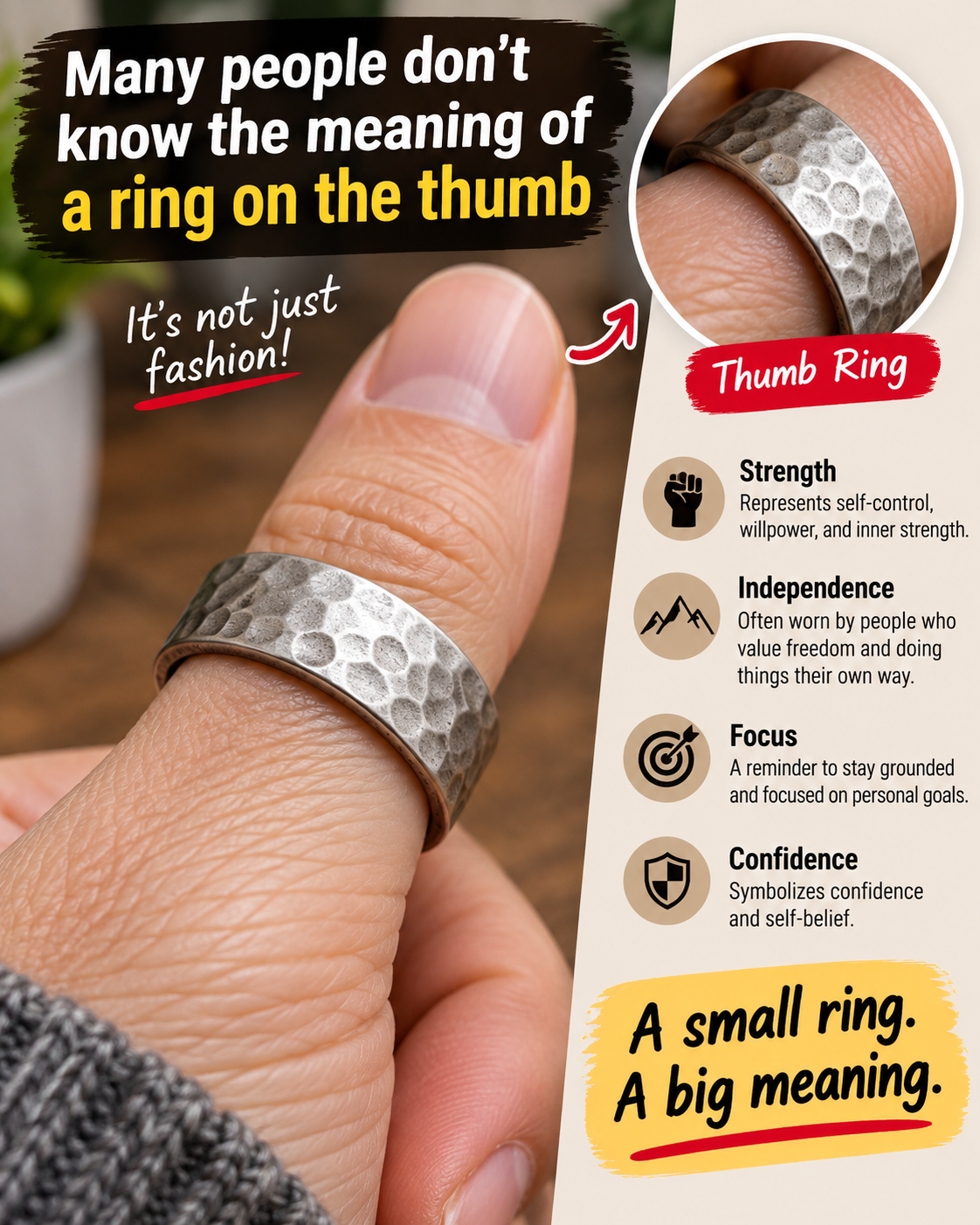
The Hidden Meaning Behind Thumb Rings for Women vs. Men has fascinated jewelry lovers for years. A thumb ring stands apart from rings worn on the other fingers because of its size, position, and unmistakable visibility. As a result, people often associate it with confidence, individuality, independence, or simply a strong sense of personal style.
However, a thumb ring does not carry one universal secret meaning. Its symbolism changes across cultures, historical periods, fashion movements, and individual wearers. For some people, a thumb ring communicates boldness. For others, it represents nothing more complicated than enjoying an unusual piece of jewelry.
I remember noticing how differently people reacted to the same simple silver thumb ring. One person immediately described it as rebellious, another thought it looked artistic, and someone else associated it with confidence. That contrast made me realize how easily we assign meanings to jewelry based on our own experiences. The ring itself had not changed, yet every observer read something different into it. That remains one of the most interesting things about thumb rings: they attract attention, but they rarely tell a complete story without knowing the person wearing them.
Historically, thumb rings also had purposes far beyond modern fashion. Archers in several cultures wore specially shaped rings to protect the thumb while drawing a bowstring. In Ottoman, Indian, Mughal, and Manchu contexts, some archery rings eventually became elaborate objects made from jade, precious metals, gemstones, amber, and other valuable materials. Museums preserve examples that served both practical and decorative purposes, and some also communicated social status.
Today, the meaning usually depends much more on the wearer than on a fixed rule. Therefore, understanding thumb ring symbolism requires separating documented history from modern fashion interpretations and internet myths.
The History and Symbolism of Thumb Rings
Thumb Rings Began as More Than Fashion
Long before thumb rings became modern accessories, specialized versions played an important role in archery. In several archery traditions, the archer hooked the thumb around the bowstring. A protective ring reduced pressure on the thumb and helped create a smoother release.
Historical examples survive from India, China, the Ottoman Empire, and other regions. The Metropolitan Museum of Art holds Indian, Turkish, Mughal, and Chinese thumb rings connected with archery. Some examples remain relatively plain and clearly functional, while others use jade, gold, rubies, emeralds, ivory, amber, and detailed carving.
Over time, these objects could also communicate rank or wealth. For example, elaborately decorated Indian archer’s rings could function as costume accessories that conveyed social position. Likewise, Ottoman examples could symbolize elevated status because archery held associations with noble sporting culture.
In Manchu culture, the distinction between practical and decorative thumb rings became particularly clear. Archers could use plain bone or antler rings for hunting and warfare, while wearing more elaborate pieces made from precious or fragile materials as personal adornment. Therefore, the same basic object could move between equipment, jewelry, and status symbol depending on the setting.
This history matters because it shows why simplistic claims about thumb rings often fall apart. Thumb rings did not emerge from one culture with one permanent meaning. Instead, different societies used them for practical, decorative, ceremonial, and social purposes.
What Thumb Rings Commonly Symbolize Today
Modern thumb ring symbolism feels much more personal. Because the thumb sits apart from the other fingers, jewelry worn there naturally looks distinctive. Consequently, people often interpret a thumb ring as a sign of independence or a willingness to make unconventional style choices.
Confidence also appears frequently in modern interpretations. A large band on the thumb occupies noticeable visual space, so wearing one can create a bold appearance even when the design remains simple. Someone who deliberately chooses a chunky silver ring, wide gold band, or sculptural piece may simply enjoy jewelry that attracts attention.
Individuality represents another common association. Traditional engagement and wedding rings carry widely recognized placement customs, while thumb rings usually operate outside those conventions. Therefore, many wearers feel freer to choose a thumb ring purely according to taste.
Still, these meanings remain interpretations rather than universal rules. A woman wearing a thumb ring does not automatically communicate independence, rebellion, sexuality, relationship status, or any other specific personal characteristic. Likewise, a man wearing one does not automatically signal power, dominance, wealth, or membership in a particular group.
The safest interpretation remains the simplest: a thumb ring tells you that the wearer chose to put a ring on their thumb. Everything beyond that depends on context. Fashion can suggest personality, but it cannot reliably reveal someone’s private identity or intentions.
Thumb Ring Meaning for Women vs. Men
What a Thumb Ring May Mean for Women
For women, thumb rings often create a bold contrast with more delicate jewelry. A wide band can balance stacked rings, bracelets, or minimalist pieces, while a thin thumb ring can add an unexpected detail without dominating the hand.
Because women’s jewelry has historically included many socially coded pieces, people sometimes search for a hidden meaning behind thumb placement. Online claims may link women’s thumb rings to independence, feminism, confidence, relationship choices, or sexual orientation. However, none of these interpretations functions as a dependable universal code.
In modern fashion, a woman may wear a thumb ring simply because she likes how it looks. She might choose it to create symmetry with rings on her other hand, fill an empty visual space, or highlight a manicure. Additionally, the larger circumference of the thumb can accommodate wider and more sculptural designs that may feel uncomfortable on smaller fingers.
Some women intentionally use jewelry as personal symbolism. A thumb ring might mark a milestone, represent self-confidence after a difficult period, memorialize someone important, or serve as a reminder of a personal promise. In that case, the meaning comes from the wearer rather than from an established cultural rule.
Therefore, the Hidden Meaning Behind Thumb Rings for Women vs. Men becomes less mysterious once personal choice enters the picture. Women can certainly assign powerful meanings to thumb rings, but observers should not assume those meanings without context.
What a Thumb Ring May Mean for Men
Thumb rings for men often appear in wider, heavier designs because the thumb can comfortably support a substantial band. Stainless steel, silver, gold, titanium, dark metals, carved designs, signet-inspired styles, and textured bands can all create a strong visual statement.
Historically, some elaborate male thumb rings genuinely communicated status. Ottoman and Indian archery rings could use valuable materials and intricate decoration, while Mughal examples sometimes functioned as luxury jewelry as well as objects connected to archery. Therefore, associations between thumb rings, prestige, and masculinity do have historical precedents in certain cultures.
However, that history does not create a universal modern meaning. A man wearing a thumb ring today might choose it because he likes vintage jewelry, alternative fashion, minimalist accessories, or simply the physical comfort of wearing a band on that finger.
Some people interpret a man’s thumb ring as confidence or nonconformity because men traditionally wear fewer rings in many contemporary Western settings. Consequently, adding jewelry to the thumb can appear more intentional than wearing a standard wedding band.
Even so, style should not become a personality test. A thumb ring cannot reliably tell you whether a man is wealthy, dominant, rebellious, single, married, artistic, or part of a particular social group. Those interpretations may sometimes match the wearer’s intention, but they remain assumptions until the wearer confirms them.
Left Thumb vs. Right Thumb Ring Meaning
Does the Hand Change the Symbolism?
One of the most common questions about thumb rings involves whether the left and right hands carry different meanings. Internet guides often provide elaborate explanations, sometimes assigning emotional qualities to one hand and practical qualities to the other.
In everyday modern fashion, no widely recognized rule gives a left thumb ring and right thumb ring completely different universal meanings. A person may choose one side simply because the ring feels more comfortable there.
Dominant hand use can influence that decision. Someone who writes, works with tools, cooks, types, plays an instrument, or exercises frequently may find a large ring inconvenient on the dominant thumb. Therefore, wearing it on the opposite hand can be purely practical.
Balance also matters. If someone already wears a watch, bracelet, wedding ring, or several rings on one side, placing a thumb ring on the other hand can create visual symmetry. Fashion styling often explains ring placement better than symbolic theories do.
Of course, an individual can intentionally assign meaning to the left or right thumb. Someone may wear a memorial ring on one hand or choose a specific side because of family tradition. However, that remains personal symbolism rather than a universal jewelry language.
Does Sexual Orientation or Relationship Status Affect the Meaning?
Thumb rings have occasionally acquired associations with particular communities or subcultures, especially through fashion trends and informal social codes. Because such associations vary across places and generations, treating them as permanent rules can create misleading conclusions.
A thumb ring alone does not reliably indicate sexual orientation. Likewise, it does not reliably indicate whether someone is single, married, dating, divorced, or interested in meeting someone. Assuming intimate personal information based on ring placement can easily lead to incorrect conclusions.
Wedding and engagement traditions provide a useful contrast. Many cultures have recognizable conventions surrounding wedding bands, although even those conventions differ between countries and communities. Thumb rings generally lack that level of standardized meaning.
Therefore, context matters. If people within a specific community intentionally use thumb jewelry as a shared symbol, that meaning can matter within that community. However, outsiders should not assume that everyone wearing a similar ring shares the same identity or intention.
Ultimately, jewelry works as communication only when people understand the same code. Since modern thumb rings lack one universally shared code, their meaning remains flexible. Asking someone about an interesting ring will usually reveal far more than guessing.
Choosing and Wearing a Thumb Ring Today
What Your Thumb Ring Style Can Communicate
Although thumb placement does not reveal a fixed personality type, the design itself can create different impressions. A slim polished band looks understated and modern, while a thick sculptural ring creates a much bolder appearance.
Metal choice also changes the overall style. Yellow gold can feel warm and classic, while silver or white metals often create a cooler, more contemporary effect. Darkened metals can give the ring an industrial or alternative appearance.
Decorative details add another layer. Engraving, gemstones, symbols, geometric shapes, hammered finishes, and carved patterns can make a thumb ring feel highly personal. Some people choose symbols with private significance, while others simply appreciate the design.
Stacking changes the effect as well. A single thumb ring can become the focal point of the hand, whereas several rings across different fingers create a more eclectic look. Therefore, the same thumb ring can feel completely different depending on the surrounding jewelry.
Comfort should still guide the final choice. The thumb moves constantly and plays an essential role in gripping objects, so an excessively bulky ring can interfere with everyday activities. A properly fitted ring should feel secure without restricting movement or causing pressure.
How to Make a Thumb Ring Feel Personal
The most meaningful thumb ring often carries a story chosen by the wearer. You can select a ring to mark a birthday, career change, personal achievement, relationship milestone, recovery, trip, or another significant experience.
Engraving can make a simple band feel deeply personal. Initials, dates, short phrases, coordinates, or symbols can transform an ordinary piece of jewelry into a private reminder. Importantly, nobody else needs to understand the message for it to matter.
Inherited jewelry offers another option. Although a family ring may not originally fit the thumb, professional resizing can sometimes make it wearable in a new way. That approach allows an older piece to become part of a modern style while preserving its emotional significance.
You can also choose a thumb ring without attaching any symbolic meaning to it at all. Fashion does not require justification. Sometimes a ring looks good, feels comfortable, and completes an outfit, and that provides reason enough to wear it.
That freedom may represent the most accurate modern answer to the Hidden Meaning Behind Thumb Rings for Women vs. Men. Historically, thumb rings sometimes carried specific practical or social functions. Today, however, the wearer usually gets to decide what the ring says.
Frequently Asked Questions
What does wearing a thumb ring symbolize?
A thumb ring can symbolize confidence, independence, individuality, status, personal achievement, or simply an interest in fashion. However, no single modern meaning applies to every wearer. Historical thumb rings also served practical purposes, particularly in archery.
Does a thumb ring mean something different on a woman?
Not automatically. Women may choose thumb rings for fashion, comfort, personal symbolism, or sentimental reasons. Claims that every woman wearing a thumb ring communicates a specific relationship status, personality trait, or identity oversimplify a highly personal fashion choice.
What does a thumb ring mean on a man?
A man’s thumb ring may create an impression of confidence or bold style, especially when the design uses a wide band or substantial metalwork. Historically, certain elaborate archer’s rings also reflected social status. However, modern men’s thumb rings have no universal hidden meaning.
Is there a difference between wearing a thumb ring on the left or right hand?
There is no universal modern rule that assigns fixed meanings to left and right thumb rings. Comfort, dominant-hand use, other jewelry, and personal preference usually influence placement. Individuals can still assign their own symbolic meaning to a particular hand.
Can you tell someone’s relationship status or sexual orientation from a thumb ring?
No. A thumb ring by itself cannot reliably reveal someone’s sexual orientation or relationship status. Meanings connected with particular communities or periods may exist, but they do not apply universally. Personal identity should never be assumed from one piece of jewelry.
Conclusion
The Hidden Meaning Behind Thumb Rings for Women vs. Men becomes much more interesting when we separate documented history from modern myths. Thumb rings have a genuine and fascinating past. Archers used specialized rings to protect their thumbs, while beautifully decorated examples from Ottoman, Indian, Mughal, and Manchu cultures could also serve as jewelry and indicators of status.
Modern thumb rings, however, operate with far fewer rules. Women and men may wear them to express confidence, individuality, creativity, sentiment, or simply personal taste. Neither gender nor the chosen hand creates one dependable secret message.
Therefore, the most accurate meaning usually comes from the person wearing the ring. A simple silver band might commemorate an important milestone for one person and function purely as a fashion accessory for another.
That flexibility makes thumb rings especially appealing. They carry centuries of history while still leaving plenty of room for individual expression. Instead of worrying about what a thumb ring is supposed to say, wear it in the way that feels natural, comfortable, and meaningful to you.
More Blog
- Drinking Water on an Empty Stomach — What Science Actually Supports (No Hype, Just Facts)
- Waking Up Between 3 and 5 AM? It Might Be Your Soul Trying to Talk to You
- What a “Bleach” Patch on Your Underwear Really Means — And Why It’s Actually a Good Sign
- This Drink May Weaken Your Bones From The Inside — But Everyone Drinks It Anyway