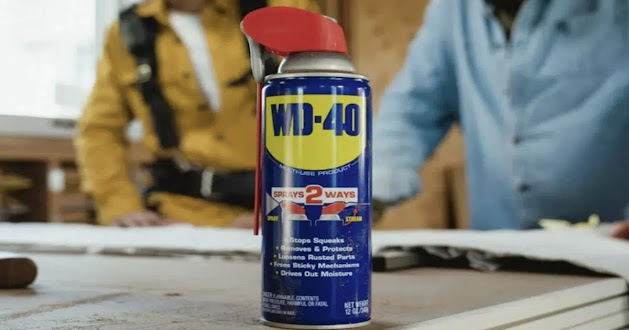
It sits in garages, workshops, toolboxes, and utility closets around the world. When a bolt won’t move, a metal part is covered in grime, or moisture needs to be displaced, many people instinctively reach for that familiar blue-and-yellow can.
But despite its popularity, there’s one surprisingly common question:
What does “WD-40” actually mean?
The answer goes back to the 1950s, the early aerospace industry, and a small company in San Diego trying to solve a very specific engineering problem.
And yes—the number 40 really does mean something.
What Does WD-40 Stand For?
According to the history published by the manufacturer, WD-40 stands for “Water Displacement, 40th Formula.”
The name essentially describes how the product was developed.
In 1953, a small company called the Rocket Chemical Company was working to develop a substance that could prevent corrosion by displacing water from metal surfaces.
The team reportedly went through numerous formulations before finding the one they wanted.
The successful formulation was recorded as the 40th formula.
Hence:
WD = Water Displacement
40 = 40th Formula
A technical development note eventually became one of the most recognizable product names in the world.
It Wasn’t Originally Created for Squeaky Hinges
Today, many people think of WD-40 primarily as a household maintenance product.
That wasn’t its original purpose.
The formula was developed as a water-displacing and corrosion-prevention product for industrial applications.
One famous early use involved aerospace contractor Convair, which used the product in connection with the Atlas missile program to help protect components from rust and corrosion.
This was during the 1950s, when the United States was rapidly developing missile and aerospace technology.
So that can sitting beside your hammer and screwdrivers has roots in the early American aerospace era.
How Did It End Up in People’s Homes?
There’s a fun part of the company’s history that helps explain the transition.
Workers reportedly began taking the product home because they discovered it was useful for all sorts of everyday jobs.
That suggested something important:
The product wasn’t useful only in industrial environments.
Consumers might want it too.
WD-40 was eventually packaged in aerosol cans and sold for household use, beginning a transformation from specialized industrial formula to familiar garage staple.
The Company Eventually Took the Product’s Name
The product became so successful that the business behind it eventually changed its name.
Rocket Chemical Company became WD-40 Company in 1969.
That’s an impressive reversal: instead of simply putting the company name on the product, the product became famous enough to give its name to the company.
Is WD-40 Actually a Lubricant?
This question causes endless debate.
The familiar WD-40 Multi-Use Product can provide lubrication, but describing it simply as “a lubricant” doesn’t capture everything it does.
Its traditional uses include:
- Displacing moisture
- Helping protect metal against corrosion
- Penetrating stuck components
- Lubricating moving parts
- Loosening certain grime and residue
However, that doesn’t mean it’s automatically the ideal long-term lubricant for every mechanical application.
Some equipment requires a specific grease, oil, silicone lubricant, or other specialized product.
Always follow the equipment manufacturer’s recommendations.
What Can WD-40 Be Used For?
The classic Multi-Use Product has numerous practical applications when used according to its label.
Loosening Stuck Metal Parts
A corroded nut, bolt, or other metal component may become easier to loosen after an appropriate penetrating product is applied.
For heavily seized components, however, a dedicated penetrating oil or professional assistance may sometimes be more appropriate.
Displacing Moisture
This is closely connected to the product’s original purpose.
Its ability to displace moisture from surfaces is literally where the “WD” in the name comes from.
Protecting Metal Surfaces
Applied appropriately, it can leave a protective layer that helps defend metal against moisture and corrosion.
Lubricating Certain Moving Parts
It can reduce friction in some light-duty applications.
For equipment requiring sustained or specialized lubrication, use the lubricant specified by the manufacturer.
Removing Certain Sticky Residues
WD-40 is also commonly used to help loosen some adhesives and sticky residue.
But always test it on an inconspicuous area first because it may affect certain finishes or materials.
Where Should You NOT Spray It?
The idea that WD-40 can be sprayed on practically anything is one myth worth abandoning.
Different materials and mechanisms have different requirements.
Don’t automatically use it on:
- Braking surfaces
- Surfaces where reduced friction could create a hazard
- Sensitive electronics unless a product is specifically intended for that application
- Food-contact surfaces without following appropriate cleaning instructions
- Materials that may react with petroleum-based products
- Equipment requiring a specialized lubricant
If you’re unsure, consult the product label and the equipment manufacturer’s instructions.
Don’t Spray It Near Flames or High Heat
WD-40 aerosol products require appropriate handling.
Aerosol contents and propellants can be flammable, so the product should be kept away from flames, sparks, ignition sources, and inappropriate heat.
Use it with adequate ventilation and follow all warnings printed on the container.
Never puncture, burn, or deliberately heat an aerosol can.
What About Electrical Equipment?
This is another area where internet advice can become dangerously oversimplified.
Although the product is famous for displacing moisture, that doesn’t mean you should casually spray the standard formula into energized electrical equipment.
Disconnect power first and use only products appropriate for the specific application.
Electrical repairs should be handled according to manufacturer instructions and appropriate safety practices.
Is the Formula Really Secret?
The exact formulation of the classic product has long been treated as proprietary information.
Like many famous commercial formulas, its secrecy has become part of the brand’s mythology.
But you don’t need to know the exact recipe to understand what the product was designed to accomplish.
Its name already gives away the original mission:
Displace water and help protect metal.
Was WD-40 Really a “Cold War Invention”?
Broadly speaking, it was developed during the Cold War era and became associated with aerospace and missile applications.
But calling it a “Cold War miracle” can exaggerate the story.
WD-40 wasn’t invented as a secret weapon or mysterious military technology. It was developed commercially to solve the practical engineering problem of protecting metal from water and corrosion.
Its connection to the Atlas missile program simply became one particularly memorable chapter in its early history.
Why Has WD-40 Lasted So Long?
Part of the answer is versatility.
Instead of solving only one highly specialized problem, the product proved useful for many everyday maintenance tasks.
There’s also something unusually memorable about its name.
“Water Displacement, 40th Formula” sounds like a laboratory note that accidentally escaped into the consumer world.
And that’s essentially what happened.
More than seven decades later, those letters and numbers are still printed on cans around the world.
The Bottom Line
The mystery behind WD-40’s name has a surprisingly simple answer:
WD-40 means “Water Displacement, 40th Formula.”
It was developed in 1953 by the Rocket Chemical Company as a solution for preventing corrosion and displacing water from metal surfaces. Its early industrial history included use connected with the Atlas missile program before the product eventually found its way into homes and workshops.
So the next time you’re staring at that blue-and-yellow can, remember:
The WD describes the problem its inventors wanted to solve.
And the 40 is a reminder that sometimes the solution doesn’t arrive on the first try.
More Blog
- Drinking Water on an Empty Stomach — What Science Actually Supports (No Hype, Just Facts)
- Waking Up Between 3 and 5 AM? It Might Be Your Soul Trying to Talk to You
- What a “Bleach” Patch on Your Underwear Really Means — And Why It’s Actually a Good Sign
- This Drink May Weaken Your Bones From The Inside — But Everyone Drinks It Anyway