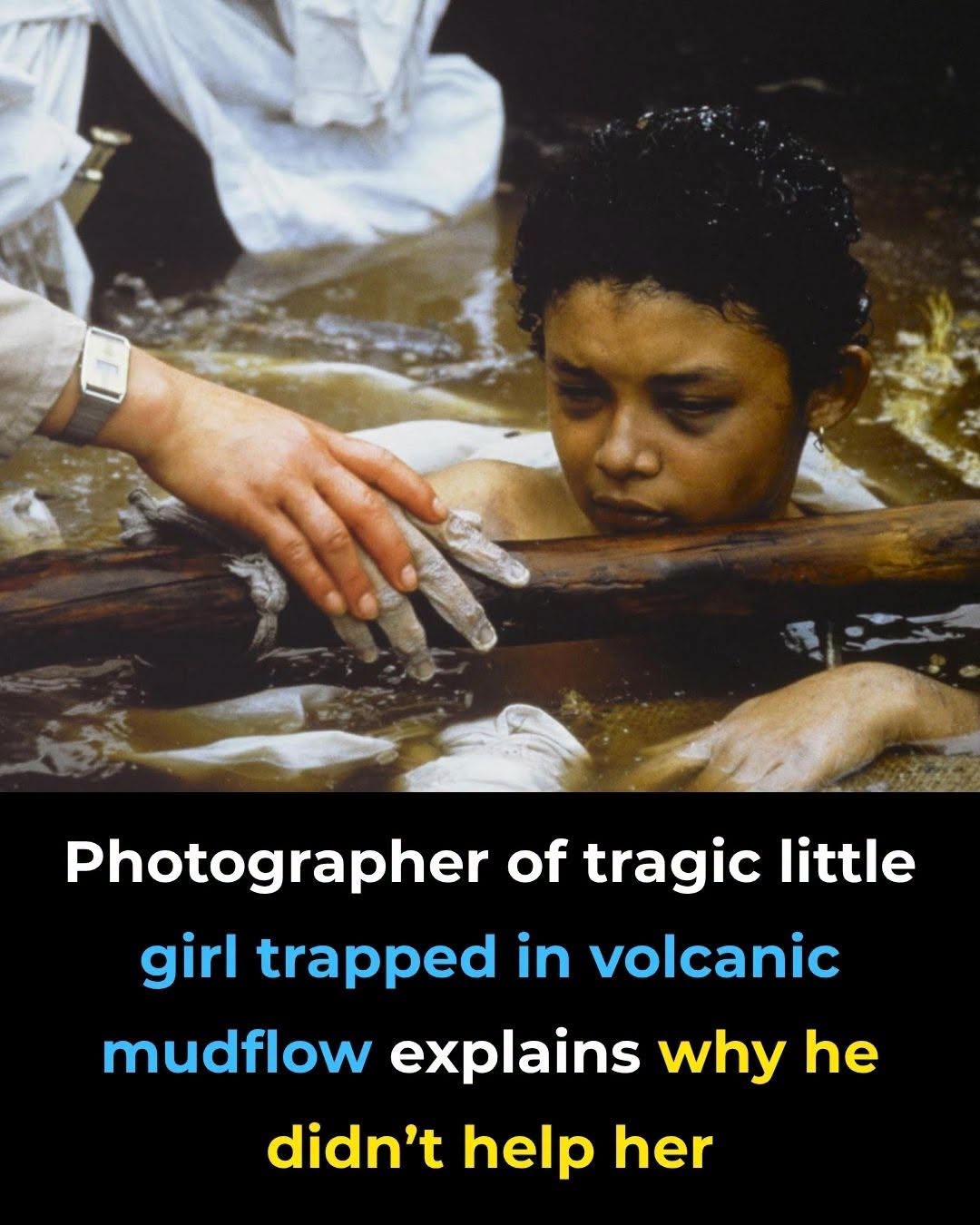
Photographer of tragic little girl trapped in volcanic mudflow explains why he didn’t help her is a headline that still raises a painful question decades after one of the worst volcanic disasters of the 20th century.
On November 13, 1985, Colombia’s Nevado del Ruiz volcano erupted. The eruption itself was relatively modest compared with some historic volcanic events, yet it generated devastating lahars, or volcanic mudflows, after hot volcanic material interacted with snow and ice near the summit. Those lahars rushed down river valleys and overwhelmed communities below, including the town of Armero. More than 20,000 people died in Armero, while the total regional death toll reached roughly 25,000.
Among the victims was 13-year-old Omayra Sánchez. Trapped in debris for days, she became the human face of the catastrophe after French photographer Frank Fournier photographed her during the rescue effort.
The resulting image became one of the most haunting photographs in modern photojournalism. Yet it also generated a question that followed Fournier for years: Why did he photograph the girl instead of saving her?
The answer reveals that the situation on the ground was far more complicated than a single photograph could show.
I first encountered Omayra Sánchez’s story through the famous photograph, and my immediate reaction was the same question many people have asked: Why didn’t someone simply pull her out? Only after learning about the destruction surrounding her did I understand how misleading a single frozen image can become. The camera showed one girl and several people nearby, but it could not show the massive wreckage beneath the water, the collapsed structures, the lack of specialized equipment, or the thousands of other victims needing help. That realization changed how I viewed the photograph. It became less about one photographer’s choice and more about the terrible limits rescuers faced during an overwhelming disaster.
The Disaster That Destroyed Armero
A relatively small eruption created a deadly chain reaction
Nevado del Ruiz rises high in Colombia’s Andes and carries ice and glaciers near its summit. That combination made the volcano particularly dangerous.
When the volcano erupted on November 13, 1985, hot volcanic material interacted with the ice. Meltwater mixed with ash, rock, soil, and debris, creating fast-moving lahars.
These flows traveled through river channels toward populated areas below.
Armero lay directly in the path of one of the most destructive flows.
The town had tens of thousands of residents, and many people were still inside their homes when the mud arrived. Darkness, poor communication, and insufficient evacuation compounded the disaster.
Within a remarkably short period, enormous sections of Armero disappeared beneath thick mud and debris.
Homes collapsed.
Roads vanished.
Buildings broke apart.
People became trapped beneath walls, roofs, vehicles, trees, and layers of mud.
According to U.S. Geological Survey accounts, lahars from the eruption traveled extraordinary distances through river valleys. More than 20,000 people died in Armero alone, and thousands more suffered injuries or died elsewhere in the affected region.
Photographer of tragic little girl trapped in volcanic mudflow explains why he didn’t help her therefore cannot be understood without this larger context.
Fournier did not arrive at an ordinary accident scene where one injured child waited beside an accessible road.
He entered the aftermath of a city-scale catastrophe.
Rescuers faced destroyed infrastructure, widespread flooding, unstable debris, deep mud, and an overwhelming number of people who needed help.
Additionally, the disaster had already disrupted transportation and communication.
Consequently, even when rescuers located survivors, reaching and freeing them could become extraordinarily difficult.
Warnings existed before the catastrophe
The scale of the loss became even more painful because scientists had already recognized the danger posed by Nevado del Ruiz.
Researchers had studied possible volcanic hazards, including lahars capable of reaching populated communities.
However, warnings did not translate into a successful evacuation before the eruption.
The U.S. Geological Survey later described the death toll as unnecessarily large because hazard warnings did not effectively reach residents in time.
That failure became one of the defining lessons of the Armero tragedy.
Volcano monitoring alone cannot protect communities.
Scientists can detect warning signs.
Experts can create hazard maps.
Officials can develop predictions.
However, communities also need communication systems, evacuation plans, transportation, public education, and officials willing to act quickly when evidence points toward danger.
After the disaster, the international volcanic-hazard community changed significantly. The tragedy directly contributed to the creation of the Volcano Disaster Assistance Program in 1986, an effort designed to help countries respond to dangerous volcanic unrest.
Therefore, Omayra’s story belongs to a much larger history.
She became the most recognizable individual victim, yet thousands of families experienced similar loss.
Entire neighborhoods disappeared.
Survivors lost parents, children, siblings, homes, and livelihoods in a single night.
The famous photograph captured one human face from an enormous catastrophe.
However, understanding what surrounded that face helps explain why saving her proved far more difficult than viewers might imagine.
Omayra Sánchez Became the Face of the Tragedy
Rescuers struggled to free the 13-year-old
Omayra Sánchez survived the initial destruction.
However, debris from her collapsed home trapped her body.
Rescuers could reach her upper body, speak with her, give her water, and remain nearby. Yet they could not simply lift her free.
Accounts from the scene described her legs as pinned beneath heavy wreckage.
Removing that material required resources that were not readily available.
At different points, rescuers reportedly considered several approaches. However, the unstable environment and the way debris trapped her made extraction extraordinarily dangerous.
The image seen around the world did not show what existed below the muddy water.
That limitation became central to later criticism.
People saw a young girl.
They saw adults standing nearby.
Therefore, the scene could appear deceptively simple.
Why not reach down and pull?
Why not carry her away?
Why keep taking photographs?
Yet the physical reality beneath the surface made those options impossible.
Photographer of tragic little girl trapped in volcanic mudflow explains why he didn’t help her becomes much easier to understand once the hidden part of the scene enters the picture.
Fournier was not preventing a rescue.
Rescuers were already present.
They had been trying to help.
The problem involved severe entrapment, inadequate equipment, and a disaster zone where resources had become painfully scarce.
Moreover, thousands of survivors needed assistance across a devastated region.
A single piece of specialized equipment could not instantly reach everyone.
Consequently, Omayra remained trapped while those around her searched for a way to free her.
Her ordeal continued for roughly three days.
During that time, cameras and television crews documented parts of what happened.
Those images would eventually travel around the world.
Her courage made the story unforgettable
One reason Omayra’s story remains so powerful involves the way she interacted with people around her.
Despite being trapped in unimaginable circumstances, she spoke with rescuers and journalists.
She displayed remarkable composure during much of the ordeal.
As time passed, however, her condition deteriorated.
Exhaustion and prolonged exposure took their toll.
The people surrounding her understood that the situation had become increasingly desperate.
Eventually, she died after spending around three days trapped in the disaster zone.
She was only 13.
The tragedy transformed her into an international symbol almost immediately.
However, reducing her memory to a famous photograph risks overlooking the person inside the image.
She was a child.
She had a family.
She had school, routines, relationships, plans, and an ordinary life before one night destroyed her town.
That human reality explains much of the photograph’s lasting emotional force.
Unlike an aerial photograph of destroyed buildings, Fournier’s portrait made the catastrophe personal.
Thousands of deaths can become difficult for people far away to comprehend.
Numbers become abstract.
One face does not.
Therefore, Omayra came to represent an entire disaster for millions of people who had never visited Colombia.
The photograph forced viewers to confront what the death toll actually meant.
Every number represented a person.
Every destroyed home contained a story.
Every victim belonged to someone.
Why Frank Fournier Did Not Simply Rescue Her
The photographer arrived after rescuers were already trying
The most common criticism aimed at Fournier starts with a simple assumption.
If he stood close enough to photograph Omayra, he must have stood close enough to rescue her.
However, physical proximity did not solve the problem.
Fournier was a photographer, not the person controlling the rescue operation.
More importantly, Omayra’s entrapment required far more than somebody reaching toward her.
Rescuers had already been working around her.
The problem involved what held her beneath the water and debris.
A photographer could not remove massive wreckage with his hands.
He also could not create unavailable rescue equipment simply by putting down his camera.
That distinction matters.
People sometimes imagine journalists at disaster scenes as detached observers who choose photography instead of assistance.
In reality, circumstances vary greatly.
A journalist who encounters an injured person alone may face one kind of ethical decision.
A photographer who arrives where organized rescuers already struggle with an impossible extraction faces another.
Photographer of tragic little girl trapped in volcanic mudflow explains why he didn’t help her reflects that second situation.
Fournier later defended his decision to document Omayra because he believed the world needed to see what had happened.
He also rejected the suggestion that taking the photograph meant he did not care.
The emotional reaction generated by the image became part of its purpose.
People became angry.
People asked questions.
People donated.
People demanded explanations.
The photograph carried the disaster beyond Colombia and placed Omayra’s face in newspapers and magazines around the world.
Therefore, Fournier saw his role as connecting distant audiences with a catastrophe they might otherwise experience only through statistics.
The camera became a way to make the world pay attention
Photojournalism often carries a difficult responsibility.
Photographers document wars, famine, disasters, protests, accidents, and human suffering.
Sometimes their images become uncomfortable precisely because viewers wish somebody could stop what the photograph shows.
That discomfort creates an ethical tension.
Should the photographer document?
Should the photographer intervene?
Can the photographer do both?
The answer depends heavily on circumstances.
In Omayra’s case, rescuers had already surrounded her and had tried to solve the physical problem keeping her trapped.
Fournier could not personally provide the equipment needed to extract her.
However, he could document the consequences of the catastrophe.
His photograph did exactly that.
A distant volcanic disaster became immediate.
Readers could no longer think only about ash, geology, mudflows, and casualty totals.
They saw a child.
The image also intensified criticism surrounding disaster preparedness.
USGS historical accounts describe how warnings and hazard information failed to protect Armero’s population adequately.
Consequently, the photograph did more than document an individual tragedy.
It became part of a broader conversation about government responsibility, emergency planning, rescue resources, and how societies respond to scientific warnings.
That does not make the image easy to view.
It should not.
Photographs of real suffering demand care and context.
However, discomfort does not automatically make documentation unethical.
Sometimes documentation becomes the evidence that prevents tragedy from disappearing quietly.
What the Photograph Still Teaches Decades Later
Photojournalism can create accountability
Powerful photographs often survive long after the news event that produced them.
Most people forget daily headlines.
Images can remain.
That staying power gives documentary photography tremendous influence.
However, it also gives photographers serious responsibility.
They must consider dignity.
They must consider context.
They must avoid turning suffering into spectacle.
Most importantly, they must remember that the person inside a photograph remains a human being rather than simply a dramatic image.
Fournier’s photograph continues to generate debate because it sits directly inside these ethical questions.
Some viewers see documentation.
Others initially see helpless observation.
However, the history surrounding the image shows that rescue efforts were already underway and that Omayra’s physical entrapment could not be solved through one photographer’s intervention.
Therefore, the question changes.
Instead of asking only, “Why didn’t he help?” we can ask, “Why did the people trying to help lack what they needed?”
That question points toward systems rather than individuals.
Why did warnings fail?
Why had residents not evacuated?
Why did adequate equipment fail to reach the scene?
What can governments and emergency agencies learn from that failure?
Those questions remain relevant during modern disasters.
A hazard does not automatically become a catastrophe.
Preparation often determines the difference.
Clear warnings save lives.
Trustworthy communication saves lives.
Evacuation planning saves lives.
Emergency equipment saves lives.
Public understanding saves lives.
The Armero catastrophe ultimately influenced volcanic disaster preparedness far beyond Colombia, including the development of international assistance efforts designed to help countries monitor and respond to volcanic crises.
Omayra’s legacy reaches beyond one photograph
Omayra Sánchez became a symbol, but her story should never become entertainment.
She represents the enormous human cost of failed disaster preparation.
She also represents the courage of people caught in circumstances they never chose.
Decades later, visitors still remember Armero and the thousands who died there.
Scientific organizations continue to cite Nevado del Ruiz as a defining example of deadly lahar hazards.
USGS material describes the 1985 Nevado del Ruiz disaster as one of the deadliest volcanic events in modern history, with mudflows accounting for roughly 25,000 deaths.
That history matters because volcanic disasters remain possible.
Communities around ice-covered volcanoes still face lahar hazards.
Scientists can monitor activity and create detailed hazard maps.
However, those maps only protect people when officials and communities use them.
Therefore, Omayra’s legacy belongs not only to photojournalism.
It also belongs to disaster preparedness.
Her story asks communities to take warnings seriously.
It asks authorities to act before a crisis removes their options.
It asks journalists to document human suffering with dignity.
And it asks viewers to look beyond a single image before judging what the people inside that image could or could not do.
Photographer of tragic little girl trapped in volcanic mudflow explains why he didn’t help her sounds, at first, like a story about one man’s decision.
Ultimately, it tells a much larger story.
It tells us what happens when a natural hazard meets inadequate preparation.
It shows the limits of rescue once catastrophe has already arrived.
And it reminds us why documenting failure can sometimes become a form of public service.
Frequently Asked Questions
Who was the girl in the famous volcanic mudflow photograph?
The girl was Omayra Sánchez, a 13-year-old resident of Armero, Colombia. She became trapped in debris after lahars generated by the November 13, 1985, eruption of Nevado del Ruiz devastated the town.
Why couldn’t rescuers simply pull Omayra Sánchez out?
Heavy wreckage trapped her lower body beneath the muddy water. Therefore, pulling her upward was not a simple or safe option. Rescuers needed resources and specialized equipment that the overwhelmed disaster response could not provide effectively at the scene.
Why did photographer Frank Fournier take the photograph instead of helping?
Rescuers were already present and attempting to free Omayra. Fournier could not remove the wreckage that trapped her. He chose to document the situation because he believed showing the world what had happened could create awareness, accountability, and international response.
How many people died in the Nevado del Ruiz disaster?
Estimates vary slightly by source, but U.S. Geological Survey material places the overall death toll at roughly 25,000, with more than 20,000 people killed in Armero.
Did the Armero disaster change volcanic emergency planning?
Yes. The catastrophe became an important lesson in volcanic hazard communication and preparedness. It also contributed directly to the creation of the Volcano Disaster Assistance Program in 1986, which supports countries facing dangerous volcanic activity.
Conclusion
Photographer of tragic little girl trapped in volcanic mudflow explains why he didn’t help her continues to attract attention because the famous photograph appears to present an unbearable contradiction.
A child desperately needs help.
Adults stand nearby.
A photographer raises his camera.
From that single frame, the obvious question seems to be why nobody simply rescued her.
Yet the full story changes that interpretation.
Omayra Sánchez remained trapped beneath heavy wreckage after a catastrophic lahar destroyed much of Armero. Rescuers had already reached her, but reaching her was not the same as being able to free her. They faced unstable debris, destroyed infrastructure, inadequate resources, and a disaster that had affected thousands of people simultaneously.
Frank Fournier could not solve those physical problems by putting down his camera.
Instead, he documented what he saw.
The resulting photograph carried Omayra’s story around the world and transformed an enormous casualty figure into something painfully human.
It also forced people to confront larger failures.
Scientists had recognized volcanic hazards around Nevado del Ruiz, yet Armero still suffered catastrophic loss. Historical USGS accounts note that warnings failed to protect residents effectively, and the tragedy later influenced major improvements in international volcano-disaster response.
Omayra should therefore be remembered as much more than the subject of a famous photograph.
She was a 13-year-old girl whose final days revealed both extraordinary human courage and devastating institutional limitations.
The most useful question today is not simply why one photographer failed to rescue her.
It is how societies can prepare well enough that children never become trapped in the same impossible situation again.
WP Recipe Maker JSON Import Block
{
  "title": "Photographer of Tragic Little Girl Trapped in Volcanic Mudflow Explains Why He Didn’t Help Her",
  "summary": "A historical account of Omayra Sánchez, the 1985 Nevado del Ruiz disaster, photographer Frank Fournier, and the difficult rescue conditions behind one of photojournalism's most haunting images.",
  "notes": "This historical story explains the disaster context, the limitations rescuers faced, the role of photojournalism, and the lasting lessons of the Armero tragedy.",
  "ingredients_flat": [
    {
      "amount": "1",
      "unit": "",
      "name": "historical account of the 1985 Nevado del Ruiz eruption"
    },
    {
      "amount": "1",
      "unit": "",
      "name": "story of Omayra Sánchez"
    },
    {
      "amount": "1",
      "unit": "",
      "name": "account of Frank Fournier's photograph"
    },
    {
      "amount": "1",
      "unit": "",
      "name": "overview of the Armero rescue effort"
    },
    {
      "amount": "1",
      "unit": "",
      "name": "discussion of disaster preparedness"
    }
  ],
  "instructions_flat": [
    {
      "name": "Step 1",
      "text": "Explain how the November 13, 1985, eruption of Nevado del Ruiz generated deadly lahars that traveled toward communities below the volcano.",
      "summary": "",
      "image_url": ""
    },
    {
      "name": "Step 2",
      "text": "Describe how the lahars devastated Armero and caused one of the deadliest volcanic disasters of the 20th century.",
      "summary": "",
      "image_url": ""
    },
    {
      "name": "Step 3",
      "text": "Introduce 13-year-old Omayra Sánchez and explain how wreckage from the disaster trapped her.",
      "summary": "",
      "image_url": ""
    },
    {
      "name": "Step 4",
      "text": "Explain that rescuers could reach Omayra but could not safely free her from the heavy debris trapping her lower body.",
      "summary": "",
      "image_url": ""
    },
    {
      "name": "Step 5",
      "text": "Describe photographer Frank Fournier's arrival and explain why taking a photograph did not replace an available rescue that he could personally perform.",
      "summary": "",
      "image_url": ""
    },
    {
      "name": "Step 6",
      "text": "Explain how the photograph drew international attention to Omayra, the Armero disaster, and failures in emergency preparedness.",
      "summary": "",
      "image_url": ""
    },
    {
      "name": "Step 7",
      "text": "Connect the tragedy with later improvements in volcanic hazard communication and international disaster response.",
      "summary": "",
      "image_url": ""
    }
  ],
  "equipment": [
    {
      "name": "Historical photographs",
      "notes": ""
    },
    {
      "name": "Volcanic hazard maps",
      "notes": ""
    },
    {
      "name": "Archived disaster reports",
      "notes": ""
    }
  ],
  "nutrition": {
    "calories": "0",
    "carbohydrates": "0 g",
    "protein": "0 g",
    "fat": "0 g",
    "saturated_fat": "0 g",
    "polyunsaturated_fat": "0 g",
    "monounsaturated_fat": "0 g",
    "trans_fat": "0 g",
    "cholesterol": "0 mg",
    "sodium": "0 mg",
    "potassium": "0 mg",
    "fiber": "0 g",
    "sugar": "0 g",
    "vitamin_a": "0%",
    "vitamin_c": "0%",
    "calcium": "0%",
    "iron": "0%"
  },
  "tags": {
    "course": [
      "Historical Story"
    ],
    "cuisine": [
      "World History"
    ],
    "keyword": [
      "Photographer of tragic little girl trapped in volcanic mudflow explains why he didn’t help her",
      "Omayra Sánchez",
      "Frank Fournier",
      "Armero tragedy",
      "Nevado del Ruiz",
      "volcanic mudflow"
    ]
  }
}
SEO Output
Focus Keyword
Photographer of tragic little girl trapped in volcanic mudflow explains why he didn’t help her
SEO Title
Photographer of Tragic Little Girl Trapped in Volcanic Mudflow Explains Why
Meta Description
Photographer of tragic little girl trapped in volcanic mudflow explains why he couldn’t save Omayra Sánchez during the devastating Armero disaster.
Expert SEO Title
Photographer of Tragic Little Girl Reveals 7 Haunting Truths
Midjourney Prompt
Respectful historical documentary scene inspired by the 1985 Armero volcanic disaster in Colombia, young teenage girl visible from the shoulders upward while trapped in muddy floodwater and non-graphic debris, rescue workers nearby attempting to help, documentary photographer standing at a respectful distance holding a professional film camera, devastated town and misty volcanic landscape in the background, somber human expressions, historically inspired 1980s clothing and equipment, absolutely no gore, no graphic injuries, emotional but dignified visual storytelling, realistic photojournalism, cinematic natural overcast lighting, vertical composition, clean visual hierarchy, generous negative space at the top for text overlay suitable for Pinterest pins, realistic food photography level of sharpness and professional editorial detail –v 6 –ar 2:3
More Blog
- Drinking Water on an Empty Stomach — What Science Actually Supports (No Hype, Just Facts)
- Waking Up Between 3 and 5 AM? It Might Be Your Soul Trying to Talk to You
- What a “Bleach” Patch on Your Underwear Really Means — And Why It’s Actually a Good Sign
- This Drink May Weaken Your Bones From The Inside — But Everyone Drinks It Anyway