Step-by-Step Guide to Reading the Sky
Birds can give us fascinating clues about changing weather, but they aren’t a substitute for an actual forecast. Their behavior can be influenced by wind, insects, temperature, pressure, and many other factors.
Still, watching these patterns can be a wonderful way to become more observant of the natural world.
Step 1: Watch Where the Birds Are Flying
One of the most noticeable behaviors before unsettled weather is a change in the height of insect-eating birds.
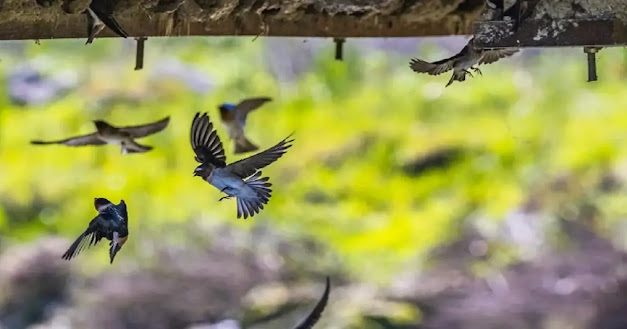
Swallows, swifts, and other aerial insectivores may sometimes fly lower when insects are flying lower. Before or during changing weather, shifts in air pressure, humidity, wind, and temperature can affect where insects are found.
And when the insects move, the birds often follow.
So when you see swallows suddenly swooping closer to the ground, you may be witnessing a change in the entire food chain—not a bird consciously “predicting” rain.
Step 2: Look at the Insects
The birds aren’t the only creatures worth watching.
Flying insects are highly sensitive to atmospheric conditions. Changes in temperature, humidity, wind, and air pressure can affect their activity and altitude.
If you notice birds feeding unusually close to the ground, look carefully. You may discover that they’re following an abundance of insects concentrated in that particular layer of air.
Nature is interconnected in wonderfully practical ways.
Step 3: Pay Attention to Wind Direction
A sudden change in wind can be one of the more useful visual clues that weather is changing.
Watch trees, grasses, flags, and clouds. If the wind becomes noticeably stronger or shifts direction, a weather system may be approaching.
Birds respond to these changes too. Strong winds can make soaring and long-distance flight more difficult, so some species may seek shelter or alter their normal flight patterns.
Step 4: Watch the Clouds
Don’t rely on birds alone.
Cloud development can provide a much more direct clue about changing conditions. Growing towers of dark, vertically developed clouds can indicate increasingly unstable air and the possibility of thunderstorms.
A rapidly darkening sky, strengthening winds, distant thunder, and falling atmospheric pressure together provide much stronger evidence of approaching unsettled weather than bird behavior by itself.
Step 5: Compare What You See With the Forecast
This is where modern technology and old-fashioned observation can work beautifully together.
Check your local weather forecast, radar, or weather warnings while observing what is happening outside.
If the forecast calls for thunderstorms and you notice birds changing their feeding patterns, stronger winds arriving, and towering clouds developing, the observations can add an interesting layer to what the instruments are already telling you.
But if the forecast says clear skies and a flock of birds happens to fly low across your yard, don’t assume a storm is guaranteed.
Step 6: Keep a Nature Journal
If you’re genuinely curious about whether local bird behavior corresponds with weather changes, try keeping a simple record.
Write down:
- The date and time
- Which birds you observed
- How high they were flying
- Wind conditions
- Cloud cover
- Temperature, if available
- Whether rain or storms followed
- How much time passed before the weather changed
After several weeks or months, you may begin noticing patterns specific to your area.
That’s much more reliable than relying on a single observation.
Do Birds Really Know a Storm Is Coming?
In a sense, birds can detect environmental changes that humans may not notice immediately.
Research has suggested that some birds can respond to atmospheric pressure and other environmental signals associated with approaching weather systems. Some species may even alter their behavior before severe weather arrives.
But that doesn’t mean birds possess a magical ability to forecast tomorrow’s weather.
Their behavior is a response to environmental conditions—not a conscious prediction of the future.
That’s an important distinction.
Why the “Low-Flying Birds Mean Rain” Saying Sometimes Works
There’s actually a simple ecological explanation.
Many birds feed on flying insects. When atmospheric conditions change, insects may fly at different heights. Birds following those insects can consequently appear to fly unusually low.
So the old saying isn’t completely baseless.
It’s simply more complicated than:
“Birds fly low, therefore rain is coming.”
A better interpretation is:
“Changes in atmospheric conditions can influence insects, birds, and weather at the same time.”
That is arguably even more fascinating.
Other Natural Clues Worth Watching
Birds are only one part of the backyard weather story.
You might also notice:
Changes in insect activity: Mosquitoes, flies, and other insects can alter their behavior as temperature, wind, and humidity change.
Animals seeking shelter: Some animals may become less active or move toward protected areas before severe weather.
Rapidly changing clouds: Fast-growing storm clouds can be a particularly useful visual warning.
Sudden temperature changes: A noticeable drop in temperature can accompany an approaching storm or front.
Increasing wind: Stronger and shifting winds can signal that a weather system is moving closer.
None of these signs should be treated as a guaranteed forecast individually. Together, however, they can make a backyard walk surprisingly informative.
Nature Is a Clue, Not a Forecast
There is something wonderfully humbling about realizing that birds, insects, trees, and clouds are constantly responding to changes in the atmosphere around us.
We don’t need to turn every unusual behavior into a prediction.
Sometimes it’s enough simply to notice.
The next time you see swallows skimming low across a field, pause for a moment. Look at the insects they’re chasing. Feel the wind on your face. Notice the clouds gathering overhead.
Then check the radar.
You might discover that nature was telling part of the story all along.
The Bottom Line
Birds don’t have a magical weather forecast hidden in their feathers. But they are remarkably responsive to their environment.
When conditions change, insects move differently. Birds respond to the insects. Wind affects flight. Temperature and pressure influence behavior. Clouds reveal developing atmospheric instability.
All of these pieces fit together.
So, yes, low-flying birds can sometimes accompany approaching rain—but they’re best viewed as one interesting clue among many, rather than a guaranteed prediction.
And perhaps that’s the most beautiful lesson of all: you don’t need to be a meteorologist to become more connected to the weather.
Sometimes you simply need to step outside, slow down, and pay attention.
More Blog
- Drinking Water on an Empty Stomach — What Science Actually Supports (No Hype, Just Facts)
- Waking Up Between 3 and 5 AM? It Might Be Your Soul Trying to Talk to You
- What a “Bleach” Patch on Your Underwear Really Means — And Why It’s Actually a Good Sign
- This Drink May Weaken Your Bones From The Inside — But Everyone Drinks It Anyway