My neighbor borrowed everything from me – until she damaged the one thing I treasured most. What started as ordinary neighborly generosity slowly turned into a pattern I should have addressed much sooner.
When Denise first moved next door, I liked her immediately. She was friendly, easy to talk to, and always ready to chat over the fence. We helped each other with small things, and lending her an item now and then felt completely normal.
At first, she borrowed a ladder. Then she needed my pressure washer. After that came a cooler, crock pot, steamer, and roasting pan.
Every request sounded harmless.
“I’ll bring it back really quickly,” she would say.
However, “quickly” often meant a week or two. Sometimes an item appeared on my porch without a word. It might come back dirty, greasy, or missing a small part. Still, I kept overlooking it because I did not want an argument with someone who lived next door.
Looking back, that was the real beginning of the problem. I thought being easygoing would protect our relationship. Instead, my silence slowly created resentment. Each missing lid or dirty appliance felt too small to confront on its own, so I kept telling myself to let it go. Then Denise asked for something completely different: my mother’s old stand mixer. That request forced me to recognize the difference between being generous and ignoring my own boundaries.
The mixer was not simply kitchen equipment.
It carried decades of memories.
And when it came back damaged, everything changed.
Why I Finally Said Yes to Something I Never Wanted to Lend
The Mixer Meant Far More Than Its Dollar Value
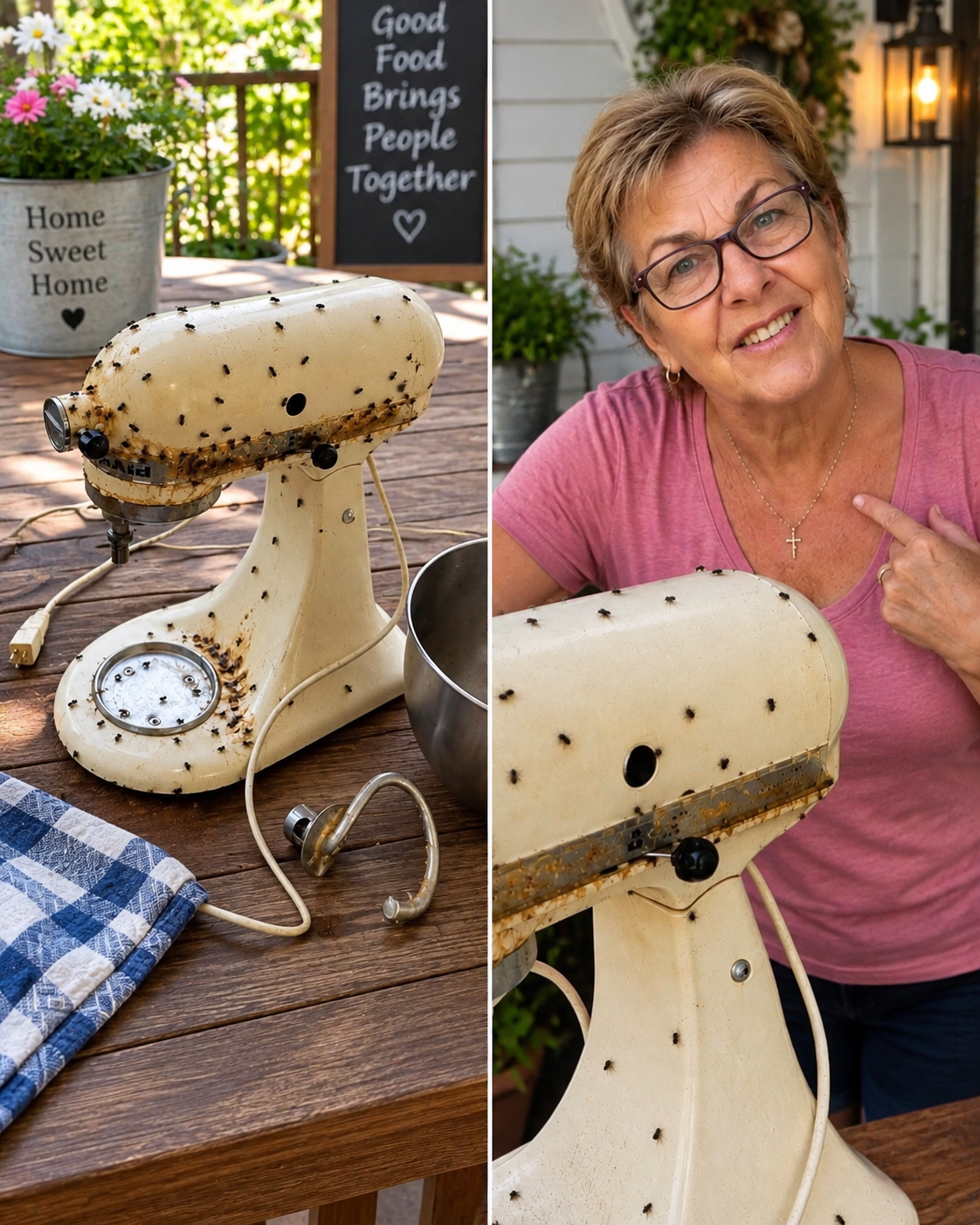
The stand mixer was a cream-colored KitchenAid my mother had bought in 1989.
It was not a pristine collector’s item. It had scratches along the side, a small chip near the base, and a finish that had faded with age.
However, I would not have traded it for a brand-new one.
My mother used that mixer throughout my childhood. I remembered hearing its motor on Sunday mornings while she baked. I remembered sitting at the kitchen counter and waiting for her to hand me a beater covered with chocolate batter.
I remembered the smell of cake filling the house.
After my mother died, I kept the mixer.
Suddenly, every scratch had meaning. The tiny chip that once looked like ordinary wear became part of a history I could still touch.
That is why I answered immediately when Denise asked to borrow it.
“No. I’m sorry, but I don’t lend that one out.”
I explained why.
I told her it had belonged to my mother and mattered deeply to me.
At that point, I expected the conversation to end.
Instead, Denise kept asking.
She said she only needed it for a few hours. Then she promised she would be incredibly careful. She explained that buying another mixer for one baking project seemed wasteful.
I still did not want to lend it.
Nevertheless, after several minutes of pressure, I gave in.
That decision bothered me almost immediately.
I had already given a clear answer. Yet I allowed another person’s persistence to turn my “no” into a reluctant “yes.”
The First Boundary Was the One I Should Have Kept
Before anything went wrong, Denise already knew that the mixer was different.
I had told her directly.
That detail mattered later because the damage was not simply about an appliance breaking. It was about ignoring the importance I had clearly placed on it.
Still, I cannot put the entire responsibility for the situation on Denise.
I had said no, and then I abandoned my own boundary.
That became one of the hardest lessons from the experience.
People often imagine that boundaries depend on getting others to understand or agree with them. However, a boundary loses its meaning when I refuse to enforce it myself.
I did not need Denise to believe the mixer was special.
I only needed to decide that it was not available to borrow.
Instead, I began negotiating with myself.
Maybe I was being too protective.
Maybe nothing would happen.
Maybe refusing would make things awkward between neighbors.
Those thoughts eventually overpowered the answer I had already given.
So I handed over the mixer and told Denise I needed it back Saturday.
She smiled and promised I would not regret it.
Saturday came.
Then Saturday afternoon disappeared.
By evening, I still had not heard from her.
Finally, I noticed the mixer sitting outside on my porch.
She had not knocked.
She had not sent a message.
She had simply left it there.
The moment I picked it up, I knew something had gone wrong.
What Happened When the Mixer Came Back Damaged
A Familiar Sound Was Replaced by Grinding
The mixer looked terrible.
Dried frosting covered parts of the bowl and whisk. Sticky residue had hardened around the cord. Batter clung to the base.
I cleaned it carefully.
Then I plugged it in.
I expected the familiar motor sound I remembered from my mother’s kitchen.
Instead, the mixer made an ugly grinding noise.
The motor struggled.
Then it stopped.
I tried turning it on again.
Nothing happened.
My stomach sank.
The next Monday, I carried the mixer to a local repair shop. The technician examined the machine and tested the motor.
He told me the motor had been seriously overheated.
According to his assessment, the machine appeared to have been overloaded and then kept running while the motor struggled.
That information changed the situation for me.
This was not simply an old appliance reaching the end of its life.
The mixer had survived decades of use.
Now, after one weekend away, it needed a major repair.
The estimate came to $347.
From a purely financial perspective, spending that much on an old mixer may not have made sense.
However, the calculation meant nothing to me.
I did not want a newer machine.
I wanted my mother’s mixer.
So I agreed to the repair.
Then I contacted Denise and explained what the technician had found.
I sent her the estimate.
I expected an apology.
Instead, she said she would not pay $347 for a mixer from the 1980s and suggested that I replace it.
Her Response Hurt More Than the Repair Bill
The $347 bothered me.
However, Denise’s reaction bothered me more.
I reminded her that I had originally refused to lend the mixer. I also reminded her that I had specifically explained its sentimental importance.
She responded that she had not realized it was “that fragile.”
That sentence stayed with me.
The mixer was not fragile.
It had worked for decades.
The bigger problem was that Denise apparently kept using it after it began struggling.
Eventually, I paid the repair bill myself.
I did not want a neighborhood war. I did not want shouting, threats, or months of hostility every time we passed each other outside.
Still, something had changed permanently.
Until then, I had treated Denise’s borrowing habits as a collection of small inconveniences.
A late return.
A dirty appliance.
A missing accessory.
I had handled each incident separately and quietly.
Now I saw the pattern.
Every time something came back in poor condition, I fixed the problem myself. Every time she returned an item late, I said nothing. Every time a small part disappeared, I decided it was easier to forget about it.
Without meaning to, I had taught her that borrowing my belongings came with almost no expectations.
That realization mattered because it gave me something useful to change.
I could not undo the mixer damage.
However, I could stop repeating the same pattern.
A few days later, Denise knocked on my door again.
She needed several items for a graduation party.
This time, I was ready.
How a $350 Deposit Changed Our Entire Relationship
I Replaced Resentment With Clear Rules
Denise wanted my cooler, crock pot, and folding tables.
Under the old arrangement, I probably would have handed everything over while privately worrying about when or how it would come back.
Instead, I went inside and returned with a clipboard.
On it was a simple lending agreement.
The terms were straightforward.
Anything Denise borrowed needed to come back on time, clean, completely dry, in the same condition, and with every part and accessory included.
Then she reached the final requirement.
A $350 refundable deposit.
She looked at me in disbelief.
“You’re charging me a deposit to borrow your stuff?”
“Yes.”
She called the idea ridiculous.
I stayed calm.
If she did not like the terms, she did not need to borrow anything.
That sentence felt completely different from the way I had handled the mixer.
I did not argue.
I did not overexplain.
I did not try to persuade her that my boundary was fair.
I simply gave her a choice.
She could accept the conditions or rent equipment somewhere else.
Denise decided to rent.
For a while, I assumed that ended the matter.
Then, on the day of her graduation party, she returned.
The rental company had delivered the wrong equipment.
The tables were too small, and the cooler could not hold what she needed.
The party was only hours away.
She wanted my things after all.
I looked at her.
She looked at me.
Finally, she agreed to sign the paper.
She handed over the $350 deposit.
I gave her the tables, cooler, and crock pot.
I even helped carry them next door.
Accountability Worked Better Than Anger
The next afternoon, Denise returned everything.
The tables were clean.
The cooler was dry.
The crock pot had been washed.
Nothing was missing.
Nothing was damaged.
Everything came back on time.
So I returned every dollar of her deposit.
Then something unexpected happened.
Denise apologized.
She admitted that she should have stopped using the mixer when it began struggling.
She said she should have called me.
Then she acknowledged something I had wanted to hear from the beginning.
She should have paid for the repair.
That apology did not erase what happened.
However, it changed the direction of our relationship.
I realized that the agreement had accomplished something anger probably would not have achieved.
The deposit created accountability before the problem occurred.
Instead of arguing afterward about what “careful” meant, we had agreed on the expectations in advance.
The boundary also removed much of my resentment.
I could help Denise without quietly wondering whether I would regret it.
Meanwhile, Denise understood that borrowing something came with responsibility.
The experience taught me that generosity works better when both people understand the terms.
Clear expectations do not automatically make a relationship cold or transactional.
Sometimes they protect the relationship from exactly the kind of resentment that vague expectations create.
What the Repaired Mixer Ultimately Taught Me
The Relationship Survived Because the Boundary Became Clear
There was no dramatic neighborhood feud.
Nobody shouted across the yard.
There were no angry online posts or neighbors choosing sides.
Instead, two adults eventually had the conversation they should have had much earlier.
Since then, Denise has borrowed things from me again.
However, the entire process feels different.
She asks clearly.
She tells me when she plans to return an item.
She takes better care of what she borrows.
And yes, she still signs the agreement.
The clipboard has even become something we occasionally joke about.
Still, the humor does not erase the reason it exists.
We both understand the boundary.
That understanding has actually made helping her easier.
Previously, I often said yes while feeling irritated underneath.
Now, if I agree to lend something, I know the expectations are clear.
If I do not want to lend something, I can simply say no.
That last part matters most.
The mixer taught me that kindness does not require automatic access to everything I own.
A person can be generous and still keep certain belongings private.
Likewise, saying no does not automatically mean rejecting someone.
Sometimes it simply means recognizing that an item, a commitment, or even your time carries a value that another person does not need to fully understand.
The important part is communicating that boundary clearly and then honoring it yourself.
The Mixer Came Home With One More Story
A few days after the repair, the technician called.
The mixer was ready.
I brought it home and set it on my kitchen counter.
For a moment, I hesitated before turning it on.
Then I flipped the switch.
The motor started.
That familiar sound filled the room.
Immediately, I thought of my mother.
I remembered Sunday baking.
I remembered chocolate cake.
I remembered sitting in the kitchen as a child.
That weekend, my daughter Sophie and I decided to make my mother’s chocolate cake.
We pulled out the old recipe and measured everything together.
Then I turned on the mixer.
Soon, the smell of chocolate filled the kitchen.
At that moment, I realized the mixer had gained another chapter.
It still represented my mother.
However, now it also reminded me of something I had learned much later in life.
Memories can survive damage.
Relationships can survive uncomfortable conversations.
And boundaries do not have to destroy kindness.
Sometimes boundaries preserve kindness by preventing generosity from turning into resentment.
I wish I had stood by my original answer when Denise first asked for the mixer.
I wish I had spoken up the first time something came back dirty or incomplete.
However, the experience changed how I handle those situations now.
I no longer believe being a good neighbor means making myself endlessly available.
Generosity is something I choose to give.
It is not something another person gets to demand.
Frequently Asked Questions
Was the neighbor wrong to keep asking after being told no?
The story shows that the narrator clearly said she did not lend out the mixer because it belonged to her mother and carried strong sentimental value. Denise continued asking until the narrator changed her answer. That persistence became an important reason the narrator later realized she needed firmer boundaries.
Why did the narrator pay the $347 repair bill herself?
She wanted the sentimental mixer repaired and did not want the disagreement to become a prolonged neighborhood feud. Although Denise refused to pay, the narrator valued restoring her mother’s mixer more than arguing over the cost.
Why was the refundable deposit $350?
The $350 deposit closely matched the $347 repair bill the narrator had just paid. It created financial accountability while still allowing Denise to get every dollar back when she returned the borrowed items clean, complete, undamaged, and on time.
Did the lending agreement ruin their friendship?
No. In the story, the opposite happened. Denise eventually followed the agreement, returned everything properly, apologized for damaging the mixer, and continued borrowing items under clearer expectations. Their relationship became healthier because both people understood the boundary.
What is the biggest lesson from the story?
The central lesson is that generosity and boundaries can exist together. Helping someone does not require giving that person unlimited access to your belongings. Clear expectations can reduce resentment and make future acts of kindness easier.
Conclusion
My neighbor borrowed everything from me – until she damaged the one thing I treasured most, and that experience changed how I thought about generosity.
For a long time, I assumed being a good neighbor meant overlooking inconveniences.
I ignored late returns.
I ignored missing pieces.
I ignored dirty appliances.
Eventually, I even ignored my own instinct when I said no to lending my mother’s mixer.
That was the mistake I regretted most.
The damaged mixer cost $347 to repair, but the larger lesson had little to do with money.
It taught me that a boundary only works when I respect it myself.
The $350 refundable deposit may have seemed excessive to Denise at first, yet it removed uncertainty from future borrowing. She knew exactly what I expected. I knew exactly what would happen if something came back damaged.
Most importantly, the boundary did not destroy our relationship.
It improved it.
Denise eventually apologized, returned future items carefully, and respected the new arrangement.
Meanwhile, the repaired mixer returned to my kitchen.
When I hear its familiar motor now, I still think of my mother and those Sunday baking memories. However, I also remember the lesson that came decades later.
You can be generous without allowing people to take advantage of your generosity.
You can care about someone while still protecting the things that matter to you.
And sometimes the kindest, clearest thing you can say is simply this:
“I’m happy to help, but this is my boundary.”
More Blog
- Drinking Water on an Empty Stomach — What Science Actually Supports (No Hype, Just Facts)
- Waking Up Between 3 and 5 AM? It Might Be Your Soul Trying to Talk to You
- What a “Bleach” Patch on Your Underwear Really Means — And Why It’s Actually a Good Sign
- This Drink May Weaken Your Bones From The Inside — But Everyone Drinks It Anyway