The difference between green onions, scallions, spring onions and chives can be confusing because all four look green, slender, and vaguely onion-like. At a glance, they may even seem interchangeable. However, their flavor, appearance, texture, maturity, and best culinary uses differ in important ways.
Green onions and scallions usually refer to almost the same thing in everyday cooking. Spring onions generally develop a larger bulb and stronger flavor. Chives, meanwhile, are a separate herb with much thinner leaves and a gentler onion taste.
Once you know what to look for, telling them apart becomes surprisingly easy.
I used to treat every bundle of thin green stalks in the produce section as basically the same ingredient. If a recipe asked for scallions, I bought green onions. If I saw chives, I assumed they were simply smaller green onions. That worked sometimes, but not always. A delicate potato dish tasted much stronger when I substituted green onion tops for chives, while a stir-fry felt underwhelming when I used too few chives instead of scallions. Learning to look at the bulb, leaf thickness, and flavor made shopping much easier. More importantly, it helped me understand why recipes choose one of these ingredients over another.
Difference Between Green Onions, Scallions, Spring Onions and Chives at a Glance
Green Onions and Scallions Are Usually the Closest Match
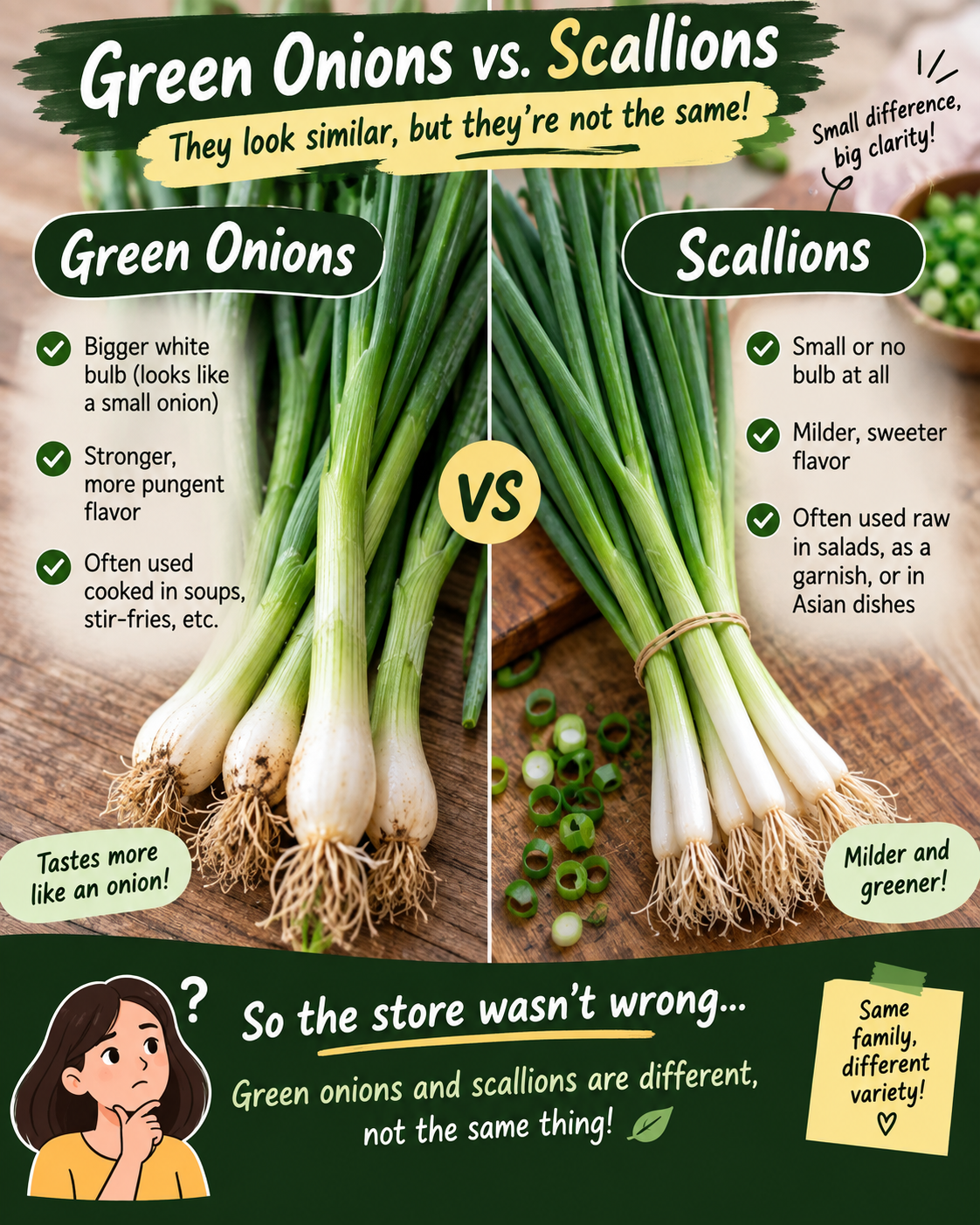
Green onions and scallions cause the most confusion because grocery stores and recipes often use the two names interchangeably.
Both usually describe young onions harvested before a large bulb develops.
They have long green leaves and a narrow white base. The bottom may widen slightly, but it usually does not form the obvious round bulb that you would see on a mature onion.
For everyday cooking, you can generally treat green onions and scallions as substitutes for each other.
Their flavor stays mild compared with fully mature onions.
However, the white and green parts taste slightly different.
The white section has a stronger, sharper onion flavor. Therefore, cooks often add it earlier during cooking with garlic, ginger, or other aromatics.
The green tops taste fresher and milder. As a result, they work well when added near the end or sprinkled over a finished dish.
You can use green onions and scallions in fried rice, soups, noodles, eggs, dips, stir-fries, salads, sauces, and many other savory foods.
Regional naming creates some of the confusion.
In one supermarket, a bundle may carry the label “green onions.” Another store may sell nearly identical produce as “scallions.”
Different onion varieties can also fall under these names.
Still, most home cooks do not need to worry about the botanical details.
If the plant has long green tops, a white base, and almost no rounded bulb, you can usually use it wherever a recipe calls for either green onions or scallions.
Spring Onions and Chives Look and Taste More Distinct
Spring onions differ because they usually grow longer before harvest.
That extra maturity allows them to form a more noticeable bulb.
The bulb may appear white, pale yellow, reddish, or slightly purple depending on the variety.
This visible bulb gives you one of the easiest ways to separate spring onions from scallions.
Spring onions also tend to taste stronger.
They still have a fresh onion quality, but the bulb provides more of the familiar flavor associated with mature onions.
Because of that, they work especially well for grilling, roasting, sautéing, pickling, or adding to soups and sauces.
Chives look very different once you compare them side by side.
Their leaves are extremely thin, tubular, and grass-like.
They usually lack the substantial white base found on green onions.
Chives also taste more delicate.
Rather than delivering a sharp onion bite, they add a mild, fresh note that works particularly well as a finishing herb.
You might sprinkle them over baked potatoes, eggs, soup, fish, cream cheese, dips, or sauces.
Because their flavor fades with prolonged heat, cooks often add chives just before serving.
Therefore, a simple visual rule works well.
If you see a noticeable bulb, think spring onion.
If you see very thin grass-like stems with no real bulb, think chives.
If you see thicker green leaves with a narrow white base, you are probably looking at green onions or scallions.
How Flavor and Texture Change the Way You Use Them
Green Onions and Spring Onions Handle Cooking Well
Green onions and scallions offer flexibility because different parts of the plant respond differently to heat.
The white section can tolerate cooking well.
For example, you can slice it and sauté it at the beginning of a stir-fry. Heat softens the texture and mellows its sharper onion flavor.
The green portion works differently.
Long cooking can reduce its fresh taste and bright appearance.
Therefore, many cooks add the green tops during the final minute of cooking or sprinkle them over the finished meal.
This two-part quality makes green onions especially useful.
One bunch can provide both an aromatic base and a fresh garnish.
Spring onions offer even more substance.
Their bulb behaves somewhat like a small onion.
You can cut it in half and grill it, roast it whole, sauté slices in a pan, or pickle it.
Meanwhile, the attached green tops can still function much like scallion greens.
Spring onions tend to provide a stronger flavor than scallions, although they remain fresher and often less intense than mature storage onions.
That makes them useful when you want noticeable onion flavor without overwhelming a dish.
Texture matters too.
Green onions offer crispness when raw, while cooked spring onion bulbs become tender and slightly sweet.
Therefore, choosing between them can depend as much on texture as flavor.
A fresh noodle bowl may benefit from crisp scallions.
A grilled vegetable plate may work better with spring onions.
Understanding these differences helps you use each ingredient intentionally rather than treating them as identical.
Chives Work Best When Their Delicate Flavor Can Stand Out
Chives behave more like an herb than a vegetable.
Their thin leaves have a gentle onion flavor that can disappear under intense heat.
Therefore, they shine when you add them late.
Sprinkle chopped chives over scrambled eggs just before serving.
Add them to sour cream or yogurt dips.
Mix them into softened cream cheese.
Use them on baked potatoes, soups, fish, or creamy sauces.
Because the flavor remains subtle, chives can complement rich foods without dominating them.
That makes them especially useful in dishes where strong raw onion might feel too aggressive.
Their texture also differs from green onions.
Chives feel finer and softer.
When chopped, they create tiny green pieces rather than crunchy rings.
This makes them attractive as a garnish.
However, chives do not always work as a direct replacement for scallions.
If a recipe needs crunch or a noticeable onion bite, chives may taste too mild.
Likewise, replacing chives with the white part of a green onion can make a delicate dish unexpectedly sharp.
Green onion tops offer the closest substitute because they are milder than the white portion.
Even then, use a little less at first and taste before adding more.
Garlic chives create another wrinkle.
Unlike common chives, garlic chives have flatter leaves and a more noticeable garlic flavor.
They appear often in Asian dishes, dumplings, noodles, and stir-fries.
Therefore, do not assume every ingredient labeled “chives” will taste exactly the same.
How to Choose the Right One at the Store
Look at the Bulb, Leaf Shape, and Thickness
The easiest way to identify these ingredients is to ignore the name for a moment and study the plant itself.
Start with the base.
Green onions and scallions usually have a narrow white bottom with little or no rounded bulb.
Spring onions usually have a visible bulb.
That bulb may look like a miniature regular onion attached to long green leaves.
Then check the leaves.
Green onion and scallion leaves look thicker and broader than chives.
They are hollow and sturdy enough to hold their shape.
Chives look much thinner and resemble fine green tubes or blades of grass.
Their overall appearance feels more delicate.
You can also use aroma as a clue.
Spring onions often smell stronger because of their greater maturity.
Green onions smell fresh and clearly onion-like.
Chives usually smell more delicate.
However, labels still help because regional terminology can vary.
Some markets use “spring onion” for plants that look almost identical to scallions.
Others make a clear distinction based on bulb development.
That is why physical appearance gives you more useful information than the printed name alone.
When shopping, also check freshness.
Choose green onions with crisp, upright leaves and firm white bases.
Avoid bunches with excessive sliminess, yellowing, or mushy areas.
Spring onion bulbs should feel firm rather than soft.
Chives should look bright and fresh instead of limp or dried at the ends.
Good quality improves both flavor and storage life.
Regional Names Can Make Simple Ingredients Seem More Complicated
Common plant names do not always follow universal rules.
That explains why two people can use the words scallion, green onion, and spring onion differently while both believe they are correct.
In many parts of the United States, “scallion” and “green onion” mean essentially the same thing.
In other regions, “spring onion” may refer to a young onion with a more developed bulb.
Elsewhere, the same term may describe something closer to a scallion.
Rather than getting stuck on terminology, focus on what the recipe actually needs.
Does it need a mild, fresh onion flavor?
Green onions or scallions will probably work.
Does it need a more substantial bulb that can be grilled or sautéed?
Look for spring onions.
Does it need a delicate herbal onion note at the end?
Choose chives.
This practical approach makes substitutions easier too.
If a recipe calls for scallions but your store only sells green onions, use them.
If you need spring onions but can only find green onions, they can still work, although the flavor may be milder and the bulb less substantial.
If a recipe calls for chives, green onion tops can sometimes substitute in a pinch, but chop them finely and use a smaller amount.
The goal does not need to be botanical perfection.
Instead, choose the ingredient that best matches the flavor, texture, and cooking method the dish requires.
Storage, Nutrition, and Smart Substitutions
Proper Storage Helps Keep Them Fresh Longer
Green onions, scallions, spring onions, and chives all benefit from refrigeration, but their delicate leaves can lose quality quickly.
For green onions and scallions, you have several storage options.
You can place them in a breathable produce bag or container in the refrigerator.
You can also wrap them loosely in paper towel to help manage moisture.
Some people place the root ends in a small amount of water, then store them upright.
Whatever method you use, avoid leaving the greens soaking wet.
Excess moisture can encourage sliminess and spoilage.
Spring onions can be stored similarly.
Because the bulb contains more moisture and structure, it may feel sturdier than a very young scallion, but the attached greens can still wilt.
Chives require gentler handling.
Their fine leaves dry out or become limp more quickly.
Wrap them loosely in a slightly damp paper towel or store them in a container that protects them from excessive moisture loss.
Use them relatively soon for the best flavor.
You can freeze all of these ingredients, although freezing changes texture.
Frozen scallions and chives work better in cooked dishes than in fresh garnishes.
Chop them first, freeze in small portions, and add them directly to soups, sauces, eggs, or stir-fries.
Freezing may eliminate their crispness, but it can help reduce food waste.
That is particularly useful when you buy a larger bunch than you can finish fresh.
They Add Flavor and Nutrients, but Variety Still Matters
All of these ingredients can contribute useful nutrients.
Depending on the type and serving size, they may provide vitamin K, vitamin C, folate, fiber, and various plant compounds.
As members of the Allium group, they also contain sulfur-containing compounds responsible for their characteristic aroma and flavor.
However, you usually eat them in relatively small amounts.
Therefore, they should complement a varied diet rather than serve as major nutritional staples by themselves.
Their real advantage often comes from flavor.
A small amount of green onion can make a simple bowl of rice, eggs, soup, or vegetables taste more interesting.
Chives can brighten a rich dish without requiring a heavy sauce.
Spring onions can add depth and sweetness after grilling or roasting.
This flavor contribution can make home cooking more enjoyable.
Some people experience digestive discomfort after eating onions and related Allium vegetables.
Symptoms can include gas, bloating, or abdominal discomfort.
People who are sensitive to certain fermentable carbohydrates may notice these effects more strongly.
Portion size can make a difference.
If large quantities cause discomfort, smaller amounts may feel easier to tolerate.
Ultimately, the difference between green onions, scallions, spring onions and chives matters most in the kitchen.
Each offers its own balance of flavor, texture, and intensity.
Frequently Asked Questions
Are green onions and scallions exactly the same?
In everyday cooking, green onions and scallions are usually treated as the same ingredient. Both generally describe young onions with long green tops and little bulb development. However, exact botanical varieties and regional naming can differ.
What is the easiest way to identify a spring onion?
Look at the base. A spring onion usually has a more obvious rounded bulb than a scallion or green onion. It also tends to have a slightly stronger onion flavor.
Can I substitute chives for green onions?
You can in some dishes, but the result will taste different. Chives are milder and more delicate. They work best when you need a subtle onion flavor, while green onions provide more crunch and intensity.
Which one is best for stir-fries?
Green onions or scallions usually work best. Cook the white portion early with other aromatics, then add the green tops toward the end for color and fresh flavor. Spring onions also work well when you want a stronger onion taste.
Which one is best as a garnish?
Chives work especially well as a delicate garnish because of their fine texture and mild flavor. Green onion tops also make an excellent garnish when you want a more noticeable onion taste and a little crunch.
Conclusion
The difference between green onions, scallions, spring onions and chives becomes much easier to understand once you stop relying only on their names.
Green onions and scallions are generally the closest match. They have long green leaves, a narrow white base, and little bulb development. In most recipes, you can substitute one for the other without much trouble.
Spring onions usually grow longer before harvest, so they develop a more noticeable bulb and stronger flavor. That makes them especially useful for grilling, roasting, sautéing, or using anywhere you want more onion character.
Chives stand apart as a delicate herb. Their thin, grass-like leaves and mild flavor make them ideal for garnishing potatoes, eggs, soups, dips, fish, and creamy dishes.
When shopping, focus on the bulb, leaf thickness, texture, and aroma instead of the label alone.
Once you understand those visual and flavor differences, choosing the right ingredient becomes simple.
Use green onions or scallions for freshness and versatility, spring onions for a stronger onion bite, and chives for a gentle finishing touch.
None is universally better than the others. Each simply brings something different to the kitchen.
More Blog
- Drinking Water on an Empty Stomach — What Science Actually Supports (No Hype, Just Facts)
- Waking Up Between 3 and 5 AM? It Might Be Your Soul Trying to Talk to You
- What a “Bleach” Patch on Your Underwear Really Means — And Why It’s Actually a Good Sign
- This Drink May Weaken Your Bones From The Inside — But Everyone Drinks It Anyway