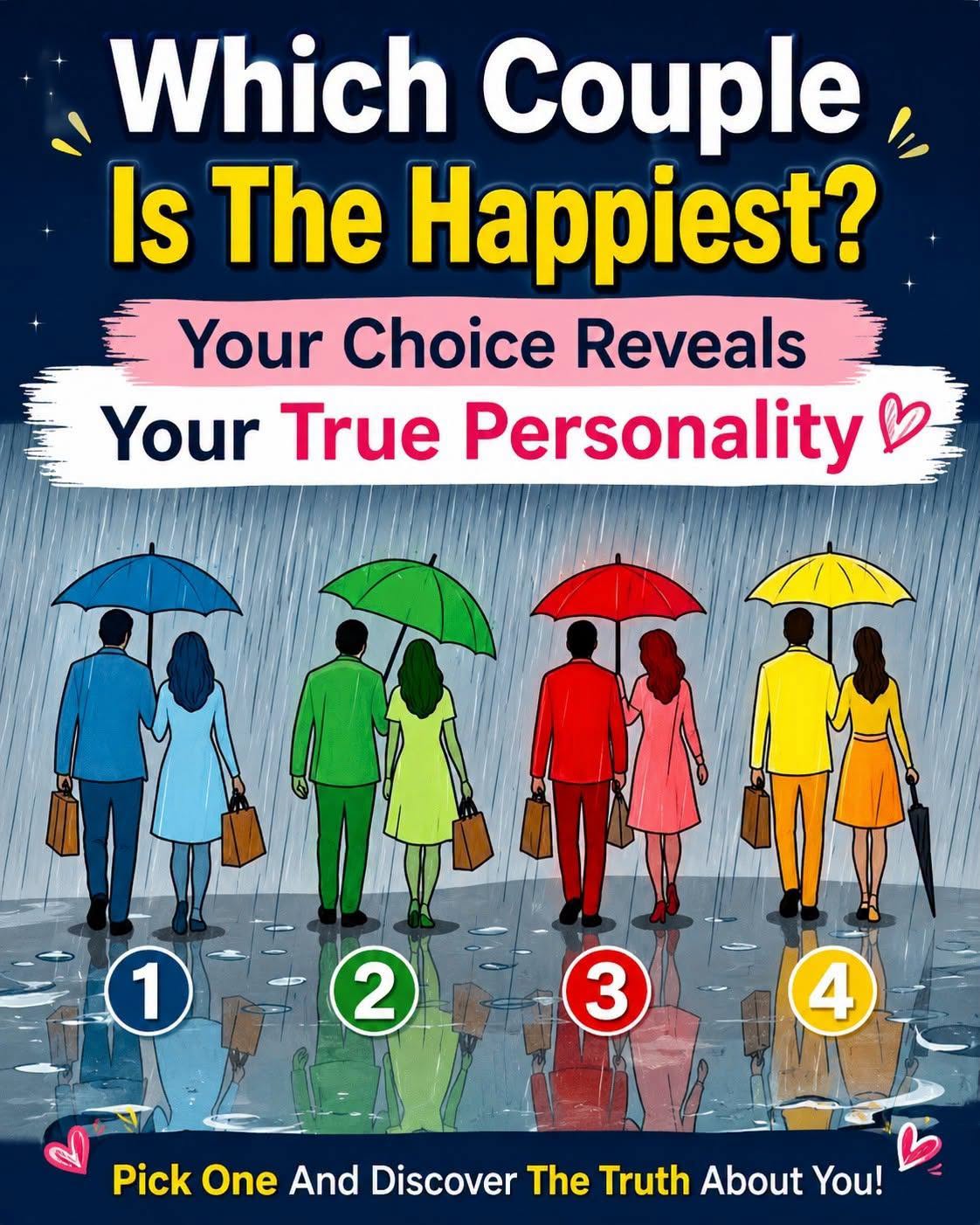
Which Couple Is the Happiest? At first glance, the question sounds simple. You see four couples sharing a rainy-day moment, and one pair immediately catches your attention. However, the reason behind that choice may be more interesting than the choice itself.
Visual personality quizzes have become popular because they invite us to make fast, instinctive decisions. Although a picture cannot scientifically diagnose your personality, your first reaction can encourage useful self-reflection. You may notice that you naturally respond to affection, security, excitement, independence, or some other relationship quality.
So, look at the four couples and choose the one that seems happiest to you. Try not to analyze every detail. Instead, notice which couple draws your attention first. Then, discover what that choice might suggest about the qualities you appreciate in relationships, friendships, and everyday life.
I once came across a similar picture while scrolling online during a rainy afternoon. I chose almost immediately, while a friend sitting nearby picked a completely different couple. We spent the next several minutes explaining why each pair looked happiest to us. Interestingly, neither of us focused on the same details. I noticed closeness and protection, while my friend noticed confidence and freedom. The picture obviously could not define either of us. Still, the conversation revealed how differently we viewed affection. Since then, I have enjoyed these visual quizzes less as personality tests and more as simple prompts for understanding personal values.
What Your First Impression Can Tell You
Why One Couple Stands Out Immediately
When you first see the image, your attention may move toward body language before you consciously consider why. Perhaps one partner seems especially attentive. Maybe another couple appears playful, relaxed, or independent. Therefore, your choice may reflect the signals you personally associate with happiness.
For example, someone who values emotional security may naturally notice a couple standing close together. Meanwhile, someone who values adventure may prefer a pair that appears energetic and carefree.
However, that does not mean your choice uncovers a hidden psychological truth. Instead, it can simply show which visual cues feel meaningful to you at that moment.
Context also matters. If you recently experienced a stressful situation, you might find calmness especially appealing. On the other hand, if life has felt repetitive lately, a more adventurous-looking couple may stand out.
Your mood can influence your response as well. Consequently, you might even choose differently if you see the same image another day.
That flexibility makes the question interesting. Which Couple Is the Happiest? may not have one permanent answer for you. Instead, your response can change as your priorities and experiences change.
The most useful part comes from asking yourself why you made your selection. Did you notice physical closeness? Shared laughter? Confidence? Independence? Protection?
Those details can reveal what happiness looks like through your eyes.
Why These Quizzes Feel So Personal
Visual quizzes feel personal because they encourage quick decisions. Usually, you do not have enough information to judge the people in the picture accurately. Therefore, your mind fills in the missing story.
One couple might appear deeply loyal to you, while someone else sees the same pair as cautious. Another couple might look spontaneous to one viewer but irresponsible to another.
As a result, the exercise often says more about interpretation than objective reality.
That is exactly why people enjoy comparing answers. Two people can look at the same four couples and create completely different stories about them.
Moreover, relationship happiness has no single appearance. Some couples express affection openly, while others communicate through quiet support. Some partners enjoy doing nearly everything together. Others feel happiest when both people maintain strong independence.
Therefore, the goal is not to identify the objectively happiest pair.
Instead, consider the image an invitation to explore the traits that attract your attention.
Which Couple Is the Happiest? becomes more meaningful when you replace the question with another one: What does happiness in a relationship look like to me?
Your answer may include trust, optimism, passion, freedom, humor, patience, stability, or a combination of several qualities.
Couple 1 and Couple 2: Stability Versus Optimism
Couple 1: Loyalty, Trust, and Dependability
If Couple 1 caught your attention first, you may place a high value on loyalty and emotional security. You likely appreciate people who remain consistent rather than disappearing when situations become difficult.
Reliability matters to you because actions often feel more meaningful than dramatic promises. Therefore, you may trust people gradually and pay attention to whether their behavior matches their words.
In relationships, you probably appreciate teamwork. You want both partners to feel supported, respected, and protected. Additionally, you may believe that strong relationships grow through everyday acts of care rather than occasional grand gestures.
Friends may also view you as dependable. When someone asks for help, you often try to show up. Likewise, you probably remember important details about the people closest to you.
However, valuing stability does not necessarily mean you dislike excitement. Instead, you may simply want a secure foundation before taking emotional risks.
You might also feel uncomfortable when people behave unpredictably. Because trust matters so much, inconsistency can bother you more than it bothers others.
Still, your strongest quality may be commitment. Once someone earns your trust, you tend to take that connection seriously.
If you selected this pair while asking Which Couple Is the Happiest?, you may associate happiness with knowing that someone will stand beside you through both easy and difficult moments.
For you, love may look less like constant excitement and more like dependable companionship.
Couple 2: Optimism, Hope, and Shared Adventure
If Couple 2 seemed happiest, you may naturally focus on possibilities. You probably appreciate relationships that feel encouraging, energetic, and forward-looking.
Rather than concentrating only on problems, you often look for solutions. Therefore, people may describe you as hopeful or motivating.
You may also enjoy shared experiences. Trips, spontaneous outings, new hobbies, and long conversations about future plans can strengthen your connections.
In addition, you probably value partners and friends who support personal growth. You do not want relationships to feel stagnant. Instead, you want people to inspire one another.
When setbacks happen, you may recover relatively quickly because you naturally search for the next opportunity. That attitude can help others feel hopeful as well.
However, optimism sometimes creates challenges. You might occasionally underestimate practical difficulties because you expect things to work out eventually. Consequently, balancing enthusiasm with realistic planning can help you turn ideas into lasting results.
Still, your ability to see possibilities remains a major strength.
If Couple 2 answered Which Couple Is the Happiest? for you, happiness may look like two people enjoying life’s journey together.
You may believe that the strongest partnerships involve laughter, encouragement, curiosity, and a willingness to explore unfamiliar experiences.
For you, a happy relationship does not simply provide comfort. Instead, it creates momentum.
Couple 3 and Couple 4: Passion Versus Independence
Couple 3: Emotion, Intensity, and Determination
If Couple 3 immediately stood out, you may experience emotions strongly. When you care about something, you rarely approach it halfway.
You probably become deeply invested in relationships, goals, interests, and creative projects. As a result, your enthusiasm can feel contagious.
People may appreciate your ability to commit fully. When someone matters to you, you want that person to know it.
Likewise, you probably value emotional honesty. Rather than pretending everything feels fine, you may prefer direct conversations about what people truly think and feel.
Passion can also influence your ambitions. Once you decide that something matters, you may pursue it with considerable determination.
However, intense emotions can sometimes encourage quick reactions. Therefore, giving yourself time before making major decisions may help you separate temporary feelings from long-term priorities.
Still, passion brings energy into relationships. You may dislike connections that feel distant, mechanical, or emotionally flat.
If Couple 3 seemed like the answer to Which Couple Is the Happiest?, you may associate happiness with emotional closeness and strong chemistry.
You probably want relationships to feel alive. Consequently, shared excitement, affection, and meaningful conversations may matter more to you than routine comfort alone.
You may also respect people who express themselves openly.
For you, happiness may involve giving your full heart rather than protecting yourself from every possible disappointment.
Couple 4: Freedom, Creativity, and Individuality
If Couple 4 captured your attention, you may place a strong value on personal freedom. You probably believe healthy relationships should bring people together without erasing their individuality.
You may enjoy exploring unfamiliar ideas, visiting new places, or changing routines simply because something different sounds interesting.
Likewise, you probably respect people who have their own goals, friendships, and interests.
You do not necessarily interpret independence as emotional distance. Instead, you may see it as confidence and mutual trust.
Therefore, overly restrictive relationships can feel uncomfortable. You want connection, but you also want room to grow.
Creativity may play an important role in your personality as well. You may enjoy approaching problems differently rather than automatically following tradition.
Because you adapt easily, unexpected changes may feel less threatening to you than they do to some people.
However, independence can sometimes create misunderstandings. People who need frequent reassurance may interpret your need for personal space incorrectly. Clear communication can therefore help both sides understand each other’s expectations.
If Couple 4 answered Which Couple Is the Happiest? for you, you may believe the strongest relationships allow both people to remain fully themselves.
Happiness, from your perspective, may involve choosing one another freely rather than depending on constant closeness.
You likely appreciate relationships built on trust, respect, flexibility, and personal growth.
What the Happiest Couple Question Really Reveals
Your Choice Reflects Values More Than Personality
The biggest mistake people make with visual personality quizzes involves treating them like psychological assessments.
A single picture cannot measure your complete personality. Furthermore, psychologists use carefully designed methods when evaluating personality traits, behavior, or mental health.
Therefore, nobody should use this quiz to make important conclusions about themselves or someone else.
Still, Which Couple Is the Happiest? can offer something useful.
Your answer may highlight the relationship quality you noticed first.
Perhaps Couple 1 reminded you of stability. Couple 2 might represent optimism. Couple 3 may symbolize passion, while Couple 4 suggests independence.
None of those qualities automatically makes one relationship happier than another.
In fact, healthy relationships usually include several of them.
Partners often need dependability during difficult periods. At the same time, optimism helps couples imagine a better future. Passion maintains emotional connection, while independence gives each person space to maintain individual interests and goals.
Therefore, the strongest takeaway comes from combining qualities rather than choosing one as superior.
You may also discover that your selection reflects what you currently want more of in your life.
For instance, someone surrounded by uncertainty may crave stability. Meanwhile, a person who feels restricted may notice freedom.
Consequently, your answer can become a useful starting point for reflection.
Instead of asking, “What does this prove about me?” ask, “Why did this quality catch my attention?”
That question often produces a much more meaningful answer.
What Happiness Actually Looks Like in Relationships
Real relationship happiness rarely looks exactly like a photograph.
A happy couple may laugh constantly in public, while another happy couple appears quiet. Likewise, one pair may love constant physical affection, while another prefers subtle gestures.
Happiness also changes throughout a relationship.
During stressful periods, happiness may mean supporting one another through responsibilities. During calmer times, it may involve travel, humor, hobbies, or simply relaxing together.
Therefore, body language in one frozen moment cannot tell the complete story.
Healthy relationships generally depend on communication, respect, trust, boundaries, and mutual effort. Additionally, both people need enough emotional safety to express needs and disagreements.
Conflict itself does not automatically signal unhappiness. Every close relationship experiences differences. Instead, the way people handle disagreements often matters more.
Likewise, independence does not signal weak commitment. Couples can remain deeply connected while maintaining separate interests.
Passion does not automatically guarantee stability either. Strong emotional chemistry can enrich a relationship, but lasting partnerships usually require practical cooperation as well.
So, when you ask Which Couple Is the Happiest?, remember that the image provides only a playful snapshot.
Still, your interpretation can reveal something interesting about your expectations.
You may discover that you prioritize loyalty, adventure, affection, personal space, or some balance between all four.
Ultimately, the best relationships usually allow partners to build their own version of happiness rather than copying someone else’s.
Frequently Asked Questions
Can a picture really reveal my personality?
No single picture can scientifically determine your personality. However, your interpretation may reflect preferences, current emotions, experiences, or qualities you value. Therefore, visual quizzes work best as entertainment and self-reflection rather than formal psychological evaluation.
What if I cannot decide which couple looks happiest?
That reaction can be meaningful too. You may appreciate several different qualities equally. For example, you could value Couple 1’s stability while also liking Couple 4’s independence. Real relationships often combine several characteristics, so choosing more than one does not create a problem.
Can my answer change over time?
Yes. Your answer can change because your priorities, relationships, experiences, and mood change. Someone who once valued excitement most may later appreciate stability more strongly. Therefore, choosing differently later does not mean your first answer was wrong.
Which couple actually has the healthiest relationship?
The picture does not provide enough information to answer that question. Body language can suggest certain emotions, but it cannot reveal communication habits, trust, respect, conflict resolution, or long-term compatibility. Consequently, no couple can objectively be declared healthiest based only on the image.
Why do people enjoy visual personality quizzes?
These quizzes provide quick, simple opportunities for self-reflection. They also create interesting conversations because different people interpret the same image differently. Additionally, comparing choices can help friends or partners discuss what they value in relationships without making the conversation feel overly serious.
Conclusion
Which Couple Is the Happiest? has no scientifically correct answer, and that is part of what makes the question entertaining.
If you chose Couple 1, you may admire loyalty and dependable support. If you picked Couple 2, optimism and shared adventure may attract you. Meanwhile, Couple 3 may appeal to people who appreciate passion and emotional intensity. Finally, Couple 4 may represent freedom, creativity, and individuality.
However, no single choice defines your personality.
Instead, your answer can offer a small opportunity to think about what happiness looks like to you.
Perhaps you want someone who always shows up. Maybe you prefer a relationship filled with laughter and discovery. You might crave emotional intensity, or you may believe love works best when both partners maintain independence.
Most fulfilling relationships combine several of these qualities.
Trust creates security. Optimism keeps partners moving forward. Passion deepens connection. Meanwhile, independence gives each person space to grow.
Therefore, rather than treating your choice as a fixed personality label, use it as a conversation starter.
Ask yourself what you noticed first and why it mattered.
Sometimes a simple picture cannot reveal who you are, but it can help you notice what you value.
More Blog
- Drinking Water on an Empty Stomach — What Science Actually Supports (No Hype, Just Facts)
- Waking Up Between 3 and 5 AM? It Might Be Your Soul Trying to Talk to You
- What a “Bleach” Patch on Your Underwear Really Means — And Why It’s Actually a Good Sign
- This Drink May Weaken Your Bones From The Inside — But Everyone Drinks It Anyway