Air travel occasionally produces unusual discoveries. A forgotten bag under a seat, an unfamiliar object in an overhead compartment, or a strange-looking food item can quickly become the subject of curiosity—and sometimes unnecessary alarm.
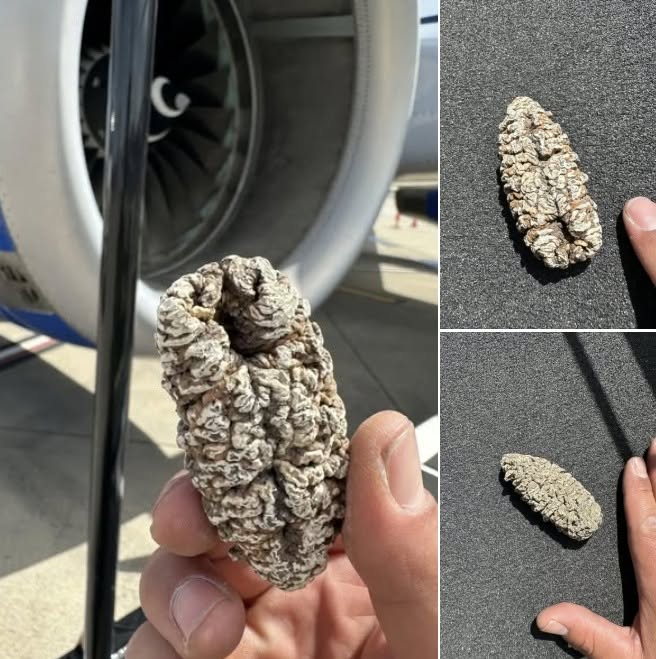
One particularly unusual object that travelers may encounter looks dark, wrinkled, hard, and almost prehistoric. At first glance, it can be difficult to determine whether it is a plant, an animal, or something else entirely.
One possible explanation is surprisingly simple: a dried sea cucumber, a traditional food consumed in several parts of the world.
What Is a Sea Cucumber?
Despite its name, a sea cucumber isn’t a vegetable.
It is a marine animal belonging to the echinoderm group, making it a relative of starfish and sea urchins. Thousands of species inhabit ocean floors around the world.
Fresh sea cucumbers generally have soft, elongated bodies. Once processed and dried, however, their appearance changes dramatically.
They can become extremely firm, shriveled, dark, and irregularly shaped—making them almost unrecognizable to someone unfamiliar with the product.
Why Would Someone Carry One on a Plane?
Dried sea cucumber is considered a valuable culinary ingredient in several cultures, particularly in parts of East and Southeast Asia.
Drying dramatically extends its shelf life, making the product easier to store and transport than fresh seafood.
Before cooking, dried sea cucumber generally requires extensive soaking and preparation to restore its softer texture.
Depending on the species, origin, and quality, certain varieties can also be expensive. That helps explain why someone might carefully transport dried sea cucumber while traveling rather than treating it like an ordinary grocery item.
Is Sea Cucumber Nutritious?
Sea cucumber provides protein while generally being relatively low in fat. It also contains various naturally occurring compounds that have attracted scientific interest.
However, descriptions of sea cucumber as a miraculous “superfood” should be treated cautiously.
Laboratory research has investigated compounds found in sea cucumbers, including triterpene glycosides and other bioactive substances. That does not establish that eating sea cucumber can prevent disease, eliminate inflammation, repair damaged tissue, or treat medical conditions in humans.
Traditional culinary or medicinal use and clinically proven medical treatment are not the same thing.
What About Collagen?
Sea cucumber tissues contain collagen, which is one reason the animal has attracted nutritional and biomedical research.
But eating a collagen-containing food doesn’t mean intact collagen travels directly to your skin or joints.
During digestion, proteins are largely broken down into smaller peptides and amino acids that the body can subsequently use in numerous ways.
Sea cucumber can therefore be viewed as an interesting protein-rich traditional food—not a guaranteed shortcut to younger skin or healthier joints.
There’s an Important Travel Issue
Finding an unfamiliar biological or food item on an aircraft doesn’t mean passengers should immediately handle or open it.
International transportation of animal products can be regulated because countries have rules intended to protect agriculture, ecosystems, wildlife, and public health.
Some sea cucumber species are also subject to conservation-related trade restrictions.
If an unidentified animal product is discovered aboard an aircraft, the appropriate response is simple: leave it where it is and inform the cabin crew. Airline, airport, customs, or biosecurity personnel can determine what it is and whether any action is necessary.
Why It Looks So Strange
The mystery mostly comes from dehydration.
Removing water dramatically changes biological tissues. Something that was once soft and flexible can become hard, lightweight, wrinkled, and considerably smaller.
Without knowing what the fresh animal looks like, most people would have little reason to identify the dried version correctly.
That is why photographs of dried sea cucumbers frequently generate guesses ranging from strange roots and fossils to unidentified marine creatures.
An Ancient Food in a Modern Setting
Perhaps the most interesting aspect of such a discovery isn’t how strange the object looks.
It’s the contrast.
A modern passenger jet represents some of the world’s most sophisticated transportation technology, yet inside someone’s luggage might be a food preserved using one of humanity’s oldest techniques: dehydration.
What initially appears mysterious can therefore have a surprisingly ordinary explanation.
Sometimes, the strange object discovered thousands of feet above the ground isn’t mysterious at all.
It may simply be someone’s dinner traveling home with them.
More Blog
- Drinking Water on an Empty Stomach — What Science Actually Supports (No Hype, Just Facts)
- Waking Up Between 3 and 5 AM? It Might Be Your Soul Trying to Talk to You
- What a “Bleach” Patch on Your Underwear Really Means — And Why It’s Actually a Good Sign
- This Drink May Weaken Your Bones From The Inside — But Everyone Drinks It Anyway