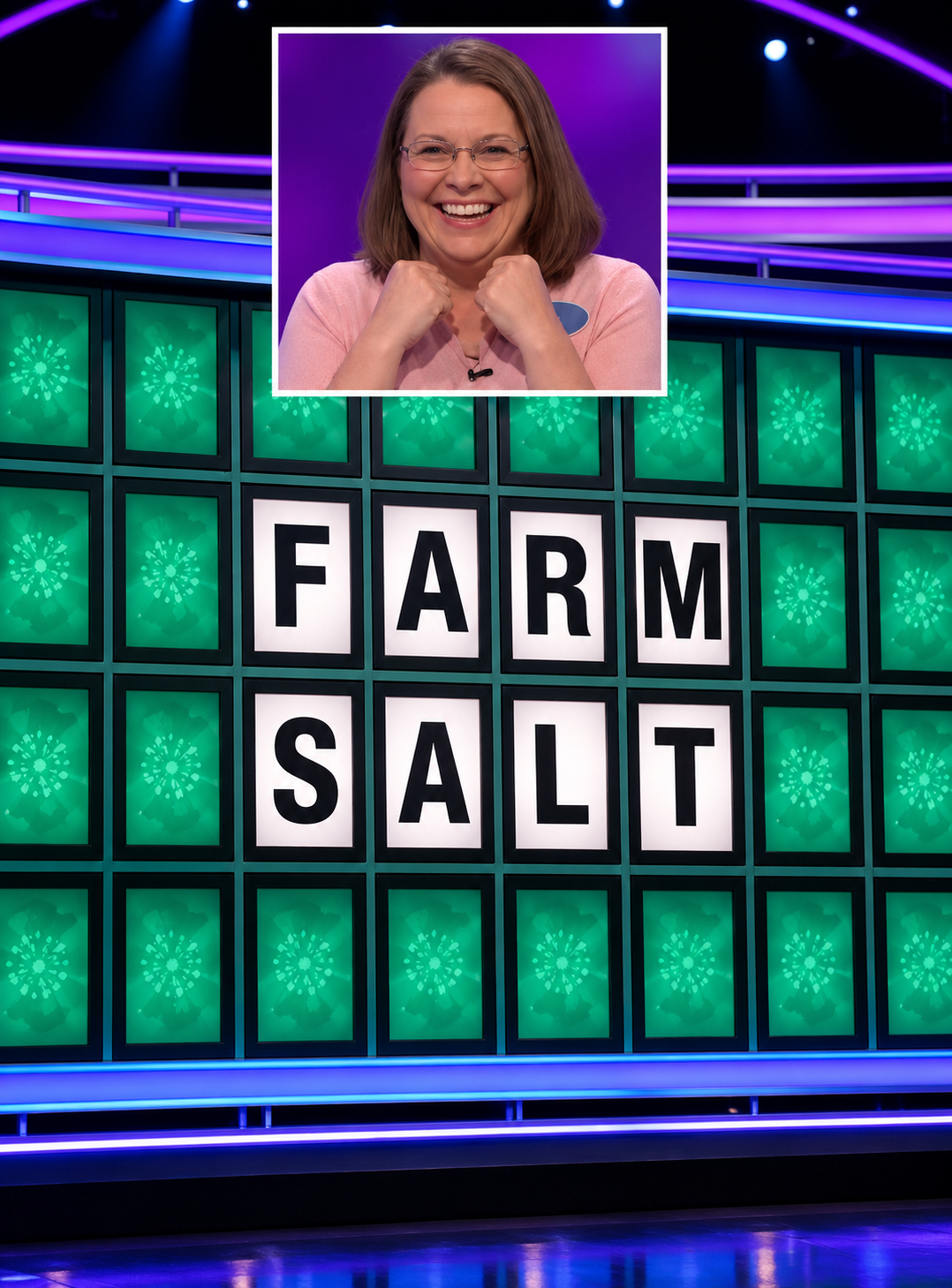
Wheel of Fortune Contestant Misses $40,000 After Final Puzzle Leaves Viewers Divided after Conner Kemmsies reached the Bonus Round and faced a deceptively ordinary final answer: “I DID MY HOMEWORK.”
From the comfort of home, the solution can look almost painfully obvious. However, a contestant onstage faces bright lights, cameras, an audience, a countdown clock, and a major prize hanging on every guess. In Conner’s case, he recognized “I DID MY,” yet “HOMEWORK” never arrived before the clock expired.
The missed solution cost him a chance at an additional $40,000. Still, he did not leave empty-handed. According to the account of the episode, Conner finished with $19,080 in cash and prizes.
However, the money quickly became only one part of the conversation. Some viewers questioned whether “I DID MY HOMEWORK” belonged in the “Phrase” category, while others argued that the category worked perfectly well. That disagreement transformed one difficult Bonus Round into a memorable game-show debate.
I remember watching a timed word puzzle with friends and feeling completely certain that I could solve it faster than the person on screen. Then someone paused the game and gave me a similar puzzle with only a few seconds to answer. Suddenly, every obvious word disappeared from my mind. I could see the letters and knew the answer should be simple, yet nothing connected. Once the timer stopped, the solution appeared instantly. That experience changed how I watch game shows. From the couch, viewers get comfort and distance. Contestants get pressure, noise, cameras, money, and seconds to think. Those conditions can make an ordinary answer surprisingly difficult.
Why the Final Wheel of Fortune Puzzle Became So Memorable
“I DID MY HOMEWORK” Looked Easy After the Reveal
The frustrating thing about many game-show puzzles is that the answer can seem effortless once someone reveals it.
Conner faced exactly that situation.
The Bonus Round answer was “I DID MY HOMEWORK.”
He reportedly recognized the beginning, “I DID MY,” which made the missing final word seem tantalizingly close.
However, the word “HOMEWORK” did not come to him before time expired.
Afterward, the complete answer looked natural.
People say “I did my homework” all the time. Therefore, viewers could easily wonder how the final word remained hidden.
Yet that reaction ignores an important difference between solving afterward and solving under pressure.
Once the show reveals “HOMEWORK,” your brain no longer needs to search through possible answers.
Instead, it simply recognizes a completed sentence.
Recognition and active retrieval feel very different.
During the Bonus Round, Conner needed to generate the missing word while a timer counted down.
Meanwhile, he had to process the available letters, understand the category, test possibilities, and speak guesses aloud.
The $40,000 prize added another layer of pressure.
Consequently, the final seconds carried far more mental weight than the same puzzle would carry on a living-room couch.
That contrast helps explain why Wheel of Fortune Contestant Misses $40,000 After Final Puzzle Leaves Viewers Divided became such a relatable story.
Almost everyone knows the feeling of remembering an obvious answer immediately after the moment when it mattered.
His Reaction Helped Turn Disappointment Into Entertainment
Missing $40,000 could easily create a painful television moment.
However, Conner reportedly responded with humor, which helped change the tone.
Rather than allowing the missed answer to define the entire experience negatively, his reaction gave viewers something lighter to remember.
That matters because game shows depend on more than correct answers.
Contestants create memorable television through personality, reactions, excitement, and sometimes mistakes.
A perfect performance can impress viewers.
However, an imperfect performance can become even more memorable when the contestant handles it well.
Conner still had a successful appearance.
He finished with $19,080 in cash and prizes, according to the episode account.
That amount represents a substantial win regardless of what happened during the final puzzle.
Still, the missed $40,000 naturally became the headline.
People tend to focus on what almost happened.
If a contestant wins $19,080 and leaves, that sounds successful.
If the same contestant comes within one word of another $40,000, the story suddenly feels dramatically different.
The outcome did not erase what he had already won.
Instead, it created a memorable “what if?”
That emotional combination—success, frustration, humor, and an obvious-looking answer—gave viewers several reasons to keep discussing the episode after it ended.
Why Solving a Puzzle on Television Feels Completely Different
Time Pressure Can Make Familiar Words Difficult to Retrieve
At home, viewers enjoy several advantages without realizing it.
You can sit comfortably.
Nobody points a camera at you.
Thousands of dollars do not depend on your next sentence.
You can quietly test answers without worrying about how you sound.
Most importantly, you experience the puzzle as entertainment.
A contestant experiences it as a high-stakes challenge.
That difference can affect thinking.
When the clock starts, every second suddenly matters.
A contestant may recognize part of an answer but become mentally locked onto the wrong possibilities.
For example, once Conner reached “I DID MY,” many words could theoretically follow.
“I did my best.”
“I did my part.”
“I did my research.”
“I did my job.”
“I did my homework.”
Although the visible letters would eliminate many options, the contestant still needs the correct connection to appear quickly.
The timer does not care whether the answer would arrive five seconds later.
That makes the story behind Wheel of Fortune Contestant Misses $40,000 After Final Puzzle Leaves Viewers Divided easier to understand.
The answer was not necessarily difficult because “homework” represents an unusual word.
Instead, the challenge came from retrieving the right ordinary word at exactly the right moment.
Anyone who has forgotten a familiar name during an introduction or lost a simple word during a presentation understands a smaller version of that experience.
Viewers Have the Advantage of Watching Without the Stakes
Television makes game-show solving look deceptively simple.
The camera presents the puzzle clearly.
Viewers focus directly on the board.
Meanwhile, they do not need to manage the physical experience of standing on a studio set.
That distance creates confidence.
A viewer may shout the correct answer at the television and wonder why the contestant cannot see it.
However, the viewer faces no consequences for being wrong.
You can make several silent guesses in quick succession.
Nobody records your mistakes.
You also know that the program expects a solution, so your attention remains entirely on finding it.
Contestants carry additional mental distractions.
They may think about the prize.
They may notice the audience.
They may become aware of the clock.
They may worry that their first guess sounded foolish.
Furthermore, reaching the Bonus Round already follows an entire episode of competition.
Therefore, the contestant arrives at the final challenge after making decisions, solving puzzles, and experiencing repeated bursts of excitement.
The phrase “I DID MY HOMEWORK” becomes much easier when you already know the answer.
That hindsight explains why online reactions to game-show misses can become harsh.
Viewers judge the contestant with information the contestant did not have at the critical moment.
Once the answer appears, uncertainty disappears.
Consequently, the puzzle suddenly feels much easier than it did seconds earlier.
Why Viewers Debated the “Phrase” Category
Some Thought the Answer Sounded More Like a Sentence
The final puzzle reportedly appeared under the category “Phrase.”
That classification became another source of discussion.
Some viewers apparently felt that “I DID MY HOMEWORK” sounded like an ordinary sentence rather than the kind of recognizable expression they expected from a category called “Phrase.”
That reaction is understandable.
When people hear “phrase,” they may imagine an expression such as “better late than never” or “once in a blue moon.”
Those examples carry familiar meanings beyond the literal words.
By comparison, “I did my homework” can simply describe an everyday action.
Therefore, some viewers felt the category gave the contestant less guidance than expected.
If you interpret “Phrase” as an idiomatic expression, you might search mentally for sayings and common expressions rather than straightforward sentences.
Under time pressure, even a subtle expectation can influence which words come to mind.
However, game-show categories do not always follow strict linguistic definitions.
A television puzzle category can use “Phrase” more broadly.
From that perspective, “I DID MY HOMEWORK” fits as a group of words that forms a familiar expression.
That disagreement explains why the puzzle became more interesting than a straightforward missed answer.
The debate moved beyond whether Conner should have solved it.
Instead, viewers started discussing what kind of answer the category should contain.
Others Felt the Category Was Completely Fair
The opposing argument is simple.
“I DID MY HOMEWORK” is a familiar phrase that people understand immediately.
Therefore, viewers who accept a broad definition of “Phrase” may see nothing unusual about the category.
From this perspective, the puzzle did not require specialized knowledge.
The contestant simply needed to connect the available letters before time expired.
This interpretation places the difficulty on the Bonus Round itself rather than the category.
That distinction matters.
A puzzle can be fair and still be difficult under pressure.
Likewise, an answer can seem obvious afterward without having been obvious during the countdown.
The Wheel of Fortune Contestant Misses $40,000 After Final Puzzle Leaves Viewers Divided discussion therefore has no single satisfying side for everyone.
If you expect “Phrase” to mean a well-known saying, the answer may feel unusual.
If you accept ordinary expressions and sentences within the category, the puzzle may seem perfectly reasonable.
Either way, the debate increased interest in the episode.
Without the category controversy, viewers might simply remember a contestant missing “HOMEWORK.”
With the disagreement, the moment became a question people could argue about themselves.
Would you have solved it?
Would you call it a phrase?
Would the category have helped you?
Those questions allow viewers to participate long after the episode ends.
What Conner’s $40,000 Miss Reveals About Game Shows
The Miss Did Not Erase His $19,080 Win
A dramatic headline can make it sound as though Conner walked away with nothing.
That was not the case.
According to the episode account, he finished with $19,080 in cash and prizes.
The additional $40,000 represented the Bonus Round opportunity he missed.
That distinction deserves attention.
Reaching the final round already meant Conner had performed successfully during the main game.
Therefore, the episode included a genuine achievement alongside the frustrating ending.
Yet people naturally focus on the missed opportunity because losses and near-misses create strong emotional reactions.
Imagine two contestants.
One wins $19,080 and never gets an opportunity for more.
Another wins the same amount but then sees $40,000 slip away because of one missing word.
Their final winnings could remain identical, yet the second story feels far more dramatic.
The difference comes from expectation.
For several seconds, the larger prize felt possible.
Then the opportunity disappeared.
That emotional swing helps explain why Wheel of Fortune Contestant Misses $40,000 After Final Puzzle Leaves Viewers Divided attracted attention.
However, looking at the complete outcome provides a more balanced picture.
Conner did not fail at the entire game.
He won thousands of dollars in cash and prizes and reached the Bonus Round.
Then one word stopped him from adding substantially more.
Both parts belong to the story.
Imperfect Moments Often Become the Most Memorable Television
Game shows create suspense because viewers know contestants can make mistakes.
If every person always solved every puzzle immediately, the experience would lose much of its tension.
Instead, viewers watch because outcomes remain uncertain.
Sometimes a contestant produces an astonishing solve.
Other times, someone misses an answer that appears easy.
Those moments invite viewers to imagine themselves onstage.
“I would have known that,” someone says.
Perhaps they would.
However, nobody can know exactly how they would react under the same conditions until they experience them.
That uncertainty forms part of the appeal.
Conner’s final puzzle also demonstrates how humor can change a disappointing moment.
A contestant who can laugh after losing a major prize may leave viewers with a positive impression even when the final result hurts.
The missed answer becomes a story rather than simply a failure.
Years later, someone may forget most puzzles from the episode while still remembering the contestant who could not connect “I DID MY” with “HOMEWORK.”
That does not diminish his earlier success.
Instead, it shows how television memory works.
The smooth moments often disappear.
The unexpected moments survive.
Frequently Asked Questions
What was Conner Kemmsies’ final Bonus Round answer?
The final answer in the account was “I DID MY HOMEWORK.” Conner reportedly recognized “I DID MY” but did not solve “HOMEWORK” before the timer expired.
How much did Conner Kemmsies win?
According to the supplied episode account, Conner finished with $19,080 in cash and prizes.
How much was the missed Bonus Round prize?
The potential additional Bonus Round prize was $40,000.
What category was the final puzzle?
The category was “Phrase,” which became part of the viewer debate surrounding the puzzle.
Why did viewers disagree about “I DID MY HOMEWORK”?
Some viewers thought it sounded more like an ordinary sentence than a traditional phrase. Others considered it a perfectly acceptable “Phrase” puzzle and viewed the miss as a result of Bonus Round pressure.
Conclusion
Wheel of Fortune Contestant Misses $40,000 After Final Puzzle Leaves Viewers Divided because the moment combined almost everything that makes a game show memorable.
There was a large prize.
There was a countdown.
There was an answer that seemed easy afterward.
And there was a category that gave viewers something extra to debate.
Conner Kemmsies reached the Bonus Round and reportedly recognized “I DID MY,” yet the final word “HOMEWORK” never came before time expired.
That missing word cost him the opportunity to add $40,000 to his winnings.
However, his appearance was still successful.
According to the account, Conner finished with $19,080 in cash and prizes.
His reaction also helped turn the missed opportunity into an entertaining television moment rather than a purely disappointing one.
Meanwhile, viewers continued debating the “Phrase” category.
Some considered “I DID MY HOMEWORK” too much like an everyday sentence.
Others saw nothing wrong with the classification.
That disagreement may never produce a universally satisfying answer.
However, it reveals why the moment attracted so much attention.
From home, solving looks easy.
Onstage, everything changes.
The lights feel brighter.
The seconds disappear faster.
The money feels real.
And sometimes the most familiar word becomes impossible to find until the moment after the buzzer sounds.
That is the painful—and entertaining—difference between knowing the answer once it appears and producing it when $40,000 depends on it.
More Blog
- Drinking Water on an Empty Stomach — What Science Actually Supports (No Hype, Just Facts)
- Waking Up Between 3 and 5 AM? It Might Be Your Soul Trying to Talk to You
- What a “Bleach” Patch on Your Underwear Really Means — And Why It’s Actually a Good Sign
- This Drink May Weaken Your Bones From The Inside — But Everyone Drinks It Anyway