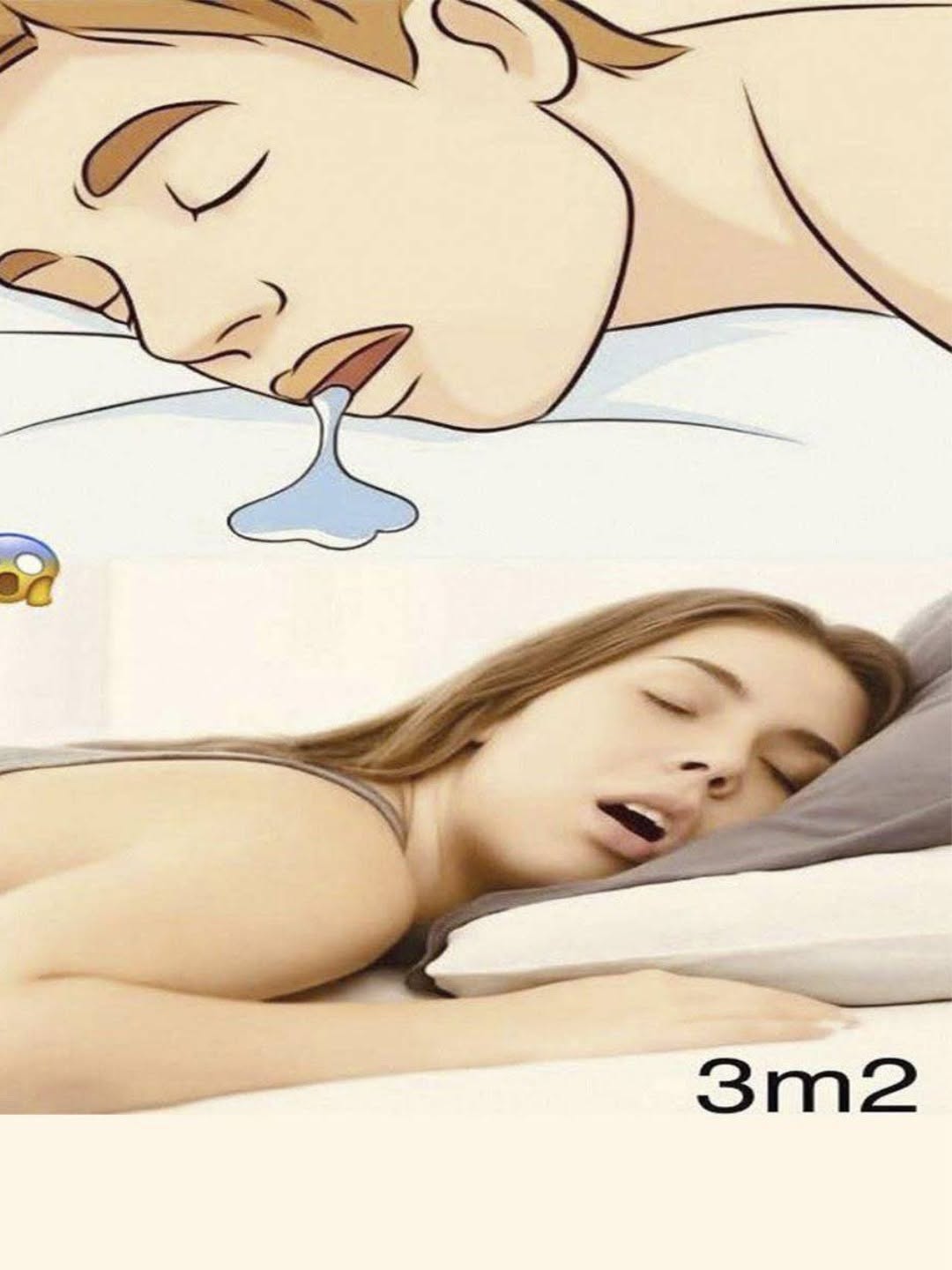
What Your Brain Says When You Drool in Your Sleep sounds mysterious, but the explanation usually comes down to ordinary sleep physiology. Your salivary glands continue making saliva while you sleep, your swallowing pattern changes, your facial and oral muscles relax, and your sleeping position can allow saliva to escape from your mouth.
Occasional nighttime drooling is common and usually does not signal poor hygiene, laziness, or a lack of bodily control. Cleveland Clinic notes that drooling commonly occurs during sleep and that side or stomach sleeping makes it more likely because gravity allows saliva to leave the mouth more easily.
However, drooling does not prove that you entered exceptionally deep sleep or that your brain achieved some special state. Several factors can contribute, including sleep position, nasal congestion, allergies, reflux, medications, excess saliva, and problems with swallowing or oral muscle control.
I remember waking one morning and finding a noticeable damp patch on the pillow after sleeping heavily through the night. At first, I assumed it meant I had slept unusually deeply. However, I eventually noticed a much simpler pattern: it happened more often whenever I slept on my side or had a stuffy nose. Once I paid attention to those details, the mystery disappeared. The experience became a useful reminder that our bodies keep managing breathing, swallowing, saliva, and muscle tone throughout sleep. A little drooling can simply reflect how those systems interact while the conscious mind rests.
What Your Brain and Body Do With Saliva During Sleep
Saliva never becomes unnecessary when you fall asleep. Your salivary glands continue supporting oral tissues, while your nervous system continues coordinating swallowing and breathing.
However, sleep changes muscle activity and behavior. You no longer consciously close your lips, reposition your jaw, or deliberately swallow when saliva collects.
That combination explains much of ordinary nighttime drooling.
Your Brain Still Coordinates Automatic Functions
During waking hours, you rarely think about swallowing saliva. Your nervous system coordinates that action automatically.
During sleep, your body continues managing essential automatic functions. However, sleep changes muscle tone and swallowing behavior. Therefore, saliva may remain in the mouth longer before you swallow it.
Drooling happens when saliva escapes instead.
MedlinePlus defines drooling simply as saliva flowing outside the mouth. It identifies three broad mechanisms: difficulty keeping saliva inside the mouth, difficulty swallowing it, or producing more saliva than usual.
That explanation matters because it corrects a common misconception surrounding What Your Brain Says When You Drool in Your Sleep.
The brain does not intentionally “switch off” saliva control because you have reached perfect sleep. Rather, normal sleep alters the balance among muscle tone, position, swallowing, and saliva movement.
For most healthy adults who drool occasionally, this process causes no serious problem.
However, frequent or severe drooling can tell a different story.
If saliva consistently escapes because swallowing has become difficult, for example, the underlying issue may require medical attention. Neurological disorders, medication effects, reflux, infections, and other health conditions can contribute to excessive drooling.
Therefore, context matters much more than the damp spot itself.
Your Sleep Position Can Make a Big Difference
Gravity strongly affects where saliva goes.
If you sleep on your back, gravity generally helps keep saliva inside your mouth and directs it toward the throat.
However, if you sleep on your side or stomach, saliva can move toward the corner of your mouth. If your lips relax or open slightly, it can reach the pillow.
Cleveland Clinic specifically identifies side and stomach sleeping as positions that increase the likelihood of nighttime drooling.
Consequently, occasional drooling may reveal more about your sleeping position than your brain health.
This pattern also explains why someone may suddenly notice drooling after changing pillows or sleeping positions.
For example, a new pillow may make side sleeping more comfortable. Likewise, an injury may encourage someone to avoid sleeping on their back.
Nasal congestion can influence position as well. When your nose feels blocked, you may breathe more through your mouth. An open mouth gives saliva a much easier path onto the pillow.
Therefore, What Your Brain Says When You Drool in Your Sleep often has a straightforward mechanical explanation.
You do not need to interpret every episode as a sign of abnormal health.
Instead, notice whether it happens occasionally, whether congestion accompanies it, and whether other sleep-related symptoms appear.
Common Reasons You May Drool While Sleeping
Nighttime drooling has many possible causes.
Some involve completely ordinary habits, while others involve temporary conditions such as allergies or sinus infections. A smaller number involve chronic medical problems.
Therefore, frequency and accompanying symptoms help determine whether drooling deserves closer attention.
Congestion, Allergies, and Reflux Can Contribute
A blocked nose can encourage mouth breathing.
Allergies, sinus infections, swollen nasal tissues, and other causes of congestion may therefore make nighttime drooling more likely.
Cleveland Clinic lists allergies and infections among conditions associated with drooling. It also identifies gastroesophageal reflux disease, or GERD, as another potential contributor.
MedlinePlus similarly lists allergies, heartburn or GERD, swollen adenoids, infections, and certain medicines among potential causes of excessive saliva or drooling.
Reflux can increase saliva production because saliva helps protect the mouth and esophagus from acid. Cleveland Clinic explains that GERD may stimulate salivary glands to release additional saliva in response to stomach acid entering the esophagus.
As a result, someone experiencing nighttime reflux may notice both extra saliva and drooling.
Temporary illness can also change the pattern.
Imagine that you usually sleep comfortably with your mouth closed. Then a cold blocks your nose for several nights. You begin mouth breathing, shift onto your side, and suddenly wake with saliva on your pillow.
That does not mean your brain abruptly changed.
Instead, congestion changed the mechanics of sleeping and breathing.
Therefore, when considering What Your Brain Says When You Drool in Your Sleep, look for temporary factors first.
Medications and Medical Conditions Can Also Play a Role
Some medications can increase saliva production.
Cleveland Clinic specifically notes that certain drugs, including some antipsychotic medicines, can cause hypersalivation.
Meanwhile, neurological conditions can interfere with effective swallowing or control of the muscles around the mouth.
MedlinePlus lists Parkinson disease, multiple sclerosis, stroke, cerebral palsy, amyotrophic lateral sclerosis, and several other neurological conditions among possible causes of drooling.
This does not mean nighttime drooling suggests one of these conditions in an otherwise healthy person.
In fact, occasional drooling during sleep remains common.
However, sudden severe drooling, especially when it occurs during waking hours as well, deserves a different level of attention.
Likewise, newly developing difficulty swallowing requires evaluation.
Severe chronic drooling can also create complications. Excess saliva may irritate the skin around the mouth, while swallowing problems can increase the risk of saliva entering the lungs in some people.
Therefore, distinguish a slightly damp pillow from persistent uncontrolled saliva loss.
The first often reflects ordinary sleep circumstances.
The second may indicate a problem that requires professional assessment.
Does Drooling Mean You Are Sleeping Deeply?
People frequently connect drooling with extremely deep or high-quality sleep.
The idea feels intuitive. After all, you may wake after sleeping heavily and discover saliva on your pillow.
However, evidence does not support using drooling as a reliable measure of sleep quality.
Drooling Is Not a Sleep-Quality Score
A person can drool while sleeping well.
A person can also drool while sleeping poorly.
Therefore, What Your Brain Says When You Drool in Your Sleep should not become a shortcut for judging whether you reached restorative deep sleep.
Sleep quality depends on far more meaningful factors, including sleep continuity, breathing, sleep stages, total sleep duration, and how rested you feel during the day.
Someone can spend eight hours in bed and still experience disrupted sleep because of repeated breathing problems.
Conversely, someone may occasionally drool after an otherwise uneventful night.
The presence or absence of saliva on a pillow cannot distinguish those situations.
This distinction becomes particularly important with sleep apnea.
Obstructive sleep apnea causes repeated narrowing or blockage of the airway during sleep. Common warning signs include loud snoring, observed pauses in breathing, gasping or choking during the night, morning headaches, dry mouth, and excessive daytime sleepiness.
Therefore, waking with evidence of mouth breathing or drooling should not reassure someone who also experiences those symptoms.
Drooling alone does not diagnose sleep apnea either.
Instead, pay attention to the complete pattern.
Mouth Breathing May Point Toward a Breathing Issue
Your nose normally provides an efficient route for breathing.
However, congestion or airway problems can encourage mouth breathing.
When the mouth remains open, saliva escapes more easily.
Therefore, frequent drooling combined with loud snoring can justify a closer look at nighttime breathing.
Sleep apnea causes repeated interruptions in breathing because the airway narrows or closes during sleep. Mayo Clinic explains that throat muscles relax, the airway narrows, and the brain briefly wakes the sleeper so breathing can resume. These episodes can repeat many times throughout the night.
Someone with sleep apnea may not remember those awakenings.
Therefore, a bed partner sometimes notices the problem first.
Warning signs include pauses in breathing, choking sounds, gasping, loud disruptive snoring, morning headaches, and severe daytime sleepiness.
If those symptoms accompany nighttime drooling, discussing them with a healthcare professional makes sense.
However, remember the distinction: drooling does not equal sleep apnea.
Likewise, drooling does not automatically equal deep sleep.
It simply tells you that saliva escaped the mouth while you slept.
When Nighttime Drooling Deserves More Attention
For many people, nighttime drooling needs no treatment.
However, a sudden or dramatic change can provide useful information.
The same principle applies when drooling starts interfering with sleep, causes skin problems, or appears alongside swallowing or neurological symptoms.
Signs That Make Medical Evaluation Worthwhile
Cleveland Clinic recommends medical attention when drooling becomes excessive or starts suddenly.
Persistent excess saliva also deserves evaluation because a clinician can investigate the underlying cause.
Pay particular attention when drooling occurs alongside difficulty swallowing.
Likewise, seek medical advice if you suddenly begin drooling while awake despite never having experienced that problem before.
Breathing symptoms matter as well.
If a partner notices repeated breathing pauses during sleep, or if you wake gasping or choking, speak with a healthcare professional. Mayo Clinic also recommends evaluation for excessive daytime drowsiness and disruptive snoring, especially when snoring includes periods of silence.
A sleep study may help diagnose sleep apnea when symptoms suggest it. MedlinePlus notes that clinicians use medical history, physical examination, and sleep studies to diagnose the condition.
Additionally, seek medical care if drooling begins after a neurological event or appears with new facial weakness, speech difficulty, or swallowing trouble.
In those situations, the saliva itself matters less than the accompanying symptoms.
Simple Steps May Reduce Ordinary Nighttime Drooling
When occasional drooling comes mainly from sleeping position, changing position may help.
Back sleeping can reduce the gravitational pull that allows saliva to escape from the mouth. Cleveland Clinic specifically notes that people who sleep on their backs have a lower tendency to drool than side or stomach sleepers.
However, not everyone finds back sleeping comfortable or appropriate.
If nasal stuffiness contributes, addressing the underlying congestion may help restore easier nasal breathing.
Likewise, if reflux consistently accompanies nighttime drooling, discussing reflux management with a healthcare professional may address the actual cause rather than the saliva alone.
Avoid trying to suppress saliva production aggressively without medical advice.
Saliva performs important jobs. It moistens oral tissues, supports swallowing, helps protect teeth, and contributes to digestion.
Therefore, the goal should not involve eliminating normal saliva.
Instead, focus on the reason it escapes.
That approach provides a much more accurate understanding of What Your Brain Says When You Drool in Your Sleep.
Frequently Asked Questions
Does drooling while sleeping mean I reached deep sleep?
Not necessarily. Drooling can happen during sleep because your muscles relax, your swallowing pattern changes, and your sleeping position allows saliva to escape. It does not reliably measure deep sleep or overall sleep quality.
Is it normal for adults to drool while sleeping?
Yes. Cleveland Clinic notes that drooling commonly occurs during sleep. Side and stomach sleeping make it more likely because gravity can pull saliva toward the opening of the mouth.
Why did I suddenly start drooling in my sleep?
Temporary congestion, allergies, sinus infection, reflux, medication changes, or a change in sleeping position can contribute. However, sudden excessive drooling or new swallowing problems warrant medical evaluation.
Can sleep apnea cause nighttime drooling?
Drooling does not diagnose sleep apnea, but mouth opening and disturbed breathing can occur alongside sleep-related breathing problems. Seek evaluation if drooling accompanies loud snoring, pauses in breathing, gasping, choking, morning headaches, or significant daytime sleepiness.
How can I stop drooling on my pillow?
Try identifying the likely cause first. Changing from side or stomach sleeping to back sleeping may reduce ordinary positional drooling. Addressing nasal congestion or reflux may also help when those problems contribute. Persistent or severe drooling deserves professional evaluation.
Conclusion
What Your Brain Says When You Drool in Your Sleep is usually much simpler than dramatic social media explanations suggest.
Your brain continues managing automatic functions while you sleep. Meanwhile, your mouth keeps producing saliva, your muscles relax, and your swallowing behavior changes. If you sleep on your side or stomach or keep your mouth open, gravity can allow some of that saliva to reach the pillow.
Therefore, occasional drooling usually does not mean anything alarming.
It also does not prove that you achieved unusually deep, restorative sleep.
Instead, sleeping position, nasal congestion, allergies, reflux, medications, excess saliva production, and swallowing difficulties can all influence nighttime drooling.
The surrounding symptoms provide the most useful clues.
A small amount of occasional drooling without other problems generally differs greatly from sudden excessive drooling, daytime drooling, or difficulty swallowing.
Likewise, frequent nighttime drooling combined with loud snoring, breathing pauses, choking, gasping, morning headaches, or severe daytime sleepiness deserves closer attention because those symptoms can occur with sleep apnea.
Your pillow cannot provide a neurological diagnosis.
However, noticing changes in your normal sleep patterns can still help you recognize when something deserves attention.
For most people, a little nighttime drooling simply shows that saliva, gravity, relaxed muscles, and sleeping position happened to line up.
More Blog
- Drinking Water on an Empty Stomach — What Science Actually Supports (No Hype, Just Facts)
- Waking Up Between 3 and 5 AM? It Might Be Your Soul Trying to Talk to You
- What a “Bleach” Patch on Your Underwear Really Means — And Why It’s Actually a Good Sign
- This Drink May Weaken Your Bones From The Inside — But Everyone Drinks It Anyway