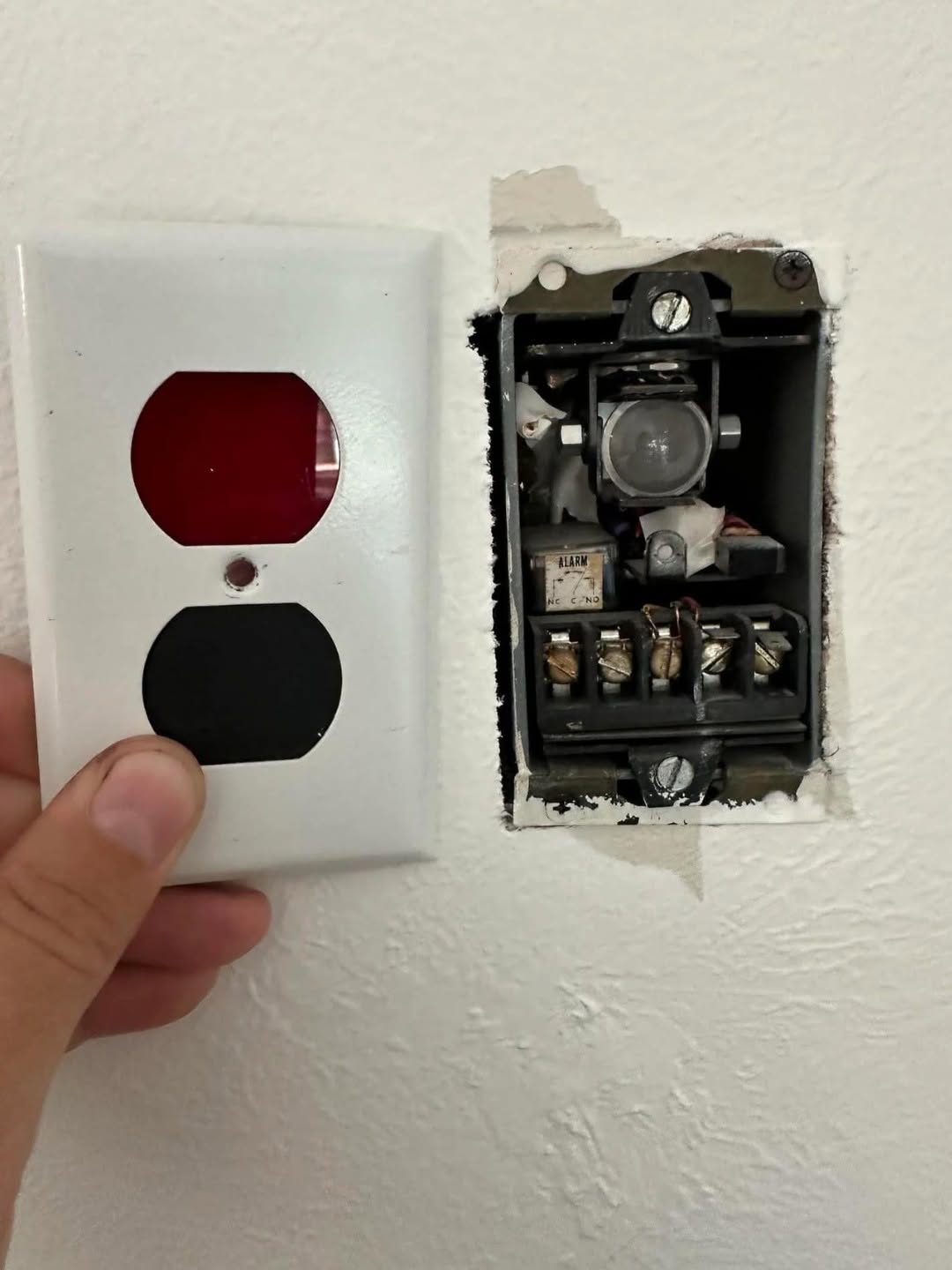
What Was the Detect-O-Ray? Long before connected doorbells, wireless cameras, and app-controlled home alarms became everyday technology, this unusual photoelectric device offered a remarkably clever way to detect movement using a beam of light.
The Detect-O-Ray appeared during the 1940s and came from the Detect-O-Ray Company of Chicago. Rather than watching a room with a camera, the unit projected light toward an external mirror. The mirror reflected that beam back toward a photoelectric cell inside the device. When a person or object interrupted the beam, the system could activate a bell, alarm, camera, light, or another connected electrical device. Period advertising even promoted it for burglar protection, automatic doors, counters, machinery, and industrial safety.
That technology sounds surprisingly modern. Yet it relied on straightforward electrical components rather than software, Wi-Fi, cloud storage, or smartphones.
I first became fascinated by devices like the Detect-O-Ray after seeing an old black metal box with a glass lens that looked more like forgotten laboratory equipment than home technology. At first, I assumed it had belonged to a radio system. However, learning that similar equipment could create an invisible security boundary completely changed how I viewed it. Suddenly, that strange old object represented something much bigger: an early attempt to make buildings respond automatically to human movement. The design felt wonderfully direct. Shine a beam, monitor it, and trigger something whenever the beam disappears. That simple idea still powers countless modern sensors today.
How the Detect-O-Ray Actually Worked
The Photoelectric Principle Behind the Device
The Detect-O-Ray belonged to a broader family of devices commonly called photoelectric switches or “electric eyes.” Photoelectric sensing had already started appearing in consumer and industrial equipment during the 1930s, and the Detect-O-Ray brought that principle into a compact commercial product during the following decade.
Its operation was elegantly simple.
A lamp inside the device projected a beam toward a separate mirror. That mirror reflected the light back toward a lens on the Detect-O-Ray itself. The lens then focused the returning light onto a photoelectric cell.
As long as the cell continued receiving the reflected beam, the system remained in its normal state.
However, when a person, package, machine part, or another object passed through the beam, the light reaching the photoelectric cell changed. That change activated an amplifier and relay.
The relay could then control another electrical device.
Therefore, the Detect-O-Ray itself did not need to function only as a burglar alarm. It acted more like an automatic electrical switch triggered by light interruption.
A 1948 catalog described the Detect-O-Ray as capable of activating alarms, bells, cameras, safety devices, and other equipment when an object broke its light path. The same catalog promoted applications that included burglar alarms, fire or smoke alarms, electric door openers, counters, sorting equipment, and machine-safety systems.
That versatility explains why calling it simply an antique motion detector understates what it could do.
In principle, it served as an early automation sensor.
Modern smart-home systems often follow a similar logical sequence:
A sensor detects an event.
Then a controller interprets the event.
Finally, another device performs an action.
The Detect-O-Ray accomplished that sequence with light, relays, and electrical circuits instead of microprocessors and software.
It Wasn’t Necessarily Two Electronic Boxes Facing Each Other
One detail about the Detect-O-Ray often gets simplified in modern descriptions.
You may encounter explanations saying that one electronic box transmitted a beam while a second box across the room received it. Some photoelectric security systems did use separate transmitters and receivers. However, period descriptions of the Detect-O-Ray itself show a different arrangement.
The Detect-O-Ray projected its beam toward an external mirror. The mirror then reflected the beam back to the photoelectric sensor inside the main unit.
Consequently, if you discover one vintage Detect-O-Ray box mounted somewhere, you should not automatically assume that an identical electronic receiver originally stood directly opposite it.
A reflector or mirror may have completed the beam path instead.
This configuration also provided a practical advantage. Housing the light source, sensing electronics, and controls in one main cabinet simplified the electrical installation because the reflector did not need its own power connection.
Catalog descriptions from the late 1940s show that the system could project a visible white beam or what advertising called an “unseen” beam. One 1949 listing claimed an effective range of roughly 60 feet for the white beam and approximately 35 feet for the unseen mode.
That represented impressive coverage for a relatively compact device of its era.
The main unit also included adjustments that allowed users to change sensitivity and select how the connected equipment responded after the beam broke.
For example, one mode could maintain an action after a single interruption, while another could respond independently each time something crossed the beam.
Those controls made the Detect-O-Ray suitable for far more than catching an intruder.
It could count objects on a production line, trigger equipment, monitor entrances, or automatically photograph something moving through a specific location.
Where Detect-O-Ray Technology Was Used
From Burglar Alarms to Automatic Doors
What Was the Detect-O-Ray used for? Security represented one obvious application, but historical advertising reveals an unexpectedly broad list.
Homes, stores, offices, and factories could use photoelectric systems for burglar protection. A strategically positioned beam could monitor an entrance, hallway, window area, or another passage.
If someone crossed that beam, the attached relay could activate a bell or another warning device.
However, manufacturers also promoted photoelectric switches for industrial automation.
A 1948 electronics catalog listed remote controls, automatic counters, sorting equipment, electric door openers, burglar alarms, fire alarms, smoke alarms, and machine-safety applications.
That range makes the Detect-O-Ray particularly interesting from a technology-history perspective.
Today, we separate many of those functions into different products.
A store might use a photoelectric door sensor.
A warehouse might use an optical object counter.
A factory might install safety light curtains around hazardous equipment.
A homeowner might use a motion detector as part of an alarm system.
Yet all of these technologies share a basic concept with early photoelectric switching: observe a light signal and respond when something changes it.
Period catalogs also reveal how consumers viewed the technology.
The Detect-O-Ray appeared alongside electronics, alarm equipment, relays, and hobbyist components. Some versions were sold as complete units, while later listings advertised kits that users could assemble themselves.
A 1950 catalog, for example, described a Detect-O-Ray electric-eye kit intended for burglar alarms, door announcing, counting, and sorting applications.
In other words, this technology occupied an unusual position between household gadget, security equipment, industrial control, and electronics hobby project.
Why It Looked So Different From Modern Sensors
Anyone accustomed to today’s tiny plastic motion sensors may find a vintage Detect-O-Ray surprisingly large.
One historical version measured roughly 6 1/2 by 5 by 5 inches and weighed several pounds. It operated from household AC power and contained components that modern electronics have reduced dramatically in size.
That bulky construction reflected the technology available at the time.
Modern motion sensors can contain tiny semiconductor components, integrated circuits, compact infrared elements, and wireless radios. Engineers can fit sophisticated detection hardware inside a housing that fits easily in your palm.
The Detect-O-Ray came from a different electrical world.
It relied on a lamp, optical components, a photoelectric cell, amplification circuitry, mechanical or electromechanical switching, and conventional wiring.
As a result, the cabinet needed considerably more room.
The surviving units also have a distinctive industrial appearance. Dark metal cases, prominent lenses, switches, knobs, vents, and external reflectors make them look almost theatrical compared with the intentionally discreet devices sold today.
However, that appearance served a practical purpose.
Manufacturers designed these devices for serviceability.
A technician could access components, replace a failed lamp, adjust sensitivity, inspect connections, and align the optics.
The downside was maintenance.
Early photoelectric systems could suffer from several limitations. Ambient light could affect performance, lamps gradually lost brightness, alignment mattered, and burned-out filaments could disable the system.
Modern sensing systems solve many of those problems through improved emitters, digital filtering, better optics, self-diagnostics, and sophisticated signal processing.
Still, considering its era, the Detect-O-Ray accomplished something remarkable with comparatively basic components.
It allowed an electrical system to “notice” when something crossed a room.
Why the Detect-O-Ray Was Ahead of Its Time
An Early Form of Home and Building Automation
What Was the Detect-O-Ray if not an early smart-building sensor?
Of course, calling it “smart” in the modern software sense would stretch the meaning. It did not identify people, record video, connect to a network, or send alerts to a phone.
Nevertheless, its underlying purpose feels strikingly familiar.
It allowed the physical environment to respond automatically to an event.
Someone passes through a beam.
A door opens.
An alarm sounds.
A counter advances.
A camera activates.
A machine stops.
That concept sits at the heart of modern automation.
Today’s connected homes use sensors to detect doors opening, movement inside rooms, changes in temperature, water leaks, smoke, broken glass, light levels, and many other conditions.
Software then combines those inputs with automated rules.
The Detect-O-Ray accomplished a much simpler version of the same process mechanically and electrically.
The company behind it appears to have been established around 1940 in Chicago, and surviving examples date from the World War II era and the years immediately afterward. The Made-in-Chicago Museum identifies the Detect-O-Ray Company with an address at 2622 N. Halsted Street in Chicago.
By the late 1940s, catalog advertisements clearly positioned the equipment as useful for both security and automation.
Eventually, newer technologies made such bulky photoelectric switching equipment obsolete. The Detect-O-Ray Company appears to have disappeared by roughly the 1960s, although surviving historical records leave parts of the company’s story uncertain.
Its central idea, however, certainly did not disappear.
Photoelectric sensors remain everywhere.
Automatic doors, conveyor systems, industrial counters, elevator equipment, safety barriers, and alarm systems all continue using variations of optical detection.
The hardware evolved dramatically.
The principle endured.
How It Compares With Modern Motion Sensors
Comparing a Detect-O-Ray with a modern smart motion detector reveals both enormous technological progress and surprising continuity.
A traditional Detect-O-Ray watched a specific optical path.
If something interrupted that path, the device responded.
Modern passive infrared motion detectors work differently. Instead of requiring a continuous beam across a space, they usually detect changes in infrared radiation caused by warm objects moving through different zones in the sensor’s field of view.
Other contemporary systems use radar, microwave sensing, ultrasonic detection, cameras, lidar, or combinations of several technologies.
Therefore, a modern motion detector generally covers an area rather than a single beam line.
Connected devices add another layer.
Once a modern sensor detects activity, software can send a notification, record footage, turn on lights, lock doors, activate an alarm, or trigger an automation sequence.
The Detect-O-Ray could not provide that digital flexibility.
However, it could still trigger multiple electrical actions through relays.
In that sense, the gap between the old technology and new technology becomes smaller than it first appears.
Both begin with the same basic question:
Did something happen in the monitored space?
Then both systems trigger a response.
The primary difference lies in how they detect the event and how sophisticated the response can become.
That makes the Detect-O-Ray more than an antique curiosity.
It represents a recognizable ancestor of modern sensor-driven environments.
Discovering or Preserving an Old Detect-O-Ray
What to Do If You Find One
What Was the Detect-O-Ray may become a very practical question if you encounter one while cleaning an attic, renovating an older property, or browsing vintage electronics.
First, avoid assuming that an old electrical device remains safe to power.
Original insulation, capacitors, wiring, switches, and other electrical components can deteriorate over many decades. Equipment designed around 110- or 115-volt household electricity deserves particular caution.
Therefore, do not simply plug an unidentified vintage Detect-O-Ray into an outlet to see whether it works.
Instead, leave it unplugged and inspect it visually.
Look for manufacturer markings, model numbers, labels, patent information, control names, and original wiring.
Photograph those details before cleaning anything aggressively.
Likewise, preserve unusual accessories that appear nearby.
A plain mirror or reflector may seem unimportant, yet it could belong to the original optical setup.
If the device remains installed in an old building, document its location before removing it. The placement may explain how the original system monitored the space.
For example, the beam might once have crossed an entrance, stairway, store aisle, or industrial work area.
Preserving that context makes the object much more historically meaningful.
If restoration interests you, involve someone familiar with vintage electronics and mains-powered equipment.
A knowledgeable technician can evaluate deteriorated components and determine whether the system could operate safely.
However, restoration does not require making the original high-voltage circuitry functional.
You could preserve the exterior while leaving the original electronics disconnected.
That approach protects the object’s appearance without introducing unnecessary electrical risk.
Why These Devices Deserve Preservation
Many old household objects survive because people immediately recognize their purpose.
Telephones look like telephones.
Radios look like radios.
Clocks usually look like clocks.
A Detect-O-Ray presents a different challenge.
Without context, it can look like obsolete electrical junk.
Therefore, surviving examples may easily disappear during renovations or cleanouts.
Yet these devices tell an important story about the development of automation.
They show that decades before connected homes became a popular idea, engineers were already finding ways to make buildings and machines react automatically to their surroundings.
The Detect-O-Ray also demonstrates how rapidly electronics changed during the middle of the twentieth century.
A device that once needed a several-pound metal cabinet can now perform its basic sensing function with components small enough to hide inside a doorway or handheld gadget.
That transformation makes the original hardware valuable as a teaching object.
It helps explain photoelectric sensing.
It illustrates early electrical control.
It shows how relays automated physical equipment.
Most importantly, it reminds us that technological progress usually builds on earlier ideas rather than appearing suddenly.
The smart sensors around us today did not begin with smartphones.
Their lineage runs through decades of photocells, relays, electric eyes, industrial controls, alarm systems, and experimental devices.
More Blog
- Drinking Water on an Empty Stomach — What Science Actually Supports (No Hype, Just Facts)
- Waking Up Between 3 and 5 AM? It Might Be Your Soul Trying to Talk to You
- What a “Bleach” Patch on Your Underwear Really Means — And Why It’s Actually a Good Sign
- This Drink May Weaken Your Bones From The Inside — But Everyone Drinks It Anyway