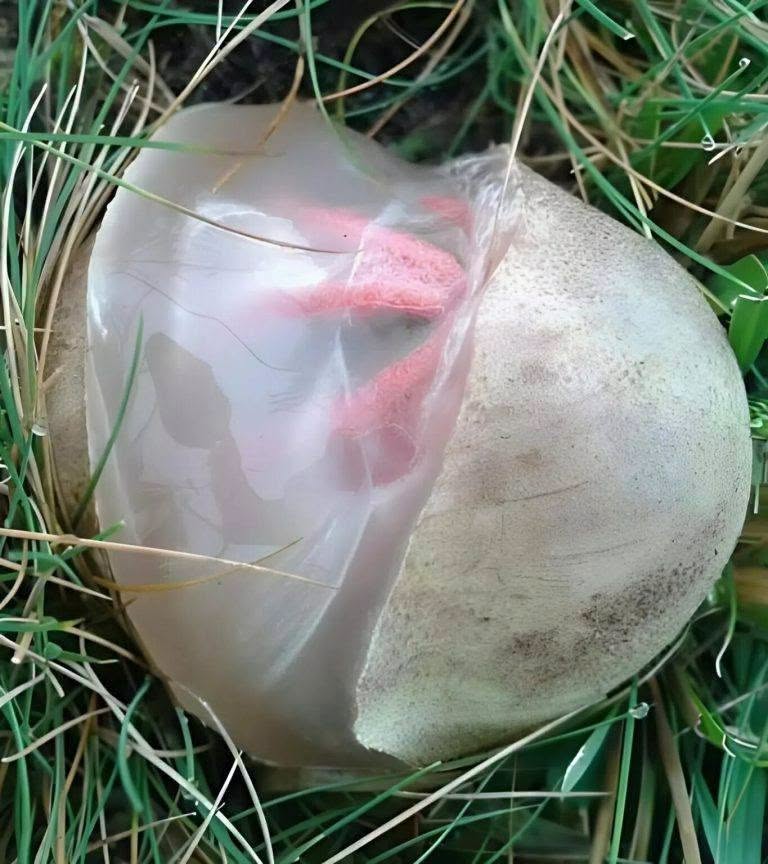
The Curious Case of the Stinkhorn “Egg” often begins with a discovery that looks completely ordinary. A pale, rounded object appears beneath mulch, beside a tree, or among fallen leaves. At first, it can resemble a small egg, an immature puffball, or even a smooth stone partially buried in the soil.
Then something remarkable happens.
The rounded structure splits. A strange fungus rapidly pushes upward, sometimes forming a tall stalk and sometimes developing branching arms, columns, or an intricate lattice. Soon afterward, an unmistakable odor may fill the surrounding area.
Despite their unusual appearance and unpleasant smell, stinkhorns perform useful work in many gardens and natural environments. They break down dead organic material and return nutrients to the ecosystem. Even more fascinating, many species rely on flies and other insects rather than wind to carry their spores.
The Curious Case of the Stinkhorn “Egg” becomes much less mysterious once you understand this unusual life cycle. What initially looks alarming actually represents an impressive fungal reproductive strategy.
I first noticed one after several rainy days when a pale lump appeared beneath a thick layer of garden mulch. My first instinct was to remove it because I assumed something had gone wrong in the soil. However, curiosity made me leave it alone. By the next day, the harmless-looking ball had transformed into a bizarre structure that hardly resembled what I had seen earlier. The smell made the discovery even stranger. Still, watching the transformation changed my view of garden fungi. I started seeing mushrooms less as unwanted intruders and more as visible evidence of an active ecosystem quietly recycling material beneath my feet.
The Curious Case of the Stinkhorn “Egg” Begins Below the Surface
What Exactly Is a Stinkhorn Egg?
The Curious Case of the Stinkhorn “Egg” starts with the immature fruiting body of a stinkhorn fungus.
Despite the familiar nickname, this structure has nothing to do with birds, reptiles, or animal eggs.
Instead, the “egg” contains the developing stinkhorn.
Depending on the species and growing conditions, it may appear white, cream, pale brown, pinkish, or slightly gray. The outside often feels firm or rubbery, while the interior contains several developing layers.
A gelatinous material surrounds the immature fungal structures inside.
That unusual construction serves an important purpose. The stinkhorn must grow extremely quickly once conditions become suitable. Therefore, much of the mature structure already exists in compressed form inside the egg.
When moisture, temperature, and other environmental conditions align, the outer covering ruptures.
Then the mature fruiting body expands.
This process can happen surprisingly quickly. A stinkhorn that appeared as a small rounded object in the morning may look dramatically different later that day.
The Curious Case of the Stinkhorn “Egg” becomes particularly interesting because the transformation reverses what people usually expect from mushroom growth.
Many familiar mushrooms seem to slowly appear from soil or wood. Stinkhorns, however, can expand so rapidly that their growth appears almost sudden.
The remaining portion of the egg frequently stays around the base of the mature fungus. Mycologists call this cup-like remnant a volva.
Consequently, finding a strange stalk emerging from a whitish cup can provide an important clue that you are looking at a stinkhorn.
However, identification should never depend on one feature alone.
Fungi vary tremendously, and several unrelated species can share similar shapes during early development.
Therefore, observing the complete structure usually provides much better information than judging an immature specimen by appearance alone.
Why Stinkhorns Grow So Quickly
The Curious Case of the Stinkhorn “Egg” becomes even more impressive when you understand the speed of its transformation.
Stinkhorns do not build their mature structures from scratch after the egg opens.
Instead, the immature fruiting body develops inside the protective structure before emergence. Once conditions favor growth, specialized tissues expand rapidly.
Water plays an important role in that process.
Consequently, stinkhorns commonly appear after rain, irrigation, or extended periods of damp weather.
Mulched gardens create especially favorable conditions.
Wood chips, decaying roots, leaves, compost, and other organic materials provide both moisture and food for fungal networks.
Most of the fungus remains hidden.
Like many fungi, stinkhorns grow through threadlike structures called hyphae. Together, those threads form a network known as mycelium.
The visible stinkhorn represents only the reproductive structure.
Therefore, removing the mushroom does not necessarily remove the fungus itself.
A useful comparison involves an apple tree. Picking an apple removes the fruit, but the tree remains. Likewise, removing a stinkhorn fruiting body usually leaves the underground fungal network intact.
The Curious Case of the Stinkhorn “Egg” also demonstrates how effectively fungi respond to temporary environmental opportunities.
A fruiting body does not need to survive for weeks.
Instead, it needs enough time to expose spores and help disperse them.
Rapid expansion allows stinkhorns to accomplish that goal efficiently.
Their speed may seem almost unnatural when someone encounters them for the first time. However, the process follows ordinary biological mechanisms.
No mysterious force pushes the fungus from the ground overnight.
Instead, moisture, cellular expansion, stored structures, and favorable conditions combine to produce one of the fungal kingdom’s most dramatic growth patterns.
The Curious Case of the Stinkhorn “Egg” Gets Much Stranger
Why Does a Stinkhorn Smell So Bad?
The Curious Case of the Stinkhorn “Egg” would already rank among nature’s stranger transformations based on appearance alone.
Then comes the smell.
Many stinkhorn species produce odors that people compare with rotting meat, sewage, spoiled food, or decomposing organic material.
Although that seems unpleasant from a human perspective, the smell performs a highly effective biological function.
Stinkhorns need to spread their spores.
Many familiar mushrooms release enormous quantities of tiny spores into the air. Wind currents then carry those spores away.
Stinkhorns often use a different strategy.
The mature fungus develops a sticky, spore-containing substance commonly called gleba. This material can coat part of the stalk, cap, arms, or other structures, depending on the species.
The gleba produces the characteristic odor.
Flies and other insects detect that smell and approach the fungus because it resembles the odors associated with materials they normally investigate.
They land on the sticky surface.
As a result, spores can attach to their bodies.
The insects then move elsewhere, carrying those spores with them.
Some spores may also pass through an insect’s digestive system after feeding.
Therefore, the smell that makes people want to move away encourages the stinkhorn’s preferred transporters to move closer.
The Curious Case of the Stinkhorn “Egg” provides an excellent example of how evolution can produce strategies that seem unpleasant to humans yet work remarkably well for another organism.
A stinkhorn does not need to smell pleasant.
It needs to reproduce.
Consequently, the powerful odor represents an adaptation rather than a biological accident.
Once you understand that relationship, the stinkhorn becomes easier to appreciate.
Its smell, shape, rapid growth, and insect activity all contribute to the same reproductive strategy.
Why Do Stinkhorns Have Such Bizarre Shapes?
The Curious Case of the Stinkhorn “Egg” becomes visually fascinating because mature stinkhorns come in dramatically different forms.
Some produce a single upright stalk.
Others form several columns.
Certain species develop branching structures that resemble fingers, tentacles, or arms.
Meanwhile, some tropical and subtropical stinkhorns produce elaborate netlike structures.
Their colors can also vary.
White, cream, orange, pink, yellow, and vivid red structures all occur within the broader stinkhorn group.
These unusual shapes support reproduction.
The mature fruiting body must expose its spore-containing material where insects can find it. Therefore, quickly lifting or spreading the gleba increases opportunities for contact with potential carriers.
The structures may look elaborate, but they serve practical biological purposes.
However, appearance alone can cause unnecessary concern.
Bright colors and unusual shapes sometimes make people assume a stinkhorn must be dangerous.
That conclusion does not automatically follow.
Colorful fungi are not necessarily poisonous, while plain-looking fungi are not necessarily safe.
Therefore, color should never serve as the only guide for determining whether an unidentified fungus presents a risk.
Likewise, homeowners should avoid tasting wild fungi simply to identify them.
Young stinkhorn eggs can also resemble other fungi, which makes immature specimens particularly difficult for beginners to identify confidently.
The Curious Case of the Stinkhorn “Egg” therefore offers another useful lesson: observation works better than assumption.
Look at where the fungus grows.
Notice its mature shape.
Observe its color.
Consider whether a strong odor develops.
Check whether flies gather around the mature structure.
Those combined features provide much more information than the egg stage alone.
Even then, people who require a precise species identification should consult reliable field references or experienced local experts rather than relying entirely on a photograph or social media comment.
The Curious Case of the Stinkhorn “Egg” in Your Garden
Are Stinkhorns Harmful to Plants, Pets, or People?
Finding The Curious Case of the Stinkhorn “Egg” beside prized plants can cause understandable concern.
Fortunately, stinkhorns generally function as decomposers rather than plant pathogens.
They feed primarily on dead and decaying organic material.
Consequently, their presence in mulch, compost-rich beds, decaying wood, or areas containing buried roots often indicates abundant organic matter and moisture.
The fungus participates in decomposition.
As organic material breaks down, nutrients return to the surrounding ecosystem.
Therefore, a stinkhorn growing near a healthy plant does not automatically mean the fungus is attacking that plant.
In many situations, the two simply share the same moist, organic-rich environment.
However, people should still use sensible precautions around unidentified fungi.
Do not assume that a wild fungus is edible because it resembles something shown in a photograph.
Likewise, teach children not to taste unfamiliar mushrooms or fungal growths.
Pets that routinely eat strange objects should also remain supervised around unfamiliar fungi.
If a person or animal consumes an unidentified wild fungus and develops concerning symptoms, seek appropriate medical or veterinary advice rather than attempting identification solely from an internet image.
The Curious Case of the Stinkhorn “Egg” can create another problem that has nothing to do with toxicity.
The odor may become extremely unpleasant.
A stinkhorn growing beside a patio, doorway, window, outdoor dining area, or frequently used walkway can make the surrounding space uncomfortable.
Therefore, removal may make sense even when the fungus itself does not threaten nearby plants.
The decision often comes down to tolerance.
If the stinkhorn grows in a distant garden bed, leaving it alone allows decomposition and spore dispersal to continue naturally.
If it appears beside your front door, you may reasonably prefer removal.
How to Manage Stinkhorns Without Damaging the Garden
The Curious Case of the Stinkhorn “Egg” can return even after you remove the visible fungus.
That happens because the larger fungal network may remain inside the soil or organic material.
However, simple garden management can reduce repeated fruiting.
First, remove visible eggs and mature stinkhorns before they become especially odorous.
Wear garden gloves and place the material in a bag for disposal if you want to prevent it from remaining in the immediate area.
Next, inspect the surrounding mulch.
Very thick layers of constantly wet wood mulch can create excellent conditions for decomposer fungi.
Therefore, gently turning the mulch may improve airflow and help excessively damp material dry.
You can also reduce unnecessary watering if the bed remains consistently saturated.
However, do not deprive landscape plants of the moisture they genuinely need simply to discourage fungi.
Replacing heavily decomposed mulch may also help when stinkhorns repeatedly appear in the same location.
Still, complete elimination can prove difficult.
Fungal mycelium may extend beyond the exact spot where fruiting bodies emerge.
Additionally, spores occur naturally throughout outdoor environments.
The Curious Case of the Stinkhorn “Egg” therefore rarely requires aggressive treatment.
Applying harsh chemicals to garden soil can damage beneficial organisms without guaranteeing long-term control.
Likewise, fungicides may provide little practical benefit when the underlying environment continues supplying moisture and decomposing organic matter.
Physical removal and moisture management usually offer a simpler approach.
Most importantly, consider whether removal is necessary at all.
A stinkhorn in an unused corner of a garden may cause no meaningful problem.
It appears, releases spores, decomposes, and eventually disappears.
Although the process may look dramatic, the fungus remains part of the ordinary recycling system operating in healthy outdoor environments.
The Curious Case of the Stinkhorn “Egg” Reveals a Hidden Ecosystem
Stinkhorns Help Recycle Organic Material
The Curious Case of the Stinkhorn “Egg” becomes easier to appreciate when you look beyond the visible mushroom.
Gardens contain enormous biological communities.
Bacteria, fungi, insects, worms, roots, and microscopic organisms constantly interact beneath the surface.
Dead leaves fall.
Wood decomposes.
Roots die.
Mulch gradually breaks apart.
Without decomposers, organic material would accumulate rather than cycling back through ecosystems.
Stinkhorn fungi participate in that recycling process.
Their hidden mycelium grows through suitable organic material and helps break it down.
Therefore, the strange fruiting body above the ground represents only a temporary reproductive stage of a much larger organism.
The Curious Case of the Stinkhorn “Egg” can actually provide evidence that decomposition is actively occurring.
This does not mean gardeners must enjoy the smell.
However, understanding the fungus can transform the reaction from alarm to curiosity.
Instead of immediately assuming that something has infected the garden, you can consider the environmental conditions that encouraged fungal growth.
Has the weather been rainy?
Did you recently add wood mulch?
Does the area stay shaded and damp?
Are old roots or buried wood decomposing nearby?
Those factors often explain why fungi suddenly appear.
Furthermore, stinkhorns demonstrate that a garden never consists only of the plants people intentionally placed there.
It functions as an ecosystem.
Much of that ecosystem remains invisible until conditions cause a mushroom, slime mold, insect, or other organism to appear.
Consequently, discovering a stinkhorn can become an opportunity to observe ecological processes that normally remain hidden.
What initially looks like an unwelcome visitor may actually reveal how actively the garden recycles its own organic material.
Why Observing the Transformation Can Be Fascinating
The Curious Case of the Stinkhorn “Egg” provides an unusually accessible opportunity to observe fungal development.
If you discover an intact egg in a safe location, consider photographing it rather than immediately disturbing it.
Take another photograph several hours later.
Then check again the following morning.
Depending on the species and environmental conditions, you may witness an extraordinary transformation.
The egg may rupture.
A stalk or other structure may emerge.
The mature fungus may expand quickly.
Flies may soon arrive.
Eventually, the structure will deteriorate.
That short sequence demonstrates an entire reproductive strategy.
Children who enjoy nature observation may find the transformation especially interesting, although adults should supervise them and discourage touching or tasting unidentified fungi.
A simple photo sequence can also help with identification because mature structures usually provide more useful features than the egg stage.
The Curious Case of the Stinkhorn “Egg” reminds us that nature does not always present beauty in familiar forms.
Some biological strategies look elegant.
Others smell terrible.
Some rely on flowers and pollinators.
Others rely on decaying odors and flies.
Yet each reflects organisms responding to the challenges of survival and reproduction.
That makes stinkhorns worth noticing.
They may never become anyone’s favorite garden fragrance. However, they provide one of the most dramatic demonstrations of fungal biology that homeowners can observe without specialized equipment.
A pale ball in the mulch can become a completely different structure within a remarkably short period.
Once you understand why, the transformation feels less disturbing and much more fascinating.
Frequently Asked Questions
What is inside a stinkhorn egg?
A stinkhorn egg contains the developing fruiting body surrounded by protective and gelatinous tissues. Much of the future stinkhorn already exists in compressed form inside the egg. When environmental conditions become favorable, the outer layer splits and the structure rapidly expands.
Why did stinkhorns suddenly appear in my mulch?
Warm temperatures, moisture, and decomposing organic material create favorable conditions for stinkhorn fungi. Therefore, they often appear after rain or regular irrigation in beds containing wood chips, compost, buried roots, or other organic debris.
Are stinkhorns bad for garden plants?
Generally, stinkhorns act as decomposers and feed on dead organic material rather than attacking healthy garden plants. Their presence often reflects moist conditions and abundant decomposing material in the surrounding soil or mulch.
Why do stinkhorn mushrooms attract flies?
The mature fungus produces a strong-smelling, sticky spore mass. The odor attracts flies and other insects that normally investigate decaying material. Spores attach to the insects or enter their digestive systems, allowing the insects to transport them elsewhere.
Should I remove a stinkhorn egg from my yard?
You can remove it if the location or expected odor creates a problem. However, removal is not always necessary. If the stinkhorn grows in an unused area and poses no practical concern, you can leave it and observe its short life cycle.
Conclusion
The Curious Case of the Stinkhorn “Egg” begins with an object that hardly seems capable of becoming anything remarkable.
Yet inside that pale structure waits one of nature’s most unusual fungal transformations.
When conditions become favorable, the egg opens and a mature fruiting body rapidly expands. Depending on the species, it may form a stalk, columns, arms, or an elaborate lattice.
Then its reproductive strategy becomes impossible to ignore.
The stinkhorn produces a strong odor that attracts flies and other insects. Those visitors help transport spores, giving the fungus an alternative to the wind-based dispersal strategy used by many other mushrooms.
At the same time, the hidden fungus contributes to decomposition.
It helps process dead organic material in mulch, soil, wood, and other natural debris.
Therefore, The Curious Case of the Stinkhorn “Egg” represents more than an odd mushroom appearing unexpectedly in the yard.
It offers a glimpse into the enormous fungal ecosystem that operates mostly beyond human sight.
Gardeners do not need to tolerate a foul-smelling stinkhorn beside a patio or doorway. Physical removal remains a reasonable option when location creates a nuisance.
However, aggressive treatment usually makes little sense.
Instead, managing excessive moisture, turning dense mulch, removing heavily decomposed material when necessary, and physically removing fruiting bodies can provide a practical response.
Most importantly, unfamiliar does not automatically mean harmful.
The strange egg in your mulch may simply represent a decomposer preparing for one of the fastest and most unusual transformations in the fungal world.
If you have the opportunity to watch one develop from a safe distance, consider leaving it for a little while.
The smell may not win you over.
The biology just might.
{
  "title": "The Curious Case of the Stinkhorn “Egg”: Nature’s Strangest Fungal Transformation",
  "summary": "A beginner-friendly guide to the unusual stinkhorn egg, its rapid transformation, distinctive smell, insect-assisted spore dispersal, ecological role, and practical garden management.",
  "notes": "Stinkhorns commonly grow in moist, organic-rich environments. Avoid eating unidentified wild fungi, and supervise children and pets around unfamiliar mushrooms.",
  "ingredients_flat": [
    {
      "amount": "1",
      "unit": "",
      "name": "stinkhorn egg or mature stinkhorn for observation"
    },
    {
      "amount": "1",
      "unit": "pair",
      "name": "garden gloves"
    },
    {
      "amount": "1",
      "unit": "",
      "name": "disposal bag if removal is needed"
    },
    {
      "amount": "1",
      "unit": "",
      "name": "garden rake or hand cultivator"
    },
    {
      "amount": "1",
      "unit": "",
      "name": "camera or phone for documenting growth"
    }
  ],
  "instructions_flat": [
    {
      "name": "Step 1",
      "text": "Observe the pale rounded structure without tasting or unnecessarily handling the unidentified fungus.",
      "summary": "",
      "image_url": ""
    },
    {
      "name": "Step 2",
      "text": "Check the surrounding environment for damp mulch, decomposing wood, old roots, compost, or other organic material.",
      "summary": "",
      "image_url": ""
    },
    {
      "name": "Step 3",
      "text": "Photograph the stinkhorn egg and observe it again several hours later to document its rapid transformation.",
      "summary": "",
      "image_url": ""
    },
    {
      "name": "Step 4",
      "text": "Observe the mature structure from a safe distance and note its shape, color, odor, and any insects visiting the spore-bearing surface.",
      "summary": "",
      "image_url": ""
    },
    {
      "name": "Step 5",
      "text": "Leave the fungus in place if it causes no problem, or wear gloves and physically remove it if the odor or location creates a nuisance.",
      "summary": "",
      "image_url": ""
    },
    {
      "name": "Step 6",
      "text": "Reduce persistently excessive moisture and gently turn dense mulch if stinkhorns repeatedly appear in an unwanted location.",
      "summary": "",
      "image_url": ""
    }
  ],
  "equipment": [
    {
      "name": "Garden gloves",
      "notes": ""
    },
    {
      "name": "Hand cultivator",
      "notes": ""
    },
    {
      "name": "Garden rake",
      "notes": ""
    },
    {
      "name": "Camera or smartphone",
      "notes": ""
    }
  ],
  "nutrition": {
    "calories": "0",
    "carbohydrates": "0 g",
    "protein": "0 g",
    "fat": "0 g",
    "saturated_fat": "0 g",
    "polyunsaturated_fat": "0 g",
    "monounsaturated_fat": "0 g",
    "trans_fat": "0 g",
    "cholesterol": "0 mg",
    "sodium": "0 mg",
    "potassium": "0 mg",
    "fiber": "0 g",
    "sugar": "0 g",
    "vitamin_a": "0%",
    "vitamin_c": "0%",
    "calcium": "0%",
    "iron": "0%"
  },
  "tags": {
    "course": ["Educational Guide"],
    "cuisine": ["Nature and Gardening"],
    "keyword": ["The Curious Case of the Stinkhorn “Egg”", "stinkhorn egg", "stinkhorn fungus", "garden fungi", "stinkhorn mushroom"]
  }
}
SEO Output
Focus Keyword: The Curious Case of the Stinkhorn “Egg”
SEO Title: The Curious Case of the Stinkhorn “Egg”: What Gardeners Should Know
Meta Description: The Curious Case of the Stinkhorn “Egg” explains its strange growth, powerful smell, ecological purpose, and what gardeners should do.
Expert SEO Title: The Curious Case of the Stinkhorn “Egg”: 7 Fascinating Facts
Midjourney Prompt: The Curious Case of the Stinkhorn Egg, realistic macro nature photography showing a pale white gelatinous stinkhorn egg splitting open in dark damp garden mulch beside a fully emerged unusual stinkhorn fungus, scientifically accurate fungal textures, moist wood chips and scattered leaves, subtle flies near the mature spore-bearing structure, natural morning light, highly detailed organic textures, fascinating rather than frightening mood, shallow depth of field, clean uncluttered garden background, vertical composition, generous negative space in upper portion for text overlay suitable for Pinterest pins –v 6 –ar 2:3
More Blog
- Drinking Water on an Empty Stomach — What Science Actually Supports (No Hype, Just Facts)
- Waking Up Between 3 and 5 AM? It Might Be Your Soul Trying to Talk to You
- What a “Bleach” Patch on Your Underwear Really Means — And Why It’s Actually a Good Sign
- This Drink May Weaken Your Bones From The Inside — But Everyone Drinks It Anyway