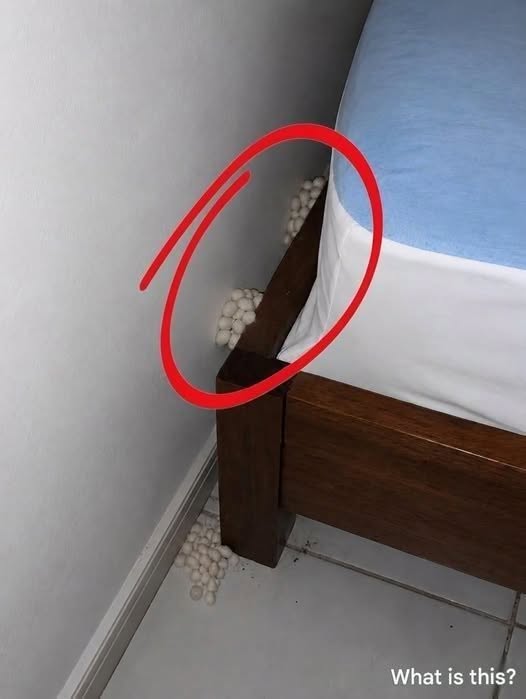
Imagine reaching underneath your bed to retrieve something and discovering several tiny, pale, oval objects tucked into a dark corner.
They look almost like miniature eggs—white or cream-colored, firm, and slightly chalky.
Your first question is probably obvious:
What on earth laid those under my bed?
In warm climates especially, one surprisingly common explanation is house gecko or small lizard eggs. But appearance alone isn’t enough for a definite identification. Several household visitors can leave eggs, cases, cocoons, or other objects that look remarkably similar from a distance.
Here’s how to narrow down the possibilities—and what to do if you find them.
🦎 Possibility #1: House Gecko Eggs
If the objects are small, white, oval, and relatively hard or chalky, gecko eggs are one possibility worth considering.
House geckos often live remarkably close to humans. They hide behind furniture, appliances, curtains, wall openings, and other sheltered locations during the day and emerge at night to hunt insects.
When laying eggs, females generally look for protected places where the eggs are unlikely to be disturbed.
Depending on the species, eggs may be deposited in cracks, behind furniture, inside cabinets, beneath objects, or in other concealed areas.
What Gecko Eggs Can Look Like
Look for objects that are:
- White to cream-colored
- Small and oval or nearly round
- Firm rather than soft and gelatinous
- Sometimes chalky in appearance
- Hidden in a sheltered location
Some gecko species commonly lay only one or two eggs at a time, although communal nesting can result in multiple eggs accumulating in one location.
So finding a larger cluster doesn’t necessarily mean one lizard produced them all at once.
🪳 Could They Be Cockroach Eggs?
This is one of the first concerns many people have—but cockroach egg cases generally look quite different.
Cockroaches produce structures called oothecae.
Rather than looking like smooth white eggs, an ootheca is typically:
- Brown, reddish-brown, or tan
- Elongated
- Capsule-like
- Often ridged along one edge
Depending on the species, they can resemble a tiny purse, bean, or rectangular capsule.
So if the objects are genuinely white, smooth, and chalky, classic cockroach egg cases become a less convincing match.
That said, household pests vary, so photographs or professional identification are preferable to relying on color alone.
🕷️ What About Spider Eggs?
Spider eggs themselves usually aren’t scattered around the home as individual chalky ovals.
Most spiders enclose numerous tiny eggs inside a protective silk egg sac.
The sac may appear:
- White
- Cream
- Grayish
- Round or irregular
- Cottony, papery, or silken
If what you’ve found consists of distinct hard shells rather than silk-covered sacs, spiders are less likely.
🐌 Could They Be Snail or Slug Eggs?
Snail and slug eggs can also be pale, but they’re generally quite different from hard gecko eggs.
Many land-snail eggs appear:
- Round rather than strongly oval
- Whitish or translucent
- Moist or pearl-like
- Clustered together
They’re also usually deposited in damp soil, compost, leaf litter, or other humid protected environments.
A dry bedroom floor beneath a bed would therefore be an unusual location unless there is significant moisture or nearby plant material.
🦋 Could They Be Insect Pupae?
Possibly.
Some insects spend their pupal stage inside small cases or cocoons that can appear oval.
Carpet beetles, clothes moths, flies, and other insects can leave evidence in undisturbed household areas.
However, insect cases are often accompanied by additional clues such as:
- Silk or webbing
- Shed skins
- Small holes in natural-fiber fabrics
- Larvae
- Insect droppings
- Adult insects nearby
If the objects are associated with damaged carpets, wool, clothing, or stored fabrics, an insect explanation becomes more important to investigate.
🔎 Look for Context Clues
The surrounding area can be just as informative as the objects themselves.
Have You Seen Small Lizards Indoors?
If geckos frequently appear on your walls or ceilings at night, gecko eggs become a much stronger possibility.
Are There Brown Capsule-Like Objects Elsewhere?
That could point toward cockroach activity.
Is There Fabric Damage?
Tiny holes, shed larval skins, or webbing around wool, rugs, or stored clothing could indicate fabric pests.
Is the Area Damp?
Moisture makes certain snails, insects, and other organisms more plausible and can also indicate a household moisture problem worth addressing.
⚠️ Don’t Identify Mystery Eggs by Touching or Breaking Them
If you find unfamiliar eggs, cocoons, or capsules, avoid immediately crushing or opening them.
Instead:
- Take clear photographs from several angles.
- Place a familiar object such as a coin nearby for scale without disturbing the objects.
- Note their approximate size, color, texture, number, and location.
- Look for insects, lizards, droppings, webbing, moisture, or other clues nearby.
- If identification remains uncertain, show the photographs to a local pest professional, wildlife specialist, or knowledgeable extension service.
A close-up photograph is often far more useful for identification than a description like “small white eggs.”
🦎 If They Really Are Gecko Eggs
House geckos are generally harmless to people and are often beneficial because they eat insects such as moths, flies, mosquitoes, and other small arthropods.
If eggs are confirmed as belonging to a harmless native species, you may choose to leave them undisturbed.
If they need to be moved, however, don’t automatically pick them up and rotate them. Reptile eggs can be more sensitive to movement after development has begun than bird eggs.
Contacting a local wildlife professional is the safest approach when you’re unsure about the species or appropriate handling.
🧹 Preventing More Surprise Visitors
If you’d rather not discover another mystery nursery beneath your furniture, focus on preventing animals from entering rather than spraying chemicals unnecessarily.
Check for:
- Gaps around windows
- Openings beneath doors
- Torn window screens
- Cracks around pipes
- Gaps around air-conditioning units
- Wall or ceiling openings
Reducing indoor insect populations can also make the house less attractive to insect-eating geckos.
Regularly vacuuming underneath beds and furniture makes it less likely that any animal will find a completely undisturbed nesting location.
One Important Correction About Gecko Eggs
It’s tempting to assume that every chalky white object found indoors is a gecko egg.
It isn’t.
Appearance and location can suggest an identification, but they cannot confirm it.
Egg size, shell texture, shape, geographic location, and the animals commonly found around the home all matter.
That’s why a clear photograph—with something included for scale—is usually the best next step.
The Bottom Line
Small, white, chalky oval objects discovered beneath furniture could be gecko or small-lizard eggs, particularly in regions where house geckos commonly live indoors.
But they could also be insect cases or something unrelated to eggs altogether.
The best response isn’t panic—and it isn’t immediately reaching for insecticide.
Photograph them, examine the surrounding clues, avoid unnecessary handling, and identify them before deciding what to do.
Sometimes the strange little objects hiding beneath the bed aren’t evidence of a dangerous infestation at all.
They may simply reveal that a tiny, unexpected neighbor found the same quiet corner of your home appealing that you did.
More Blog
- Drinking Water on an Empty Stomach — What Science Actually Supports (No Hype, Just Facts)
- Waking Up Between 3 and 5 AM? It Might Be Your Soul Trying to Talk to You
- What a “Bleach” Patch on Your Underwear Really Means — And Why It’s Actually a Good Sign
- This Drink May Weaken Your Bones From The Inside — But Everyone Drinks It Anyway