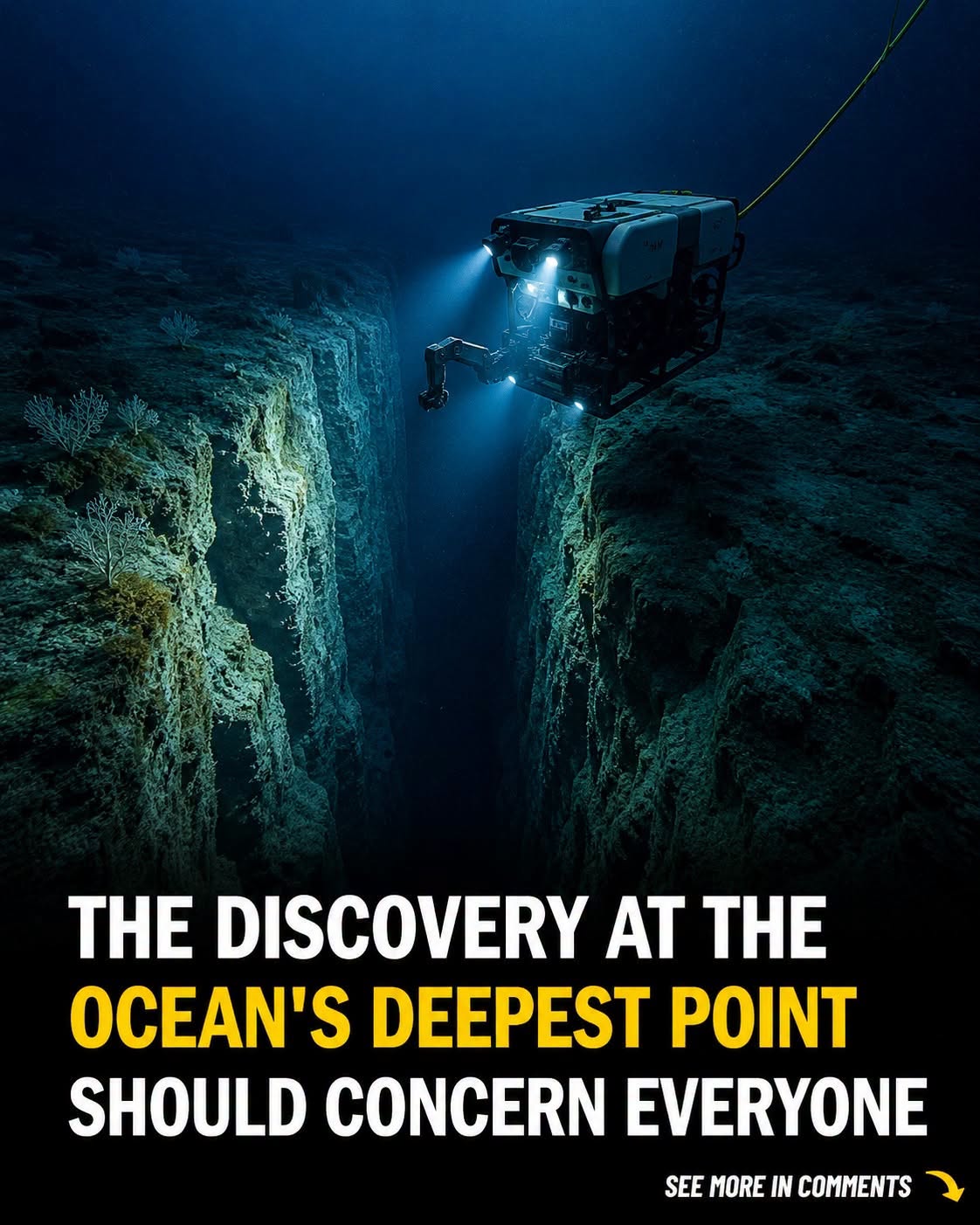
When people imagine the Mariana Trench, they often picture one of the last truly untouched places on Earth.
Located in the western Pacific Ocean, the trench contains Challenger Deep, the deepest known part of the world’s oceans, reaching almost 11 kilometers below sea level.
At such extreme depths—far from cities, factories, highways, and coastlines—it might seem reasonable to assume that human pollution couldn’t possibly reach it.
Unfortunately, scientists have discovered the opposite.
Plastic debris, microplastics, and other forms of human-made contamination have been detected even in some of the deepest marine environments on the planet. A review of decades of deep-sea observations documented a plastic bag at approximately 10,898 meters in the Mariana Trench, demonstrating just how far everyday waste can travel.
A Plastic Bag Nearly 11 Kilometers Below the Surface
One of the most striking findings came from an analysis of the Deep-sea Debris Database maintained using observations from thousands of deep-sea dives.
Researchers examined records from 5,010 dives and identified thousands of pieces of human-made debris.
More than one-third of the debris recorded was large plastic waste. In areas deeper than 6,000 meters, plastics represented an even greater share of the debris, and most of those plastic items were associated with single-use products.
The deepest recorded item was a plastic bag observed at 10,898 meters in the Mariana Trench.
That discovery is remarkable for a simple reason:
Something manufactured for everyday use at the surface managed to reach one of Earth’s most remote environments.
The Deep Ocean Isn’t Protected From Us
For a long time, the enormous depth of ocean trenches made them seem isolated from the environmental problems happening at the surface.
But ocean systems are connected.
Material entering the ocean doesn’t necessarily remain near the shoreline.
Plastic can be transported by:
- Rivers
- Ocean currents
- Storm runoff
- Coastal discharge
- Sinking organic material
- Marine organisms
- Gravity-driven movement into deeper waters
As plastics break down, they can also become tiny fragments and fibers known as microplastics.
These particles can eventually sink into deep-ocean environments.
Microplastics Have Been Found Inside Deep-Sea Animals
Perhaps even more concerning than finding visible plastic debris is discovering that deep-sea organisms are actually ingesting microscopic synthetic material.
In one study, researchers examined amphipods—small crustacean-like scavengers—collected from six deep-ocean trenches around the Pacific.
The animals came from depths ranging from approximately 7,000 to 10,890 meters.
Researchers detected microparticles in more than 72% of the specimens examined. The materials identified included synthetic substances such as nylon, polyethylene, PVC, polyamide, and other fibers and fragments.
That means plastic pollution isn’t simply lying on the seafloor.
At least some of it is entering the bodies of animals living in these extreme environments.
How Does Plastic Reach Such Extreme Depths?
It doesn’t need to be dumped directly into a trench.
Plastic entering the ocean at the surface can gradually make its way downward.
Plastic Breaks Into Smaller Pieces
Sunlight, waves, heat, and physical abrasion can weaken larger plastic items.
Instead of completely disappearing, many plastics fragment into increasingly small particles.
Particles Become Heavier
Microplastics may become coated with microorganisms, minerals, or organic material.
This additional material can make particles heavy enough to sink.
Organic Matter Carries Pollution Downward
Particles can become incorporated into marine snow—a continuous shower of dead organisms, waste, mucus, and other organic material falling from surface waters.
Trenches Can Act as Collection Zones
The shape and geology of deep-ocean trenches may allow them to accumulate material transported from elsewhere.
Research on sediments from Challenger Deep and other hadal environments has found microplastics at depths approaching 10,890 meters, supporting the idea that trenches can function as sinks for plastic pollution.
Deep Trenches May Become Long-Term Plastic Sinks
This is particularly troubling because environmental conditions in the deep ocean are dramatically different from those at the surface.
There is:
- No sunlight
- Very low temperature
- Enormous pressure
- Slow biological activity
Those conditions can influence how quickly materials degrade.
Plastic that reaches the deep sea may therefore remain there for extremely long periods.
Researchers studying deep-sea debris have warned that these environments could become long-term repositories for human waste.
Plastic Can Physically Disturb the Seafloor
Plastic pollution can also interact physically with deep-sea environments.
During research in the Philippine Trench at approximately 10,000 meters depth, scientists observed drifting plastic bags moving along the seafloor and leaving tracks in the sediment.
In a 90-minute survey, researchers reported seeing nine plastic bags compared with only one sea cucumber, illustrating just how noticeable human debris can become even at extreme depths.
Scientists are still studying exactly what these disturbances mean for deep-sea ecosystems.
Why Microplastics in Animals Matter
Finding microplastics inside deep-sea animals raises several scientific questions.
Researchers want to understand whether ingestion affects:
- Feeding
- Growth
- Reproduction
- Energy use
- Behavior
- Survival
The full ecological consequences aren’t yet known.
That’s an important distinction.
It would be inaccurate to claim that every microplastic particle automatically causes severe disease or reproductive failure in every deep-sea organism.
What scientists can say with confidence is that synthetic material has become bioavailable—meaning organisms can encounter and consume it—even at extraordinary depths.
Plastic Isn’t the Only Pollutant Reaching the Deep Sea
The discovery of plastic also reflects a broader problem.
Human-generated contaminants can travel far beyond the places where they were originally released.
Scientists have investigated deep-ocean environments for persistent organic pollutants, metals, and other contaminants capable of moving through marine food webs and sediments.
The deep ocean therefore shouldn’t be viewed as disconnected from surface activity.
What happens on land and in coastal waters can eventually influence ecosystems thousands of meters below.
Why the Mariana Trench Matters
The Mariana Trench isn’t simply an empty hole at the bottom of the ocean.
It supports organisms adapted to some of the most extreme environmental conditions on Earth.
These ecosystems operate under:
- Crushing pressure
- Near-freezing temperatures
- Complete darkness
- Limited food availability
Many deep-sea species have evolved highly specialized adaptations.
Scientists are still discovering how these ecosystems function.
That makes widespread pollution especially concerning: humans are introducing materials into environments that we don’t yet fully understand.
A Symbol of a Much Larger Problem
A single plastic bag nearly 11 kilometers below the surface is visually shocking.
But the bigger issue isn’t one bag.
The discovery demonstrates that plastic pollution has become geographically enormous.
Waste produced at the surface can travel:
From streets → into drains → into rivers → into oceans → through currents → toward the deepest seafloor.
The Mariana Trench has therefore become a powerful symbol of how interconnected the planet really is.
Why Single-Use Plastic Is Particularly Important
The deep-sea debris analysis found a high proportion of single-use plastics among observed debris.
These include products designed to be used briefly before being discarded.
Examples can include:
- Bags
- Wrappers
- Packaging
- Disposable containers
- Bottles and related items
Their useful lifespan may be measured in minutes or hours.
Their environmental lifespan can be dramatically longer.
That imbalance is one reason plastic waste has become such a difficult global environmental problem.
What Can Actually Be Done?
Cleaning plastic out of an ocean trench nearly 11 kilometers deep isn’t a realistic strategy on a meaningful global scale.
Prevention is far more practical.
Improve Waste Management
Better collection, recycling, and disposal systems can prevent plastic from entering waterways.
Stop Leakage Into Rivers and Oceans
Rivers are important transport pathways for land-based waste.
Preventing waste from entering them can reduce downstream marine pollution.
Reduce Unnecessary Single-Use Plastics
Avoiding unnecessary disposable items can reduce the volume of waste entering the system.
Improve Product Design
Products that are reusable, recyclable, or designed for a circular economy can reduce dependence on throwaway materials.
Strengthen Monitoring
Researchers have emphasized the importance of continued monitoring and international data sharing to better understand deep-sea pollution.
Individual Choices Matter—but They Aren’t the Whole Solution
Consumers can help by:
- Reusing products when practical
- Avoiding unnecessary disposable plastics
- Recycling correctly where facilities exist
- Preventing litter
- Supporting responsible waste-management systems
But plastic pollution isn’t something individuals can solve alone.
Manufacturers, governments, waste-management systems, retailers, shipping industries, and international organizations also play important roles.
The scale of the problem requires both individual and systemic action.
The Most Disturbing Part of the Discovery
The Mariana Trench is thousands of kilometers from many major population centers.
It is dark, inaccessible, and deeper than Mount Everest is tall.
Yet our waste is already there.
Scientists have found large plastic debris on the trench floor, microplastics in deep-sea sediments, and synthetic particles inside animals living thousands of meters beneath the surface.
That is what makes the discovery so powerful.
The deepest parts of the ocean are not isolated from human activity.
The Bottom Line
The disturbing discovery at the bottom of the Mariana Trench isn’t simply an environmental curiosity.
It is evidence of how far human pollution can travel.
A plastic bag was documented at approximately 10,898 meters, and studies have also found microplastic particles in sediments and inside animals living in some of Earth’s deepest marine ecosystems.
There is still much scientists don’t know about the long-term ecological effects of deep-sea plastic contamination.
But one conclusion is already difficult to ignore:
If our discarded plastic can reach the deepest known parts of the ocean, then there may be virtually nowhere on Earth completely beyond the reach of human pollution.
More Blog
- Drinking Water on an Empty Stomach — What Science Actually Supports (No Hype, Just Facts)
- Waking Up Between 3 and 5 AM? It Might Be Your Soul Trying to Talk to You
- What a “Bleach” Patch on Your Underwear Really Means — And Why It’s Actually a Good Sign
- This Drink May Weaken Your Bones From The Inside — But Everyone Drinks It Anyway