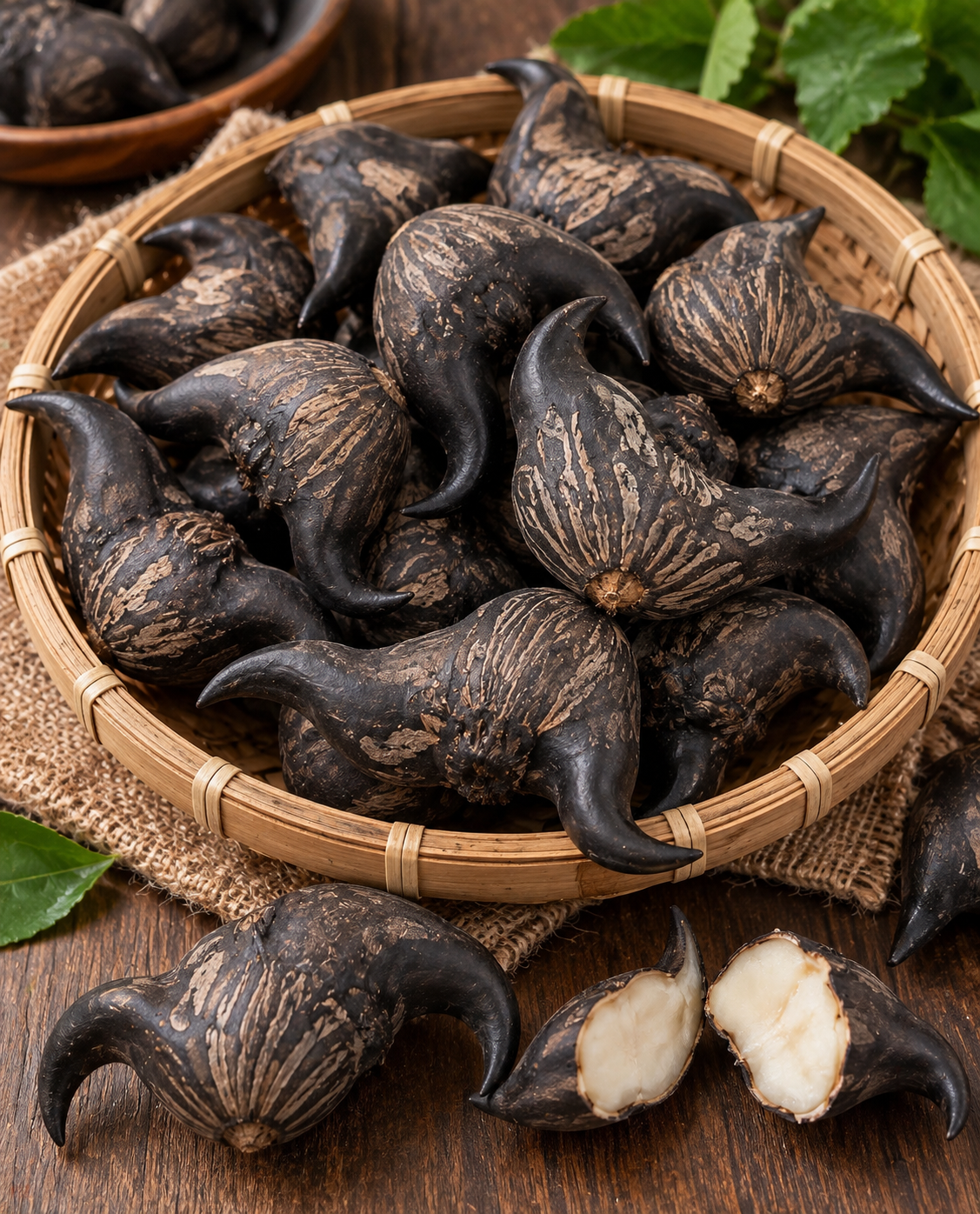
My neighbor gave me these strange fruits, and at first glance they looked almost impossible to identify. Their dark shells, sharp horn-like projections, and unusual shape make them look more like decorative objects than food.
These mysterious fruits are most likely water caltrops, aquatic fruits from plants in the genus Trapa. Depending on the region, people may call them water caltrops, horned water chestnuts, buffalo nuts, bat nuts, devil’s nuts, or singhara.
Despite their intimidating appearance, water caltrops have a long history as food in parts of Asia. Inside the hard shell sits a pale, starchy kernel that people traditionally cook before eating.
However, unfamiliar aquatic foods require caution. Proper identification matters, and thorough cooking is especially important because freshwater plants can carry microorganisms or parasites.
I remember seeing water caltrops for the first time and thinking they looked more like tiny black animals than something anyone would willingly eat. The pointed ends made them seem even stranger. Once I learned that people had been boiling, peeling, and eating them for generations, the appearance made much more sense. The biggest surprise was the contrast between the dark shell and the pale interior. Still, I would never treat an unfamiliar bag of them like ordinary fruit. Knowing where they came from and confirming what they are matters just as much as knowing how people traditionally prepare them.
My Neighbor Gave Me These Strange Fruits: What Water Caltrops Actually Are
Their Horned Shape Makes Them Easy to Remember
Water caltrops grow on aquatic plants in freshwater environments such as ponds, lakes, and slow-moving waterways.
Their fruits develop hard shells with pointed projections.
Depending on the species and variety, a water caltrop may have two, three, or four prominent points.
Those projections explain many of its colorful common names.
Some people think the fruit resembles a bat.
Others see the shape of a buffalo head.
The dramatic appearance has even inspired names such as devil’s nut.
Although these common names sound unusual, the fruit itself serves a practical biological purpose.
The hard exterior protects the seed inside.
The fruit eventually sinks or interacts with its aquatic environment in ways that support the plant’s reproductive cycle.
From a human perspective, however, the shell creates a challenge.
You cannot peel a water caltrop as easily as an apple or orange.
The exterior becomes hard and woody, while the pointed ends may feel sharp.
That means careful handling is important.
The exact appearance also varies considerably.
Some water caltrops look almost symmetrical, while others appear twisted or irregular.
Color can range from brown to nearly black when mature.
Because several species and varieties exist, one bag may look slightly different from pictures found online.
This variation is another reason a photograph should not serve as the only method for identifying an unfamiliar wild food.
Still, the combination of an aquatic origin, dark hard shell, and obvious horn-like points strongly suggests a water caltrop.
The Edible Part Hides Inside the Hard Shell
The outside of a water caltrop gives very little indication of what sits inside.
Once cooked and opened, the fruit reveals a pale, firm kernel.
That kernel contains a significant amount of starch.
People often compare its texture to a chestnut, potato, or another firm starchy food, although the exact texture depends on variety and cooking method.
The flavor usually stays relatively mild.
Some people describe it as slightly sweet or nutty.
Others notice more of an earthy, starchy taste.
Because the flavor does not overpower a dish, cooked water caltrops can work in both simple snacks and more elaborate preparations.
The edible kernel can be eaten by itself after cooking.
It can also appear in soups, rice dishes, porridges, traditional sweets, or savory dishes.
In some regions, people dry and grind the kernels into flour.
This flour can become part of traditional foods and religious fasting dishes.
The contrast between shell and kernel makes water caltrops especially memorable.
Outside, they look hard, dark, and almost threatening.
Inside, the food looks surprisingly ordinary.
However, only the interior kernel is eaten.
The shell remains tough and inedible.
Therefore, anyone preparing water caltrops needs to remove the shell carefully after cooking.
The points can remain sharp, so rushing the process is not a good idea.
Water Caltrops Are Not the Same as Regular Water Chestnuts
Similar Names Hide Important Botanical Differences
One of the biggest sources of confusion involves the name “water chestnut.”
People sometimes use that term for water caltrops, but the familiar Chinese water chestnut is a completely different plant.
Chinese water chestnuts come from Eleocharis dulcis.
They grow as underground corms attached to an aquatic sedge.
Those corms are usually round and smooth.
They are the crisp white pieces commonly found in many stir-fries and other dishes.
Water caltrops, on the other hand, belong to the genus Trapa.
They produce fruits with hard shells and distinctive horn-like projections.
Therefore, the two foods may share a common nickname, but they differ botanically and visually.
Traditional tree-grown chestnuts are different again.
Chestnuts grow on trees and develop inside spiny husks.
Their brown shells look nothing like the dark, angular structure of a mature water caltrop.
This naming confusion can make online identification more difficult.
A person might search for “water chestnut” and see several completely different foods.
For practical purposes, look at the physical structure.
A horned, dark aquatic fruit usually points toward water caltrop.
A smooth, rounded corm points toward Chinese water chestnut.
Understanding that difference matters because preparation methods may not be identical.
You should never assume that instructions for one food automatically apply to another simply because people use similar names for them.
Regional Names Can Add Even More Confusion
Water caltrops have been used in different food traditions for generations.
As a result, they carry many local names.
In parts of South Asia, people commonly know some varieties as singhara.
Elsewhere, names may refer to the horned shape or aquatic growing habit.
This naming variety reflects cultural history, but it can make identification harder for someone seeing the fruit for the first time.
One person may confidently call it a buffalo nut.
Another may call it a water chestnut.
A third may recognize it only as singhara.
All three could refer to a similar Trapa fruit.
The exact species can still differ.
That is why appearance, local knowledge, and source matter more than a single common name.
If someone gives you a bag of these fruits, ask where they came from.
Were they bought at a produce market?
Were they harvested from a pond?
Were they collected in the wild?
Does the person who gave them to you know the local name?
Those details can help establish whether the fruit is a familiar food in your area.
If the source remains uncertain, avoid eating it until someone qualified can confirm the identification.
That caution applies to any unfamiliar plant.
A social media comment can provide a useful clue, but it cannot guarantee safety.
Why Water Caltrops Should Be Cooked Before Eating
Freshwater Foods Can Carry Microorganisms and Parasites
Water caltrops grow in aquatic environments.
That means they can come into contact with microorganisms and, in some regions, parasites found in freshwater.
For this reason, eating an unidentified or raw water caltrop creates unnecessary risk.
One parasite associated with raw or inadequately prepared aquatic plants in some parts of the world is Fasciolopsis buski, an intestinal fluke.
The presence of this parasite does not mean every water caltrop is contaminated.
Risk depends on geography, water quality, harvesting conditions, and local disease patterns.
Still, the possibility illustrates why traditional cooking methods matter.
Thorough cooking can reduce many biological hazards.
Washing the shell also helps remove dirt and surface contamination before the fruit goes into a pot or steamer.
However, washing alone should not replace cooking.
A fruit can look perfectly clean and still carry invisible organisms.
That is why treating water caltrops like ordinary fresh fruit is not a good idea.
The same principle applies to many aquatic foods.
Clean water sources, proper handling, and adequate cooking all contribute to safer consumption.
If you cannot confirm what the fruit is or where it came from, the safest choice is not to eat it.
No unusual snack is worth guessing about.
Spoilage Still Matters Even If You Plan to Cook Them
Cooking cannot rescue every questionable fruit.
If a water caltrop smells unpleasant, feels unusually slimy, shows visible mold, or has obvious decay, discard it.
Spoilage can involve organisms or compounds that cooking does not always make harmless.
Therefore, start with fruits that appear sound.
Store edible water caltrops appropriately and keep them cool if they are perishable.
Avoid leaving them in a warm area for long periods.
Because local varieties and harvesting practices differ, storage guidance can vary.
A trusted vendor or regional food guide can offer more specific advice.
Handling also deserves attention.
The shell points can be sharp.
Use care when washing or moving a large quantity.
After cooking, allow the fruits to cool enough to handle safely.
Then open them carefully with an appropriate kitchen tool.
Do not squeeze or crack them aggressively in your bare hand.
The hard shell can slip, and the points can cause scratches or punctures.
Good food safety includes avoiding physical injury as well as preventing contamination.
Water Caltrops Have a Long Culinary and Cultural History
Different Regions Use Them in Different Ways
Water caltrops may look exotic to someone who has never seen them, but they are familiar seasonal foods in several parts of Asia.
In South Asia, singhara has a long culinary tradition.
People may boil the fruits, remove the shells, and eat the kernels directly.
They may also dry the kernels and grind them into flour.
This flour appears in various traditional foods.
In some communities, it has particular importance during fasting periods when certain grains are avoided.
East and Southeast Asian food traditions also include different Trapa species.
Preparation can vary by region.
Some people boil the fruits.
Others steam or roast them.
Cooked kernels may appear in snacks, desserts, porridges, soups, or savory meals.
This diversity highlights something important about unfamiliar foods.
What seems mysterious in one country may be completely ordinary somewhere else.
People often learn to recognize foods through childhood exposure and local markets.
Without that context, even a traditional ingredient can look strange.
Water caltrops demonstrate this especially well because their appearance is so dramatic.
Their long history also explains why so many common names exist.
They Also Raise Environmental Questions in Some Regions
Not every water caltrop population is welcomed.
Some Trapa species can become invasive outside their native range.
Under favorable conditions, aquatic plants may spread quickly across ponds and waterways.
Dense growth can interfere with boating, fishing, swimming, and other recreation.
It can also block light from reaching native aquatic vegetation.
For this reason, some regions regulate certain water caltrop species.
That means growing them at home or releasing seeds into local waterways may be restricted.
If you receive live fruits or seeds, do not throw them into a pond, stream, lake, or drainage system.
Even food plants can create environmental problems when introduced into the wrong ecosystem.
Instead, follow local disposal guidance.
The same caution applies if you consider growing water caltrops yourself.
They require aquatic growing conditions and may fall under invasive-species rules.
Check local agricultural or environmental regulations before cultivation.
This environmental side of the story adds another layer to an already unusual food.
Water caltrops can be a traditional food, an agricultural crop, and an invasive aquatic plant depending on location.
Context determines which description applies.
Frequently Asked Questions
What are the strange black fruits with horns?
They are most likely water caltrops from the genus Trapa. Their hard dark shells and pointed projections give them a distinctive appearance.
Are water caltrops safe to eat?
Properly identified water caltrops from a reliable food source can be edible when prepared correctly. Because they grow in freshwater, thorough cooking is generally safer than eating them raw.
Are water caltrops the same as Chinese water chestnuts?
No. Chinese water chestnuts are underground corms from Eleocharis dulcis. Water caltrops are horned fruits produced by plants in the genus Trapa.
What do water caltrops taste like?
The cooked interior is usually mild, starchy, and slightly nutty or sweet. Its texture may remind some people of chestnuts or firm potatoes.
Should I eat water caltrops if I cannot confirm where they came from?
No. If you cannot confirm the identity, source, and intended use of an unfamiliar aquatic fruit, avoiding it is the safer choice.
Conclusion
My neighbor gave me these strange fruits, and their horned appearance may make them seem almost impossible to identify at first.
They are most likely water caltrops, aquatic fruits from plants in the genus Trapa.
Their hard dark shells protect a pale, starchy kernel that people have eaten in parts of Asia for generations.
However, their unusual appearance is not the only reason to handle them carefully.
Because they grow in freshwater environments, proper identification, washing, and thorough cooking matter.
They should not be treated like ordinary raw fruit.
You should also avoid eating fruits that smell bad, show visible mold, feel slimy, or come from an unknown source.
Remember that water caltrops are different from Chinese water chestnuts and ordinary tree chestnuts despite the confusing common names.
If someone hands you a bag, the best first step is simple: ask where they came from and how the giver normally prepares them.
Once properly identified and cooked, these strange horned fruits reveal something surprisingly ordinary inside—a mild, starchy food with a long culinary history.
Their appearance may be unusual, but that is exactly what makes water caltrops such an interesting reminder of how diverse traditional foods can be.
More Blog
- Drinking Water on an Empty Stomach — What Science Actually Supports (No Hype, Just Facts)
- Waking Up Between 3 and 5 AM? It Might Be Your Soul Trying to Talk to You
- What a “Bleach” Patch on Your Underwear Really Means — And Why It’s Actually a Good Sign
- This Drink May Weaken Your Bones From The Inside — But Everyone Drinks It Anyway