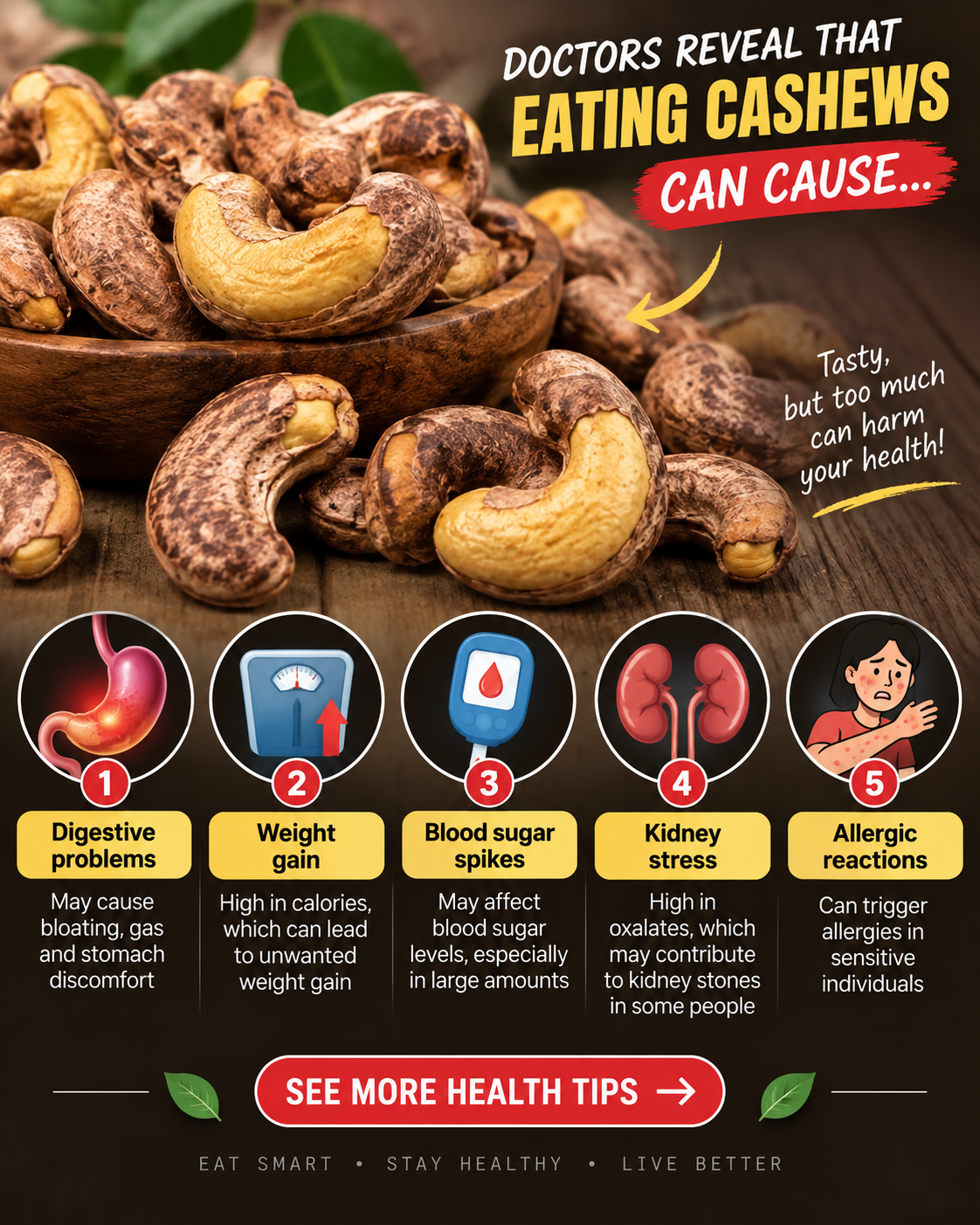
Doctors Reveal That Eating Cashews Causes… See More is the kind of headline that can make a perfectly ordinary snack sound dangerous. Cashews often appear in alarming social media posts that claim they cause weight gain, high cholesterol, kidney problems, or other serious health issues.
The reality is far more balanced.
For most people, commercially prepared cashews can fit comfortably into a healthy diet. They provide unsaturated fats, plant protein, minerals, and other nutrients. Research on nuts as a group also links regular nut intake with favorable cardiovascular outcomes when nuts replace less nutritious foods.
However, cashews are not ideal for everyone. People with cashew allergies must avoid them. Some people with certain types of kidney stones may also receive advice to limit high-oxalate foods, including some nuts. Portion size matters as well because nuts pack a considerable amount of energy into a small serving.
I used to think of cashews as one of those foods that was either completely healthy or something I needed to limit because of the fat. That changed when I started looking at what actually made up that fat. A small handful of plain cashews felt much more satisfying than a bag of crackers, and I did not feel the same urge to keep snacking afterward. What mattered most was the portion and what the cashews replaced. Adding unlimited nuts to everything would have been different. Using a modest serving instead of a highly processed snack made much more sense.
So what really happens when you eat cashews regularly? The answer depends on how much you eat, your health history, and the rest of your diet.
What Eating Cashews Regularly Can Give Your Body
Cashews Provide Unsaturated Fats, Protein, and Minerals
Cashews contain a mixture of nutrients that makes them more than just a crunchy snack.
Like other nuts, cashews provide fat and protein. Much of the fat found in nuts comes from unsaturated fatty acids, which differ from the saturated fats found in many fatty meats, butter, and certain highly processed foods.
Unsaturated fats can support healthier blood lipid patterns when they replace saturated fats in the diet. Harvard’s Nutrition Source also notes that nuts provide protein, fiber, minerals, vitamins, and other beneficial compounds.
Cashews also provide minerals such as magnesium, copper, zinc, and iron.
Magnesium supports many processes throughout the body, including normal muscle and nerve function. Copper contributes to energy metabolism and connective tissue formation. Zinc supports normal immune function, while iron contributes to oxygen transport.
However, cashews should not become your only source of these nutrients.
A balanced diet still needs vegetables, fruits, whole grains, legumes, protein-rich foods, and other sources of healthy fats.
That variety matters because no single nut contains everything your body needs.
When Doctors Reveal That Eating Cashews Causes… See More appears in a viral warning, it often leaves out this broader nutritional context.
Cashews do contain fat. However, dietary fat itself does not automatically make a food unhealthy.
The type of fat matters.
For example, replacing chips, pastries, or other highly processed snacks with a small serving of plain cashews can improve the nutritional quality of your snack.
On the other hand, adding several large handfuls of cashews to an already calorie-heavy diet may increase your overall calorie intake.
Therefore, the best way to think about cashews involves balance rather than fear.
They provide useful nutrients, but portion size and the rest of your diet still matter.
Cashews Can Help Make Snacks More Satisfying
Cashews may also help make meals or snacks feel more substantial.
They contain fat, protein, and some fiber. That combination can take longer to eat and digest than many refined snack foods.
As a result, a modest portion may feel satisfying.
Consider the difference between eating a handful of plain cashews and grabbing a handful of candy.
Both foods provide calories. However, cashews also provide protein, unsaturated fat, minerals, and other nutrients.
That does not mean you can eat unlimited amounts.
Nuts are energy-dense foods. Harvard notes that nuts average roughly 185 calories per ounce, which means large servings can add calories quickly. For that reason, nuts work particularly well when they replace another snack rather than when you simply add them on top of everything else you already eat.
A practical serving often looks like a small handful.
You can also combine cashews with fruit for a more balanced snack. For example, cashews with an apple or orange provide fat and protein from the nuts along with water, carbohydrates, and fiber from the fruit.
Cashews can also add texture to oatmeal, yogurt, salads, vegetable dishes, or grain bowls.
However, flavored varieties deserve extra attention.
Honey-coated, caramelized, heavily salted, or chocolate-covered cashews can contain much more added sugar, sodium, or calories than plain versions.
That does not make them forbidden foods.
It simply means they function more like treats than everyday plain nuts.
If you eat cashews regularly, plain or lightly roasted versions make the easiest everyday choice.
In that context, Doctors Reveal That Eating Cashews Causes… See More becomes less alarming.
For most people, a modest portion of cashews can simply serve as a filling, nutrient-rich snack.
How Cashews May Fit Into Heart and Weight Management
Nuts Can Support a Heart-Friendly Eating Pattern
Nuts have received considerable attention in cardiovascular nutrition research.
Large observational studies have found associations between regular nut consumption and lower rates of cardiovascular disease. Harvard’s Nutrition Source notes that people who eat nuts several times per week have shown lower cardiovascular risk in multiple large studies.
However, that does not mean cashews act like a medicine.
The benefit likely comes from several factors working together.
Nuts provide unsaturated fats, fiber, minerals, plant protein, and other compounds. In addition, people may receive the greatest benefit when nuts replace foods that contain more saturated fat, refined carbohydrates, or sodium.
That replacement effect matters.
For example, swapping a processed snack for plain cashews changes more than one nutrient.
You may reduce refined carbohydrates while increasing unsaturated fat and protein.
Likewise, using chopped cashews over a salad may provide a different nutritional profile than topping the salad with bacon or a large amount of cheese.
The American nutrition conversation around fat has changed for this reason.
Health professionals now pay close attention to the type of fat people eat rather than simply recommending extremely low-fat diets.
Harvard describes unsaturated fats as beneficial fats that can help improve blood cholesterol levels when they replace less healthy fats.
Therefore, claims that cashews automatically raise cholesterol because they contain fat oversimplify the issue.
Still, cashews cannot cancel out an otherwise poor diet.
Eating a handful of nuts does not erase the effects of regularly consuming large amounts of processed meat, sugary drinks, or highly refined foods.
The entire eating pattern matters.
That means cashews work best as one component of a diet built around vegetables, fruit, whole grains, legumes, lean proteins, and healthier sources of fat.
Cashews Do Not Automatically Cause Weight Gain
Another common warning claims that cashews cause weight gain because they contain many calories.
The first part is true.
Cashews are calorie-dense.
However, the conclusion does not automatically follow.
Body weight changes according to total energy intake over time, along with physical activity, sleep, medications, health conditions, genetics, and many other factors.
One small serving of cashews does not cause weight gain by itself.
What matters is how the serving fits into the rest of the day.
If you replace cookies or chips with a small portion of cashews, your total calorie intake may remain similar while the nutritional quality of your snack improves.
You may also feel more satisfied.
However, if you continue eating all your usual meals and snacks and then add several handfuls of cashews every day, those additional calories can add up.
That is why Doctors Reveal That Eating Cashews Causes… See More needs context.
Cashews can support a balanced eating pattern, but they remain an energy-dense food.
Mindful portions help.
You do not need to count every cashew. Still, pouring nuts directly from a large container can make it surprisingly easy to eat several servings.
Instead, place a modest amount in a bowl.
Then put the container away.
You can also use cashews as an ingredient rather than a stand-alone snack.
Sprinkle chopped cashews over vegetables. Add a spoonful to oatmeal. Mix a small serving into yogurt.
These strategies provide flavor and texture without making nuts the entire meal.
The bigger lesson is simple.
Weight management does not require fearing calorie-dense foods.
It requires understanding portions and the total eating pattern.
Cashews can fit into that pattern when you use them intentionally.
When Eating Cashews Can Actually Cause Problems
Cashew Allergies Can Be Serious
Cashew allergy represents one of the most important exceptions to the idea that cashews are safe for everyone.
Cashews belong to the tree nut category.
Tree nut allergies can cause severe reactions, including anaphylaxis. Food allergy guidance also notes clinically important cross-reactivity between certain tree nuts, including cashew and pistachio.
Symptoms of an allergic reaction may include hives, itching, swelling, vomiting, breathing difficulty, dizziness, or a sudden drop in blood pressure.
A severe allergic reaction requires emergency medical attention.
Therefore, someone with a known cashew allergy should not experiment with eating small amounts simply because cashews offer nutritional benefits.
Avoidance remains necessary.
People with other tree nut allergies should also follow the plan provided by their allergist.
Not everyone with one nut allergy reacts to every nut. However, cross-contact and cross-reactivity can complicate the picture.
That makes personalized medical guidance important.
Food labels deserve attention too.
Cashews can appear in sauces, vegan cheeses, desserts, energy bars, nut butters, and dairy-free foods because their creamy texture works well in recipes.
Someone with a serious allergy cannot rely solely on recognizing visible whole nuts.
This is one area where a viral headline about danger can accidentally hide a real concern.
For most people, cashews are nutritious.
For someone with a cashew allergy, even a small amount can create a serious medical emergency.
That distinction matters.
If you have eaten cashews many times without a reaction, there is usually no reason to become frightened by sensational claims.
However, if cashews consistently cause itching, swelling, throat symptoms, wheezing, or another allergic-type reaction, stop eating them and seek appropriate medical evaluation.
Allergy symptoms deserve more attention than internet rumors.
Kidney Stones and Digestive Sensitivity May Require Individual Attention
Cashews may also require more thought for people with certain kidney stone histories.
Oxalates naturally occur in many plant foods, including nuts.
The National Kidney Foundation notes that people who form calcium oxalate kidney stones may receive individualized advice to limit foods that contain a lot of oxalate. It also emphasizes that kidney stone prevention should depend on the specific type of stone and the person’s overall health.
That means someone with a history of kidney stones should not automatically eliminate every nut.
Instead, follow guidance based on your stone type.
Adequate fluid intake also plays an important role in kidney stone prevention.
Digestive comfort presents another consideration.
Eating a large amount of cashews at once may cause bloating, gas, or stomach discomfort in some people.
Nuts contain fat and fiber, and individual tolerance varies.
People with sensitive digestive systems may find smaller portions easier to manage.
Preparation also matters.
Heavily salted cashews can add substantial sodium if eaten frequently. That makes plain or lightly salted versions a better everyday option for people who need to watch sodium intake.
Cashews can also appear in creamy plant-based products.
Those products may contain additional oils, salt, sugar, or other ingredients. Therefore, read the ingredient list rather than assuming every cashew-based food offers the same nutritional profile as whole cashews.
The key point remains individualization.
When Doctors Reveal That Eating Cashews Causes… See More appears online, it may present a special concern as if it applies to everyone.
Usually, it does not.
Kidney stone history, allergy status, digestive tolerance, and other medical factors can change what makes sense for one person.
For everyone else, moderate cashew consumption generally fits within the same basic principles that apply to other nuts.
How to Eat Cashews Without Falling for Common Myths
Choose Reasonable Portions and Simple Preparations
The easiest way to enjoy cashews regularly involves keeping things simple.
Start with plain, dry-roasted, or lightly salted cashews.
A small handful works well as a snack or meal addition.
You can pair cashews with fruit, yogurt, oats, or vegetables.
You can also chop them and use them as a topping.
Cashews work especially well in stir-fries, salads, grain bowls, curries, and vegetable dishes because they add crunch and richness.
However, portion awareness still matters.
Because nuts contain many calories in a small volume, eating directly from a large bag can make it difficult to notice how much you have consumed.
Pre-portioned servings can solve that problem.
You can also mix cashews with other foods rather than eating an entire bowl of nuts.
For example, combine a few cashews with berries and plain yogurt.
Or add chopped cashews to a vegetable salad.
These combinations improve variety and create a more complete snack or meal.
Also pay attention to added ingredients.
Salted nuts can contribute significant sodium if you eat large servings frequently.
Sweetened or candied cashews can contain a substantial amount of added sugar.
Chocolate-covered versions may function more like dessert.
Again, those foods can still fit occasionally.
However, they differ from plain cashews.
When choosing everyday options, simpler usually works better.
That approach also helps put Doctors Reveal That Eating Cashews Causes… See More into perspective.
The real question is rarely whether cashews are universally healthy or harmful.
The useful question is how they fit into your diet.
A small serving of plain nuts can provide unsaturated fats, protein, and minerals.
A giant bowl of sweetened nuts may deliver far more calories and sugar.
The food looks similar, but the dietary effect can differ substantially.
Avoid Extreme Claims in Either Direction
Cashews do not deserve to be feared.
They also do not deserve miracle-food status.
That balance matters.
Eating cashews will not instantly unclog arteries, cure diabetes, eliminate inflammation, or guarantee weight loss.
At the same time, moderate nut consumption does not automatically cause obesity, high cholesterol, or kidney disease in healthy people.
Health outcomes come from much larger patterns.
Your regular diet, physical activity, sleep, smoking status, blood pressure, genetics, body weight, medical conditions, and medications all play roles.
Cashews occupy only one small place in that picture.
This is why sensational nutrition headlines create so much confusion.
They often take one small finding and turn it into a universal warning.
For example, a person with a tree nut allergy absolutely should avoid cashews.
However, that does not mean cashews are dangerous for everyone.
A person who forms certain kidney stones may need to manage oxalate-rich foods.
That does not mean everyone should stop eating nuts.
A person who routinely eats several hundred extra calories from nuts may gain weight.
That does not mean a small serving inevitably causes weight gain.
Context changes everything.
The best approach involves choosing minimally processed foods, eating varied meals, and using portions that match your needs.
Cashews can fit into that approach.
You can enjoy them several ways without treating them as either medicine or poison.
Ultimately, Doctors Reveal That Eating Cashews Causes… See More becomes much less frightening when you look beyond the headline.
For most people, the evidence supports a simpler conclusion.
Cashews can serve as a nutritious food when eaten in appropriate portions as part of a varied diet.
Frequently Asked Questions
Are cashews healthy to eat every day?
For most people, a modest serving of cashews can fit into a healthy daily diet. Cashews provide unsaturated fats, protein, minerals, and other nutrients. However, portion size matters because nuts are calorie-dense.
Do cashews raise cholesterol?
Cashews do not automatically raise cholesterol simply because they contain fat. Nuts contain substantial amounts of unsaturated fat, and replacing saturated-fat-rich foods with unsaturated fats can support healthier blood lipid patterns. Your entire diet still matters.
Can cashews make you gain weight?
Cashews can contribute to weight gain if they regularly push your total calorie intake above what your body uses. However, a modest serving does not automatically cause weight gain. Nuts may fit well into weight-management diets when they replace less nutritious snacks.
Who should avoid cashews?
People with a diagnosed cashew allergy should avoid them. People with certain kidney stone conditions may also need individualized advice about nut and oxalate intake. Anyone with a medical condition that affects dietary needs should follow guidance from their healthcare professional.
Are raw cashews dangerous?
Cashews sold for eating commercially have undergone processing that makes them suitable for consumption. Consumers should buy cashews from established food retailers rather than trying to eat nuts directly from unprocessed cashew shells.
Conclusion
Doctors Reveal That Eating Cashews Causes… See More sounds alarming, but most healthy people do not need to fear cashews.
Cashews provide unsaturated fats, plant protein, minerals, and other nutrients. Nuts as a group can fit well into heart-conscious eating patterns, particularly when they replace foods higher in saturated fat or highly refined carbohydrates.
However, cashews still require common sense.
They contain many calories in a relatively small serving. Therefore, large portions can quickly add significant energy to your diet.
People with cashew allergies must avoid them because allergic reactions can become severe. Meanwhile, people who form certain types of kidney stones may need personalized guidance about oxalate-containing foods.
For everyone else, a simple strategy works well.
Choose plain or lightly seasoned cashews most often. Keep portions reasonable. Use them to replace less nutritious snacks rather than adding unlimited amounts to your regular diet. Pair them with fruit, vegetables, whole grains, yogurt, or other nutritious foods.
Most importantly, ignore claims that turn one food into either a cure or a threat.
Cashews cannot transform your health by themselves. However, they can contribute valuable nutrients to a balanced eating pattern.
In the end, the truth behind Doctors Reveal That Eating Cashews Causes… See More is much less dramatic than the headline suggests: for most people, cashews are not something to fear. They are simply a nutrient-rich food best enjoyed in sensible portions as part of a varied diet.
More Blog
- Drinking Water on an Empty Stomach — What Science Actually Supports (No Hype, Just Facts)
- Waking Up Between 3 and 5 AM? It Might Be Your Soul Trying to Talk to You
- What a “Bleach” Patch on Your Underwear Really Means — And Why It’s Actually a Good Sign
- This Drink May Weaken Your Bones From The Inside — But Everyone Drinks It Anyway