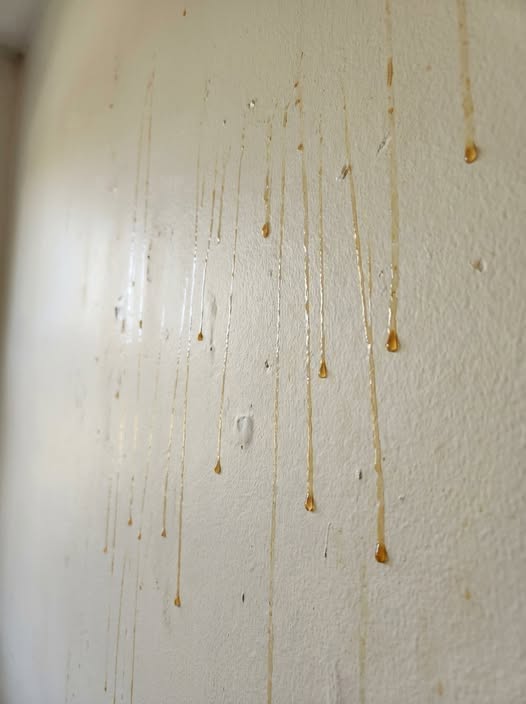
You walk into the bathroom and notice something unusual: yellow or brownish droplets slowly running down the walls.
It can look alarming, particularly when the walls were recently cleaned. But yellow bathroom streaks aren’t caused by one single problem. They can result from condensation interacting with residues on the wall, mineral deposits, old smoke contamination, paint components, or—in some cases—a hidden moisture problem.
Identifying the source is important because repeatedly wiping the walls won’t solve an underlying leak or ventilation issue.
1. Condensation Is Often the Starting Point
Bathrooms generate enormous amounts of humidity.
During a hot shower, water vapor fills the room and eventually condenses on cooler surfaces such as painted walls and ceilings. Those droplets can dissolve or carry substances already present on the surface.
As the water travels downward, it creates visible yellow or brown streaks.
This explains why the problem often appears after long, hot showers and may be worse in bathrooms without an effective exhaust fan or window.
2. Paint Surfactant Leaching
One frequently overlooked explanation is the paint itself.
Latex paints contain substances called surfactants, which help stabilize the paint during manufacturing and application. Under very humid conditions, some of these compounds can migrate toward the painted surface.
They may appear as:
- Yellowish or brownish droplets
- Sticky or oily-looking streaks
- Shiny patches
- Marks that repeatedly return after showers
This phenomenon is commonly called surfactant leaching.
It can occur particularly in humid rooms and doesn’t necessarily mean something dangerous is growing inside the wall.
Improving ventilation and gently cleaning the surface can help, although persistent cases may eventually require repainting with a product appropriate for bathrooms.
3. Old Tobacco Residue
If the home previously belonged to smokers, another possibility is residue accumulated on walls and ceilings.
Smoke can leave yellow-brown contamination on painted surfaces. When bathroom humidity condenses on those surfaces, some of that residue can become visible again as discolored streaks.
This can happen even if nobody currently smokes in the home.
Older properties may therefore develop mysterious yellow drips long after the original source disappeared.
4. Hard Water and Mineral Deposits
Water containing elevated levels of minerals can leave visible deposits as droplets evaporate.
Iron is particularly associated with yellow, orange, or rusty discoloration.
If similar staining appears around faucets, showerheads, toilets, sinks, or other places where water regularly sits, mineral-rich water becomes a more plausible explanation.
However, mineral deposits alone are less likely to explain widespread yellow streaks appearing high on bathroom walls unless water or condensation is regularly reaching those surfaces.
5. Soap, Oils and Product Residue
Bathrooms accumulate microscopic residues from everyday activities.
Shampoo, conditioner, hairspray, body products, cleaning sprays, soaps, and skin oils can gradually settle on surrounding surfaces.
When condensation forms, these residues may combine with water and travel downward, creating streaks.
Regular cleaning and better ventilation usually reduce this type of buildup.
6. Could It Be Bacteria or Mold?
Microbial growth is another possibility, particularly when a bathroom remains damp for long periods.
Certain bacteria can produce pink, reddish, or orange discoloration around wet bathroom surfaces. Mold can appear in many different colors and patterns.
However, color alone isn’t enough to identify a microorganism.
A yellow streak shouldn’t automatically be labeled mold or bacteria simply because it appeared in a humid bathroom.
Look instead for accompanying clues such as persistent musty odors, recurring patches, deteriorating surfaces, or moisture that remains even when nobody has recently showered.
7. The Possibility You Shouldn’t Ignore: A Hidden Leak
Yellow or brown discoloration can sometimes indicate water moving through building materials.
This deserves more attention if the stain:
- Appears when nobody has showered
- Continues getting larger
- Is concentrated around the ceiling or one particular wall
- Produces bubbling or peeling paint
- Makes drywall feel soft
- Is accompanied by a musty smell
- Returns quickly after cleaning
A leaking pipe, roof problem, waterproofing failure, or water coming from a room above could be responsible.
In that situation, cleaning the stain only hides the symptom.
The source of the moisture needs to be found.
A Simple Way to Narrow Down the Cause
Pay attention to when the yellow liquid appears.
If it develops primarily during or immediately after hot showers across several painted surfaces, condensation, surface residue, or paint surfactants are reasonable possibilities.
If it originates from one specific location regardless of shower use, investigate for a leak.
If staining is concentrated around plumbing fixtures, consider mineral deposits, corrosion, or plumbing-related moisture.
And if the wall is damaged, persistently damp, or producing significant microbial growth, professional inspection may be appropriate.
How to Prevent Yellow Bathroom Drips
Good moisture control makes the biggest difference.
Use the exhaust fan during showers and leave it running afterward. Open a window when practical, keep bathroom surfaces reasonably clean, and allow wet walls to dry instead of keeping the room closed and humid.
Most importantly, don’t simply repaint persistent stains without determining why they appeared.
The Bottom Line
Yellow liquid running down bathroom walls is usually a symptom, not a diagnosis.
Sometimes the explanation is relatively harmless—condensation interacting with paint or accumulated residue. Other times, the discoloration can reveal excessive humidity or hidden water intrusion.
The location, timing, texture, smell, and condition of the surrounding wall provide much better clues than color alone.
And if the yellow streaks keep returning from exactly the same spot, the most important question isn’t how to clean them—it’s where the moisture is coming from.
More Blog
- Drinking Water on an Empty Stomach — What Science Actually Supports (No Hype, Just Facts)
- Waking Up Between 3 and 5 AM? It Might Be Your Soul Trying to Talk to You
- What a “Bleach” Patch on Your Underwear Really Means — And Why It’s Actually a Good Sign
- This Drink May Weaken Your Bones From The Inside — But Everyone Drinks It Anyway