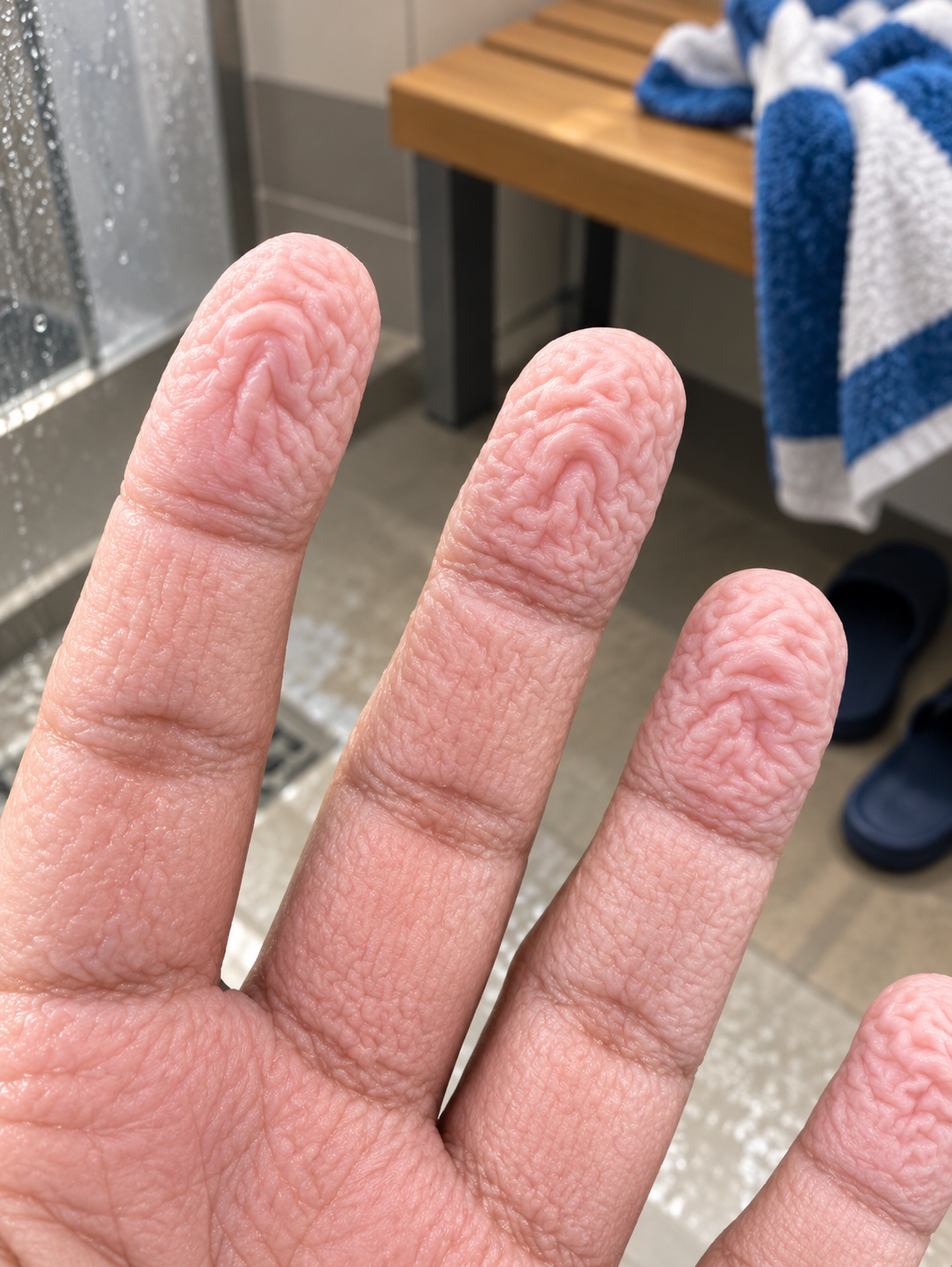
Wrinkled Fingers After Water Exposure are usually a completely normal response to spending time in a bath, swimming pool, shower, or sink. The fingertips and palms develop familiar grooves after several minutes in water, then gradually return to normal once the hands dry.
Many people assume that fingers wrinkle simply because the skin absorbs water and swells. However, the process involves the autonomic nervous system and changes in the small blood vessels beneath the skin. Researchers have linked normal water-immersion wrinkling to sympathetic nerve activity and vasoconstriction in the fingers and palms.
Most temporary wrinkling needs no treatment. However, extremely rapid or unusually pronounced changes can sometimes represent a rare condition called aquagenic wrinkling of the palms. That condition can cause dramatic wrinkles, swelling, pale bumps, itching, or discomfort within only a few minutes of water contact.
I used to notice my fingertips after washing dishes and assume the skin had simply soaked up too much water. The changes looked dramatic but disappeared so quickly that I never thought much about them. What surprised me later was learning that the nervous system plays an important role. That made the everyday phenomenon much more interesting. I also learned that there is an important difference between ordinary temporary wrinkling and hands that develop intense white, swollen, painful, or itchy areas almost immediately after touching water. Paying attention to that difference makes the subject much easier to understand without becoming unnecessarily worried about normal changes.
Why Wrinkled Fingers After Water Exposure Happen
Your Nervous System Helps Create the Wrinkles
Normal Wrinkled Fingers After Water Exposure involve more than the outer layer of skin.
When your hands remain in water, the autonomic nervous system triggers changes in the small blood vessels beneath the hairless skin of the fingers and palms.
Those vessels constrict.
As the volume of tissue beneath the surface changes, the overlying skin forms ridges and grooves.
Research into water-immersion wrinkling has connected the response with sympathetic nerve function and vasoconstriction.
This explanation also helps account for an interesting medical observation.
People with certain nerve injuries may show reduced or absent water-induced finger wrinkling in affected areas.
That finding helped scientists recognize that the process does not result from passive water absorption alone.
However, doctors do not use finger wrinkling by itself to diagnose nerve disorders.
Many factors can affect how quickly or strongly someone’s fingers wrinkle.
Temperature, duration of exposure, skin condition, and individual differences may all influence what you see.
Therefore, ordinary variation does not automatically signal a neurological problem.
For most people, Wrinkled Fingers After Water Exposure appear after several minutes and disappear after the hands dry.
That reversible pattern represents normal physiology.
No cream, medication, or special treatment needs to stop it.
Instead, the skin gradually smooths as the vascular and nerve response returns toward its usual state.
The key distinction comes from timing, severity, and additional symptoms.
Ordinary wrinkles after a long bath differ significantly from palms that turn dramatically white, swollen, itchy, painful, or deeply wrinkled within only a few minutes.
Wrinkles May Help With Wet Grip
Scientists have also explored why humans developed this response in the first place.
One idea suggests that wrinkled fingertips may improve handling of wet objects.
The grooves could help move water away from the contact surface, somewhat like tread patterns help manage water beneath a tire.
Experiments have produced evidence that wrinkled fingers can improve handling of wet objects under certain conditions, although researchers continue to study the full evolutionary significance.
Therefore, Wrinkled Fingers After Water Exposure may represent a useful adaptation rather than a meaningless side effect of getting wet.
The response occurs most noticeably on the palms and fingertips.
These areas contain thick, specialized hairless skin designed for gripping and fine touch.
They also contain abundant sweat glands and specialized blood vessel networks.
That combination makes the palms and fingers different from many other areas of skin.
Normal wrinkles usually appear gradually.
They should also fade after water exposure ends.
A person who spends 20 minutes swimming may notice deep fingertip grooves afterward.
That alone generally does not indicate illness.
Likewise, people may wrinkle at slightly different speeds.
Water temperature and individual physiology can influence the response.
The important point is that normal Wrinkled Fingers After Water Exposure remain temporary and usually cause no pain, itching, swelling, or persistent skin damage.
Once the hands dry, the appearance should gradually return toward normal.
If the changes behave very differently from that pattern, another explanation may deserve consideration.
When Finger Wrinkling May Be Unusual
Aquagenic Wrinkling Can Develop Very Quickly
Aquagenic wrinkling of the palms represents a rare skin condition that looks more dramatic than ordinary water-induced wrinkling.
People with this condition can develop excessive wrinkles within only a few minutes of water exposure.
The palms may also develop swollen, translucent, whitish, or yellowish bumps and plaques.
Some people experience itching, burning, or pain.
A clinical review notes that normal palmar wrinkling may become apparent after roughly 11 minutes of immersion, while aquagenic wrinkling can appear within around 3 minutes in affected individuals. The changes commonly resolve after water exposure ends.
That distinction makes timing particularly useful.
If Wrinkled Fingers After Water Exposure begin only after prolonged swimming and cause no discomfort, they usually fit the normal pattern.
By contrast, dramatic palm changes after a very brief shower or handwashing session deserve more attention, especially when the reaction happens repeatedly.
Aquagenic wrinkling usually affects both palms, although unusual patterns can occur.
The soles may occasionally become involved as well.
Doctors generally consider the person’s history and examine the hands.
In some situations, a short water-immersion test can make the characteristic changes easier to observe.
However, a clinician should interpret those findings rather than relying on home testing alone.
The condition itself remains uncommon.
Therefore, people should not assume that ordinary wrinkling means they have a rare disease.
Instead, look for a combination of unusually fast onset, excessive wrinkling, swelling, white papules, pain, or itching.
Those features distinguish aquagenic wrinkling from the harmless changes most people experience.
Some Medical Conditions Have Associations With Excessive Wrinkling
Researchers have found a notable association between aquagenic wrinkling of the palms and cystic fibrosis.
It can also occur in some people who carry a cystic fibrosis-related gene variant without having classic cystic fibrosis.
For that reason, clinicians may consider further evaluation when a person has clear aquagenic wrinkling along with a family history or symptoms that raise concern for cystic fibrosis.
However, Wrinkled Fingers After Water Exposure alone do not diagnose cystic fibrosis.
That point matters.
Ordinary fingertip wrinkling affects healthy people every day.
Even aquagenic wrinkling can occur without an identifiable underlying disorder.
Medical literature has also described associations with excessive sweating, atopic dermatitis, Raynaud disease, and certain medications. Researchers have reported drug-related cases involving medicines that influence salt transport or related pathways.
Therefore, a clinician may look at the entire medical picture rather than focusing only on the hands.
Age, family history, respiratory symptoms, digestive problems, medications, sweating patterns, and skin findings can all provide useful context.
You should avoid stopping a prescription medicine simply because you notice wrinkling.
Instead, discuss the change with the healthcare professional who prescribed the medication.
They can decide whether the timing and pattern suggest a possible connection.
Likewise, do not interpret Wrinkled Fingers After Water Exposure as evidence of a specific genetic condition based on photographs or social media claims.
The overwhelming majority of temporary water wrinkles reflect normal physiology.
Medical evaluation becomes more appropriate when the reaction appears unusually fast, severe, persistent, painful, or accompanied by other unexplained symptoms.
How Water, Soap, and Dryness Affect Your Hands
Frequent Washing Can Damage the Skin Barrier
Not every unusual-looking hand after water exposure comes from an uncommon medical disorder.
Repeated washing can irritate the skin barrier.
Soap, detergent, cleaning products, and frequent exposure to water remove some of the oils that help keep skin flexible.
As a result, the hands can become dry, rough, flaky, tight, or cracked.
Those changes may make normal Wrinkled Fingers After Water Exposure appear more dramatic.
People who wash their hands many times every day can experience this problem.
Healthcare workers, cleaners, food-service workers, hairdressers, caregivers, and parents may have particularly frequent exposure.
Household chores can contribute as well.
Long dishwashing sessions combine water with detergent, creating an environment that can strip the skin barrier.
Hand sanitizer can also contribute to dryness in some people, especially when they already have irritated skin.
However, proper hand hygiene remains important.
The goal should not be to avoid necessary washing.
Instead, protect the skin between exposures.
Use lukewarm rather than extremely hot water when practical.
Choose a mild cleanser when you do not need a stronger product for a particular task.
Dry your hands gently rather than rubbing aggressively.
Then, apply a fragrance-free moisturizer.
Thicker creams and ointments usually reduce moisture loss more effectively than thin lotions.
If Wrinkled Fingers After Water Exposure come with chronic cracking, redness, or itching between water exposures, skin irritation or hand eczema may play a role.
A dermatologist or other healthcare professional can assess persistent symptoms.
Moisturizers and Gloves Can Protect Irritated Hands
A simple skin-care routine can make a noticeable difference when repeated water exposure causes dryness.
Apply moisturizer after washing while the skin remains slightly damp.
This helps trap moisture in the outer skin layer.
Look for uncomplicated fragrance-free products when your skin reacts easily.
Petrolatum-based ointments or thick barrier creams can work particularly well overnight.
Protective gloves also help during wet household work.
For example, wearing suitable gloves while washing dishes can reduce prolonged contact with water and detergent.
However, sweaty hands inside gloves can also become irritated.
Therefore, remove the gloves when the task ends and let your hands dry.
For longer jobs, cotton glove liners may improve comfort for some people.
These measures target irritation and dryness.
They do not prevent the normal nervous-system response responsible for Wrinkled Fingers After Water Exposure.
Likewise, ordinary moisturizers do not treat true aquagenic wrinkling of the palms.
Medical treatments for confirmed aquagenic wrinkling differ.
Published reviews describe topical aluminum chloride as a commonly used first treatment, particularly when excessive sweating contributes to symptoms. Other approaches have been tried when symptoms persist, although treatment effectiveness varies.
People should not start concentrated treatments based solely on photographs from the internet.
Those products can irritate skin.
A clinician can first determine whether the changes represent normal wrinkling, irritant dermatitis, eczema, aquagenic wrinkling, or something else.
That distinction prevents unnecessary treatment.
When to Talk With a Healthcare Professional
Look for Pain, Color Changes, or Wrinkling Without Water
Ordinary Wrinkled Fingers After Water Exposure should happen after getting the hands wet.
Therefore, persistent wrinkling that appears without meaningful water contact deserves a different evaluation.
Seek medical advice when changes come with significant pain, numbness, unusual weakness, persistent swelling, open sores, or major color changes.
Blue, very pale, or unusually cold fingers can involve circulation or vascular responses that require assessment, particularly when symptoms are severe or new.
Skin peeling also deserves attention when it becomes extensive.
A small amount of dryness can occur after frequent handwashing.
However, widespread peeling, blisters, painful fissures, or recurrent inflammation may indicate eczema, contact dermatitis, infection, or another skin disorder.
Rapid water-related changes can justify evaluation as well.
If your palms develop dramatic white bumps, swelling, pronounced wrinkling, itching, or burning within only a few minutes every time they touch water, take note of the pattern.
Photographs taken during an episode may help a clinician because the changes can disappear before an appointment.
Aquagenic wrinkling itself often resolves within minutes after drying.
Keep the context in mind.
Normal Wrinkled Fingers After Water Exposure do not require medical tests simply because the wrinkles look deep.
Instead, clinicians become more interested when the reaction differs clearly from your previous pattern or comes with additional symptoms.
The same principle applies when only one hand changes dramatically while the other behaves normally.
A healthcare professional can determine whether neurological, vascular, or dermatologic assessment makes sense.
Keep Normal Wrinkling in Perspective
For most people, the correct response to water-wrinkled fingertips is simple: dry your hands and continue your day.
The wrinkles should gradually fade.
No detoxification method, supplement, special soak, or treatment needs to remove them.
They do not show that the body has become dangerously waterlogged.
They also do not prove dehydration, vitamin deficiency, kidney disease, or another systemic illness on their own.
The physiology behind Wrinkled Fingers After Water Exposure actually shows how actively the body responds to the environment.
The nervous system can adjust blood vessel tone within the fingertips, producing visible changes on the skin.
That ordinary response has fascinated researchers precisely because something so familiar involves surprisingly complex biology.
At the same time, knowing what normal looks like makes unusual changes easier to recognize.
Regular temporary wrinkles after a bath or swim fit the expected pattern.
Rapid excessive wrinkling with whitish swelling, pain, or itching does not fit as neatly.
Persistent symptoms without water exposure deserve even more attention.
When uncertainty remains, a primary care clinician or dermatologist can examine the skin and review related symptoms.
If true aquagenic wrinkling appears likely, medical history may guide whether additional investigation makes sense.
That balanced approach avoids two extremes.
You do not need to fear ordinary water wrinkles.
However, you also do not need to ignore persistent or uncomfortable changes simply because wrinkling often happens normally.
Frequently Asked Questions
Why do fingers wrinkle after being in water?
Your autonomic nervous system contributes to the process by causing blood vessels beneath the finger and palm skin to constrict. This changes the volume beneath the skin and creates the familiar ridged appearance.
How long should Wrinkled Fingers After Water Exposure last?
Normal wrinkles usually begin fading after the hands leave the water and dry. The exact timing varies. Aquagenic wrinkling can also resolve after drying, although it tends to develop much faster and may involve white bumps, swelling, itching, or pain.
Does wrinkling mean my skin absorbed too much water?
Not simply. Water affects the skin, but the characteristic fingertip wrinkling response depends substantially on nervous-system-controlled blood vessel changes rather than passive swelling alone.
Are very fast water wrinkles a sign of cystic fibrosis?
Not necessarily. Aquagenic wrinkling has a documented association with cystic fibrosis and CF carrier status, but fast wrinkling alone cannot diagnose either condition. A clinician can decide whether additional evaluation makes sense based on the complete medical history.
When should I see a doctor about wrinkled fingers?
Consider medical evaluation when wrinkling occurs without water exposure or comes with significant pain, numbness, persistent swelling, dramatic discoloration, sores, severe peeling, or repeated rapid swelling and whitish bumps after brief water contact.
Conclusion
Wrinkled Fingers After Water Exposure usually represent a normal and temporary biological response.
The familiar grooves that appear after swimming, bathing, or washing dishes involve the autonomic nervous system and constriction of small blood vessels beneath the skin.
For most people, the wrinkles cause no discomfort and disappear naturally after the hands dry.
Therefore, ordinary water-related wrinkling does not require treatment.
However, unusually rapid or excessive wrinkling deserves a closer look when it repeatedly appears within only a few minutes.
A rare condition called aquagenic wrinkling of the palms can cause pronounced wrinkles, swelling, pale bumps, itching, or pain after brief water exposure.
Medical research has documented associations with cystic fibrosis and several other factors, although the presence of wrinkled fingers alone does not diagnose any particular disease.
Frequent handwashing and exposure to soap can create a different problem by weakening the skin barrier.
In that situation, gentle cleansing, protective gloves when appropriate, and regular fragrance-free moisturizer may reduce dryness and cracking.
Ultimately, context matters most.
Temporary Wrinkled Fingers After Water Exposure without other symptoms usually belong to normal physiology.
In contrast, severe pain, numbness, unusual color changes, sores, persistent swelling, or dramatic rapid wrinkling with skin changes deserve professional evaluation.
Understanding that difference makes it easier to appreciate a fascinating everyday body response while still recognizing when your hands may need additional attention.
Focus Keyword: Wrinkled Fingers After Water Exposure
SEO Title: Wrinkled Fingers After Water Exposure: What Your Hands May Reveal
Meta Description: Wrinkled Fingers After Water Exposure are usually normal, but rapid or painful changes may deserve attention. Learn what causes them.
Expert SEO Title: Wrinkled Fingers After Water Exposure: 7 Powerful Facts Explained
Midjourney Prompt: Realistic professional medical lifestyle photography of Wrinkled Fingers After Water Exposure, close-up of two clean adult hands after bathing with naturally pruned fingertips and palms, visible realistic water droplets, healthy skin tones, subtle comparison between normal wrinkling and slightly more pronounced palm wrinkling, bright clean bathroom or sink environment, soft natural daylight, non-alarming educational health aesthetic, highly detailed skin texture, photorealistic macro photography, vertical Pinterest composition, generous clean negative space in upper portion for text overlay –v 6 –ar 2:3
More Blog
- Drinking Water on an Empty Stomach — What Science Actually Supports (No Hype, Just Facts)
- Waking Up Between 3 and 5 AM? It Might Be Your Soul Trying to Talk to You
- What a “Bleach” Patch on Your Underwear Really Means — And Why It’s Actually a Good Sign
- This Drink May Weaken Your Bones From The Inside — But Everyone Drinks It Anyway