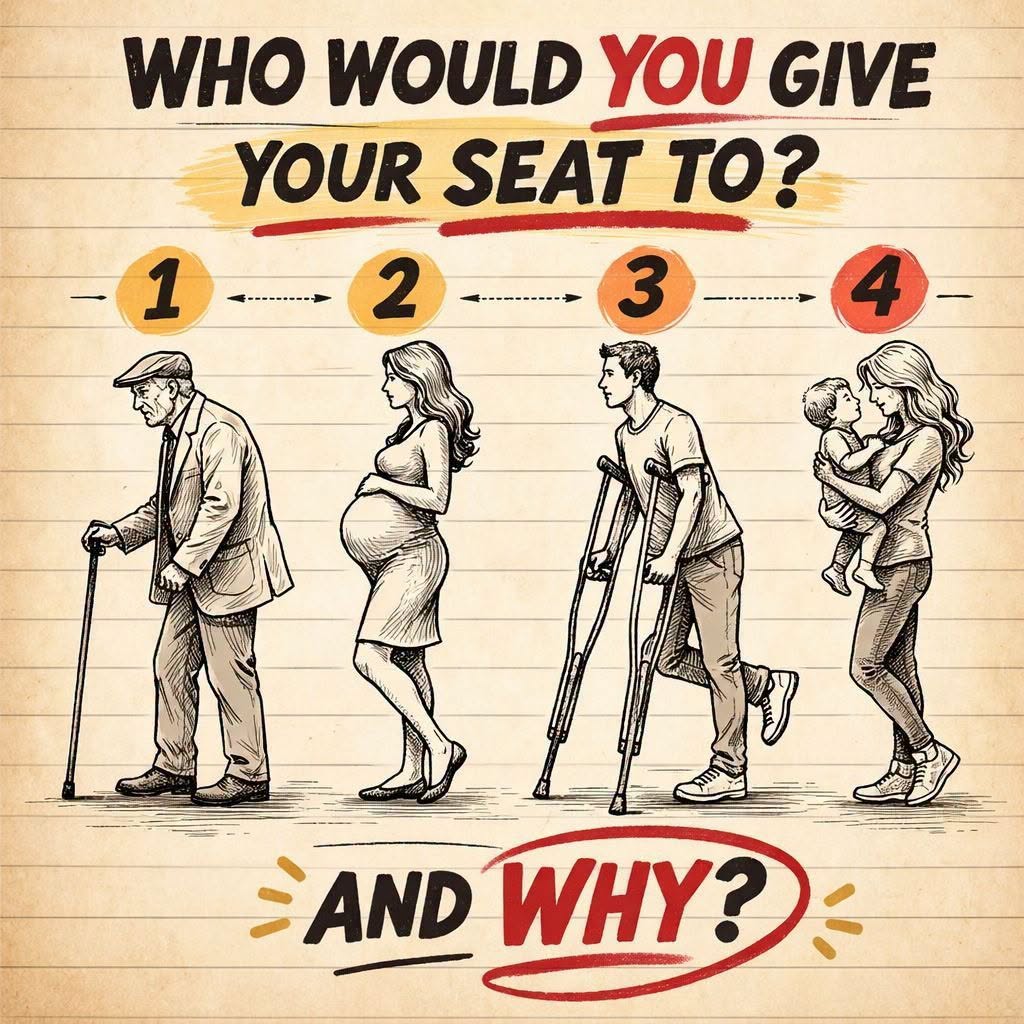
Who would you give your seat to, and why? It sounds like a simple question until you imagine the situation clearly. You are standing on a crowded bus or train. There is only one empty seat, yet four passengers appear to need it: an elderly man using a cane, a pregnant woman, an injured person on crutches, and a parent carrying a small child.
Suddenly, an ordinary act of courtesy becomes a surprisingly difficult decision.
Each person has a legitimate reason to sit. The older passenger could lose his balance. The pregnant woman might feel tired or dizzy. The injured passenger may struggle to stand safely. Meanwhile, the parent must protect both themselves and the child in their arms.
That is why Who would you give your seat to, and why? has become such an engaging social dilemma. The question does not simply test manners. Instead, it shows how people evaluate vulnerability, responsibility, safety, and compassion when several needs compete for attention.
I once faced a similar situation during a packed commute when several passengers boarded at the same stop. An older woman stood near the door while a man with a leg brace and a parent holding a sleepy child also searched for somewhere safe to stand. I had a seat, but choosing whom to offer it to suddenly felt awkward. Eventually, I stood up without pointing to anyone in particular and simply said the seat was available. The parent took it while another passenger offered a second seat to the older woman. That moment reminded me that kindness often spreads when someone acts first.
Why This Simple Seat Dilemma Feels So Difficult
Every Person Has a Genuine Need
At first glance, people often believe they can identify the person who “deserves” the seat most. However, the situation becomes complicated once you consider what each passenger may be experiencing.
The elderly man may appear stable while standing, yet age can increase vulnerability to falls. A sudden stop could cause a serious injury, especially if he already relies on a cane for balance.
The pregnant woman may look healthy, but pregnancy can bring fatigue, nausea, dizziness, back discomfort, and changes in balance. Therefore, standing on a moving vehicle may feel much harder than it appears.
The passenger using crutches has an obvious mobility limitation. Since both hands may help support the body, holding a rail can become difficult. Additionally, putting weight on an injured leg could cause pain or increase the chance of another fall.
Meanwhile, the parent carrying a child faces another challenge. The adult must remain balanced while simultaneously protecting someone else. If the vehicle stops suddenly, both parent and child could lose stability.
Consequently, Who would you give your seat to, and why? does not have one answer that works in every situation.
Visible appearances only reveal part of the story. Furthermore, one passenger may have an urgent need that others cannot immediately see.
That uncertainty explains why people often reach completely different conclusions even when they want to make a compassionate choice.
The Question Tests Priorities Rather Than Manners
Most people already know that offering a seat to someone who needs it represents good public etiquette. However, this dilemma asks something more difficult.
It asks how you prioritize several people when you can help only one.
Some people automatically choose the oldest passenger because they grew up learning to respect older adults. Others immediately prioritize pregnancy because public transportation commonly designates priority seating for pregnant passengers.
Meanwhile, someone who has experienced an injury may choose the passenger on crutches. A parent may identify more strongly with the adult carrying the child.
Personal experience often shapes these decisions.
As a result, Who would you give your seat to, and why? can reveal which forms of vulnerability stand out most strongly to you.
Still, choosing one passenger does not necessarily mean you care less about the others.
The problem forces an artificial limitation: one seat and four people.
Real life usually offers more possibilities. You can ask whether someone needs the seat. You can encourage another seated passenger to help. You can move aside to create more space. Additionally, another passenger may voluntarily stand once they notice what is happening.
Therefore, the most compassionate response may involve expanding the solution instead of simply ranking people from most deserving to least deserving.
How Each Passenger’s Situation Changes the Decision
Age, Pregnancy, and Physical Injury
The elderly passenger often receives the first offer because older adults may face a greater risk of serious injury after a fall.
However, age alone cannot tell you exactly how someone feels. Some older adults remain strong and comfortable standing for short trips. Therefore, it can help to offer rather than assume.
A simple gesture gives that person the choice.
Pregnancy creates different concerns. Changes in balance, circulation, energy levels, and physical comfort may make standing difficult. Furthermore, crowded public transportation can create additional challenges because passengers cannot always reach a secure handrail.
For those reasons, many transit systems encourage passengers to give priority seating to pregnant people.
The passenger using crutches presents perhaps the most visible mobility challenge. Crutches require coordination and space, and they can make sudden movements especially difficult to manage.
Moreover, an injured leg may prevent the passenger from placing normal weight on one side of the body. Therefore, even a short period of standing could feel exhausting or painful.
If Who would you give your seat to, and why? requires choosing among these three passengers, the person with the greatest immediate difficulty standing may reasonably receive priority.
Yet you may not know who that person is simply by looking.
That is why awareness matters more than rigid rules.
Why the Parent Carrying a Child Also Has a Strong Claim
People sometimes underestimate how difficult it can be to stand on moving transportation while holding a baby or toddler.
The parent must maintain their own balance while supporting another body. Additionally, they may have bags, bottles, a stroller, or other belongings.
A sudden stop creates an obvious safety concern.
If the parent loses balance, they cannot freely use both hands to protect themselves because one or both arms may already support the child. Therefore, sitting down can reduce risk for two people at once.
Some people consequently answer Who would you give your seat to, and why? by immediately choosing the parent.
However, even this answer depends on context.
Perhaps the child sits securely in a carrier while the parent comfortably holds a rail. Meanwhile, the injured passenger can barely remain upright.
Alternatively, the elderly passenger may look unsteady and clearly need immediate support.
Real situations rarely match perfectly controlled illustrations.
Therefore, observing how people actually appear to be coping provides better guidance than following an inflexible ranking system.
When possible, simply asking, “Would you like to sit?” can solve the uncertainty.
Someone may decline. In that case, you can immediately offer the seat to another passenger.
Kindness works best when it respects both need and choice.
What Your Choice May Reveal About Empathy
We Often Respond Most Strongly to What We Understand
Imagine asking 100 people Who would you give your seat to, and why? You would likely receive several different answers.
Those differences do not necessarily reflect differences in kindness.
Instead, people frequently respond to situations they understand personally.
Someone who cared for aging parents may immediately notice the elderly man’s cane and worry about his balance.
A person who experienced pregnancy may remember how exhausting standing became during certain stages.
Someone who recovered from a serious leg injury may understand how unstable crutches can feel on a moving vehicle.
Likewise, parents may remember trying to protect a small child while navigating crowded buses, trains, or stations.
Experience creates empathy because it provides context.
However, empathy can also grow beyond personal experience.
You do not need to experience another person’s exact situation to recognize that they may need assistance.
Instead, you can pay attention.
Notice whether someone looks uncomfortable, unstable, tired, or uncertain. Additionally, consider whether they can reach a handrail safely.
Then offer help without demanding that they prove they need it.
That approach creates a more respectful environment because it does not turn courtesy into a competition.
Visible Need Is Not Always the Greatest Need
Another important lesson from Who would you give your seat to, and why? involves invisible difficulties.
Not every disability, medical condition, injury, or physical limitation can be seen.
A young passenger who appears healthy may have chronic pain, a neurological condition, dizziness, heart problems, or another condition that makes standing difficult.
Similarly, someone sitting in a priority seat may have a legitimate reason for remaining there even if they do not use a cane, wheelchair, or visible medical aid.
Therefore, avoid judging people solely from appearances.
The same principle applies when offering your own seat.
You can make the offer politely without making assumptions about another person’s health. If that person declines, accept the answer and move on.
Likewise, if you genuinely need your own seat, you do not have to treat every social dilemma as an obligation to ignore your own physical limits.
Compassion includes awareness rather than performance.
Sometimes you can help by standing. At other times, you can make room, hold a door, help with a bag, alert another passenger, or simply ask whether assistance would help.
Small actions can create meaningful improvements in a crowded public space.
A Better Way to Think About the Last Available Seat
Replace Ranking With Situational Awareness
The most useful lesson behind Who would you give your seat to, and why? may not involve identifying a permanent winner.
Instead, consider who faces the greatest immediate risk or difficulty.
For example, if the bus starts moving and the elderly passenger visibly loses balance, offering the seat quickly makes sense.
If the pregnant passenger says she feels dizzy, her need becomes more urgent.
Likewise, if the passenger on crutches struggles to remain upright, allowing that person to sit could prevent another injury.
If the parent cannot safely hold both the child and a rail, sitting may protect two passengers.
Context changes the answer.
Therefore, observe before automatically applying a rule.
You can also communicate.
Ask whether someone would like the seat. A person who appears vulnerable may say they are getting off at the next stop and prefer standing. Meanwhile, someone else may genuinely need the seat for the remainder of the journey.
That simple exchange can eliminate much of the guessing.
More importantly, it treats people as participants in the decision rather than objects of charity.
Respect and kindness work together.
Sometimes the Best Solution Is for More People to Help
The viral dilemma usually assumes only one passenger can solve the problem.
However, a crowded bus contains many people.
Imagine that one passenger stands for the injured person. Seeing this, another passenger gives a seat to the pregnant woman. Then someone else notices the elderly man and offers another seat.
Suddenly, the original dilemma disappears.
This possibility may provide the most meaningful answer to Who would you give your seat to, and why?
A compassionate community does not wait for one person to carry every responsibility.
Instead, people notice what is happening around them and contribute when they can.
One action can also influence others.
When someone stands and offers a seat, nearby passengers may become more aware of the people around them. Consequently, another person may decide to help.
Courtesy can spread through imitation.
That principle extends far beyond public transportation.
Holding a door, allowing someone to move ahead in line, giving directions, helping with a stroller, or offering assistance with luggage can make everyday spaces easier for everyone.
None of these actions requires a dramatic sacrifice.
They simply require attention.
Frequently Asked Questions
Who should get the seat first on public transportation?
There is no universal ranking that fits every situation. Give priority to the passenger who appears to have the greatest immediate difficulty standing safely. When you cannot tell, politely offer the seat and allow the person to decide whether they need it.
Should an elderly person always receive the seat before a pregnant woman?
Not necessarily. Although older adults may face a higher risk of falls, a pregnant passenger might feel dizzy, exhausted, or physically uncomfortable. Therefore, the circumstances matter more than a rigid age-versus-pregnancy rule.
Should someone using crutches automatically receive priority?
A person using crutches often has a strong need because standing on moving transportation can be difficult and unsafe. However, you should still consider the complete situation. If possible, offer the seat directly rather than assuming what that passenger wants.
What if a parent carrying a child needs the seat too?
A parent holding a baby or toddler may struggle to maintain balance safely. Therefore, offering a seat can protect both the adult and the child. Other passengers can also help by creating space or offering an additional seat.
What does my answer to the dilemma say about me?
Your answer may reflect the kinds of vulnerability you notice first, often because of your upbringing or personal experiences. However, no single choice completely measures empathy. Your willingness to recognize another person’s difficulty and respond respectfully matters much more.
Conclusion
Who would you give your seat to, and why? becomes difficult because every person in the scenario has a legitimate reason to need help.
The elderly passenger may have difficulty balancing. The pregnant passenger may experience fatigue or dizziness. The person on crutches may find standing painful or unsafe. Meanwhile, the parent carrying a child must protect two people at once.
Therefore, the most thoughtful answer depends on the circumstances.
Instead of searching for one permanent rule, pay attention to the people around you. Offer assistance when you can. Ask rather than assume. Additionally, remember that some physical limitations remain invisible.
Most importantly, do not view kindness as a contest in which only one person can participate.
If several passengers need help, several people can choose to help them.
That may be the strongest lesson behind the entire dilemma. Empathy does not require a perfect decision. It requires awareness, consideration, and a willingness to respond when another person needs support.
The next time you find yourself on a crowded bus or train, the most meaningful question may not be Who would you give your seat to, and why?
It may simply be: Who around me could use a little help right now?
More Blog
- Drinking Water on an Empty Stomach — What Science Actually Supports (No Hype, Just Facts)
- Waking Up Between 3 and 5 AM? It Might Be Your Soul Trying to Talk to You
- What a “Bleach” Patch on Your Underwear Really Means — And Why It’s Actually a Good Sign
- This Drink May Weaken Your Bones From The Inside — But Everyone Drinks It Anyway