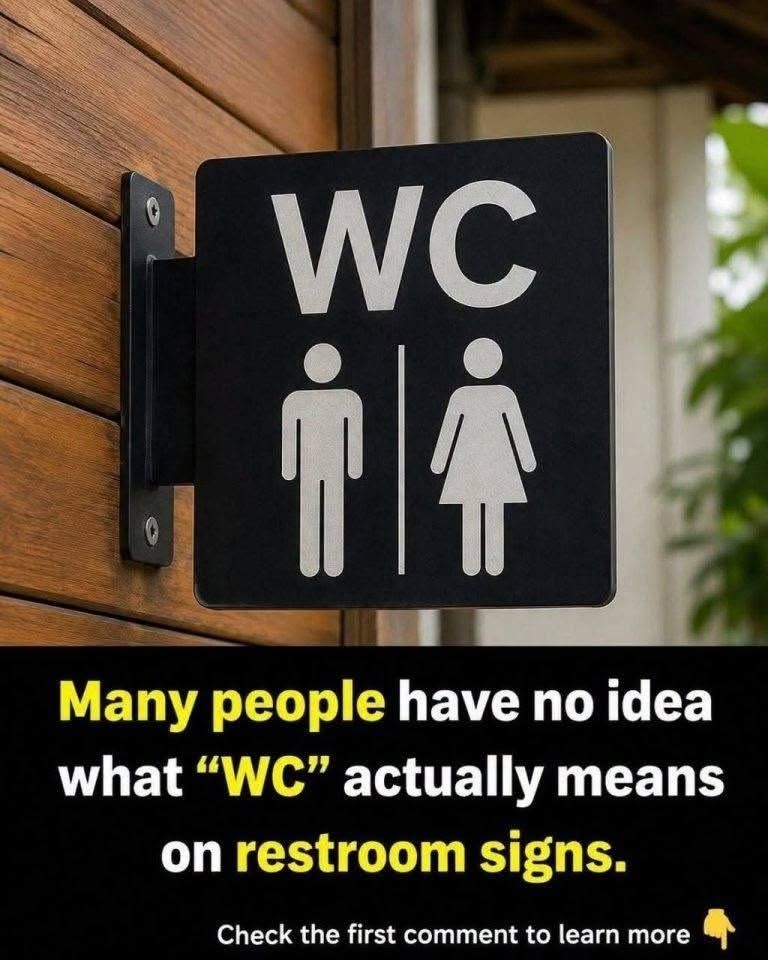
What Does WC Actually Mean on Restroom Signs? If you have traveled through Europe, stayed in an international hotel, visited an airport, or walked through an older public building, you have probably seen the letters WC printed on a door or directional sign. Most people quickly understand that the sign points toward a toilet or restroom. However, the meaning behind those two familiar letters remains a mystery to many travelers.
WC stands for water closet. The expression comes from an earlier period of indoor plumbing, when a room containing a flushing toilet represented a distinct and surprisingly modern feature of a home. Although everyday English has largely replaced “water closet” with words such as bathroom, restroom, or toilet, WC remains common on signs throughout many parts of the world.
I remember noticing a WC sign while traveling and realizing that I had followed signs like it many times without knowing what the letters meant. At first, I assumed WC might represent a foreign-language expression for bathroom. However, someone explained that it simply meant “water closet,” an old English term connected to the development of indoor toilets. Suddenly, those signs in hotels, stations, and restaurants made much more sense. That small discovery also made me curious about why such an old expression survived. After learning its history, I started noticing WC signs everywhere, especially in places designed for international visitors.
What Does WC Actually Mean on Restroom Signs?
WC Is Short for Water Closet
The direct answer is surprisingly simple: WC means water closet.
Today, the word “closet” usually makes people think about a small space for storing clothing, shoes, cleaning supplies, or household items. Historically, however, the word could describe a small private room or enclosed space.
Therefore, a water closet referred to a small private room containing a toilet that used water to carry waste away. The name described both the room and its most important feature.
The expression made practical sense when indoor toilets first became increasingly available. People needed a way to distinguish these new rooms from other household spaces. A toilet connected to a water-based flushing system represented something very different from an outdoor privy.
Consequently, “water closet” became a useful description.
Over time, people shortened the expression to WC. The abbreviation proved especially convenient for signs because it required little space. Moreover, people could recognize the two letters quickly.
The abbreviation eventually became so familiar that many people understood its purpose without knowing the words behind it.
That situation continues today. Someone may see WC on an airport sign, follow the arrow without hesitation, use the facilities, and never wonder what W and C represent.
Nevertheless, those two letters preserve a small piece of plumbing and language history.
Why the Word “Water” Matters
The “water” part of water closet distinguishes the flushing toilet from older sanitation methods.
Before widespread indoor plumbing, many households relied on outdoor privies, chamber pots, and other arrangements. Those systems did not necessarily use running water to remove waste.
As plumbing technology developed, flushing toilets offered an important change. Water could move waste through pipes and away from the immediate living area. As a result, buildings could provide a dedicated indoor space for this purpose.
People therefore needed terminology for the new arrangement.
“Water closet” provided a straightforward solution. The phrase essentially described a small private room equipped with a water-flushing toilet.
However, early water closets did not instantly resemble modern bathrooms. In many buildings, bathing and toilet facilities remained separate. A house might have one room for washing or bathing and another tiny room containing only the toilet.
This distinction helps explain why calling every toilet room a “bathroom” can seem unusual from a historical perspective. A water closet did not need a bathtub or shower. Its defining feature was the toilet.
Even today, that distinction survives in many homes. Some houses have a small toilet room separate from the main bathroom. Depending on the country, people may call it a WC, toilet, powder room, half bath, or cloakroom.
Therefore, the original idea behind the water closet has never completely disappeared.
How the Water Closet Became Part of Everyday Life
Indoor Plumbing Changed the Meaning of Convenience
Modern indoor toilets feel so ordinary that imagining life without them can prove difficult. Yet indoor sanitation developed gradually, and different communities adopted plumbing improvements at different rates.
For generations, many people used facilities located outside the main living area. In rural settings, an outhouse could serve as the household toilet. Meanwhile, chamber pots offered another solution, particularly during the night.
As cities grew, however, sanitation became increasingly important. Dense populations created challenges that required better systems for handling human waste and providing clean water.
Plumbing technology gradually improved. In addition, expanding sewer systems made practical indoor sanitation possible for more buildings.
The flushing toilet eventually became an increasingly desirable household feature.
However, early installations often occupied small dedicated rooms rather than the large multipurpose bathrooms common today. Because the toilet needed privacy but little floor space, builders could place it inside a compact enclosure.
That arrangement naturally suited the term water closet.
Furthermore, separating toilet facilities from bathing areas sometimes offered practical advantages. Several family members could use different facilities at the same time. The arrangement also helped keep certain household activities separate.
Eventually, bathroom design changed. Builders increasingly combined toilets, sinks, bathtubs, and later showers in a single room.
As that layout became familiar, Americans increasingly used “bathroom” as a general term for the room containing a toilet, even when no one planned to take a bath.
How Bathroom Vocabulary Changed
Language changes along with everyday habits. Therefore, several terms now describe essentially the same destination.
In American English, restroom commonly appears in restaurants, stores, offices, airports, and other public places. Meanwhile, people frequently use bathroom in homes and casual conversation.
In British English and many other varieties of English, people often say toilet more directly. WC also remains recognizable, particularly on signs and building plans.
Other expressions include lavatory, washroom, loo, powder room, and cloakroom. However, their popularity depends heavily on location and context.
For example, “washroom” appears frequently in Canadian English. “Lavatory” may appear in transportation settings, particularly aboard airplanes. Meanwhile, “powder room” generally describes a small guest bathroom or half bath in American homes.
Despite these differences, WC has a major advantage: brevity.
A sign only needs two letters. Therefore, designers can display WC prominently even when space remains limited. The abbreviation also avoids requiring a long translated phrase.
As international travel expanded, this simplicity became even more valuable.
Interestingly, people do not need to use the words “water closet” in conversation to understand WC. The abbreviation has developed a life of its own.
Consequently, an expression that sounds distinctly old-fashioned when spoken in full can still look perfectly normal on a modern restroom sign.
Why WC Signs Remain Common Around the World
International Travelers Can Recognize WC Easily
One major reason WC survives involves international communication.
Imagine arriving at a busy railway station in a country where you cannot read the local language. Long written directions may not help much. However, a familiar pictogram or a simple WC sign can communicate the destination immediately.
For that reason, hotels, restaurants, transportation hubs, tourist attractions, and other public spaces often use short, recognizable restroom labels.
WC works particularly well because many travelers already associate the abbreviation with toilets.
Furthermore, the letters can accompany familiar male, female, family, or accessibility symbols. Therefore, visitors can understand the sign without needing a detailed translation.
European travel provides many opportunities to encounter WC. However, the abbreviation does not belong exclusively to one country or one language.
Instead, different regions have adopted it to varying degrees.
You might see WC printed on a restaurant door, displayed above a corridor in a hotel, or included beside restroom symbols at a transportation terminal. You may also find it on maps, architectural drawings, floor plans, and accommodation listings.
Consequently, understanding WC can make travel slightly easier.
When you see an arrow followed by WC, you do not need to search for another sign marked “bathroom.” You have already found what you need.
That knowledge becomes particularly useful when signs provide little additional information.
Why Americans See WC Less Often
Although Americans generally understand the purpose of a WC sign, the abbreviation appears less frequently in everyday American English.
Instead, public buildings commonly use restroom. Homes generally use bathroom, while signs may simply display universal toilet symbols.
Cultural language preferences explain much of this difference.
American English developed several indirect expressions for toilets and toilet rooms. “Restroom” became a polite public term, while “bathroom” became an everyday household expression.
As a result, “water closet” gradually sounded formal, technical, or old-fashioned in American conversation.
However, the term never vanished completely.
Architects, plumbers, building professionals, and manufacturers may use “water closet” or WC when referring specifically to a toilet fixture. Building plans can also use WC as a compact label.
Additionally, Americans traveling abroad often encounter WC immediately.
Therefore, the abbreviation can feel both unfamiliar and strangely obvious. Even someone who has never heard another person say, “Where is the water closet?” may instantly understand a WC sign.
The difference demonstrates how vocabulary can evolve in separate directions while preserving older terminology in specialized settings.
Ultimately, Americans did not replace the actual concept of a water closet. They simply adopted different everyday words for it.
What WC Tells Us About Bathrooms Today
WC, Toilet, Bathroom, and Restroom Are Not Exactly Identical
People often treat WC, toilet, bathroom, and restroom as interchangeable terms. In ordinary conversation, that approach usually works. However, the words technically carry slightly different meanings.
A toilet can refer specifically to the plumbing fixture itself. Depending on the country, it can also describe the room containing that fixture.
A bathroom traditionally describes a room equipped for bathing. In modern American English, however, people routinely call a room a bathroom whenever it contains a toilet, even if it has no bathtub.
A restroom generally refers to a public toilet facility in American English. Despite the name, people do not normally go there to rest.
Meanwhile, a water closet historically refers to a small room or compartment containing a flushing toilet. WC can also identify the toilet facility more generally.
Therefore, context determines the most natural term.
These differences rarely create serious confusion because people interpret the words according to their surroundings. If someone in an American restaurant asks for the restroom, everyone understands the request. Likewise, a traveler who sees WC in a European railway station knows where the sign leads.
Nevertheless, understanding the distinctions reveals how history shaped ordinary vocabulary.
Why an Old Abbreviation Refuses to Disappear
WC survives because useful abbreviations can outlive the expressions that created them.
Few English speakers regularly call a bathroom a water closet during casual conversation. Yet WC remains compact, recognizable, and practical.
Signs favor simplicity. A shorter label allows designers to use larger letters and clearer layouts. Furthermore, international spaces benefit from terms that travelers already recognize.
Tradition also plays a role.
Once generations of hotels, railway stations, restaurants, public buildings, and architects adopt an abbreviation, replacing it offers little benefit. People already understand what it means.
Therefore, WC continues appearing even as bathroom technology becomes increasingly modern.
The contrast can seem amusing. A sleek contemporary airport may feature touchless faucets, automatic lighting, modern accessibility systems, and advanced plumbing while directing visitors there with an abbreviation rooted in a much earlier era.
However, that combination illustrates how language works. We constantly use old words to describe new versions of familiar things.
WC also provides a useful reminder that ordinary signs can contain hidden history. People walk past them every day without thinking about their origins.
Once you know that WC means water closet, however, the letters stop looking arbitrary. Instead, they become a small historical clue connecting modern restrooms with the development of indoor plumbing.
Frequently Asked Questions
What does WC stand for on a bathroom door?
WC stands for water closet. Historically, a water closet described a small enclosed room containing a flushing toilet. Today, WC usually means toilet or restroom when it appears on a sign.
Is WC the same as a bathroom?
In everyday use, it often serves the same purpose. However, the original meaning differs slightly. A water closet traditionally contains a toilet, while a bathroom traditionally contains facilities for bathing. Modern bathrooms often combine both functions.
Why do Europeans use WC?
WC remains widely recognized in many European countries and works well for international signage. Because the abbreviation requires only two letters, travelers can identify toilet facilities quickly even when they do not speak the local language.
Do people still say “water closet”?
Yes, although everyday usage varies by country. Many people rarely say the complete phrase in casual conversation. However, WC remains common on signs, floor plans, property descriptions, plumbing documents, and architectural drawings.
Why is it called a closet if it contains a toilet?
Historically, “closet” could describe a small private room rather than only a storage space for clothes. Therefore, “water closet” described a compact private room containing a toilet that used water for flushing.
Conclusion
What Does WC Actually Mean on Restroom Signs? The answer is water closet, an expression that developed when indoor flushing toilets represented an important new household convenience.
The name originally described the room quite literally. It was a small, private, closet-like space containing a toilet that used water to flush waste away. As homes changed, toilets increasingly became part of larger bathrooms, while everyday vocabulary shifted toward words such as bathroom, restroom, toilet, and washroom.
Nevertheless, WC survived.
Its short length makes it useful for signs, while its international recognition makes it particularly convenient in hotels, airports, restaurants, railway stations, and tourist destinations. As a result, millions of people recognize WC even though relatively few use “water closet” in normal conversation.
So, the next time you see WC printed on a restroom door, you will know exactly what those letters mean. More importantly, you will know why they remain there. Those two simple letters preserve a small but fascinating reminder of the period when indoor plumbing transformed everyday life.
WP Recipe Maker JSON Import Block
{
  "title": "What Does WC Actually Mean on Restroom Signs",
  "summary": "An informative guide explaining that WC stands for water closet, where the term originated, and why WC remains common on restroom signs around the world.",
  "notes": "This is an informational article rather than a food recipe, so recipe-specific fields contain no applicable values.",
  "ingredients_flat": [],
  "instructions_flat": [],
  "equipment": [],
  "nutrition": {
    "calories": "",
    "carbohydrates": "",
    "protein": "",
    "fat": "",
    "saturated_fat": "",
    "polyunsaturated_fat": "",
    "monounsaturated_fat": "",
    "trans_fat": "",
    "cholesterol": "",
    "sodium": "",
    "potassium": "",
    "fiber": "",
    "sugar": "",
    "vitamin_a": "",
    "vitamin_c": "",
    "calcium": "",
    "iron": ""
  },
  "tags": {
    "course": ["Informational"],
    "cuisine": ["General"],
    "keyword": ["What Does WC Actually Mean on Restroom Signs", "WC meaning", "water closet", "restroom signs"]
  }
}
SEO Output
Focus Keyword
What Does WC Actually Mean on Restroom Signs
SEO Title
What Does WC Actually Mean on Restroom Signs? Simple Explanation
Meta Description
What Does WC Actually Mean on Restroom Signs? WC means water closet. Discover its history and why these two letters still appear worldwide.
Expert SEO Title
What Does WC Actually Mean: 7 Surprising Facts Explained
Midjourney Prompt
Realistic travel photography of a classic restroom entrance featuring a prominent WC sign on an elegant door, subtle European hotel or railway station setting, tasteful vintage architectural details mixed with modern cleanliness, WC letters clearly visible as the central visual subject, warm natural lighting, highly realistic textures, clean uncluttered background, educational lifestyle photography, intriguing and instantly understandable composition, vertical Pinterest pin composition, generous negative space at the top and bottom for text overlay, professional editorial photography, sharp focus, photorealistic –v 6 –ar 2:3
More Blog
- Drinking Water on an Empty Stomach — What Science Actually Supports (No Hype, Just Facts)
- Waking Up Between 3 and 5 AM? It Might Be Your Soul Trying to Talk to You
- What a “Bleach” Patch on Your Underwear Really Means — And Why It’s Actually a Good Sign
- This Drink May Weaken Your Bones From The Inside — But Everyone Drinks It Anyway