Some discoveries change your day.
Others change your perspective.
And then there are the discoveries that make you crouch on the floor of your garage, stare at a strange crusty object for five minutes, briefly consider calling pest control, and somehow end up reminiscing about Saturday morning cartoons from twenty-five years ago.
That was my week.
It started with a simple household project. Nothing exciting. No grand adventure. Just one of those ordinary weekend tasks that begins with, “I’ll clean this up really quick,” and somehow turns into a three-hour expedition through forgotten corners of your home.
I was trying to retrieve a LEGO brick that had vanished beneath an old shelf.
Now, if you’ve ever stepped on a LEGO barefoot, you already know these tiny plastic blocks possess an almost supernatural ability to evade capture. Somehow, they disappear into dimensions unknown and only reappear when your foot is least prepared.
This particular brick had escaped days earlier.
Determined to reclaim it, I got down on my hands and knees, armed with a flashlight and the stubborn optimism that characterizes all doomed household missions.
As I peered beneath the shelf, I noticed something unusual.
Something lumpy.
Something dusty.
Something that looked suspiciously alive.
At first glance, it resembled a small nest.
Or perhaps a dead rodent.
Maybe even some bizarre fungus that had quietly evolved beneath my furniture while nobody was paying attention.
Naturally, I panicked.
Only a little.
The Discovery Nobody Wants Before Coffee
There are certain things you don’t want to encounter before your morning coffee.
A spider the size of a tennis ball.
A leaking ceiling.
A strange smell coming from the refrigerator.
And definitely not a mysterious blob lurking in the shadows beneath an old shelf.
Yet there it was.
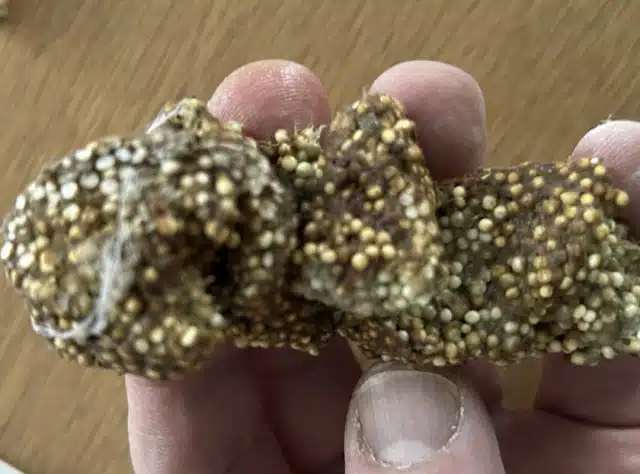
A strange mass covered in tiny beads.
The object looked ancient.
The color was impossible to identify.
Part beige.
Part orange.
Part something nature probably never intended.
The tiny foam-like beads covering the surface made it look almost organic.
Like some forgotten life form preserved by time.
I cautiously poked it with a pencil.
Nothing happened.
Good sign.
I poked it again.
Still nothing.
At least it wasn’t moving.
Progress.
After a few more seconds of careful examination, a distant memory began to stir.
The beads.
The texture.
The color.
The shape.
Suddenly it hit me.
This wasn’t a rodent.
It wasn’t mold.
It wasn’t an alien egg.
It was Floam.
Wait… Remember Floam?
If you’re a child of the 1990s or early 2000s, there’s a good chance that single word just unlocked a hidden section of your memory.
If you’re younger, however, you might be wondering what on earth Floam actually was.
Imagine taking slime.
Now imagine mixing it with thousands of tiny foam beads.
Then package it in neon colors and advertise it during children’s television programming.
Congratulations.
You’ve just created Floam.
Floam was one of those wonderfully strange toys that could only have existed during a very specific era of childhood.
It wasn’t exactly a toy.
It wasn’t exactly a craft supply.
It wasn’t exactly slime.
It existed somewhere in between.
Kids could stretch it, mold it, squish it, shape it, and generally spread it onto every surface within a ten-foot radius.
Parents hated it.
Children loved it.
Naturally, that made it wildly successful.
The Golden Age of Messy Toys
Finding that ancient blob instantly transported me back to a different time.
A time when toy companies seemed to compete over who could create the biggest mess.
The 1990s were truly a remarkable period.
Today’s toys often focus on technology.
Apps.
Screens.
Connectivity.
Interactive features.
Back then, however, many toys followed a simpler philosophy:
“Let’s give children something sticky and see what happens.”
The results were glorious.
And occasionally disastrous.
Floam belonged to an entire generation of wonderfully weird products.
There was Gak.
There was Slime.
There were sticky hands.
There were squishy creatures.
There were stretchy figures.
There were goo-filled tubes that served absolutely no practical purpose beyond making weird noises.
And somehow we loved every second of it.
Saturday Morning Memories
As I held that fossilized chunk of Floam, memories started flooding back.
I remembered sitting cross-legged on the living room floor.
Cartoons blaring from the television.
A bowl of sugary cereal balanced precariously beside me.
Commercials promising endless fun.
Bright colors.
Energetic announcers.
Kids laughing hysterically while playing with products that would undoubtedly ruin furniture.
And every commercial seemed irresistible.
Back then, advertisements possessed magical powers.
They could convince you that a blob of colorful goo was the most important object in the universe.
And honestly?
Sometimes they were right.
I distinctly remember begging my mother for Floam.
Every commercial break became another negotiation.
Another argument.
Another attempt to convince her that my happiness depended entirely on acquiring a container of neon foam-filled slime.
Eventually, I succeeded.
And when I finally got it?
I used it to build a saddle for a plastic dinosaur.
Because children are strange.
Why Childhood Toys Felt So Important
Looking back, it’s funny how deeply attached we became to seemingly ridiculous things.
A blob of slime wasn’t just a blob of slime.
It represented possibility.
Adventure.
Creativity.
Freedom.
Children have an incredible ability to transform ordinary objects into extraordinary experiences.
Give an adult Floam and they’ll see a mess.
Give a child Floam and they’ll build castles, monsters, spaceships, or entire imaginary worlds.
That’s one of the beautiful things about childhood.
Imagination fills the gaps that reality leaves behind.
A cardboard box becomes a spaceship.
A blanket becomes a fortress.
A blob of colorful goo becomes anything you want it to be.
The Great Toy Graveyard Beneath Our Furniture
Finding old Floam also reminded me of an uncomfortable truth.
Every home contains a hidden archaeological record of childhood.
Under beds.
Behind shelves.
Inside closets.
Beneath couches.
Entire civilizations of forgotten toys continue to exist.
Lost action figures.
Missing puzzle pieces.
Ancient crayons.
Half-completed craft projects.
Mysterious objects nobody remembers owning.
Most remain hidden for years.
Sometimes decades.
Then one day, during cleaning or renovation, they reappear like artifacts from an ancient culture.
And suddenly you’re holding a forgotten piece of your own history.
Time Travel Through Objects
What fascinated me most wasn’t the Floam itself.
It was the emotional reaction it triggered.
Objects have an incredible ability to transport us through time.
A photograph.
A song.
A toy.
A scent.
A piece of clothing.
They bypass logic entirely and connect directly to memory.
One moment you’re standing in your garage.
The next you’re ten years old again.
You remember things you haven’t thought about in decades.
The layout of your childhood bedroom.
The smell of your elementary school classroom.
The sound of cartoons playing on Saturday mornings.
The excitement of opening a new toy.
All from a dusty blob discovered beneath a shelf.
It’s remarkable when you think about it.
Explaining Floam to Modern Kids
My child wandered into the room while I was examining my discovery.
Naturally, he wanted answers.
“What is that?”
A reasonable question.
I attempted to explain.
“It was a toy.”
He looked skeptical.
“It doesn’t look like a toy.”
Fair point.
I tried again.
“It was kind of like slime.”
His expression suggested this explanation only raised additional questions.
“Why is it crunchy?”
Another excellent question.
One for which I had no satisfactory answer.
Because apparently twenty-five years is enough time for Floam to evolve from playful goo into something resembling archaeological evidence.
The Simplicity We Sometimes Miss
As amusing as the discovery was, it also highlighted something deeper.
Childhood entertainment used to be remarkably simple.
No subscriptions.
No notifications.
No algorithms.
No followers.
No streaming platforms.
No endless scrolling.
Just imagination.
Toys weren’t competing for attention against smartphones.
Play happened because it was enjoyable.
Not because it generated content.
Not because it earned likes.
Not because it attracted viewers.
Just because it was fun.
There’s something refreshingly pure about that.
A Brief Identity Crisis
For a few moments, I seriously considered keeping the Floam.
Not because it was useful.
Not because it had value.
But because throwing it away felt strangely significant.
This tiny object had somehow survived multiple moves, countless cleaning sessions, and decades of neglect.
It had outlasted fashions.
Technology.
Furniture.
Relationships.
Entire phases of life.
Part of me admired its persistence.
Thankfully, common sense prevailed.
Eventually.
Why Nostalgia Matters
People often dismiss nostalgia as simple sentimentality.
But I think it’s more meaningful than that.
Nostalgia reminds us who we were.
It reconnects us with forgotten experiences.
It helps us appreciate how far we’ve come.
And sometimes it encourages us to bring a little of that joy into the present.
The goal isn’t to live in the past.
The goal is to remember what made those moments special.
Curiosity.
Creativity.
Playfulness.
Wonder.
Those qualities remain valuable at any age.
The Unexpected Lesson Hidden in a Blob of Floam
By the end of the day, the ancient Floam found its way into the trash.
Its journey was over.
But the memories remained.
What began as a routine cleaning task turned into an unexpected trip through childhood.
A reminder of simpler times.
A reminder of imagination.
A reminder that some of life’s most meaningful moments arrive completely unannounced.
Not through major events.
Not through expensive purchases.
Not through grand achievements.
Sometimes they arrive disguised as a dusty, crusty blob hiding beneath a shelf.
Final Thoughts
Most nostalgic moments don’t happen when we plan them.
They happen when we least expect them.
A forgotten toy.
An old photograph.
A familiar smell.
A song from decades ago.
These small discoveries have a unique power.
They remind us of who we were before responsibilities multiplied and schedules became crowded.
Finding that ancient Floam won’t change my life.
But for a few minutes, it reminded me of endless summer afternoons, Saturday morning cartoons, and the simple joy of creating something completely pointless with a handful of colorful goo.
And honestly?
That’s a pretty wonderful thing to discover before coffee.
Even if it initially looked like a dead mouse.
More Blog
- Drinking Water on an Empty Stomach — What Science Actually Supports (No Hype, Just Facts)
- Waking Up Between 3 and 5 AM? It Might Be Your Soul Trying to Talk to You
- What a “Bleach” Patch on Your Underwear Really Means — And Why It’s Actually a Good Sign
- This Drink May Weaken Your Bones From The Inside — But Everyone Drinks It Anyway