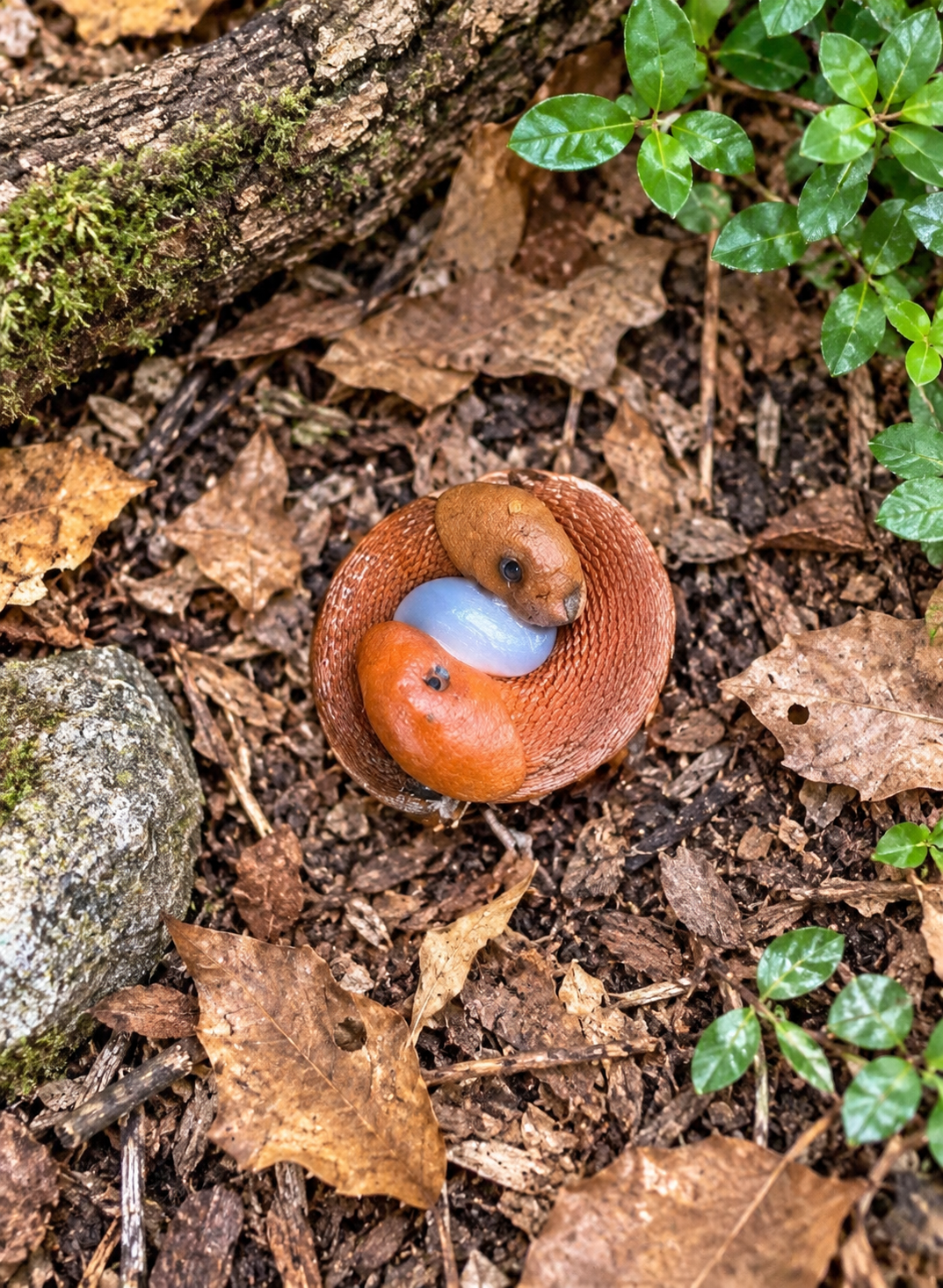
An unusual wildlife image can sometimes make even a familiar animal appear completely unrecognizable. That is exactly what happens when two large slugs become intertwined during one of nature’s more remarkable reproductive behaviors.
At first glance, the creatures may look mysterious or even otherworldly. In reality, the image captures two slugs engaged in mating behavior—a natural process that reveals some fascinating aspects of slug biology.
Identifying the Creatures
The animals resemble large terrestrial slugs belonging to the genus Arion, a group that includes the red slug, Arion rufus. These mollusks are typically found in cool, moist environments, including gardens, woodland areas, meadows, and other places where vegetation and organic matter are abundant.
Like other land slugs, they lack an external shell and depend heavily on moisture. Their mucus helps protect their bodies, reduces water loss, and allows them to move across a variety of surfaces.
They are particularly noticeable during damp weather and may become more active at night or following rainfall.
What Are the Slugs Doing?
The striking position of the animals is associated with mating.
Many land slugs are hermaphrodites, meaning a single individual possesses both male and female reproductive organs. Rather than making reproduction a simple process, however, this biological characteristic can result in surprisingly elaborate courtship and mating behavior.
When two compatible slugs encounter one another, courtship may involve following, touching, circling, and extensive physical contact. During mating, the animals can become closely intertwined while exchanging reproductive material.
The mucus naturally produced by the slugs can make the encounter appear even more unusual to a human observer.
Why Slug Mating Looks So Unusual
A slug’s soft, flexible body allows it to stretch, contract, and twist considerably. When two individuals interact during courtship and reproduction, their bodies may form shapes that bear little resemblance to the animals people normally see slowly moving across a garden.
This is one reason photographs of mating slugs are frequently mistaken for unidentified organisms.
What appears bizarre is simply the result of specialized anatomy and reproductive behavior that has evolved over countless generations.
What Happens After Mating?
Following successful reproduction, land slugs generally deposit eggs in moist, protected locations. Soil, leaf litter, spaces beneath logs, and other sheltered areas can provide the humidity necessary for the developing eggs.
The young eventually emerge as miniature versions of adult slugs and continue growing as they feed.
Environmental conditions play an important role throughout this process. Because slugs are highly vulnerable to dehydration, moisture influences everything from their daily activity to feeding and reproduction.
The Ecological Role of Slugs
Although gardeners often associate slugs with damaged plants, their ecological role is more complex.
Many species consume fungi, dead vegetation, decomposing plant material, and living plants. By feeding on organic matter, they participate in decomposition and nutrient cycling within their environments.
Slugs are also part of the food web. Depending on the ecosystem, they can become prey for birds, amphibians, reptiles, insects, and other animals.
Their presence therefore represents one small component of a much larger ecological system.
A Remarkable Glimpse Into an Overlooked World
The photograph may initially inspire confusion, but its explanation offers something more interesting than a mystery: a close look at a natural behavior that most people rarely have an opportunity to observe.
Slugs are easily overlooked because they live close to the ground and are often most active under damp or low-light conditions. Yet their biology demonstrates that even seemingly ordinary animals can possess remarkably complex reproductive strategies.
What initially appears to be a pair of strange, unidentified creatures is therefore something entirely natural—two slugs participating in an extraordinary reproductive ritual that has been taking place largely unnoticed in gardens and wild habitats for generations.
More Blog
- Drinking Water on an Empty Stomach — What Science Actually Supports (No Hype, Just Facts)
- Waking Up Between 3 and 5 AM? It Might Be Your Soul Trying to Talk to You
- What a “Bleach” Patch on Your Underwear Really Means — And Why It’s Actually a Good Sign
- This Drink May Weaken Your Bones From The Inside — But Everyone Drinks It Anyway