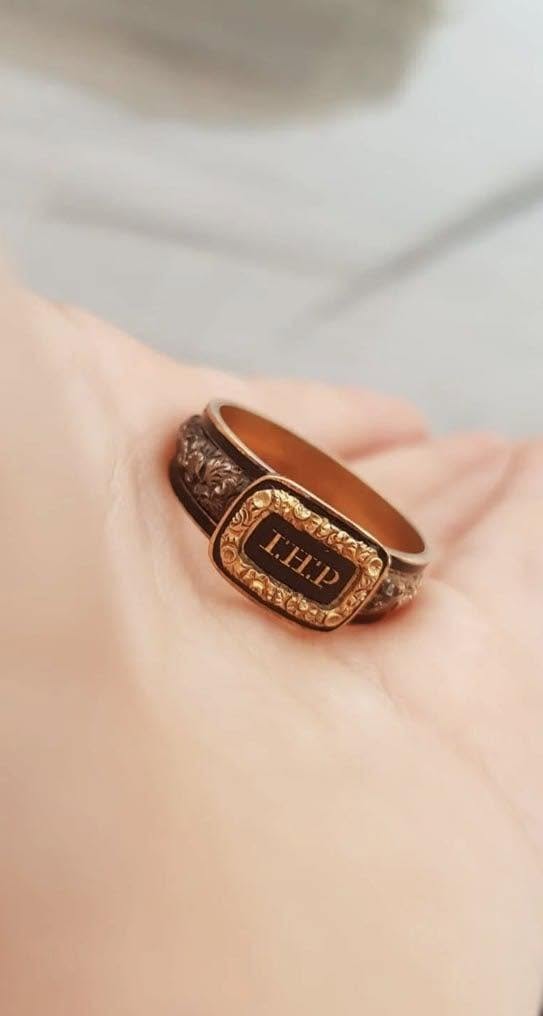
This Vintage Treasure Holds a Deep Story because a small piece of antique jewelry can carry far more than decoration. A Georgian mourning ring, often made with gold, black enamel, engraved initials, hairwork, or memorial inscriptions, served as a deeply personal reminder of someone who had died.
During the Georgian era, families often commemorated loved ones through objects they could wear close to the body. Therefore, mourning rings became more than accessories. They represented memory, loyalty, grief, and the desire to keep a loved one present even after death.
Although these rings can look mysterious today, their details often reveal surprisingly specific information. A name, date, tiny lock of hair, inscription, or symbolic image may identify the person being remembered. As a result, discovering one can feel like opening a small window into another family’s history.
I once imagined finding a dark enamel ring tucked into an old wooden box at the back of a drawer. At first glance, it looked delicate and slightly worn, with soft gold edges and tiny lettering almost erased by time. However, the inscription inside changed everything. It carried a name and a date from more than two centuries ago. Suddenly, the ring no longer felt like an antique object. It felt personal. Someone had worn it because they missed another person deeply. That realization made the jewelry seem less about fashion and more about memory. Every scratch suggested years of handling, remembrance, and quiet attachment.
The Meaning Behind Georgian Mourning Rings
Why People Wore Jewelry for the Dead
This Vintage Treasure Holds a Deep Story because Georgian mourning jewelry grew from a period when death appeared much more openly in everyday life.
The Georgian era stretched across much of the eighteenth century and into the early nineteenth century. During that time, families experienced disease, childbirth complications, accidents, and childhood mortality at rates that feel difficult to imagine today.
Consequently, mourning became a visible part of social and family life.
People used clothing, jewelry, portraits, inscriptions, and other objects to remember the dead. Mourning rings became particularly meaningful because they could be worn every day.
A ring placed memory directly on the hand.
Therefore, each time the wearer saw or touched it, the jewelry could bring a loved one to mind.
Some rings commemorated spouses. Others remembered children, parents, siblings, relatives, friends, or respected members of a community.
In some cases, a deceased person even requested mourning rings in a will. The estate could then distribute matching rings among family members and close acquaintances.
This practice transformed grief into something tangible.
Instead of preserving memory only through stories, people could wear a physical reminder.
This Vintage Treasure Holds a Deep Story because the ring often became both emotional keepsake and historical record.
Unlike ordinary jewelry, it might preserve a name, death date, age, initials, or personal motto.
As a result, a single ring could tell researchers more about a family than an entire box of unidentified jewelry.
Why Black Enamel Became So Important
Black enamel appears frequently in Georgian mourning rings because the color strongly communicated grief.
Artisans applied dark enamel around gold lettering, decorative borders, memorial motifs, and gemstone settings.
The contrast created a striking effect.
Gold suggested permanence and value, while black visually represented mourning.
Consequently, even a relatively simple ring could immediately signal its commemorative purpose.
However, not every Georgian mourning ring looked identical.
Some designs remained extremely restrained. For example, a plain gold band might carry black enamel lettering around the outside.
Other rings became much more elaborate.
They could feature painted miniature scenes, gemstones, skulls, urns, weeping willows, angels, crosses, flowers, or braided hair.
The style often reflected the period, the wealth of the family, and the relationship between the wearer and the person being remembered.
White enamel also appeared in some mourning jewelry. It sometimes carried associations with innocence, especially when commemorating a young or unmarried person.
Therefore, color could hold symbolic importance beyond simple decoration.
This Vintage Treasure Holds a Deep Story because every visual choice may communicate something.
Even the placement of a gemstone or the shape of a decorative panel can provide clues.
That makes these rings fascinating to collectors and historians.
However, their strongest appeal remains emotional.
Behind the black enamel sat a very human idea: someone wanted another person to be remembered.
Symbols and Materials That Reveal the Ring’s Story
Hairwork, Inscriptions, and Hidden Memorials
This Vintage Treasure Holds a Deep Story because Georgian mourning rings often contained physical or written connections to the person who died.
Human hair became one of the most intimate materials used in mourning jewelry.
Artisans could braid, weave, curl, or arrange hair beneath glass. In other cases, they worked it into delicate patterns alongside tiny painted scenes.
The symbolism was powerful.
Hair survives long after death, so families could preserve something physically associated with a loved one.
Therefore, a lock of hair offered a connection that felt both personal and enduring.
Some mourning rings contain hair under a crystal or glass compartment. Others hide it inside the ring, where casual observers might never notice it.
Inscriptions provide another major clue.
Look inside the band or around the outer edge for names, initials, dates, or abbreviations.
Common memorial wording could include expressions meaning “in memory of” or shortened phrases referring to death.
The date often records the person’s death rather than the date someone purchased the ring.
Age may appear as well.
Consequently, even a few tiny letters can transform an unidentified antique into a specific memorial object.
When examining an old ring, never polish aggressively before studying those markings.
Heavy cleaning can damage enamel, soft gold, tiny engraved letters, old hairwork, or fragile glass.
Instead, document the object first.
Photograph the inscription under good light.
Then enlarge the image.
Sometimes faint letters become easier to identify in photographs than with the naked eye.
This careful approach may reveal exactly whose memory the ring once carried.
Urns, Willows, Skulls, and Other Symbols
Georgian mourning jewelry used a rich visual language.
This Vintage Treasure Holds a Deep Story because symbols allowed people to communicate grief without writing long messages.
The funeral urn became especially common.
An urn could represent death, burial, memory, or the physical remains of the deceased. Therefore, miniature paintings sometimes showed a mourner beside an urn.
Weeping willow trees also appeared frequently.
Their drooping branches naturally suggested sorrow.
Consequently, a willow beside a tomb or urn created an instantly recognizable scene of remembrance.
Skulls carried older traditions of mortality.
Rather than functioning as horror imagery, a skull could remind the wearer that life remains temporary.
This idea belonged to a broader tradition sometimes described as memento mori, or remembering death.
Crosses, angels, flowers, and clouds could carry religious meaning.
Pearls sometimes symbolized tears.
Certain gemstones also acquired emotional associations.
However, symbolic meanings were not always standardized.
Therefore, avoid assuming that every detail has one fixed interpretation.
Instead, examine the complete design.
An urn beneath a willow with a named inscription clearly suggests mourning.
A gemstone by itself may not.
This Vintage Treasure Holds a Deep Story because interpretation often requires several clues working together.
The combination of black enamel, engraved dates, hairwork, and memorial imagery provides much stronger evidence than one feature alone.
That layered symbolism explains why these rings remain so compelling.
They do not simply show grief.
They encode it.
How Georgian Mourning Rings Were Made and Worn
The Craftsmanship Behind These Tiny Memorials
This Vintage Treasure Holds a Deep Story partly because Georgian mourning rings required remarkable skill to create.
Goldsmiths worked on a very small scale.
A ring might need engraved lettering, enamel work, miniature painting, stone setting, glass compartments, and decorative metalwork within an object only a few centimeters across.
Each technique required precision.
For enamel designs, artisans applied powdered glass material to metal and heated it until it fused into a smooth surface.
Engravers then created lettering or decorative details.
Miniature painters worked with extremely fine brushes to create mourning scenes beneath glass or crystal.
Meanwhile, hair artists arranged strands into patterns that could fit inside tiny compartments.
Therefore, even modest mourning rings can reveal impressive craftsmanship.
Higher-status examples could include diamonds, pearls, garnets, seed pearls, or other stones.
However, expensive materials did not necessarily make a ring more meaningful.
A simple engraved band could hold enormous emotional importance.
Some rings were made specifically after a death.
Others may have followed designs chosen before death through wills or family instructions.
Because mourning jewelry could circulate among multiple relatives, several nearly identical rings might commemorate the same person.
That creates an interesting historical possibility.
If you discover one ring today, another matching example may exist in a different collection.
Therefore, the object might belong to a wider network of family memory.
This Vintage Treasure Holds a Deep Story because it may represent only one piece of a larger memorial tradition.
Who Wore Mourning Rings and When
Mourning rings crossed several layers of Georgian society, although elaborate examples naturally cost more.
Men and women could both wear them.
Family members received them, but friends, associates, clergy, servants, and other people could also receive memorial rings depending on the deceased person’s wishes and social position.
Some rings functioned as private keepsakes.
Others visibly communicated mourning.
Therefore, a ring could serve emotional, social, and commemorative purposes at the same time.
Mourning practices often followed periods of expected dress and behavior, especially among wealthier families.
However, mourning jewelry sometimes remained in use long after formal mourning clothing changed.
A ring could continue moving through generations.
A daughter might inherit a ring from her mother.
Later, a granddaughter might receive it.
Eventually, the family story might fade while the ring survived.
That explains why antique dealers, collectors, and homeowners sometimes find mourning jewelry without knowing its original identity.
This Vintage Treasure Holds a Deep Story even when the story has partly disappeared.
Fortunately, inscriptions can restore some of that lost history.
A surname and date may connect with church records, burial records, family documents, or genealogy research.
Even a first name can provide a starting point when combined with a place of origin.
Therefore, never assume an unidentified mourning ring has lost all connection to its past.
The ring itself may still contain enough evidence to rebuild part of the story.
Identifying, Valuing, and Preserving an Antique Mourning Ring
How to Tell Whether a Ring May Be Georgian
This Vintage Treasure Holds a Deep Story, but identifying its age requires care.
Not every black enamel ring comes from the Georgian era.
Victorian mourning jewelry became extremely popular later in the nineteenth century. Additionally, modern jewelry makers continue creating mourning-inspired pieces today.
Therefore, examine several features together.
Start with the inscription.
A clearly engraved eighteenth-century or early nineteenth-century death date provides one of the strongest clues.
Next, study construction.
Older rings may show hand engraving, irregular enamel, old-cut gemstones, closed-back settings, and hand-fabricated goldwork.
Hair compartments can also support identification.
Look carefully at the typography of engraved letters. Letterforms changed over time, so experienced jewelry historians may use engraving style as supporting evidence.
Hallmarks provide another clue, although not every ring carries easily readable marks.
Likewise, old repairs can complicate dating.
A Georgian ring may have received a replacement stone, resized band, new glass cover, or later setting.
Therefore, one modern-looking component does not necessarily mean the entire object is modern.
If the ring appears significant, consult someone experienced with antique jewelry rather than relying only on online comparisons.
This Vintage Treasure Holds a Deep Story, and inaccurate cleaning or testing can permanently alter it.
Avoid acid tests, aggressive polishing, and attempts to pry open memorial compartments.
Instead, document everything before intervention.
A professional examination can usually reveal much more without damaging the object.
Preserving the Ring Without Erasing Its History
Old mourning jewelry often carries scratches, tarnish, softened engraving, and worn enamel.
Those features may look like flaws, but they also record use.
Therefore, preservation differs from making the ring look new.
This Vintage Treasure Holds a Deep Story because wear itself can become part of that story.
A polished surface may look brighter, yet heavy polishing can remove original metal and reduce engraved detail.
Likewise, soaking may damage old hairwork, adhesives, paint, foil-backed stones, or enamel.
Instead, handle the ring gently.
Store it in a dry, stable environment.
Use a soft, acid-free jewelry box or padded compartment.
Avoid direct sunlight when the ring contains hair, painted miniatures, or delicate organic materials.
Also avoid exposing it to perfume, hairspray, cleaning chemicals, swimming pools, or household cleaners.
If the ring contains loose glass or gemstones, do not wear it until a professional examines the setting.
Photograph the front, back, interior, inscription, and any hallmark.
Then write down everything known about its history.
If a relative remembers who owned it, record that information immediately.
Family stories disappear surprisingly quickly.
Therefore, documentation can become as important as preservation.
Even uncertain details matter.
For example, write, “Believed to have belonged to great-grandmother’s family,” rather than discarding the information because you cannot prove it yet.
Future research may confirm the connection.
Frequently Asked Questions
What is a Georgian mourning ring?
A Georgian mourning ring is a memorial piece of jewelry associated with the Georgian period, especially the eighteenth and early nineteenth centuries. Families used these rings to remember people who had died. Designs often included black enamel, inscriptions, hairwork, gemstones, urns, skulls, or other symbols of remembrance.
Why did mourning rings contain human hair?
Hair provided a physical connection to the deceased because it could survive for many years. Families sometimes placed locks of hair under glass or arranged strands into decorative patterns. Therefore, the jewelry became both a symbolic and literal keepsake.
Does black enamel always mean a ring is for mourning?
No. Black enamel can appear on many types of jewelry. However, black enamel combined with memorial inscriptions, death dates, hairwork, urns, or related imagery strongly suggests mourning jewelry.
Are Georgian mourning rings valuable?
Some can be valuable, particularly when they feature rare materials, important historical connections, exceptional craftsmanship, gemstones, clear inscriptions, or excellent condition. However, monetary value varies widely. Emotional and historical value may also exceed resale value.
Should I clean an antique mourning ring?
Avoid aggressive cleaning. Old enamel, hair compartments, miniature paintings, foiled stones, and engraved gold can suffer permanent damage. Gently remove loose dust and consult an antique jewelry specialist before using liquids, chemicals, polishing compounds, or ultrasonic cleaners.
Conclusion
This Vintage Treasure Holds a Deep Story because a Georgian mourning ring represents much more than an old piece of gold.
It preserves the emotional life of another era.
Someone once commissioned, received, or wore that ring because another person mattered deeply to them.
Black enamel expressed grief.
An inscription preserved a name.
Hair kept a physical connection.
An urn or willow turned sorrow into visual symbolism.
Together, those details transformed jewelry into memory.
Although centuries may separate us from the original wearer, the emotion remains immediately understandable.
People still keep photographs, letters, jewelry, clothing, and small personal objects after someone dies.
The materials change.
The need to remember does not.
Therefore, finding a Georgian mourning ring offers a rare connection between personal grief and history.
If you own one, document it carefully.
Look for names, dates, initials, hallmarks, hair compartments, enamel, gemstones, and symbolic imagery.
Avoid overcleaning.
Then preserve whatever family history still survives alongside the object.
This Vintage Treasure Holds a Deep Story because the ring was never designed simply to look beautiful.
It was designed to remember someone.
That purpose gives even the smallest worn band an extraordinary emotional weight.
More Blog
- Drinking Water on an Empty Stomach — What Science Actually Supports (No Hype, Just Facts)
- Waking Up Between 3 and 5 AM? It Might Be Your Soul Trying to Talk to You
- What a “Bleach” Patch on Your Underwear Really Means — And Why It’s Actually a Good Sign
- This Drink May Weaken Your Bones From The Inside — But Everyone Drinks It Anyway