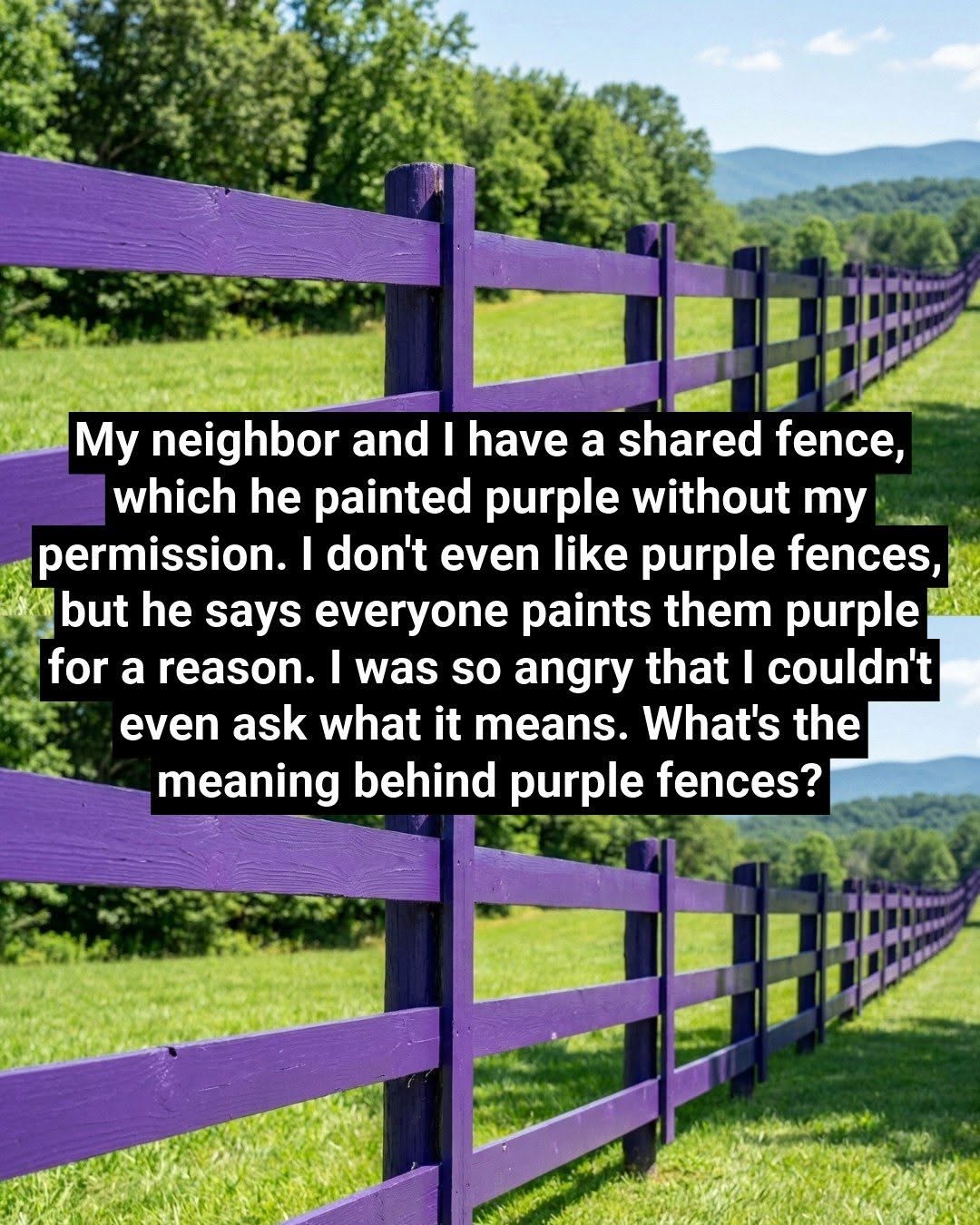
If You Spot a Painted Purple Fence, This Is What It Means: in many parts of the United States, that bright streak of color can carry a much more serious message than you might expect. Purple paint on fence posts, trees, or other boundary markers often serves as a warning that the property owner does not permit unauthorized entry.
However, purple paint laws vary from state to state. In places that recognize this method of posting property, specific rules can govern the size, position, spacing, and visibility of the marks. Therefore, you should never assume that every random splash of purple paint has the same legal effect everywhere.
Still, if you encounter deliberate purple markings while hiking, hunting, fishing, driving through rural country, or exploring unfamiliar land, the safest response remains simple: treat the boundary with respect and do not enter without permission.
I first became curious about these purple markings after noticing how easily they could blend into an ordinary rural scene. A painted fence post hardly looks as official as a large warning sign, yet it can communicate an important boundary. Living around country properties teaches you to notice small details, especially when they protect privacy and prevent misunderstandings. One quiet afternoon, with a warm cup of chamomile tea nearby, I decided to learn why landowners use purple instead of traditional signs. The answer made practical sense. A simple coat of paint can remain visible through changing weather while clearly reminding visitors to respect private property.
What a Painted Purple Fence Can Mean
Purple Paint Can Serve as a No-Trespassing Notice
When you see carefully placed purple paint on a fence post or tree, you may be looking at a legally recognized property notice. Several states allow landowners to use purple markings as one method of communicating that people should not enter the property without authorization.
Missouri provides a clear example. State law allows an owner or lessee to mark property with purple paint on trees or posts. Under the statute, qualifying marks can function as notice that is reasonably likely to come to the attention of someone approaching the property.
Pennsylvania also recognizes qualifying purple paint marks as a form of notice against trespass. Its statute specifies vertical purple lines and establishes requirements concerning their dimensions, height, visibility, and spacing.
North Carolina similarly permits purple paint markings under its property-posting rules. There, the law describes vertical lines at least eight inches long, positioned within a specified height range and placed at defined intervals.
Therefore, a painted purple fence should never automatically be dismissed as decoration. When the markings appear intentional and repeat along a property boundary, they may communicate a serious warning.
Most importantly, you do not need to determine the exact statute before making a sensible decision. If the land appears private and purple markings indicate a boundary, simply remain outside unless the owner has given you permission to enter.
Why Landowners Use Paint Instead of Signs
Traditional “No Trespassing” signs work well, but they have disadvantages. Wind can damage them. Weather can fade them. People can remove them. In addition, maintaining signs across a large rural property can require considerable time and expense.
Paint offers a practical alternative.
A property owner can apply a visible stripe directly to an existing post or tree where state law permits the practice. Consequently, there may be no separate sign to fall down, loosen, or disappear.
Purple also provides a recognizable visual signal once people understand its meaning. Instead of reading words from a distance, a hunter, hiker, or visitor can potentially recognize a marked boundary before crossing it.
However, paint does not eliminate every requirement. Some states establish very precise standards, and those standards do not necessarily match one another.
For example, Tennessee law allows identifying purple marks but also requires at least one sign at a major point of ingress explaining that purple paint signifies “no trespassing.” The statute additionally establishes dimensions and placement requirements for the marks.
That distinction matters. A general internet claim that “purple always means no trespassing” oversimplifies the issue.
Instead, remember the practical message: deliberate purple boundary markings deserve attention. If you spot them, respect the property line and check the applicable state rules if you need to know their precise legal significance.
Why Purple Became Such an Effective Boundary Color
The Color Creates a Distinctive Visual Marker
A boundary marker needs visibility. After all, a warning provides little practical value when approaching visitors cannot easily recognize it.
Purple can stand apart from many colors that naturally dominate rural landscapes. Forests, farms, and undeveloped land contain plenty of greens, browns, tans, and grays. Therefore, a strong purple stripe can create a noticeable contrast on a wooden post or tree.
More importantly, consistent use turns an unusual color into a recognizable signal.
Think about other familiar visual warnings. Certain shapes and colors immediately encourage people to pay attention even before they read accompanying words. Purple boundary paint can work in a similar practical way in jurisdictions that recognize it.
Nevertheless, the appearance of one purple object does not automatically establish a legal boundary. Someone might paint a gate, mailbox, planter, fence, or decorative feature purple simply because they like the color.
Intentional property markings usually look more systematic. You may see repeated vertical marks along posts or trees near the edge of land. Their placement can also follow the specifications established under local law.
For instance, Louisiana law describes purple marks on trees or posts as vertical lines at least eight inches long and at least one inch wide. It also specifies their height, visibility, and maximum spacing, with different spacing provisions for forest and non-forest land.
Therefore, context matters as much as color.
A decorative purple garden fence and a series of regulated purple stripes along rural acreage can communicate completely different things.
Purple Paint Rules Are Not Identical Everywhere
If You Spot a Painted Purple Fence, This Is What It Means cannot have one completely universal answer because property and trespass laws depend heavily on jurisdiction.
Some states explicitly recognize purple paint as a posting method. Others rely on different rules for signs, fencing, verbal notice, or other forms of communication.
Even among states that recognize purple paint, the technical requirements can differ.
Missouri, for example, generally requires qualifying vertical marks to measure at least eight inches long, sit within a specified height range, remain readily visible, and appear no more than 100 feet apart under one of its authorized marking methods.
North Carolina also requires vertical marks of at least eight inches, but its statute allows spacing of no more than 100 yards under the cited posting provision.
Meanwhile, Pennsylvania establishes its own specifications, including minimum dimensions, height requirements, visibility, and spacing.
Consequently, you should avoid relying on a social media graphic that presents one state’s requirements as a nationwide rule.
Instead, property owners who want to post land should verify current requirements through their state legislature or another authoritative legal resource. Visitors should also remember that a marking does not need to look like a traditional sign before it deserves respect.
When uncertainty exists, staying outside the boundary remains the easiest and most respectful option.
What You Should Do When You See Purple Paint
Stop Before Crossing the Property Line
Suppose you are hiking down an unfamiliar trail and suddenly notice several trees marked with vertical purple stripes. Alternatively, perhaps you are hunting, fishing, photographing wildlife, or looking for a shortcut across rural property.
Do not continue simply because you cannot see a printed sign.
Instead, stop and look carefully at your surroundings.
First, determine whether you remain on an established public trail, road, or other area where you clearly have permission to travel. Next, look for fencing, gates, signs, repeated paint marks, or other evidence of a private boundary.
If the purple marks appear to identify private property, stay on the side where you already have lawful access.
You should not climb a fence or open a gate merely to investigate. Likewise, do not assume that undeveloped land automatically belongs to the public. Forests, fields, ponds, creeks, and empty-looking acreage can all belong to private owners.
Additionally, a lack of houses does not make land open for recreational use.
Purple markings become particularly useful in these settings because traditional signs may appear far apart or may become difficult to see from certain directions.
Therefore, treat the marking as a reason to pay attention rather than an invitation to investigate.
If you genuinely need access, contact the property owner and request permission. Otherwise, choose another route.
That simple approach prevents conflict while respecting the person who owns or lawfully controls the land.
Never Assume Internet Advice Replaces Local Law
Online explanations can teach you what purple paint commonly represents, but they cannot replace the specific law where you live or travel.
That distinction becomes especially important because trespass laws contain details that short social media posts often omit.
For example, Tennessee does not simply say that any purple stripe automatically replaces every sign. Its statute includes a requirement for signage at a major point of ingress when purple paint is used under that provision.
Similarly, Pennsylvania, Missouri, North Carolina, and Louisiana each establish particular requirements for qualifying markings.
Meanwhile, other jurisdictions can use different methods for establishing notice. California, for example, has detailed rules concerning posted property and signage rather than a universal rule that makes any purple marking equivalent to a no-trespassing sign.
As a result, travelers should avoid memorizing one measurement or spacing rule and applying it everywhere.
Instead, remember the broader safety principle.
When repeated purple marks appear along what looks like private property, recognize that they may communicate a legal boundary. Respect the boundary first. Then, if you need exact information, consult the current law for that state.
Property owners should take an additional step. Before relying on purple paint alone, they should confirm whether their state recognizes it and exactly how the markings must appear.
Understanding the Bigger Purpose Behind Purple Paint Laws
Clear Boundaries Can Prevent Unnecessary Conflict
The most useful thing about a visible property marker is not punishment. Instead, clear markings can prevent a problem before it starts.
A person cannot always tell where public land ends and private land begins simply by looking at the landscape. Rural properties can stretch for hundreds of acres. Moreover, boundary lines can pass through forests, fields, waterways, and other areas without obvious physical barriers.
Consequently, visitors can become confused.
Repeated boundary markings give approaching people another opportunity to recognize that they should stop.
That benefits landowners because they can communicate restrictions without installing a continuous physical barrier. At the same time, it benefits hunters, hikers, anglers, and other outdoor visitors because they receive a visual warning before traveling farther.
Paint can also remain useful when a property owner manages extensive acreage. Maintaining individual signs around a long perimeter may become difficult, while properly applied markings can offer another recognized posting method where local law permits them.
Still, purple paint does not give anyone permission to confront a landowner or test whether the marking carries legal force.
If You Spot a Painted Purple Fence, This Is What It Means in practical terms: slow down, recognize that you may have reached private property, and avoid crossing without authorization.
Ultimately, respectful boundaries make rural recreation easier for everyone.
What Property Owners Should Know Before Painting
Landowners should not grab a can of purple paint and assume that a few random marks will satisfy the law.
Instead, they should check current state statutes first.
The law may specify the exact color, orientation, dimensions, height, visibility, and distance between markings. Additionally, certain jurisdictions may require signs in particular circumstances.
For example, Missouri law establishes specific ways that purple marks may be applied to trees or posts. Louisiana likewise sets detailed dimensions and spacing standards. Tennessee includes an additional sign requirement under its purple-paint provision.
Therefore, consistency matters.
Property owners should also maintain markings so approaching visitors can see and understand them. Vegetation can eventually cover paint. Weather can fade it. Trees can change as they grow. Posts can fall or get replaced.
Accordingly, boundary markings require occasional inspection just like traditional signs.
Owners should also avoid assuming that rules from a neighboring state apply to their property. Even when two states recognize purple paint, their measurements and other requirements may differ.
For legal questions involving a specific property, current state statutes and qualified local legal advice provide better guidance than generalized online summaries.
For everyone else, the lesson remains refreshingly straightforward: purple markings can carry real significance, so respect them whenever you encounter them along an apparent property boundary.
Frequently Asked Questions
Does a purple fence mean no trespassing?
A completely purple decorative fence does not necessarily mean anything legally. However, deliberate purple markings on fence posts, trees, or other boundary markers can serve as notice against trespassing in states that recognize purple paint laws. Because requirements vary, you should check the law in the relevant state.
Can purple paint legally replace a no-trespassing sign?
In some jurisdictions and circumstances, qualifying purple paint can serve as legally recognized notice. However, the answer depends on state law. Some statutes impose specific marking requirements, while others may require additional signage in certain situations. Tennessee, for example, includes a sign requirement at a major point of ingress under its purple-paint provision.
What should I do if I see purple paint while hiking?
Avoid crossing the apparent boundary unless you know you have permission. Stay on clearly authorized public trails or land, and look for additional signs, fencing, gates, or boundary markers. When you remain uncertain, choose another route rather than entering potentially private property.
Does every state recognize purple paint laws?
No universal nationwide rule makes every purple mark a legally effective no-trespassing notice. State laws differ, and the technical requirements can vary substantially. Therefore, always check current law in the jurisdiction involved before relying on purple paint as a legal posting method.
Why do landowners use purple paint?
Purple paint can provide a durable, visible way to mark property boundaries where state law recognizes the practice. Paint cannot blow away like a loose sign, and repeated markings can help identify boundaries across large rural properties. However, owners still need to follow their state’s requirements.
Conclusion
If You Spot a Painted Purple Fence, This Is What It Means may be more important than the color initially suggests. In several U.S. states, properly applied purple markings can communicate that private property has been posted against unauthorized entry.
However, the details matter. Purple paint laws are state-specific, and requirements concerning dimensions, height, spacing, placement, and additional signs can differ. Missouri, Pennsylvania, North Carolina, Louisiana, and Tennessee, for example, recognize purple markings under laws that contain their own technical standards.
Therefore, remember the practical lesson rather than assuming one rule applies nationwide. When you notice deliberate purple markings along a rural property boundary, treat them seriously. Stay outside the property unless you have permission to enter.
A small stripe of paint can communicate a surprisingly important message: this land has a boundary, and visitors should respect it.
More Blog
- Drinking Water on an Empty Stomach — What Science Actually Supports (No Hype, Just Facts)
- Waking Up Between 3 and 5 AM? It Might Be Your Soul Trying to Talk to You
- What a “Bleach” Patch on Your Underwear Really Means — And Why It’s Actually a Good Sign
- This Drink May Weaken Your Bones From The Inside — But Everyone Drinks It Anyway