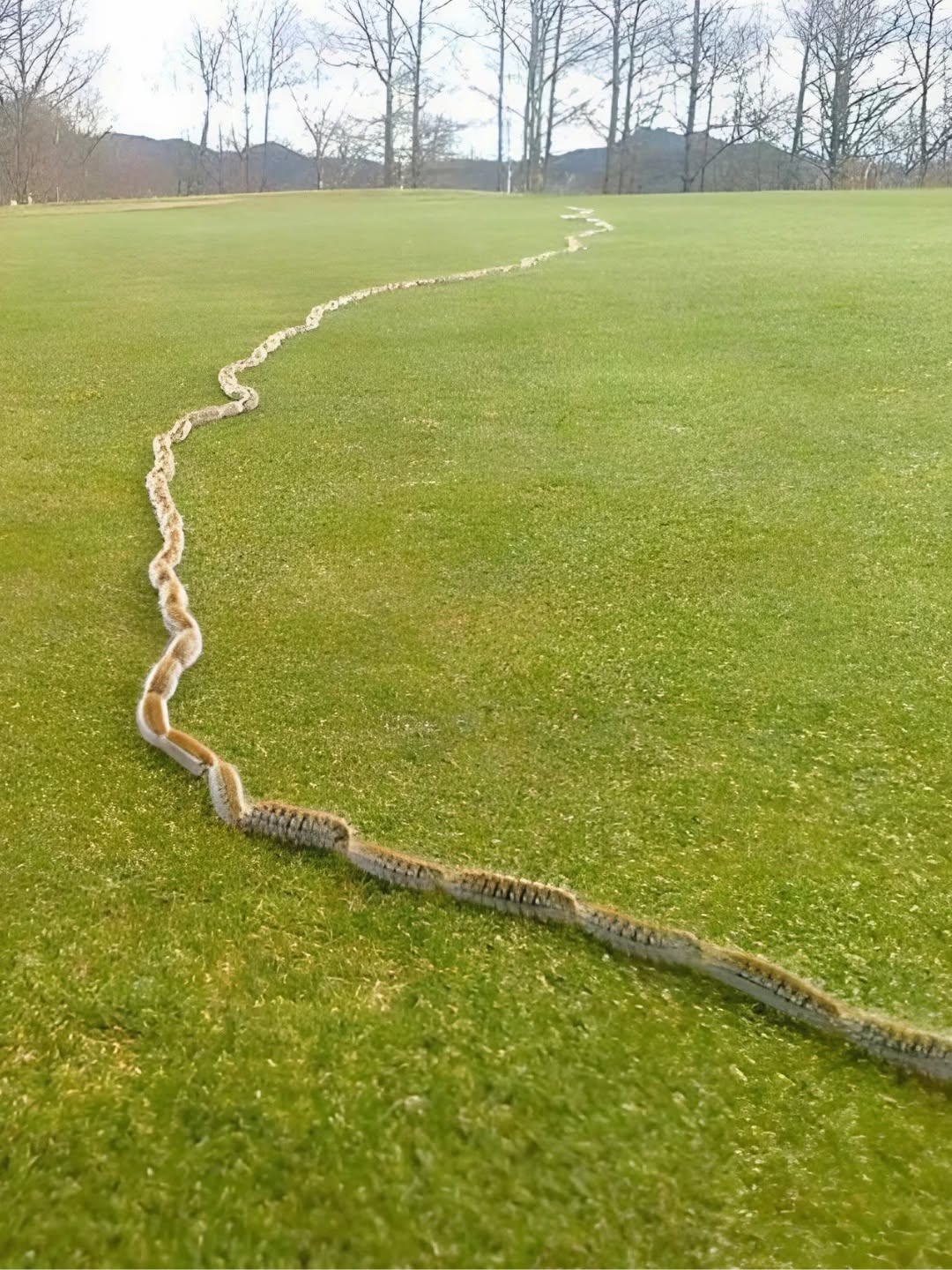
At first glance, it looked exactly like a piece of dark rope lying across the grass.
Long. Narrow. Slightly curved.
Then the “rope” moved.
Not all at once, either. A ripple seemed to travel through it, as though hundreds of tiny pieces were moving together.
That’s when I realized I wasn’t looking at a rope—or necessarily a snake.
I could be looking at a procession of caterpillars or other insect larvae traveling together.
🐛 Why Caterpillars Sometimes Form a “Living Rope”
Certain caterpillar species display gregarious behavior, meaning they feed, rest, or travel in groups rather than spending their entire larval stage alone.
When many individuals move closely together in a line, the procession can look surprisingly like one long animal from several feet away.
Depending on the species and location, these groups can contain dozens—or occasionally many more—individuals.
Their coordinated movement is one reason videos and photographs of them attract so much attention online.
Why Do They Follow Each Other?
For some procession-forming caterpillars, following the group helps them travel efficiently between their shelter and feeding areas.
They may use silk trails and chemical cues to help maintain the procession. One caterpillar follows another, creating an increasingly obvious line.
To human eyes, however, all those small bodies blend together.
From a distance, the result can resemble a rope slowly crawling across the ground.
⚠️ Don’t Touch an Unidentified Caterpillar
Finding caterpillars in your garden usually isn’t an emergency, but picking up an unfamiliar species with bare hands isn’t a good idea.
Some caterpillars have hairs or spines capable of irritating human skin. Certain species can cause considerably stronger reactions.
Children and pets should also be kept from investigating an unidentified cluster until you know what it is.
The safest approach is simple: observe from a reasonable distance and avoid handling it.
Could It Be Something Else?
Absolutely.
A photograph of a long moving formation isn’t enough by itself to identify an animal. Similar-looking garden discoveries could involve:
- Caterpillars or sawfly larvae moving together
- Millipedes gathering or migrating
- Worms concentrated by wet conditions
- Ants or other insects traveling along a trail
- Several small animals clustered so tightly that they appear to be one object
That’s why identifying the individual animals—not simply the overall shape—is important.
🌿 Are They Harmful to the Garden?
That depends entirely on the species.
Some caterpillars cause little noticeable damage. Others are enthusiastic leaf-eaters capable of stripping foliage from particular trees, shrubs, vegetables, or ornamental plants.
Before reaching for an insecticide, identify what you’re dealing with. Many caterpillars eventually become moths or butterflies, and insects play important roles in local ecosystems.
If plants are being seriously damaged, species identification will help determine whether control is actually necessary.
What Should You Do If You Find One?
Don’t panic or immediately destroy the group.
Take a clear photograph from a safe distance, including close views of individual insects and the plant or tree they’re associated with. Those details are much more useful for identification than a distant photograph of the entire formation.
If you’re uncertain, a local agricultural extension service, entomologist, or knowledgeable garden professional may be able to identify the species.
🐍 Why Our Brains Immediately Think “Snake”
There’s also a fascinating reason these encounters can feel so dramatic.
Humans are extremely good at rapidly noticing snake-like shapes. When something elongated appears unexpectedly in vegetation, our brains can make a quick threat assessment before we’ve had time to examine the details.
That’s useful when the object really is dangerous.
Occasionally, however, the “snake” turns out to be hundreds of tiny creatures cooperating in one extraordinary procession.
🌱 The Bottom Line
That mysterious moving rope in the garden may have a surprisingly simple explanation: a group of caterpillars or other larvae traveling together.
It’s an impressive natural phenomenon—but identification matters.
Don’t touch an unfamiliar cluster, keep children and pets away, photograph it carefully, and identify the species before deciding what to do.
Sometimes the strangest thing in your backyard isn’t dangerous at all.
It’s simply nature doing something most of us have never stopped long enough to notice.
More Blog
- Drinking Water on an Empty Stomach — What Science Actually Supports (No Hype, Just Facts)
- Waking Up Between 3 and 5 AM? It Might Be Your Soul Trying to Talk to You
- What a “Bleach” Patch on Your Underwear Really Means — And Why It’s Actually a Good Sign
- This Drink May Weaken Your Bones From The Inside — But Everyone Drinks It Anyway