Baking has a reputation for being one of the most exact forms of cooking. Unlike soups, casseroles, or stir-fries, where a little extra of one ingredient rarely causes problems, baking relies on chemistry. Every ingredient plays a specific role. Too much flour can make a dessert dry. Too little liquid can affect texture. Even changing the type of fat can completely alter the final result.
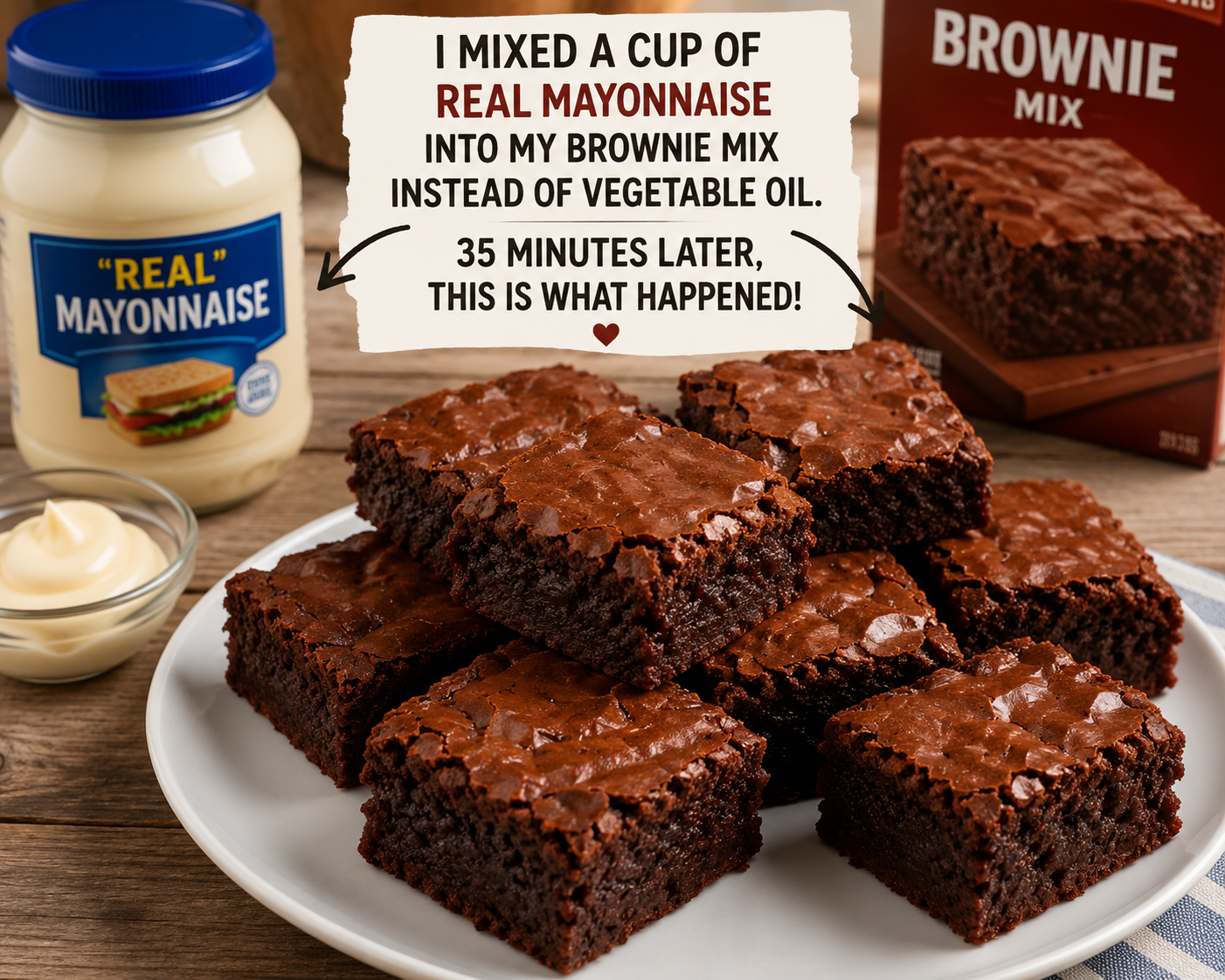
That’s why I was convinced I had ruined an entire batch of brownies when I accidentally added a full cup of real mayonnaise to my brownie mix instead of vegetable oil.
What happened next completely changed the way I think about baking.
A Simple Baking Session Turned Into a Kitchen Mistake
It started as one of those ordinary afternoons when a chocolate craving suddenly appears. I had a boxed brownie mix sitting in the pantry and figured it would be the perfect quick dessert.
The instructions were simple enough. Add eggs, water, and vegetable oil.
Easy.
I gathered everything I needed and started measuring ingredients without paying much attention. Like many people, I tend to multitask while baking. I was answering messages, listening to music, and thinking about dinner plans all at the same time.
I reached into the refrigerator and grabbed a jar.
Without thinking twice, I scooped out what I believed was the ingredient I needed and mixed it directly into the bowl.
Only after stirring for a minute did something seem strange.
The batter looked much thicker than usual.
Instead of the smooth consistency I expected, it seemed unusually creamy and dense.
That’s when I looked down at the container.
It wasn’t vegetable oil.
It was mayonnaise.
A full cup of real mayonnaise.
My First Reaction Was Pure Panic
The moment I realized my mistake, I assumed the brownies were doomed.
After all, mayonnaise belongs on sandwiches, burgers, and potato salad—not inside chocolate desserts.
I considered throwing everything away immediately.
The thought of wasting ingredients wasn’t appealing, but neither was serving brownies that tasted like a deli sandwich.
For several minutes, I stood in the kitchen debating whether to start over.
Then curiosity got the better of me.
I began thinking about what mayonnaise actually contains.
Most traditional mayonnaise is made primarily from:
- Oil
- Eggs
- Vinegar or lemon juice
- Seasonings
Suddenly the idea didn’t seem quite as ridiculous.
Brownie recipes already contain oil and eggs. The mayonnaise simply combined those ingredients into one product.
Maybe it wasn’t such a disaster after all.
So instead of dumping the batter into the trash, I poured it into the baking pan and slid it into the oven.
The Longest 35 Minutes Ever
Once the brownies started baking, I expected the kitchen to fill with some strange smell.
I imagined a mixture of chocolate and mayonnaise creating an unpleasant aroma.
Instead, something surprising happened.
The brownies smelled absolutely amazing.
Rich chocolate notes slowly spread through the house.
The familiar scent of freshly baked brownies became stronger with every passing minute.
There was no trace of mayonnaise in the air.
Not even a hint.
As the timer counted down, I became increasingly curious about what would emerge from the oven.
Would the brownies collapse?
Would they turn greasy?
Would the texture be ruined?
I had no idea what to expect.
Opening the Oven Was a Shock
When the timer finally rang, I carefully opened the oven door.
What I saw immediately caught me off guard.
The brownies looked perfect.
Actually, they looked better than many batches I had made following the recipe exactly.
The surface had developed that beautiful shiny top that brownie enthusiasts love.
The edges looked slightly crisp while the center remained soft and rich.
Nothing about them suggested that a major ingredient substitution had occurred.
If anything, they appeared more bakery-quality than usual.
Still, appearance can be deceiving.
The real test would be the first bite.
The Taste Test Changed Everything
After allowing the brownies to cool, I cut a square and took a bite.
The result was astonishing.
These weren’t merely edible.
They were incredible.
The texture was dense, moist, and intensely fudgy.
Every bite felt rich without becoming heavy.
The chocolate flavor seemed deeper and smoother than normal.
Most importantly, there was absolutely no mayonnaise flavor whatsoever.
None.
If someone had handed me the brownie without explaining how it was made, I never would have guessed there was mayonnaise involved.
The ingredient had completely disappeared into the dessert.
All that remained was a remarkably soft and delicious brownie.
Friends and Family Couldn’t Believe the Secret Ingredient
Because I was still skeptical, I decided to run an unofficial experiment.
I offered brownies to several family members and friends without mentioning the mayonnaise.
Their reactions were overwhelmingly positive.
Comments included:
“These are some of the best brownies you’ve made.”
“They’re so moist.”
“What did you do differently?”
“The texture is amazing.”
Nobody identified the secret ingredient.
In fact, when I finally revealed the truth, most people thought I was joking.
Some refused to believe me until I showed them the empty mayonnaise jar.
The surprise on their faces was almost as satisfying as the brownies themselves.
Why Mayonnaise Actually Works in Brownies
After the unexpected success, I started researching why the experiment worked so well.
The answer turned out to be surprisingly logical.
Mayonnaise contains two ingredients that baked goods already rely on:
Oil
Oil contributes moisture and tenderness.
It helps prevent brownies from becoming dry or crumbly.
Eggs
Eggs provide structure, richness, and stability.
They help bind ingredients together while contributing to texture.
Since mayonnaise combines both oil and eggs, it naturally functions as a baking ingredient.
The small amount of vinegar present in mayonnaise generally disappears during baking and doesn’t affect flavor in a noticeable way.
This explains why many experienced bakers have quietly used mayonnaise in cakes and brownies for years.
A Secret Trick Many Bakers Already Know
As it turns out, mayonnaise-based baking isn’t new.
For decades, some home bakers have added mayonnaise to chocolate cakes to create exceptionally moist crumb structures.
During periods when ingredients were scarce, creative cooks often used mayonnaise as a substitute for separate eggs and oil.
Chocolate desserts seem particularly compatible with mayonnaise because the strong cocoa flavor easily masks any remaining tang.
The result is often a richer and softer texture than traditional recipes produce.
What felt like an unusual accident was actually a technique with a long history.
I simply discovered it by mistake.
Should You Try It Yourself?
If you’re curious, the answer is yes.
Mayonnaise can work surprisingly well in brownies and chocolate cakes.
However, there are a few things worth keeping in mind:
- Use real mayonnaise rather than salad dressing substitutes.
- Avoid flavored mayonnaise varieties.
- Follow baking times carefully.
- Start with smaller substitutions if you’re hesitant.
- Choose chocolate recipes for the best results.
Many people find that mayonnaise creates a softer and more indulgent texture.
The key is remembering that it functions as a combination of ingredients rather than a strange addition.
The Lesson I Learned From a Kitchen Accident
One of the most interesting things about cooking is that mistakes sometimes lead to discoveries.
What began as a moment of panic ended with one of the best brownie batches I’ve ever made.
Instead of ruining dessert, the mayonnaise improved it.
The brownies became richer, moister, and more decadent than usual.
Most surprising of all, nobody could detect the secret ingredient.
Now, whenever I make brownies, I find myself considering whether to use mayonnaise intentionally.
While I might not add a full cup every single time, I no longer view it as a mistake.
Sometimes the best kitchen hacks aren’t discovered through careful planning.
Sometimes they happen because you accidentally grab the wrong ingredient and decide to see what happens.
In this case, 35 minutes later, what happened was a tray of unbelievably delicious brownies that disappeared faster than any batch I’d ever made before.