An ordinary walk through the garden can become memorable in seconds.
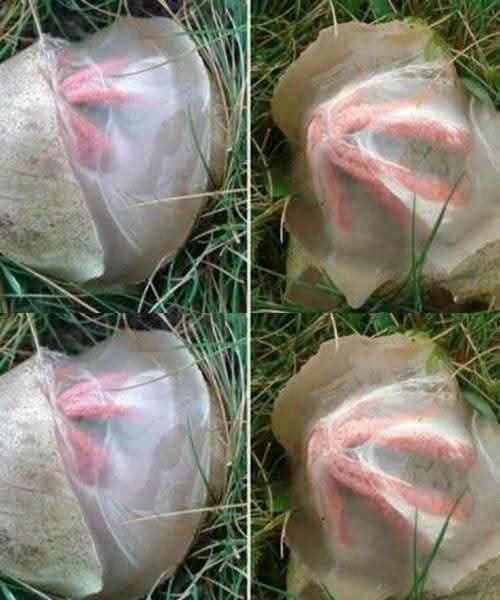
One morning, while checking the plants and clearing away fallen leaves, I noticed something unfamiliar growing near the edge of a shaded patch of soil. It was bright red, strangely shaped, and unlike anything I had seen there before.
At first, it looked almost artificial.
Its folded surface seemed glossy in places, while its unusual shape made it difficult to decide whether I was looking at a plant, an insect cluster, a piece of decaying fruit, or something far less harmless.
My first reaction was not curiosity.
It was fear.
The object had appeared suddenly, and because I could not immediately identify it, my mind began producing dramatic explanations. I wondered whether it could harm the garden, attract pests, release dangerous spores, or pose a risk to children and pets.
However, instead of touching it or removing it immediately, I stepped back and looked more carefully.
That decision changed the entire experience.
What initially seemed threatening eventually became a fascinating lesson about fungi, garden ecosystems, human perception, and the difference between something unfamiliar and something dangerous.
The Discovery That Stopped Me in My Tracks
A strange shape among familiar plants
The garden usually felt predictable.
I knew where the herbs grew, which flowers opened first in the morning, and which corner stayed damp after rain. Even the insects felt familiar after enough time spent outdoors.
That is why the red growth stood out so strongly.
It appeared in a place where nothing similar had grown before. Its color contrasted sharply with the brown soil and green leaves around it. In addition, its curved, irregular surface gave it an almost animal-like appearance.
From a distance, it seemed to have folds or tentacle-like sections. One side looked smooth, while another appeared rough and textured.
Because the object did not fit any familiar category, my imagination took control.
The garden no longer felt ordinary. Instead, it felt as though something unknown had entered it overnight.
Fear filled in the missing information
The human mind does not enjoy uncertainty.
When we cannot identify something quickly, we often create an explanation from whatever details are available.
In this case, the bright red color suggested danger. The unusual shape suggested movement, even though the object remained completely still. Its sudden appearance made it seem invasive.
Within moments, I had mentally transformed a small garden growth into a possible household emergency.
I imagined hidden roots spreading beneath the soil. I wondered whether more of them would appear. I even considered whether the area needed to be isolated.
None of those ideas came from evidence.
They came from uncertainty.
The object itself had not moved, released anything, or caused visible damage. Still, because I did not understand it, I treated it as a threat.
Choosing Observation Instead of Panic
I decided not to disturb it
My first instinct was to remove the growth immediately.
However, I realized that touching or crushing an unidentified fungus would not provide useful information. It could also spread spores or destroy something ecologically valuable.
So I paused.
I took several photographs from different angles. I looked at the surrounding soil, nearby plants, and fallen organic matter. Then I observed whether insects approached it or whether the structure changed over time.
The longer I watched, the less threatening it became.
It did not crawl.
It did not react.
It simply occupied a small place in the garden.
That quiet observation created distance between the facts and the fearful story my mind had invented.
A simple search changed the meaning
Using the photographs, I began looking through fungus-identification resources and images of unusual garden fungi.
The source account describes the discovery as a rare, harmless fungus. However, it does not provide the species name, location, or enough physical detail to confirm a precise identification.
That limitation matters.
Many fungi can look similar, while color and shape may change with age, humidity, and weather. Therefore, no one should identify an unfamiliar fungus with complete confidence from a short description alone.
Still, the search revealed something reassuring: strange-looking red fungi do exist, and dramatic appearance does not automatically mean danger.
Some fungi develop bright colors, folded surfaces, branching forms, or structures that resemble fingers, coral, flowers, or animal tissue.
What looked unnatural was actually part of nature.
Why Some Fungi Look So Unusual
Fungi are not plants
People often place fungi in the same mental category as plants because both grow from soil or decaying material.
However, fungi belong to their own biological kingdom.
They do not produce energy through photosynthesis. Instead, they absorb nutrients from organic matter around them.
The visible structure above the soil is often only the reproductive portion of a much larger organism. Beneath the surface, fine fungal threads called mycelium may spread through soil, mulch, wood, or decaying leaves.
This hidden network breaks down organic material and recycles nutrients.
Therefore, the strange object in the garden may represent only a small temporary appearance from a much larger underground system.
Bright color does not always mean poison
In nature, bright colors sometimes warn predators about toxins. However, color alone cannot determine whether a fungus is dangerous.
Some harmless fungi look dramatic. Meanwhile, certain toxic species appear plain and ordinary.
A red fungus may use color as part of its reproductive structure, moisture response, or species-specific development.
That means appearance provides clues but not certainty.
A person should never eat an unfamiliar fungus simply because it resembles an edible species online. Likewise, a strange shape should not automatically lead to panic.
The safest approach combines respect, distance, and qualified identification when needed.
The Important Role Fungi Play in Gardens
They recycle dead material
Fungi perform some of the most important work in a garden.
Leaves, wood, roots, and other organic materials do not disappear on their own. Fungi and microorganisms break them down, returning nutrients to the soil.
Without decomposers, forests and gardens would gradually fill with undecomposed plant material.
A fungus growing near mulch, old roots, or damp wood may therefore indicate that natural recycling is taking place.
Instead of harming the garden, it may be helping transform dead material into nutrients that other organisms can use.
Some fungi support living plants
Certain fungi form partnerships with plant roots.
These relationships can help plants access water and nutrients from a larger area of soil. In return, the fungi receive sugars produced by the plants.
Not every visible fungus participates in such a partnership, but the broader point remains: fungi often contribute to healthy ecosystems.
Removing every fungus from a garden may not be necessary or beneficial.
The correct response depends on where it grows, whether it damages living plants, whether children or pets might ingest it, and whether the species has been identified.
They create habitat for tiny organisms
Fungal structures can also provide food or shelter for insects and other small organisms.
Beetles, flies, slugs, and microscopic creatures may interact with fungi as part of the garden food web.
This activity can appear unpleasant from a human perspective, but it forms part of a functioning ecosystem.
The unfamiliar growth that first looked like an invader may actually belong to a complex network of relationships already present in the soil.
When a Garden Fungus May Need Attention
Keep children and pets away
Even when a fungus appears harmless, unidentified specimens should remain out of reach of children and pets.
Young children may touch or taste unusual objects. Dogs may investigate them with their mouths, while cats may paw at them.
Because the source does not identify the species, it does not support a claim that the particular fungus is safe to handle or ingest.
The practical response is simple:
- Do not eat it.
- Do not allow pets to chew it.
- Wash hands after accidental contact.
- Photograph it before removal.
- Seek professional advice if ingestion occurs.
A poison-control service, veterinarian, healthcare professional, local extension office, or qualified mycologist may provide guidance depending on the situation.
Watch for plant damage
Many fungi feed on dead material and cause no problem.
However, some fungal diseases attack living plants.
Warning signs may include:
- Rapid wilting
- Rotting stems
- Expanding leaf spots
- Soft or collapsing roots
- Repeated growth directly from damaged plant tissue
- Sudden decline in several nearby plants
If the unusual growth appears beside healthy mulch and no plants show damage, observation may be enough.
When the fungus accompanies active plant decline, a horticultural or plant-disease specialist can help identify the cause.
Consider the indoor environment
Outdoor fungi are usually part of the landscape.
Indoor fungal growth creates different concerns, especially when it appears on walls, floors, ceilings, furniture, or damp building materials.
Visible indoor mold or fungus may indicate a water leak, condensation problem, or hidden moisture.
That situation requires correction of the moisture source rather than simply wiping away the visible growth.
The garden discovery should not be confused with structural mold inside a home.
How to Observe an Unknown Fungus Safely
Photograph before touching
Clear photographs can make identification easier.
Capture:
- The top
- The sides
- The base
- The surrounding soil or wood
- Nearby plants
- The object beside a ruler or coin for scale
Do not damage the specimen before documenting it.
Color, shape, texture, and attachment can all help with identification.
Note the environment
Write down where it appeared.
Useful details include:
- Soil, wood, mulch, or roots
- Sun or shade
- Recent rainfall
- Nearby tree species
- Temperature
- Whether more than one appeared
- How quickly it changed
The same fungus may look different after rain or as it matures.
Environmental information may therefore matter as much as the photograph.
Avoid relying on one image match
Image-search results can be useful starting points, but they can also create false confidence.
Several unrelated fungi may share the same color or overall shape.
A reliable identification may require microscopic features, spore patterns, odor, internal structure, or local knowledge.
Therefore, online comparisons should guide further investigation rather than serve as permission to eat or handle an unknown species.
What the Experience Taught Me About Fear
Unknown does not automatically mean unsafe
The most important lesson had little to do with fungi.
I realized how quickly my mind had converted “I do not recognize this” into “this may harm me.”
That mental shortcut can protect us in genuinely dangerous situations. Yet it can also create unnecessary fear.
The fungus had not demonstrated any threat. Its appearance alone triggered the reaction.
Once I gathered more information, the fear decreased.
The object had not changed.
My understanding had.
Distance can exaggerate danger
From several feet away, the fungus looked more dramatic.
The shape seemed less defined, while shadows made the surface appear deeper and stranger.
Looking carefully from a safe distance and then examining photographs revealed details that my first glance had missed.
Many situations work this way.
A sound in another room feels frightening until we identify it. A shadow appears threatening until the light changes. An unfamiliar animal seems aggressive until we understand its behavior.
Sometimes the safest choice is to move away. At other times, gathering information from an appropriate distance transforms fear into understanding.
Naming something reduces its power
Before the search, the object was “that strange red thing.”
That vague label allowed endless possibilities.
After learning that it was a type of fungus, the range of explanations became smaller.
Even without a confirmed species, placing it within a biological category reduced the mystery.
Names organize experience. They connect an unfamiliar discovery to existing knowledge.
The fungus stopped feeling like an exception to nature and became another expression of it.
Curiosity as an Alternative to Immediate Removal
Gardens reward patient observation
A garden contains far more than the plants someone intentionally grows.
Seeds arrive on wind. Birds drop material. Insects lay eggs. Fungi emerge after rain. Moss develops in shaded corners.
Some of these arrivals become problems. Others contribute to the ecosystem or disappear on their own.
Immediate removal may prevent the gardener from learning what role an unfamiliar organism plays.
Observation does not mean ignoring genuine hazards.
It means collecting enough information to make a thoughtful decision.
Strange discoveries can become learning opportunities
The red fungus created an opportunity to learn about decomposition, fungal networks, moisture, soil, and perception.
It also encouraged closer attention to the garden.
Afterward, I began noticing smaller details:
- Tiny fungi on fallen twigs
- Changes in moss after rain
- Insects using decaying wood
- Differences between dry and damp soil
- The speed with which some growths appeared and vanished
The garden had not suddenly become more active.
I had simply started looking more carefully.
How Weather Encourages Fungal Growth
Moisture creates favorable conditions
Many fungi become visible after periods of rain or high humidity.
Moisture helps fungal networks grow and can trigger the formation of reproductive structures above the soil.
A specimen may appear almost overnight because much of the organism already exists beneath the surface.
This sudden emergence can make it seem as though something invaded the garden instantly.
In reality, the conditions may simply have allowed a hidden organism to become visible.
Organic material provides food
Mulch, fallen leaves, old roots, buried wood, and compost can all support fungi.
A garden bed rich in organic matter may produce more fungal growth than bare, dry soil.
This does not necessarily mean the soil is unhealthy.
In many cases, it means decomposition is active.
However, overly wet conditions can also encourage root disease in susceptible plants. Good drainage and appropriate watering remain important.
Should You Remove a Strange Fungus?
Leave it when it poses no clear problem
A fungus may be left in place when:
- It grows on dead organic matter
- Nearby plants remain healthy
- Children and pets cannot reach it
- It does not create a slipping hazard
- No one intends to eat it
- Local conditions allow safe observation
Many visible fungal structures disappear naturally after releasing spores or drying out.
Remove it carefully when necessary
Removal may make sense when:
- Young children or pets may ingest it
- It grows in a high-traffic area
- It creates a strong odor
- It appears indoors
- It accompanies plant disease
- A property manager or specialist recommends removal
Wear gloves, place the material in a bag, and wash hands afterward.
Removing the visible structure may not eliminate the underground fungal network. Therefore, repeated growth does not necessarily mean the removal failed.
It may simply indicate that the fungus continues to feed on material below the surface.
The Difference Between Respect and Fear
Respect encourages safe behavior
Respect means acknowledging that an unknown organism may deserve caution.
It supports sensible actions such as:
- Avoiding ingestion
- Protecting children and pets
- Taking photographs
- Seeking reliable identification
- Avoiding unnecessary disturbance
- Monitoring the surrounding plants
Fear, by contrast, may encourage immediate destruction without understanding.
The goal is not to become careless.
It is to respond in proportion to the evidence.
Nature does not need to look familiar to be valuable
People often feel more comfortable with flowers, butterflies, birds, and other attractive parts of nature.
Fungi challenge that preference.
They can look distorted, fleshy, slimy, dark, or strangely bright. Their forms do not always match conventional ideas of beauty.
Yet ecological value does not depend on appearance.
The strange red growth belonged to the same natural system as the flowers nearby.
It simply expressed itself differently.
Frequently Asked Questions
What was the red growth in the garden?
The source describes it only as a rare, harmless fungus. It does not provide a species name or enough identifying detail to confirm exactly what it was.
Are red fungi poisonous?
Some may be toxic, while others may not be. Color alone cannot establish safety. Never eat an unidentified fungus.
Should I touch a strange fungus?
Avoid unnecessary handling. Wear gloves if removal becomes necessary, wash your hands afterward, and keep children and pets away.
Does fungus mean my garden is unhealthy?
Not necessarily. Many fungi break down dead organic matter and contribute to soil processes. However, fungi associated with wilting, rot, or plant decline may require professional assessment.
Why did it appear so suddenly?
Rain, humidity, temperature, and decaying material can trigger visible fungal growth. The underground fungal network may have existed before the structure appeared.
Can I identify a fungus from a photograph?
A photograph can support identification, but many species require additional details or expert examination. Do not rely on an image match before eating or handling an unknown fungus.
Will removing it stop it from returning?
Not always. The visible structure may represent only part of the organism. Fungal material can remain within soil, mulch, roots, or wood.
Conclusion
The strange red fungus in the garden looked frightening because it was unfamiliar.
Its bright color, folded shape, and sudden appearance allowed my imagination to build a threat before I had gathered any facts.
Once I stopped, observed, photographed, and researched it, the experience changed.
The source describes the growth as a rare, harmless fungus, although it does not provide enough information to confirm the species. That uncertainty still required sensible caution. No one should eat an unidentified fungus or allow pets and children to investigate it closely.
However, uncertainty did not require panic.
The fungus became a reminder that nature often appears in forms we do not immediately understand. Some organisms look strange because our experience with them is limited, not because they intend harm.
The most valuable lesson was simple:
Unknown does not automatically mean dangerous.
Sometimes fear tells the story before evidence arrives. When we pause long enough to observe, learn, and name what we see, the monster can become part of the landscape.
The red fungus stayed in my thoughts long after the discovery.
Not because it was frightening, but because it showed how quickly curiosity can transform fear into wonder.