A walk through the forest can turn into a lesson in observation without warning. One moment, everything feels familiar: trees, shadows, fallen leaves, and birds moving through the branches. The next, a strange shape catches the eye and transforms an ordinary outing into a small mystery.
That is what happened during a walk through the Australian bush when nature enthusiast Kym Beechey noticed what appeared to be a young bird resting among the trees.
From a distance, the shape looked convincing. Its muted color blended into the surroundings, while its rounded form resembled a small tawny frogmouth sitting perfectly still. Excited by the possible sighting, Beechey reached for her camera and tried to capture the moment before the “bird” disappeared.
However, the closer view revealed something completely different.
The object was not a bird at all.
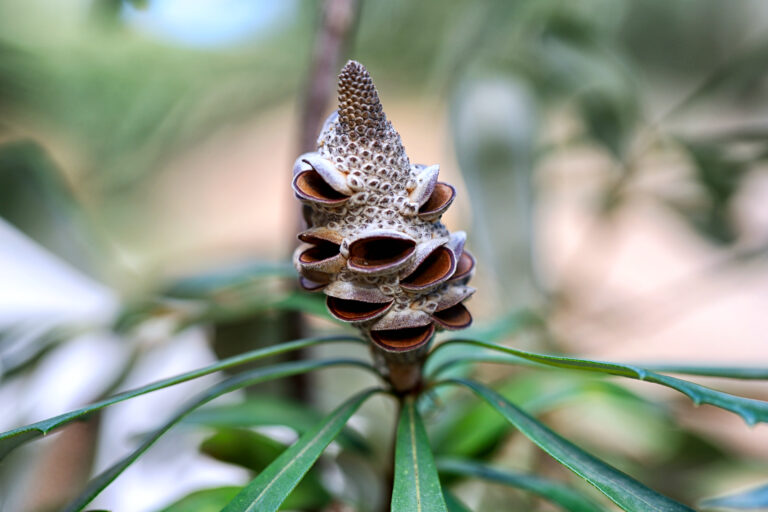
It was a banksia seed pod.
The amusing discovery became a memorable reminder that nature often hides familiar objects inside unfamiliar shapes. It also showed how quickly the human mind identifies patterns, fills in missing details, and sometimes reaches the wrong conclusion.
The Moment That Sparked the Mystery
A shape hidden among the trees
During outdoor walks, people naturally scan their surroundings for movement.
A fluttering leaf may suggest a bird. A dark branch may resemble an animal. A cluster of plants may briefly look like a face or figure.
In this case, the shape among the trees appeared unusually lifelike.
Its color matched the muted shades of the bush. Its position suggested that it was perched quietly, while its rounded form seemed similar to the body of a small bird.
The resemblance became especially convincing because tawny frogmouths are known for remaining motionless while relying on camouflage.
For someone familiar with Australian wildlife, the possibility made sense.
The forest offered the perfect setting, and the shape appeared to fit the expectation.
The camera changed the story
Beechey reportedly reacted the way many nature lovers would.
Rather than walking closer and risking disturbing the bird, she used her camera to capture the scene.
A photograph can preserve a rare wildlife sighting, especially when the animal may fly away within seconds. Zooming in also allows the observer to study details from a respectful distance.
However, the closer image changed the interpretation completely.
The apparent feathers became textured plant material. The imagined head and body became the natural curves of a seed pod.
What looked alive from a distance was simply part of a banksia tree.
The surprise created humor rather than disappointment. The object had performed an excellent imitation without moving at all.
Why the Seed Pod Looked Like a Bird
Shape can trigger instant recognition
The brain constantly searches for recognizable patterns.
When people look at an unclear object, the mind compares its outline with familiar shapes stored in memory. This happens quickly and often without conscious effort.
A rounded form with a narrower upper section may resemble a bird’s body and head. Dark openings may look like eyes, while uneven edges may suggest feathers.
Once the mind chooses an interpretation, every visible detail begins to support it.
A shadow becomes a wing.
A ridge becomes a beak.
A curve becomes a resting body.
The object itself does not change. Instead, the brain organizes incomplete information into a meaningful picture.
The setting made the mistake more likely
Context strongly influences perception.
A banksia seed pod sitting on a table would probably look like a plant structure. The same object viewed among trees and branches may look like wildlife.
The surrounding environment prepares the mind to expect birds, insects, mammals, and other forest creatures.
As a result, the brain may choose an animal explanation before considering a seed pod.
Lighting also plays a role. Outdoor shadows can hide texture and flatten details. Distance removes smaller clues that would otherwise make identification easier.
The combination of shape, setting, and low-detail viewing created a convincing illusion.
What Is a Banksia?
A distinctive Australian plant
Banksias are native Australian plants known for their striking flower spikes and unusual seed-bearing structures.
They belong to a diverse group that includes shrubs and trees. Different species grow across various parts of Australia, with many particularly associated with the southwest.
The flowers often appear in dense cylindrical clusters and may attract birds, insects, and small mammals.
After flowering, woody structures remain. These structures contain seed follicles that can produce the strange, textured forms often called banksia pods or cones.
Their shapes vary by species. Some look rough and irregular, while others resemble tiny faces, pine cones, or imaginary woodland creatures.
That unusual appearance explains why people often use them in crafts, photography, and decorative art.
Their seed structures can look almost animated
Banksia pods contain openings that may look like mouths or eyes.
When several follicles open across the surface, the pod can seem expressive. Depending on its position, it may resemble an owl, a small animal, or a carved figure.
The resemblance becomes even stronger when shadows fall inside the openings.
This visual quality has inspired countless comparisons. Some people see faces, while others see birds or strange creatures.
The pod that Beechey photographed apparently created the outline of a small resting bird so effectively that the illusion survived until she examined the enlarged image.
Banksias and Fire
Some species release seeds after heat exposure
Many Australian ecosystems have adapted to fire over long periods.
Certain banksia species hold their seeds inside woody follicles until heat encourages the structures to open. After a fire passes, the exposed ground may offer more light, space, and nutrients for new seedlings.
This does not mean every banksia species depends on fire in exactly the same way. Their responses vary.
Some release seeds gradually, while others retain them longer. Environmental conditions, species, and plant age all influence the process.
Still, the relationship between many banksias and fire illustrates how plants adapt to difficult environments.
A structure that looks dry or lifeless may contain the next generation of the forest.
Regrowth reflects resilience
Wildfire can cause enormous damage to landscapes, wildlife, communities, and individual plants.
Yet fire also forms part of the natural cycle in some Australian habitats.
Plants with fire-related adaptations may resprout from protected buds or release stored seeds after heat opens their follicles.
Banksias therefore offer a powerful example of resilience.
Their woody pods may remain closed through ordinary seasons, holding seeds until conditions support release.
The same strange structure that resembles a bird can also play a role in rebuilding plant life after disturbance.
The Tawny Frogmouth Resemblance
A master of camouflage
The tawny frogmouth is an Australian bird famous for blending into trees.
Its mottled gray, brown, and white feathers resemble bark. During the day, it often rests motionless on a branch with its body stretched upright.
This posture makes the bird look like part of the tree.
Rather than flying away immediately, a tawny frogmouth may rely on stillness and camouflage to avoid detection.
That behavior makes a quiet, bird-shaped object in the bush seem like a plausible sighting.
The observer does not need to imagine a moving bird. A perfectly still shape can match the species’ normal behavior.
Why the mistake was understandable
The misidentification did not result from carelessness.
It came from recognizing several genuine clues:
- A bird-like outline
- Natural camouflage
- A forest setting
- Complete stillness
- Colors associated with bark and feathers
The conclusion was reasonable until the camera revealed more information.
This is how observation often works in nature. People form an initial identification and then test it by examining movement, texture, sound, markings, or photographs.
Even experienced naturalists sometimes revise their first impression.
The correction becomes part of the learning process.
Why Nature Creates So Many Visual Illusions
Camouflage blurs the line between objects and animals
Many animals survive by resembling their surroundings.
Birds may look like bark. Insects may imitate leaves. Caterpillars may resemble twigs, while fish can disappear against sand or coral.
Because nature contains so much real camouflage, the mind remains prepared to discover hidden animals.
Sometimes that preparation creates false alarms.
A seed pod becomes a bird.
A branch becomes a snake.
A stone becomes a resting frog.
These mistakes reveal how effectively natural colors and shapes overlap.
Plants also imitate familiar forms by accident
Not every resemblance has an evolutionary purpose.
A banksia pod does not need to look like a bird to survive. The similarity may simply result from the way its follicles, ridges, and curves develop.
Humans then interpret the form using familiar images.
This tendency to see recognizable shapes in random or ambiguous patterns is sometimes called pareidolia.
It explains why people see faces in clouds, animals in rocks, or expressions in tree bark.
The process can create amusement, art, storytelling, and stronger engagement with the natural world.
The Value of Looking More Closely
Curiosity turns mistakes into discoveries
Beechey’s experience could have ended with a quick glance and a mistaken assumption.
Instead, she photographed the object and examined it more carefully.
That extra step revealed something unexpected.
Although she did not capture a bird, she discovered an unusual plant structure with its own fascinating biology.
Curiosity transformed a mistaken identification into a nature lesson.
This approach benefits anyone exploring outdoors.
When something looks strange:
- Observe it from a safe distance.
- Use binoculars or a camera.
- Notice texture, color, and position.
- Look for movement.
- Compare it with reliable field guides.
- Avoid disturbing wildlife or plants.
- Accept that the first guess may change.
The goal is not to identify everything perfectly at once. The goal is to remain interested enough to keep looking.
Photography can improve observation
Taking photographs encourages people to slow down.
A camera preserves details that may disappear during a brief sighting. It also allows later comparison with books, identification guides, or expert resources.
Zooming in can reveal:
- Feather patterns
- Leaf shapes
- Seed openings
- Insect markings
- Animal tracks
- Bark texture
However, photographs can also create distortions. Distance, lighting, digital zoom, and angle may alter scale or remove context.
Therefore, a picture provides useful evidence but not always a complete answer.
In Beechey’s case, the camera corrected the illusion rather than strengthening it.
A Lighthearted Moment Shared With Others
Many viewers saw the same bird
After Beechey shared the image, other people reportedly admitted that they also mistook the seed pod for a bird.
This reaction confirmed how effective the illusion was.
People with different experiences reached the same initial conclusion because the shape strongly suggested a resting animal.
The shared mistake became part of the enjoyment.
Instead of feeling embarrassed, viewers could compare what they thought they saw and appreciate how easily perception had fooled them.
The image encouraged conversation
Simple nature photographs often create strong engagement because they invite participation.
Viewers may ask:
- What did you see first?
- Does it look like a bird?
- Which bird does it resemble?
- Have you ever mistaken a plant for an animal?
- What other natural objects create illusions?
These questions turn a single image into a collective observation exercise.
They also encourage people to notice plants that might otherwise receive less attention than animals.
A seed pod can become just as memorable as a wildlife encounter when it carries a surprising shape and story.
How to Explore Nature Responsibly
Observe without disturbing
Curiosity should remain respectful.
When an object might be a bird, nest, insect, or other animal, keep enough distance to avoid causing stress.
Do not poke, shake, or remove it simply to confirm its identity.
A camera, binoculars, or careful visual inspection usually provides a safer approach.
Even plant material may play an ecological role. Seed pods can support regeneration, while fallen structures may provide shelter or contribute nutrients to the soil.
Local regulations may also prohibit removing native plant material from parks, reserves, or protected land.
Leave discoveries where they belong
An unusual seed pod may look attractive enough to take home.
However, leaving natural objects in place protects the habitat and allows other visitors to enjoy them.
It also prevents the accidental movement of insects, seeds, fungi, or plant diseases.
Photography offers a responsible way to preserve the memory without removing anything.
A clear image can become:
- A personal nature record
- An educational tool
- A conversation starter
- A drawing reference
- A citizen-science observation
The forest keeps its seed pod, while the observer keeps the story.
Turning a Mistake Into a Learning Activity
Families can practice visual identification
The banksia photograph offers an easy activity for children and adults.
Show the image briefly and ask everyone what they see.
Then reveal the closer view and discuss which details created the illusion.
This exercise teaches:
- Observation
- Pattern recognition
- Openness to correction
- Plant biology
- Wildlife camouflage
- Respectful exploration
It also shows that being wrong can feel enjoyable when it leads to discovery.
Nature journals preserve small surprises
A simple notebook can deepen outdoor experiences.
Record:
- Date and location
- Weather
- Initial identification
- Closer observations
- Final conclusion
- Questions for later research
- A sketch or photograph
Over time, the journal becomes a personal record of local plants, animals, and seasonal changes.
Not every entry needs to involve a rare species.
A strangely shaped seed pod can become one of the most memorable pages.
Frequently Asked Questions
What did Kym Beechey initially think she saw?
According to the source account, she believed the object was a small bird, possibly a young tawny frogmouth.
What was the object really?
It was a banksia seed pod.
Why can banksia pods look like animals?
Their woody surfaces contain irregular openings, ridges, and curves. From certain angles, these features can resemble eyes, mouths, feathers, or body shapes.
Are banksias native to Australia?
Yes. Banksias are native Australian plants, with many species growing in the country’s southwestern regions.
Do banksia seed pods need fire to open?
Some species hold seeds in woody follicles that may open after exposure to heat. However, the relationship with fire varies among species.
Why did so many people see a bird?
The pod’s outline, color, forest setting, and still position encouraged the brain to interpret it as a camouflaged animal.
Is it safe to remove seed pods from the forest?
It is better to leave natural objects where they are, especially in protected parks or reserves. Local regulations may prohibit collecting plant material.
Conclusion
The curious shape in the Australian bush appeared to be a small bird resting quietly among the trees.
A closer look revealed a banksia seed pod.
The discovery was simple, but it carried several lessons. It showed how strongly context shapes perception, how quickly the brain recognizes familiar patterns, and how technology can correct a first impression.
It also introduced viewers to the unusual beauty of banksia plants and their role in Australian ecosystems.
Most importantly, the moment rewarded curiosity.
Beechey did not walk away after making an assumption. She photographed the shape, studied it, accepted the surprising answer, and shared the discovery with others.
Nature does not always need rare wildlife or dramatic landscapes to inspire wonder. Sometimes all it takes is an ordinary seed pod, the right angle, and a mind willing to look twice.