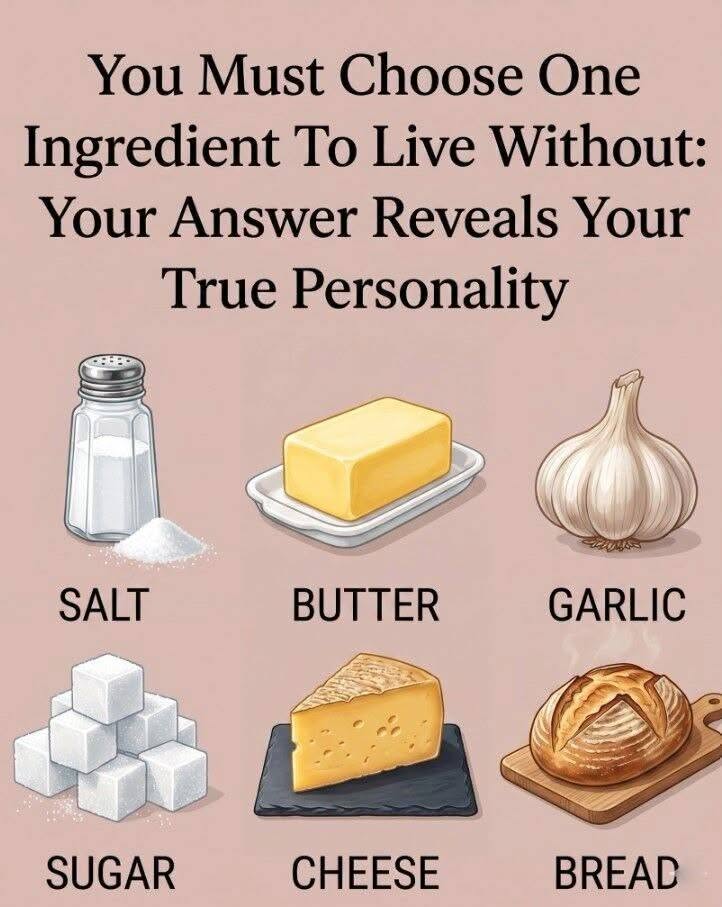
Imagine standing in your kitchen and being told you must permanently give up one familiar ingredient. Which would you choose first: sugar, salt, dairy, meat, grains, or caffeine?
At first, the question sounds like a simple food preference. However, the answer can lead to a surprisingly interesting conversation about habits, values, comfort, discipline, and the way we approach change.
Of course, Choose One Ingredient You Can Live Without and It May Reveal Something About Your Personality should remain a lighthearted exercise rather than a scientific personality test. No single ingredient can define a person. Still, food choices often connect deeply with memories, routines, cultural traditions, health priorities, and personal values.
I once tried this question during a quiet family dinner when everyone had very different opinions about what they could easily remove from their diet. One person immediately chose sugar, while another insisted life without coffee would feel impossible. Someone else said meat would be the easiest thing to surrender. What surprised me most was not the answers but the reasons behind them. Each explanation revealed a little about comfort, discipline, nostalgia, independence, and adaptability. Since then, I have viewed these playful food questions less as predictions and more as invitations to understand ourselves better.
What Your Food Choices Can Reflect
Why ingredients become emotionally meaningful
Food rarely exists as nutrition alone.
A particular flavor may remind you of childhood holidays, Sunday breakfasts, late-night conversations, family celebrations, or the person who first taught you to cook.
That emotional connection explains why giving up one ingredient may feel effortless while surrendering another sounds almost impossible.
Someone who chooses sugar may simply prefer savory foods. Another person may avoid dairy because it causes discomfort. Someone might stop eating meat because of ethical beliefs, environmental concerns, cost, religion, or personal taste.
Therefore, the choice itself cannot reliably diagnose personality.
However, the reason you make that choice can reveal something meaningful.
Do you prioritize practicality?
Tradition?
Comfort?
Health?
Adventure?
Simplicity?
Compassion?
Those motivations tell a more interesting story than the ingredient itself.
A personality quiz should inspire reflection, not judgment
Personality quizzes become enjoyable when we treat them as conversation starters.
Problems begin when broad claims become rigid labels.
For example, someone who avoids sugar is not automatically disciplined. Someone who drinks coffee is not automatically impatient. Likewise, eating meat or dairy says nothing definite about someone’s compassion, creativity, or strength.
People make food choices under countless circumstances.
Still, imagining what you could comfortably live without can reveal what you value most.
The interesting question becomes:
What would removing this ingredient represent for you?
Perhaps it means freedom from a habit.
Maybe it represents better health.
Perhaps you simply never cared much about it.
Or maybe sacrificing one ingredient helps you realize how strongly another food connects you to home.
That is where this little exercise becomes surprisingly thoughtful.
If You Would Give Up Sugar, Salt, or Dairy
If you chose to live without sugar
If sugar was your immediate answer, you may value simplicity, balance, or a sense of control.
Perhaps intensely sweet foods do not interest you. Maybe you naturally prefer fruit, savory meals, dark chocolate, or foods whose flavors come through without much added sweetness.
In the playful world of personality interpretation, choosing sugar can suggest someone who appreciates authenticity.
You may prefer straightforward people and uncomplicated situations. You could also have a practical streak that makes you comfortable declining something enjoyable when you believe you do not truly need it.
However, there is another possibility.
Perhaps you love sweet foods but would choose sugar specifically because giving it up feels like a meaningful challenge.
In that case, your answer may reflect determination.
You might enjoy setting goals, testing your discipline, and proving that habits do not control you.
There is also something symbolic about sweetness.
People often use phrases like “sugarcoat the truth” to describe making reality sound more pleasant than it is.
Therefore, someone choosing sugar in a personality game might jokingly describe themselves as a person who prefers honesty over unnecessary decoration.
You appreciate kindness, but you also want substance.
If you chose to live without salt
Choosing salt may suggest adaptability.
Salt appears in countless foods, so willingly imagining life without it can imply a willingness to adjust familiar routines.
Perhaps you are someone who finds alternatives easily.
If one plan fails, you make another.
If an ingredient disappears, you experiment with herbs, spices, citrus, garlic, vinegar, or fresh ingredients.
That resourcefulness can extend beyond the kitchen.
People who adapt comfortably often spend less time wishing circumstances were different and more time asking what they can do with what they have.
Still, your decision might be purely practical.
Maybe you simply do not enjoy heavily salted foods.
Perhaps you pay close attention to dietary choices.
Either way, selecting salt may reflect an appreciation for subtlety.
You might prefer gentle flavors, quieter environments, and experiences that do not need to overwhelm the senses to feel satisfying.
In relationships, that personality style could translate into steadiness.
You may value consistency more than drama and prefer dependable people to unpredictable excitement.
Again, this remains playful interpretation rather than fact, but it makes an interesting mirror.
If you chose to live without dairy
Choosing dairy can suggest creativity and flexibility.
Milk, cheese, butter, cream, yogurt, and countless desserts depend on dairy, so removing it requires substitutions in many traditional dishes.
People who enjoy experimenting may actually find that challenge exciting.
Instead of focusing on what disappears, they begin thinking about alternatives.
Could olive oil replace butter?
Could oat milk work here?
What about coconut milk, cashew cream, or another option?
That problem-solving mindset can indicate an inventive approach to everyday life.
You may dislike hearing that something “must” be done one particular way.
Instead, you tend to ask whether another method could work just as well.
People with this outlook frequently enjoy customizing routines, recipes, workspaces, and plans to suit their individual needs.
They respect tradition without feeling trapped by it.
In a lighthearted personality reading, choosing dairy can therefore represent independence.
You appreciate useful ideas, but you still want freedom to create your own version.
If You Would Give Up Meat, Grains, or Caffeine
If you chose to live without meat
People choose meat-free diets for many different reasons, so avoiding meat cannot define personality.
Still, if meat feels like the easiest ingredient group to surrender, you may be especially comfortable changing traditions.
Many classic meals revolve around meat. Choosing another direction often requires rethinking what makes a meal feel complete.
Instead of building dinner around steak, chicken, or another main protein, you may begin with beans, lentils, mushrooms, eggs, vegetables, grains, tofu, or other ingredients.
That shift can encourage curiosity.
In a personality quiz, choosing meat may suggest someone willing to question assumptions.
You may not automatically continue doing something simply because “that’s how it has always been done.”
Instead, you ask whether the habit still fits your values.
For some people, compassion for animals plays an important role. For others, environmental concerns, finances, health goals, religion, or simple taste preferences matter more.
Whatever the reason, giving up something culturally familiar can reflect confidence in personal decision-making.
You may care about belonging while still feeling comfortable making choices that differ from the people around you.
If you chose to live without wheat or grains
If bread, pasta, rice, cereal, or other grains were the easiest category for you to remove, you might value experimentation and self-direction.
Grains appear in many everyday meals, so avoiding them usually requires planning.
That willingness to restructure familiar routines can suggest a person who does not fear change.
You may approach life analytically.
If something stops working for you, you investigate alternatives rather than remaining loyal to habit simply because it feels familiar.
There may also be a minimalist side to this answer.
Some people enjoy simplifying their meals and routines. They like knowing exactly what works for them and removing what feels unnecessary.
That preference can extend to possessions, schedules, relationships, or work.
You may feel better when life contains fewer distractions and clearer priorities.
Of course, people who medically need to avoid certain grains have entirely different motivations, and their choices should never become personality stereotypes.
The playful interpretation only works when the decision is hypothetical.
If you chose to live without coffee or caffeine
For many people, this choice sounds almost heroic.
Coffee plays such a strong role in morning routines that giving it up can feel like surrendering an entire ritual rather than one ingredient.
If you can easily imagine life without caffeine, you may value steadiness and natural rhythms.
Perhaps you dislike relying on anything to create energy.
Maybe you enjoy quiet mornings and prefer waking gradually rather than rushing into the day.
In a playful interpretation, this can suggest patience.
You may take time before making decisions.
Rather than immediately reacting, you observe.
You could also be someone who protects sleep, calm, and predictable routines.
However, people who love coffee may choose caffeine precisely because they want freedom from dependency.
That answer would reveal something different: a desire for independence.
Sometimes what we choose to surrender tells us more about what we do not want controlling us.
What Your Answer Really Says About You
Your reason matters more than the ingredient
Imagine two people both choose sugar.
One says, “I never eat dessert anyway.”
The other says, “I love sweets, but I want to prove I could give them up.”
Those answers come from completely different motivations.
The first person values convenience.
The second values challenge.
Now imagine two people choose meat.
One cares deeply about animals.
The other simply prefers pasta and vegetables.
Again, the same choice tells two different stories.
That is why a food personality quiz becomes much more interesting when you ask a second question:
Why did you choose it?
Your explanation might reveal your relationship with comfort, discipline, nostalgia, health, independence, or change.
It may even expose something you had never consciously considered.
The ingredient you refuse to give up may reveal even more
There is another way to play this game.
Instead of asking what you could live without, ask what you absolutely would not want to surrender.
Maybe bread reminds you of home.
Coffee may represent ten quiet minutes before the day begins.
Cheese could remind you of family gatherings.
Sugar might connect you with baking alongside a parent or grandparent.
These preferences reveal the emotional side of eating.
A favorite ingredient can function like a small piece of personal history.
That is why food memories remain powerful decades later.
We may forget ordinary conversations, but we remember the smell of a kitchen.
We remember birthday cakes.
We remember holiday dinners.
We remember what someone cooked when we were sick.
Food becomes part of memory because we experience it through several senses at once.
Therefore, deciding what you could live without can unexpectedly highlight what you cherish most.
Frequently Asked Questions
Can food preferences really reveal personality?
Not reliably in a scientific sense. Personality develops through genetics, upbringing, experiences, culture, relationships, and many other influences. Food choices can still provide fun opportunities for self-reflection, especially when you examine the motivations behind them.
What does choosing sugar supposedly mean?
In a playful interpretation, choosing sugar can suggest a preference for simplicity, moderation, discipline, or authenticity. However, it may simply mean you do not enjoy sweet foods very much.
What does choosing meat mean?
It may reflect openness to alternative eating habits, compassion, independence, or curiosity. However, many people avoid meat for practical, cultural, religious, medical, financial, or personal reasons.
Does choosing coffee mean I am calm?
Not necessarily. Someone who could easily give up caffeine might value natural energy or simple routines, while someone who struggles to imagine life without coffee may simply love the flavor and ritual.
What is the best way to use this personality quiz?
Use it for conversation and self-reflection rather than labeling people. Ask what ingredient someone would remove, then ask why. The explanation usually creates the most interesting discussion.
Conclusion
Choose One Ingredient You Can Live Without and It May Reveal Something About Your Personality works best when you treat it as a playful invitation to think about the relationship between food and everyday life.
Sugar may represent indulgence or discipline.
Salt may symbolize familiarity or adaptability.
Dairy can highlight tradition or creativity.
Meat may connect with culture, ethics, or independence.
Grains can represent comfort or routine.
Caffeine may symbolize energy, ritual, or dependence.
Yet none of these ingredients can define a person.
Our personalities are far more complex than the food sitting in our kitchens.
Still, small choices sometimes open surprisingly meaningful doors.
The next time you sit around a table with friends or family, ask everyone the same question:
If you had to permanently give up one ingredient, which would you choose?
Then listen carefully to the reasons.
You might discover that the most interesting part of the game has nothing to do with food at all.