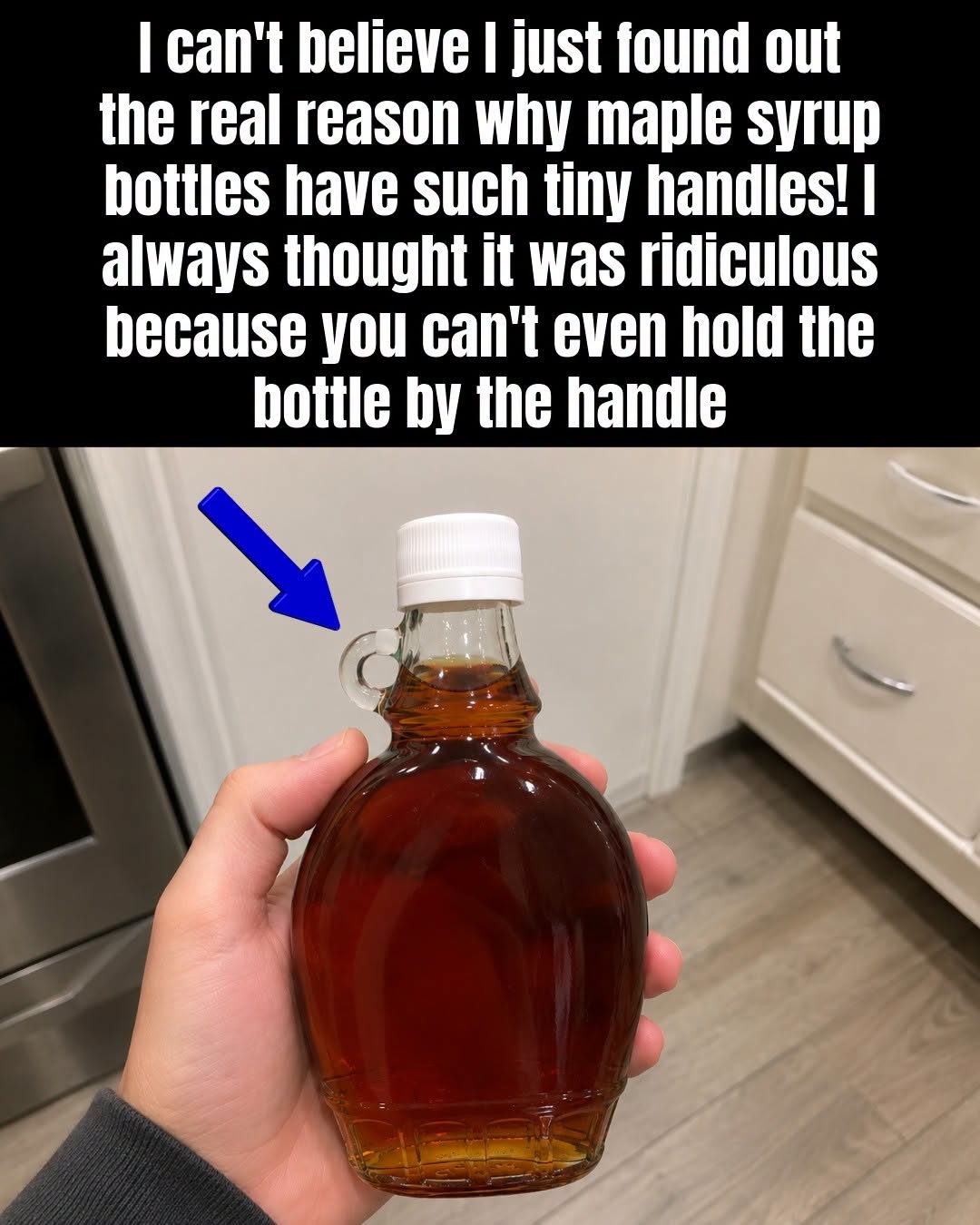
You’ve probably seen it countless times without giving it much thought: a glass maple syrup bottle with a tiny loop-shaped handle near the neck.
It looks like a miniature jug handle—but it’s far too small for most people to actually hold.
So why is it there?
Is it meant to help you pour the syrup? Is it left over from an old manufacturing process? Or is it simply decoration?
The answer is largely connected to traditional jug design and clever packaging.
First, What Is That Tiny Handle Called?
Small handles found on bottles and jugs are sometimes described as finger loops, jug handles, or decorative handles.
On many modern syrup bottles, however, the loop is so small that it isn’t particularly useful as an actual handle.
That’s your first clue.
Its main purpose today is generally aesthetic rather than practical.
It Comes From the Look of Traditional Jugs
Long before maple syrup appeared in the familiar glass containers found on supermarket shelves, liquids were commonly stored in ceramic, stoneware, and glass jugs.
These containers often had large, functional handles.
The handles made sense because older vessels could be relatively heavy, particularly when filled with liquid.
As packaging became smaller and easier to hold directly, a full-sized handle was no longer necessary.
But the jug shape remained visually appealing.
Manufacturers could reproduce the traditional appearance on a smaller scale, including a miniature version of the handle.
From Functional Handle to Decorative Detail
Imagine shrinking an old-fashioned handled jug until it’s small enough to sit comfortably on a breakfast table.
If every part were reduced proportionally, the handle would become tiny too.
That’s essentially the visual effect created by many syrup bottles.
The little loop communicates:
“This is a traditional syrup jug.”
It gives an ordinary glass bottle a rustic, old-fashioned character that fits perfectly with the imagery associated with maple syrup—sugar houses, forests, wooden cabins, and traditional breakfasts.
Was the Tiny Handle Ever Supposed to Be Used?
This is where internet explanations sometimes become more confident than the historical evidence allows.
You may encounter claims that these tiny loops were specifically invented to help people pour syrup or that they served some forgotten industrial purpose.
For many modern bottles, however, there’s a simpler explanation:
It’s part of the bottle’s design.
Larger historical jugs certainly had practical handles. But when the design was adapted into smaller commercial containers, the handle could become primarily decorative.
Unless a particular manufacturer documents another purpose for its bottle, it’s better not to assign the tiny loop a secret function.
Why Keep a Feature That Doesn’t Really Do Anything?
Because packaging isn’t only about function.
It’s also about recognition.
Imagine two bottles sitting beside each other on a supermarket shelf.
One is a plain cylindrical glass bottle.
The other resembles a miniature old-fashioned jug, complete with a little handle.
Which one immediately makes you think of traditional maple syrup?
Probably the second.
Distinctive bottle shapes can help products stand out and communicate ideas about tradition, craftsmanship, and authenticity before you’ve even read the label.
The Handle Helps Create a “Traditional” Feeling
Maple syrup has a strong connection to tradition.
Maple sap has been collected and processed in northeastern North America for generations, with Indigenous peoples possessing maple traditions long before European settlement.
Over time, maple production became strongly associated with rural sugarhouses, buckets, kettles, and later specialized collection and processing equipment.
Modern syrup production may use sophisticated tubing, filtration, and evaporator systems, but brands often retain traditional visual imagery.
A jug-shaped bottle fits naturally into that story.
The miniature handle reinforces it.
Not Every Maple Syrup Bottle Has One
Of course, plenty of maple syrup comes in completely different packaging.
You can find it in:
- Plastic jugs
- Standard glass bottles
- Metal containers
- Decorative leaf-shaped bottles
- Large commercial containers
- Traditional-style handled bottles
The tiny handle isn’t something maple syrup requires.
It’s simply one packaging style that has become closely associated with the product.
Does the Handle Help With Pouring?
For most bottles, not much.
If your finger comfortably fits through the loop and the manufacturer designed it to support the bottle, you might naturally use it for a little extra control.
But you shouldn’t assume every decorative loop is designed to bear the weight of a full bottle.
The safest and easiest method is simply to grip the body or neck of the bottle normally.
Why Maple Syrup Bottles Often Look So Distinctive
Syrup packaging has another challenge: the product itself is visually simple.
It’s essentially an amber-colored liquid.
A distinctive bottle can therefore do a lot of branding work.
Glass also lets customers see the syrup’s beautiful natural color, while unusual shapes can make smaller bottles especially attractive as gifts or souvenirs.
That’s why maple syrup is often sold in decorative bottles shaped like maple leaves or traditional jugs.
Pure Maple Syrup vs. Pancake Syrup
The bottle shape doesn’t necessarily tell you what’s inside.
If you want actual maple syrup, read the ingredient list.
Pure maple syrup is produced by concentrating sap from maple trees.
Products labeled pancake syrup or breakfast syrup may instead contain other sweeteners, flavorings, and additional ingredients.
Both may come in nostalgic-looking bottles, so packaging alone isn’t a reliable guide.
How Should You Store Maple Syrup?
The label should always be your first guide.
Unopened pure maple syrup can generally be stored according to the manufacturer’s directions until you’re ready to use it.
After opening, pure maple syrup is commonly refrigerated to maintain quality and reduce the chance of spoilage.
Storage recommendations for pancake syrups may differ because their ingredients and formulations aren’t the same.
So, What’s the Tiny Handle Really For?
The answer is less mysterious—but arguably more interesting—than many viral explanations suggest.
It’s largely a miniature version of the functional handles found on traditional jugs.
As the jug form was adapted into smaller commercial bottles, the handle became too small to be particularly useful, yet remained as a recognizable decorative feature.
In other words, you’re looking at a tiny piece of packaging nostalgia.
The Bottom Line
That miniature handle on some maple syrup bottles probably isn’t hiding an ingenious breakfast hack.
It’s there largely because the bottle is designed to resemble an old-fashioned handled jug.
What was once a practical feature on larger vessels became a charming visual detail when reproduced on smaller bottles.
So the next time you’re pouring maple syrup over pancakes and notice that ridiculously tiny loop, you’ll know why it exists.
Sometimes a design feature doesn’t survive because we still need it.
It survives because we still recognize the story it tells.
More Blog
- Drinking Water on an Empty Stomach — What Science Actually Supports (No Hype, Just Facts)
- Waking Up Between 3 and 5 AM? It Might Be Your Soul Trying to Talk to You
- What a “Bleach” Patch on Your Underwear Really Means — And Why It’s Actually a Good Sign
- This Drink May Weaken Your Bones From The Inside — But Everyone Drinks It Anyway