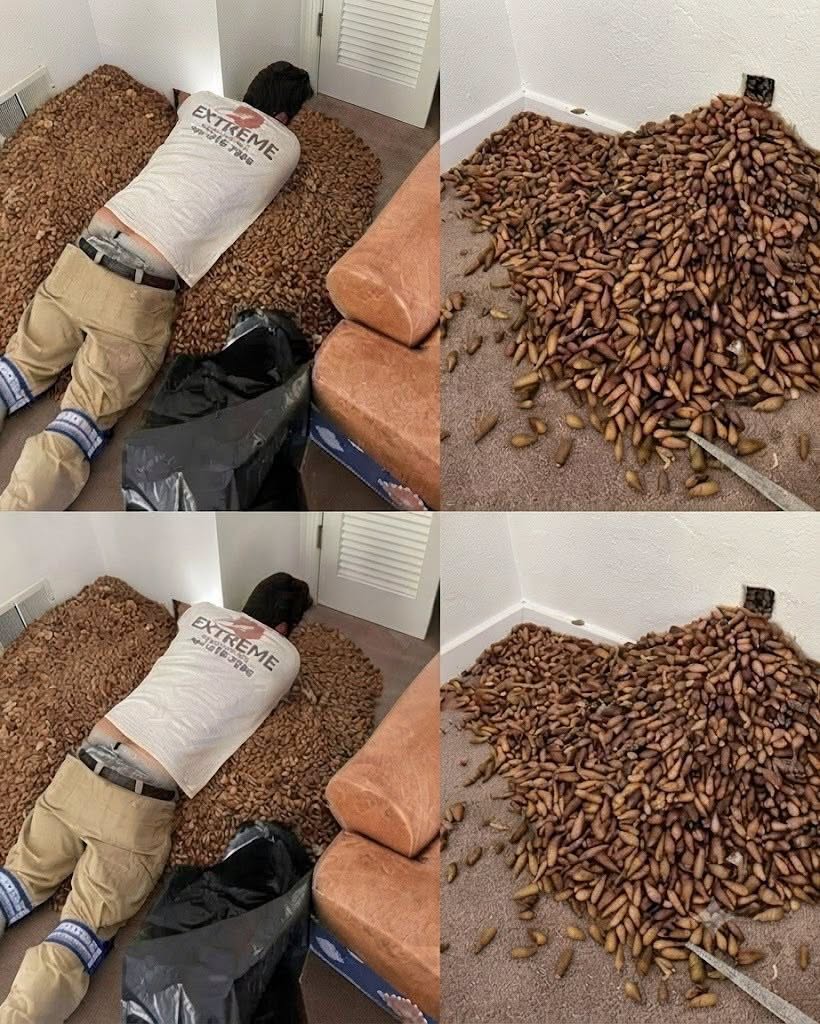
After more than two decades in pest control, Nick Castro, owner of Nick’s Extreme Pest Control in California, thought he had already encountered just about every strange thing that could be hiding inside a home.
Then came a call involving a woodpecker.
What appeared to be a relatively ordinary case of bird damage turned into one of the most memorable discoveries of his career.
When part of the wall was opened, acorns began pouring out.
Not a handful.
Not a few dozen.
An enormous hidden stash had accumulated inside the structure.
It Started With Holes in the Siding
The homeowner had noticed that a woodpecker was repeatedly making holes in the exterior siding.
That alone wasn’t especially unusual.
Woodpeckers can drill into wood and other suitable surfaces for several reasons, including searching for insects, communicating, nesting, or storing food.
In this case, the bird had apparently been using the openings to store acorns.
The problem was that the openings connected to hollow wall cavities.
Instead of staying near the holes where the bird placed them, many of the acorns simply dropped deeper into the walls.
And the bird kept bringing more.
The Wall Had Become a Giant Hidden Pantry
Castro reportedly expected to find some stored acorns when the wall was opened.
What he wasn’t prepared for was the scale.
As sections of the wall were opened, acorns began spilling out in large quantities.
The stash extended far beyond the immediate opening and appeared to have accumulated through much of the wall cavity.
What looked like a few small holes from outside concealed a massive collection of food inside.
Around 700 Pounds of Acorns Were Reportedly Removed
The total amount removed was estimated at roughly 700 pounds of acorns.
That figure is what turned the story from unusual into extraordinary.
According to accounts of the incident, the acorns filled several large bags after removal.
For a pest-control professional with decades of experience, it was unlike anything he had previously encountered.
How Could One Bird Store So Much?
The answer likely comes down to repeated behavior over a long period.
Certain woodpeckers are known for storing acorns in holes or crevices.
The acorn woodpecker, for example, famously creates what are known as granary trees, drilling thousands of small holes and storing individual acorns for later use.
In a natural setting, those acorns remain lodged in the holes.
A house wall, however, can behave very differently.
If the siding hole opens into an empty cavity, an acorn pushed through the opening may fall downward and disappear.
The bird may then return with another.
And another.
Repeated hundreds or thousands of times, that simple behavior can produce an astonishing accumulation.
Why the Bird May Have Kept Returning
From the bird’s perspective, the house may have appeared to be an excellent storage location.
There were suitable openings.
The area was protected.
And nothing immediately prevented additional acorns from being inserted.
The bird couldn’t necessarily know that much of its food was dropping out of reach inside the wall.
So it may have continued storing acorns even though many were effectively being lost.
Was the Strange Smell Really From the Acorns?
The headline surrounding the story often emphasizes a strange smell, but the most notable documented feature of the case was the enormous volume of acorns discovered in the wall.
Organic material trapped inside walls can potentially contribute to odors, especially if moisture, insects, rodents, or decay become involved.
However, an unusual smell in a house can come from many sources.
Homeowners shouldn’t assume that an odor automatically means something similar is hiding behind the drywall.
Why Wildlife Uses Houses in Unexpected Ways
To an animal, a house isn’t necessarily a “house.”
It can simply look like a collection of useful spaces.
Wildlife may interpret:
- Wall cavities as shelter
- Roof gaps as nesting sites
- Siding openings as storage cavities
- Attics as protected nesting areas
- Chimneys as hollow tree substitutes
This is why birds, squirrels, bats, rodents, and other animals sometimes interact with buildings in ways homeowners never expect.
Human structures can accidentally reproduce features animals normally use in nature.
The Bird Wasn’t Trying to Damage the House
It’s easy to describe wildlife as destructive when property damage occurs.
But animals aren’t intentionally attacking buildings.
They’re responding to instinct and opportunity.
The woodpecker was doing something completely logical from its own perspective: collecting food and attempting to store it safely.
The unusual result came from the interaction between that natural behavior and the design of the building.
Why Repeated Woodpecker Damage Shouldn’t Be Ignored
One or two holes in siding might seem minor.
Repeated holes are different.
They can allow:
- Water intrusion
- Insects to enter
- Wildlife to access wall cavities
- Moisture damage
- Further deterioration of siding
If you notice repeated pecking in the same part of a building, the important question is why the bird keeps returning.
Possible reasons include food, drumming behavior, nesting, or storage.
Understanding the cause can help determine the most effective solution.
Don’t Simply Seal an Active Nest
Wildlife problems need to be handled carefully.
Before sealing holes, homeowners should make sure they aren’t trapping birds or other animals inside a wall or nest.
This becomes especially important during nesting season.
Many native birds are also protected by wildlife laws, meaning nests, eggs, or birds may not legally be disturbed in certain circumstances.
When you’re unsure, contact a wildlife professional before closing an opening.
Humane Exclusion Is Usually the Better Approach
In situations like this, the goal should generally be to prevent the animal from continuing to use the structure rather than harming it.
Depending on the situation, that might involve:
- Repairing damaged siding
- Closing unused cavities
- Installing more durable exterior materials
- Eliminating attractive access points
- Using appropriate visual or physical deterrents
- Addressing insects that may be attracting woodpeckers
The exact solution depends on why the bird is pecking.
What Homeowners Can Learn From This Story
The biggest lesson isn’t that everyone should worry about hundreds of pounds of acorns hiding in their walls.
Cases this extreme are unusual.
The lesson is that small exterior clues can sometimes reveal much larger hidden problems.
Repeated holes, unexplained noises, odors, or animal activity deserve attention—particularly when they continue over time.
Investigating early can prevent relatively minor wildlife activity from becoming a much larger repair project.
Signs That Wildlife May Be Using Your Walls
Consider investigating if you notice:
- Repeated scratching or tapping
- Holes appearing in siding
- Birds repeatedly visiting the same opening
- Droppings beneath a particular location
- Nesting materials
- Unexplained sounds inside walls
- Persistent odors
- Damaged insulation
- Food or seeds appearing where they shouldn’t
None of these signs automatically mean there’s a serious infestation.
But together they can indicate that an animal has found a way into or around the structure.
Why Wall Cavities Can Hide So Much
Modern walls often contain surprisingly large empty spaces between studs.
Once material enters those spaces, it can accumulate without being visible from inside or outside the home.
Depending on the building design, material can fall several feet before reaching a barrier.
That means a tiny hole near the upper portion of a wall can eventually contribute to a large hidden pile near the bottom.
The homeowner may have almost no idea what is happening until a repair exposes it.
Nature Is Surprisingly Good at Adapting
Perhaps the most fascinating part of the story is how effectively wildlife can adapt to human environments.
Animals constantly encounter objects and structures that didn’t exist during most of their evolutionary history.
Yet they often find ways to use them.
A roof becomes a nesting platform.
A chimney resembles a hollow tree.
An attic becomes shelter.
And apparently, in one extraordinary case, a wall became an acorn pantry.
The Bottom Line
What began as a routine call about woodpecker damage turned into an extraordinary discovery when a California pest-control professional opened a wall and found an enormous stash of acorns hidden inside.
The bird had apparently been inserting acorns through holes in the siding, only for the food to fall into the hollow wall cavity.
Over time, the accumulation reportedly grew to hundreds of pounds.
The story is remarkable, but it also offers a practical reminder:
When wildlife repeatedly interacts with the same part of your home, don’t just repair the visible damage. Find out why the animal keeps returning.
A few tiny holes on the outside may occasionally be hiding a much bigger story inside.
More Blog
- Drinking Water on an Empty Stomach — What Science Actually Supports (No Hype, Just Facts)
- Waking Up Between 3 and 5 AM? It Might Be Your Soul Trying to Talk to You
- What a “Bleach” Patch on Your Underwear Really Means — And Why It’s Actually a Good Sign
- This Drink May Weaken Your Bones From The Inside — But Everyone Drinks It Anyway