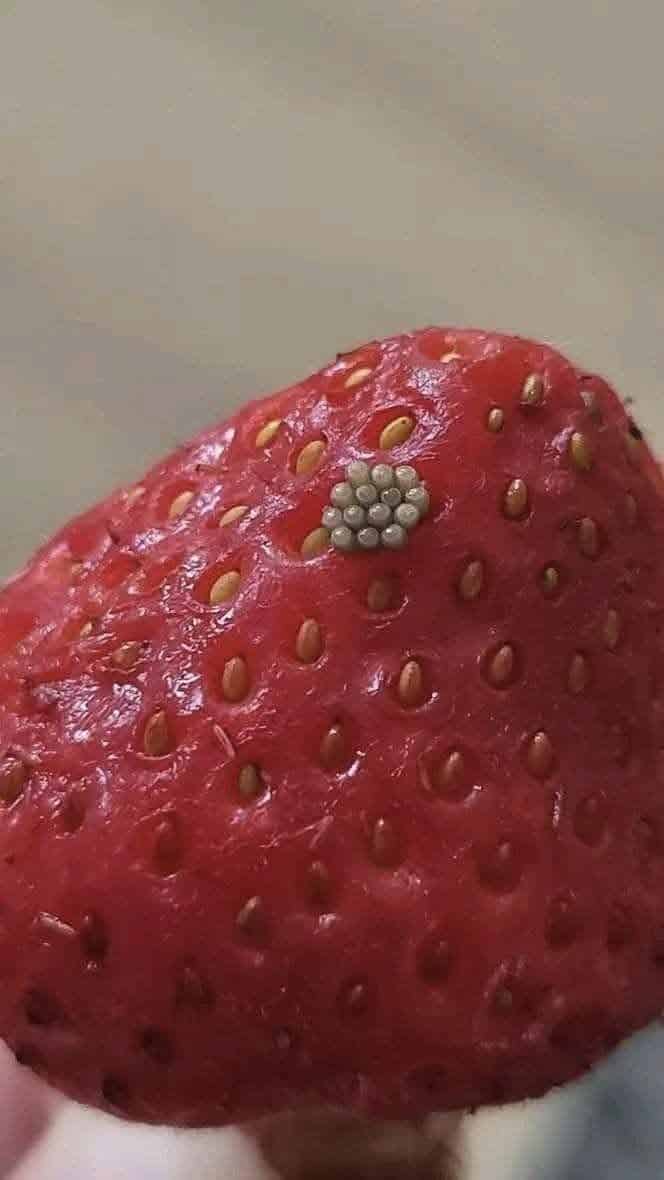
You bring home a fresh container of strawberries, eager to enjoy one of nature’s sweetest treats. The berries are bright red, fragrant, and seemingly perfect. Before eating them, you decide to try a popular cleaning trick you’ve seen online: soaking them in salt water.
A few minutes later, something unexpected happens.
Tiny white specks begin emerging from the fruit. Some appear to wriggle in the water. Suddenly, your delicious strawberries don’t seem quite so appetizing.
Your mind immediately races with questions.
Are these worms?
Are the strawberries contaminated?
Is the fruit still safe to eat?
Should the entire container be thrown away?
If you’ve experienced this unsettling discovery, you’re far from alone. Videos showing tiny white larvae emerging from strawberries have gone viral across social media platforms, generating millions of views and countless worried comments.
The good news is that the reality is far less alarming than it first appears.
Those tiny white creatures are usually harmless insect larvae that naturally occur in some fresh fruit. Their presence does not automatically mean your strawberries are unsafe, contaminated, or improperly handled. In fact, finding them often reflects the realities of growing food in nature rather than evidence of a serious problem.
Let’s take a closer look at what these tiny white larvae actually are, why they appear in strawberries, what happens during a salt water soak, and whether you should still feel comfortable eating your berries.
Why This Discovery Shocks So Many People
Modern consumers have become accustomed to visually perfect produce.
Walk through any grocery store and you’ll find strawberries that appear nearly flawless. Bright red surfaces, uniform size, and clean packaging create the impression that fruit grows in a pristine environment untouched by insects or natural processes.
The reality is quite different.
Strawberries grow outdoors.
They share their environment with:
- Bees
- Butterflies
- Beetles
- Flies
- Birds
- Microorganisms
- Beneficial insects
Agriculture takes place within living ecosystems, not sterile laboratories.
For thousands of years, humans have consumed fruits and vegetables that occasionally contained insects or larvae. In many traditional farming communities, finding a small insect in produce was considered entirely normal.
What has changed is our expectation of perfection.
As food production became increasingly industrialized, consumers grew accustomed to produce that looked spotless. Consequently, discovering tiny larvae today feels shocking even though it has always been part of nature.
What Are Those Tiny White “Worms”?
The first important fact is that they are usually not worms at all.
Most of the tiny white creatures found in strawberries are larvae of a small fruit fly known as the spotted wing drosophila.
This insect has become increasingly common in berry-growing regions around the world.
Unlike many fruit flies that target damaged or overripe fruit, spotted wing drosophila females possess a specialized egg-laying structure that allows them to deposit eggs inside healthy ripening fruit.
This ability makes berries particularly attractive.
Common targets include:
- Strawberries
- Raspberries
- Blackberries
- Blueberries
- Cherries
After eggs hatch, the larvae feed on the fruit’s interior as they develop.
Because the larvae are extremely small, most people never notice them while eating fresh fruit.
Understanding the Spotted Wing Drosophila
The spotted wing drosophila is a tiny vinegar fly originally native to parts of Asia.
Over the past several decades, it has spread across North America, Europe, and other regions.
Its success comes from a unique adaptation.
Unlike ordinary fruit flies that prefer decaying fruit, spotted wing drosophila can lay eggs in fruit before harvest.
This allows larvae to develop while the fruit remains on the plant.
By the time berries reach grocery stores, larvae may already be present inside some fruit.
This doesn’t necessarily indicate poor farming practices.
Even carefully managed farms encounter these insects.
Why Salt Water Makes the Larvae Appear
Many people discover larvae only after soaking strawberries in salt water.
This often creates the mistaken impression that the salt somehow generates the creatures.
It doesn’t.
The larvae were already present.
The salt simply encourages them to emerge.
The Science Behind the Process
Salt water creates what’s known as a hypertonic environment.
In simple terms, the water outside the larvae contains a higher concentration of salt than the fluids inside their bodies.
This causes water movement through osmosis.
As moisture leaves the larvae, they experience mild stress and irritation.
In response, they often move toward the fruit’s surface and exit into the surrounding water.
Without the salt soak, many would remain hidden and unnoticed.
The salt doesn’t create them.
It reveals them.
Why Fresh Water Usually Doesn’t Work
Many people wash strawberries under running water without seeing anything unusual.
That’s because plain water doesn’t create the same osmotic pressure.
Fresh water removes:
- Dirt
- Dust
- Surface debris
- Some pesticide residues
However, it doesn’t encourage larvae to leave the fruit as effectively as salt water.
This explains why people may eat strawberries for years without ever noticing larvae, then suddenly discover them during a salt-water experiment.
Are Strawberries with Larvae Safe to Eat?
This is the question most people care about.
The answer is generally yes.
Food safety experts widely agree that accidentally consuming fruit fly larvae poses little to no health risk for healthy individuals.
The larvae:
- Do not infect humans
- Are not parasitic
- Cannot survive in the digestive tract
- Are non-toxic
- Are digested normally
Your stomach acid breaks them down just like any other organic material.
Many people have unknowingly consumed small numbers of larvae throughout their lives without experiencing any health problems.
While the idea may be unpleasant, the actual health risk is extremely low.
Why Larvae Do Not Mean the Fruit Is Dirty
One common misconception is that larvae indicate poor hygiene.
In reality, larvae can appear even in carefully grown fruit.
Their presence reflects biological activity occurring before harvest.
A berry containing larvae may have:
- Been grown organically
- Been grown conventionally
- Been harvested properly
- Passed quality inspections
- Appeared perfectly fresh
The larvae developed while the fruit was growing.
This differs significantly from contamination caused by poor handling or improper storage.
Organic vs. Conventional Strawberries
Many people wonder whether larvae are more common in organic fruit.
The answer is often yes, although the difference varies.
Organic growers generally rely on:
- Biological controls
- Natural pest management
- Reduced synthetic pesticide use
As a result, some insects may survive in greater numbers.
However, this does not mean organic fruit is inferior.
Many consumers specifically choose organic produce to reduce chemical exposure.
The occasional presence of insects is sometimes viewed as a trade-off within that farming philosophy.
Conventional farms also encounter spotted wing drosophila.
Pesticides reduce populations but rarely eliminate them entirely.
Why Finding Larvae Doesn’t Mean the Fruit Is Spoiled
Spoilage and insect presence are separate issues.
A strawberry can contain larvae while remaining fresh and edible.
Conversely, a berry can be completely insect-free yet spoiled.
Signs of actual spoilage include:
- Mold growth
- Fermented odor
- Slimy texture
- Excessive softness
- Leakage
- Discoloration
These indicators matter far more than the presence of tiny larvae.
Always trust your senses when evaluating food quality.
How to Properly Clean Strawberries
Many people choose to remove larvae simply for peace of mind.
Fortunately, this is easy.
Salt Water Soak Method
Mix:
- 1 teaspoon salt
- 4 cups cold water
Place strawberries into the solution.
Allow them to soak for 10 to 15 minutes.
After soaking:
- Drain the water
- Rinse thoroughly under cold running water
- Pat dry before serving
This method encourages larvae to leave the fruit naturally.
Vinegar Rinse Method
Some people prefer a vinegar solution.
Mix:
- 1 part white vinegar
- 3 parts water
Soak berries briefly, then rinse thoroughly.
This method helps reduce surface bacteria and mold spores.
However, it is generally less effective than salt water for drawing out larvae.
Can Cooking Eliminate Larvae?
Absolutely.
Heat destroys larvae completely.
Cooking methods include:
- Baking
- Boiling
- Jam making
- Sauce preparation
- Pie filling production
Once heated, any larvae become harmless organic material.
For this reason, many people feel entirely comfortable using strawberries in cooked recipes regardless of whether larvae may be present.
The Bigger Picture: Food Comes from Nature
The viral fascination with strawberry larvae highlights an important reality.
Food is part of living ecosystems.
Many consumers have become disconnected from how fruits and vegetables are produced.
In nature:
- Insects visit plants
- Birds eat fruit
- Rain affects crops
- Microorganisms exist everywhere
Complete sterility rarely exists outdoors.
The occasional insect is not evidence of failure.
Rather, it reminds us that food originates in complex biological systems.
Why Food Literacy Matters
Understanding how food is grown helps reduce unnecessary fear.
Knowledge allows consumers to distinguish between:
- Natural occurrences
- Genuine food safety concerns
When people understand what they’re seeing, they can make informed decisions rather than reacting solely to shock or disgust.
This is particularly important in an era when social media often amplifies alarming content without context.
A dramatic video may generate millions of views.
Scientific explanations rarely spread as quickly.
Yet those explanations provide valuable perspective.
Frequently Asked Questions
Can larvae survive inside my body?
No. They cannot survive digestion and pose no parasitic threat.
Do all strawberries contain larvae?
No. Many strawberries contain none at all.
Are organic berries more likely to contain larvae?
Sometimes, due to reduced pesticide use, but not always.
Does freezing kill larvae?
Yes. Freezing typically kills larvae, although they may still be present physically.
Should I stop eating strawberries?
No. Strawberries remain a nutritious and safe fruit enjoyed by millions of people worldwide.
Final Thoughts
Discovering tiny white larvae in strawberries can certainly be surprising.
For many people, the experience feels unsettling at first. After all, nobody expects to see movement emerging from fruit they planned to eat.
However, understanding the science changes the picture considerably.
Those tiny white “worms” are usually fruit fly larvae, most commonly from the spotted wing drosophila. They are a natural consequence of growing fruit outdoors in living ecosystems. They do not infect humans, they do not survive digestion, and they generally pose no meaningful health risk.
The salt-water trick doesn’t create them—it simply reveals what was already there.
If seeing larvae bothers you, a simple salt soak followed by a thorough rinse can provide peace of mind. If you accidentally consume one, there is no reason for alarm.
Ultimately, finding a tiny larva in a strawberry may be less a sign of contamination than a reminder of where our food comes from.
Fresh fruit grows in nature, not in sterile environments.
And sometimes, understanding that reality is the best way to replace worry with confidence.
So the next time you enjoy a bowl of sweet, juicy strawberries, you can do so with a little more knowledge—and a lot less fear.