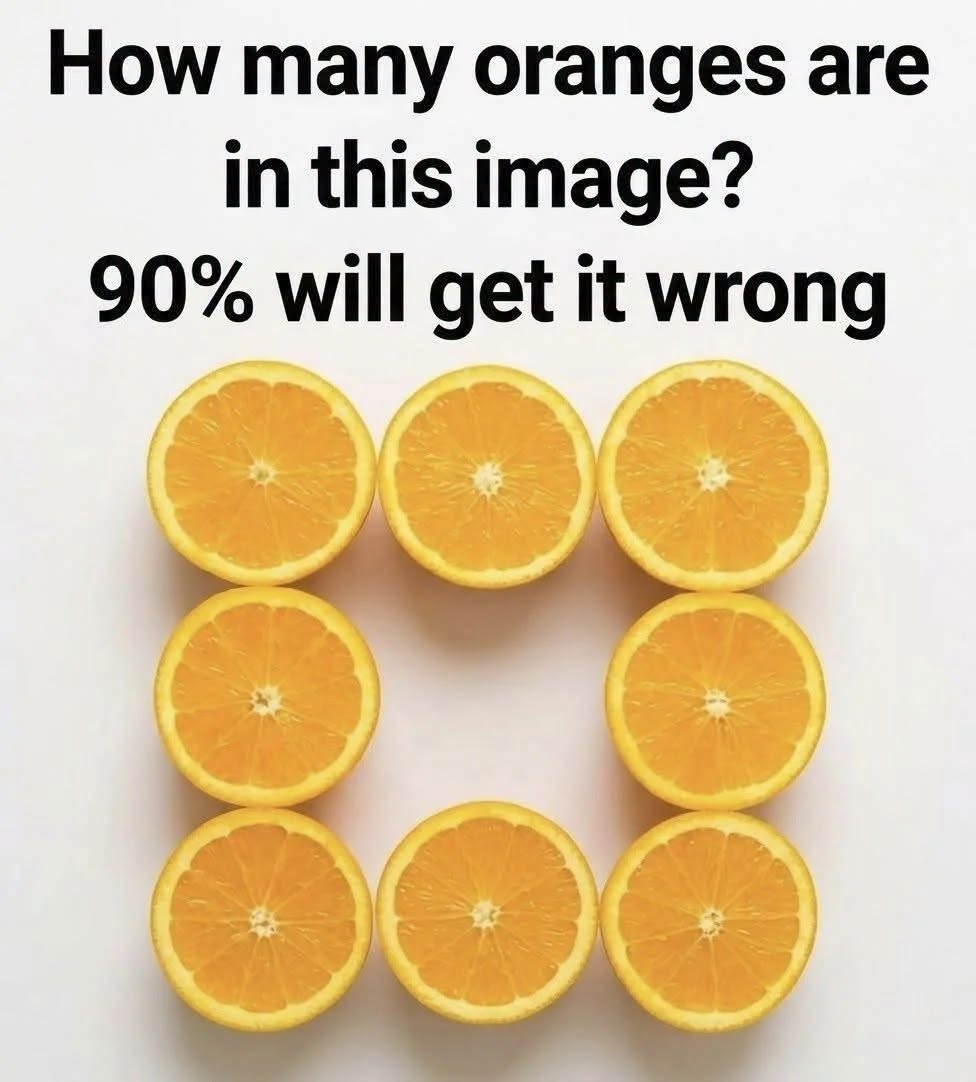
You’re scrolling through social media when a picture of oranges appears with a challenge:
“How many oranges can you see?”
It seems ridiculously easy. You count them, choose your answer, and move on.
Then you open the comments.
One person says 12. Another insists it’s 16. Someone claims the answer is 20, while another says everyone has missed an obvious trick.
How can a picture of a few pieces of fruit create so much disagreement?
The answer has less to do with oranges and more to do with attention, assumptions, visual perception, and the way viral puzzles are designed.
Why These Puzzles Are So Effective
Most viral visual puzzles exploit one basic habit:
Our brains try to understand images as quickly as possible.
When you look at a familiar object such as an orange, you don’t consciously analyze every pixel. Your visual system rapidly recognizes its shape, color, position, and relationship to nearby objects.
That’s incredibly useful in everyday life.
But it also means small changes can escape your attention.
Puzzle creators take advantage of this by encouraging you to establish a pattern—and then quietly changing it.
The First Trap: Counting Too Quickly
Imagine an image containing several rows of oranges.
Your brain immediately searches for organization.
If you see four oranges in the first row and four in the second, you may automatically expect another four in the third.
Instead of carefully counting every object, you begin calculating based on the pattern:
4 + 4 + 4 = 12.
But perhaps one orange in the final row is actually half an orange.
Or two oranges overlap.
Or one has disappeared entirely.
Your first answer may therefore reflect what you expected to see, rather than what’s actually in the picture.
The Second Trap: Small Visual Changes
This technique appears constantly in viral puzzles.
The first few lines teach you a visual rule.
Then the final line subtly breaks it.
For example:
- A whole orange becomes half an orange.
- Three pieces of fruit become two.
- One object becomes slightly smaller.
- A leaf disappears.
- Two identical-looking objects actually contain different details.
Because you’ve already categorized them as “the same orange,” your brain may not immediately notice the modification.
The Third Trap: What Exactly Are You Counting?
Sometimes the disagreement isn’t mathematical at all.
It’s linguistic.
Suppose the puzzle asks:
“How many oranges are in the picture?”
Does that mean:
- Whole oranges only?
- Every visible piece of orange?
- Two halves counted as one orange?
- Each separate fruit image?
- Or even orange-colored objects?
Without precise wording, several interpretations may be possible.
That’s one reason comment sections underneath these puzzles can become surprisingly argumentative.
People may be solving slightly different questions.
The Fourth Trap: Hidden or Overlapping Objects
Another common technique involves partial visibility.
You might see what looks like one orange while a portion of another is visible behind it.
Does that count as one or two?
If enough of the second object is visible to establish that it’s a separate fruit, many puzzle makers expect you to count it.
But again, the intended answer depends on the rules.
A good logic puzzle should provide enough information to reach one defensible conclusion.
Why Your Brain Fills in Missing Information
Human perception isn’t a camera.
Your brain constantly interprets incomplete information and fills in gaps based on experience.
If part of an orange is hidden behind another orange, you don’t perceive an inexplicable orange-colored crescent.
You perceive:
“There’s another orange behind that one.”
This ability is extremely useful.
It allows us to recognize partially obscured people, objects, letters, and shapes almost instantly.
Visual puzzles simply turn this normal cognitive shortcut against us.
The “90% of People Get This Wrong” Trick
You’ve probably seen captions such as:
“Only geniuses can solve this!”
“90% of people fail!”
“Only people with high IQ notice the mistake!”
Treat those statistics skeptically unless a credible study is actually provided.
In many cases, they’re simply engagement hooks.
They work because they challenge your identity.
Instead of thinking:
“Here’s a little fruit puzzle.”
you start thinking:
“Surely I’m not part of the 90% who can’t solve this.”
Now you’re emotionally invested enough to stop scrolling, examine the image, comment, or send it to someone else.
That’s exactly what makes the post spread.
How to Solve Visual Counting Puzzles More Reliably
Instead of immediately trusting your first answer, use a simple process.
Step 1: Ignore the Caption
Don’t let “only geniuses can solve this” influence you.
Look only at the actual problem.
Step 2: Read the Exact Question
Determine what you’re being asked to count.
Objects?
Whole fruits?
Pieces?
A numerical value?
These aren’t necessarily the same thing.
Step 3: Count Slowly
Count each visible object individually rather than assuming repeated rows contain identical numbers.
Step 4: Compare Similar Objects
Look for small differences in:
- Size
- Shape
- Number
- Orientation
- Leaves
- Missing pieces
- Overlapping objects
Step 5: Inspect the Final Row
In equation-style picture puzzles, the final line deserves particular attention.
That’s often where an object changes.
Step 6: Check the Mathematics
If the puzzle contains equations, remember the normal order of operations.
Multiplication and division generally come before addition and subtraction unless parentheses change the order.
A surprisingly large number of viral puzzle disagreements happen here.
Sometimes the Puzzle Doesn’t Have One Correct Answer
This is an important possibility.
Not every viral puzzle is carefully designed.
Some are ambiguous. Others have been repeatedly copied, cropped, edited, or recreated until important details disappear.
And increasingly, images circulating online may also be digitally manipulated or AI-generated.
If two interpretations are both consistent with what the image actually shows, declaring that everyone except one commenter is “wrong” doesn’t fix the ambiguity.
A logically sound puzzle needs sufficiently clear rules.
What These Puzzles Actually Test
Despite the captions, a viral orange puzzle isn’t a meaningful IQ test.
Solving one doesn’t prove someone is a genius, and missing a tiny altered orange doesn’t demonstrate low intelligence.
What these puzzles can exercise is something much narrower:
careful observation.
They encourage you to slow down, question assumptions, inspect details, and distinguish what you actually see from what you expected to see.
That’s useful far beyond social-media puzzles.
The Bigger Lesson Hidden Inside a Simple Orange
The most interesting part of these puzzles isn’t necessarily the final number.
It’s how quickly our brains construct patterns.
Once we’ve seen the same object several times, we stop inspecting it carefully. We assume the next one will match.
Most of the time, that mental shortcut saves enormous amounts of effort.
But occasionally, it makes us miss the tiny detail sitting directly in front of us.
The Bottom Line
The viral orange puzzle works because it takes advantage of normal features of human perception.
We recognize patterns quickly. We make assumptions. We fill in missing information. And once we think we’ve understood an image, we don’t always inspect every detail again.
So before posting your answer to the next “90% of people get this wrong” puzzle, try one thing:
Look at the picture a second time as though you’ve never seen it before.
The orange you overlooked might suddenly become impossible to miss.
More Blog
- Drinking Water on an Empty Stomach — What Science Actually Supports (No Hype, Just Facts)
- Waking Up Between 3 and 5 AM? It Might Be Your Soul Trying to Talk to You
- What a “Bleach” Patch on Your Underwear Really Means — And Why It’s Actually a Good Sign
- This Drink May Weaken Your Bones From The Inside — But Everyone Drinks It Anyway