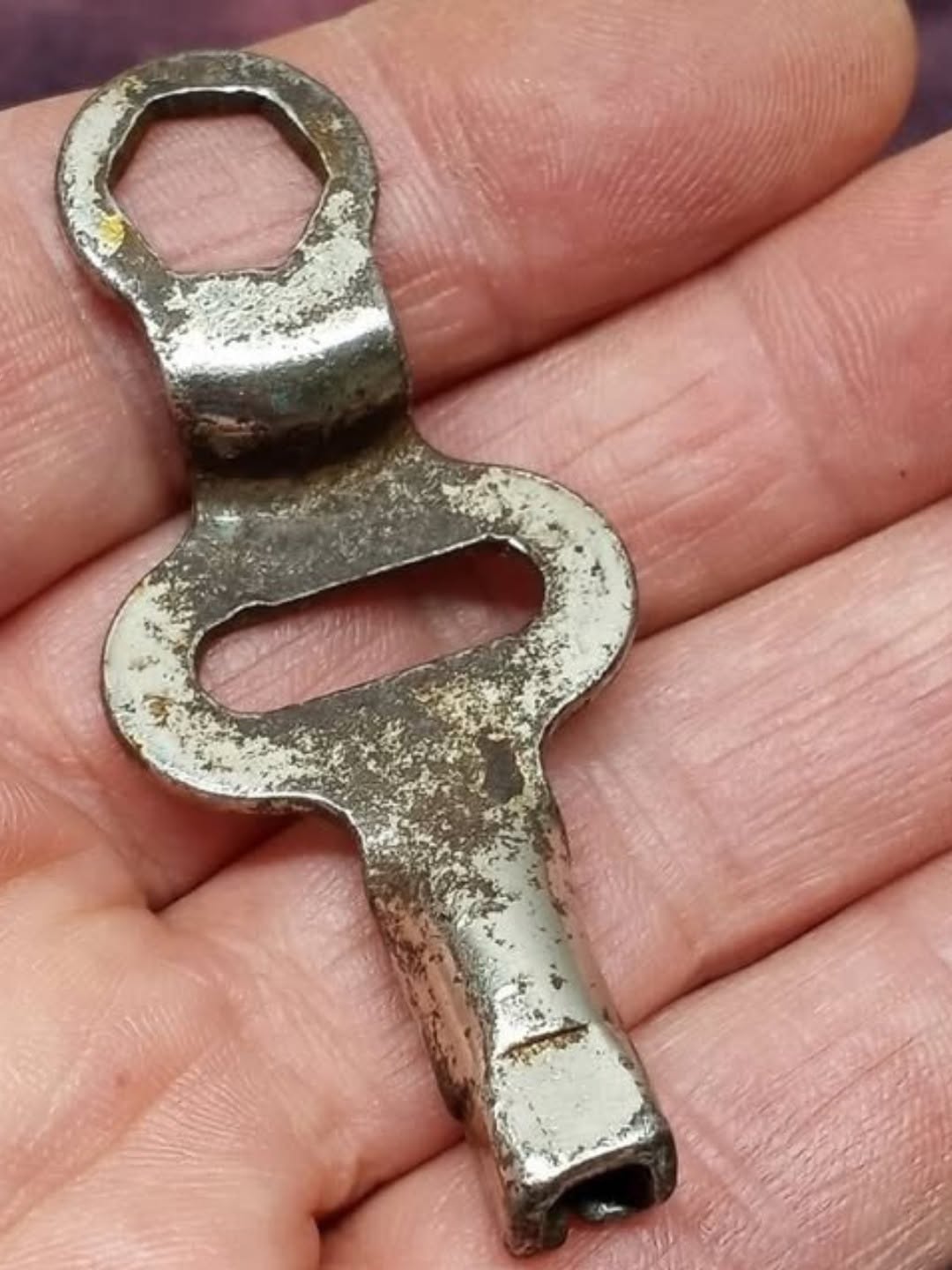
The Little Key That Held a Thousand Adventures may look like nothing more than an odd piece of stamped metal today. It has a hole, a simple shape, and sometimes a short chain or cord attached to it. To someone unfamiliar with vintage toys, it could resemble a tiny wrench or a forgotten household tool.
However, generations of children knew exactly what it was.
It was a roller skate key.
Before modern skates came with padded boots, quick-adjust buckles, and convenient straps, many children wore metal roller skates that clamped directly onto ordinary shoes. The skates needed adjustment to fit properly, and the little metal skate key provided the solution.
A few turns could tighten the toe clamps against a shoe or adjust the skate to match a growing foot. Without that small tool, a pair of clamp-on skates could become difficult or impossible to use correctly.
Yet The Little Key That Held a Thousand Adventures represented much more than mechanical adjustment. For many families, it became part of an entire childhood era filled with sidewalks, scraped knees, neighborhood races, summer evenings, and the unmistakable sound of metal wheels rolling over concrete.
I first saw an old skate key inside a small box of family keepsakes. At first, I thought it belonged to an old cabinet or perhaps a wind-up toy. Then an older relative immediately recognized it and began describing afternoons spent racing down sidewalks on metal skates. The key had hung around a neck on a shoelace so it would never disappear. Every few blocks, someone needed to tighten a loose clamp or adjust a skate. That tiny piece of metal suddenly seemed far more interesting. It had once given a child access to an entire neighborhood and countless hours of freedom.
The Little Key That Held a Thousand Adventures Had a Practical Purpose
What a Vintage Roller Skate Key Actually Did
Vintage clamp-on roller skates worked very differently from most recreational skates sold today.
Instead of arriving permanently attached to their own boots, many older skates consisted mainly of a metal frame, wheels, adjustable plates, clamps, and straps. Children placed their regular shoes on top of the skate frames.
The skate then needed to hold those shoes securely.
That is where the roller skate key became essential.
A typical clamp-on skate included adjustable metal toe clamps. Turning the key moved those clamps inward or outward so they could grip the sides or sole of the wearer’s shoe.
Therefore, The Little Key That Held a Thousand Adventures functioned much like a specialized wrench.
The exact design varied between manufacturers and periods. However, the basic principle remained remarkably practical. Instead of requiring a perfectly sized skate for every child, manufacturers could create adjustable skates that accommodated different feet.
Many designs also allowed adjustment of the skate’s overall length. As children grew, adults could loosen the mechanism, extend the frame, and tighten it again.
Consequently, one pair could last much longer than a fixed-size skate.
That flexibility mattered to families who expected toys and recreational equipment to survive for years rather than a single season.
Furthermore, siblings sometimes shared skates. The key allowed them to make quick adjustments when different-sized feet took turns.
The little tool looked insignificant, but without it, the convenience of adjustable clamp-on skates disappeared.
Why Children Often Wore the Key Around Their Neck
Losing a roller skate key created a real problem.
If a clamp became loose halfway down the sidewalk, a child could not simply tighten it by hand. Therefore, skaters needed their key nearby whenever they ventured away from home.
Many children solved the problem in the simplest possible way.
They wore it.
A shoelace, string, or chain could pass through the opening in the key. Then the child could wear it around the neck or attach it somewhere secure.
That arrangement kept The Little Key That Held a Thousand Adventures within easy reach.
Imagine skating several blocks from home and suddenly feeling one skate begin to wobble. Instead of walking back awkwardly with metal frames attached to your shoes, you could stop, pull out the key, tighten the clamp, and continue.
The key therefore became part tool and part accessory.
Moreover, its constant presence helped turn it into a powerful symbol of childhood for people who grew up with these skates.
The key might jingle against a shirt while someone walked.
It might become warm after hanging against the skin all afternoon.
Eventually, its surface might dull from years of use.
Those tiny physical details explain why an old skate key can trigger such strong memories decades later.
It did not sit forgotten in a toolbox.
Children carried it through their adventures.
How Clamp-On Roller Skates Became a Childhood Classic
From Early Roller Skates to Adjustable Metal Frames
Roller skating existed long before the sidewalk skates many people remember from the mid-20th century.
Inventors experimented with wheeled footwear for generations. However, an important development arrived in the 19th century when James Leonard Plimpton created an influential four-wheel skate design in 1863.
His design helped make turning and recreational skating more practical.
Meanwhile, inventors continued improving how skates attached to ordinary footwear.
Metal clamp systems eventually offered an alternative to relying entirely on leather straps. Later adjustable designs allowed the skate’s width and length to change.
That development created the perfect environment for The Little Key That Held a Thousand Adventures.
The skate key controlled those adjustments.
By the early 20th century, manufacturers produced sturdy metal clamp-on roller skates in large numbers. Surviving examples from the 1920s show metal skates secured by toe clamps and leather ankle straps, with the adjustment key carried alongside them.
The idea remained popular for decades.
Eventually, lightweight materials, improved wheels, shoe-mounted skates, purpose-built skating boots, and later inline designs changed what recreational skating looked like.
Still, clamp-on skates remained a familiar part of childhood well into the 20th century.
For people who grew up during that period, the sight of one metal key can bring the entire experience back instantly.
What It Felt Like to Skate on Metal Wheels
Modern recreational skates can feel remarkably smooth.
Many include padded boots, polyurethane wheels, precise bearings, supportive cuffs, and sophisticated braking systems.
Old-fashioned clamp-on skates offered a different experience.
Metal wheels transmitted almost every imperfection in the pavement directly to the skater.
Cracks mattered.
Pebbles mattered even more.
Rough sidewalks produced a distinctive rolling vibration and plenty of noise.
The skates also demanded attention because the clamps could gradually loosen as the wearer moved.
Therefore, a child often developed a routine.
Skate.
Stop.
Check the clamps.
Tighten them with the key.
Then skate again.
Although the equipment looks primitive compared with today’s designs, children could turn a driveway or ordinary sidewalk into an entire playground.
They created races.
They practiced turns.
They competed to see who could coast farthest.
They skated until porch lights appeared and parents began calling them home.
Consequently, The Little Key That Held a Thousand Adventures became associated with independence.
A child did not need electricity, an app, a screen, or complicated equipment.
A pair of skates, a key, and an open stretch of pavement could fill an afternoon.
That simplicity helps explain why people remember these objects with such affection.
Why the Roller Skate Key Became a Symbol of Nostalgia
A Tiny Object Can Hold Powerful Memories
Objects often carry memories far beyond their monetary value.
A roller skate key offers a perfect example.
On its own, the key contains very little expensive material. Most examples consist of a small piece of metal designed for one highly specific task.
Yet The Little Key That Held a Thousand Adventures can represent childhood freedom to someone who once depended on it.
The memory does not stop with the skate itself.
One person may remember a best friend waiting outside.
Another may remember learning to balance while holding a parent’s hand.
Someone else may remember racing down a hill they probably should not have attempted.
Perhaps the strongest memory involves sound.
Metal wheels created a rhythmic clatter on hard pavement that newer equipment rarely reproduces.
Then there were the sensations: warm sidewalks in summer, cool evening air, dusty knees after a fall, and the relief of successfully tightening a loose skate before continuing.
These details transform an ordinary mechanical object into something emotional.
That connection also explains why vintage skate keys frequently puzzle younger generations.
Without the skates, the object gives very few clues about its purpose.
However, show one to someone who used clamp-on skates, and recognition can happen almost instantly.
Suddenly, a forgotten little tool becomes a doorway into another time.
Why Growing Feet Made the Key So Important
Children grow quickly, which creates an obvious problem for footwear.
A pair of shoes may fit perfectly one season and become uncomfortable the next.
Therefore, adjustable roller skates offered families an important advantage.
Rather than replacing the entire pair every time a child’s feet grew, adults could alter the skate’s fit.
Many clamp-on designs allowed adjustment in more than one direction.
The toe clamps could accommodate different shoe widths, while the frame could often extend to suit longer feet.
As a result, The Little Key That Held a Thousand Adventures helped a single pair of skates serve a child for several years.
It could also allow brothers and sisters to share equipment.
Of course, those adjustments required attention.
The clamps needed enough pressure to secure the shoes but should not fit carelessly.
Loose skates could slip during use, while poorly adjusted equipment could make balancing difficult.
Children gradually learned how their skates should feel.
They knew when a clamp started to loosen.
They knew when the frame needed adjustment.
They also understood that losing the key could abruptly end an afternoon of skating.
For that reason, wearing the key around the neck made practical sense.
The small metal object stayed close because freedom on four wheels sometimes depended on having it.
What Happened to the Classic Roller Skate Key?
Why Modern Skates No Longer Need One
Eventually, skate technology moved away from clamp-on designs.
Manufacturers increasingly attached wheel assemblies directly to dedicated skating boots. This approach provided a more secure connection and eliminated the need to clamp an ordinary street shoe onto a separate metal frame.
Materials changed as well.
New wheel compounds produced smoother rides than old metal wheels. Bearings improved. Boots became more supportive. Recreational skating equipment increasingly arrived as a complete unit rather than an adjustable attachment.
Later, inline skates introduced another major shift in popular recreational skating.
Consequently, The Little Key That Held a Thousand Adventures gradually disappeared from everyday childhood.
A modern child can put on recreational skates by using laces, buckles, straps, or modern adjustment systems. They do not need to carry a special metal wrench simply to keep the skate attached.
From a convenience standpoint, modern designs offer obvious advantages.
However, the disappearance of the skate key also removed one of the small rituals that surrounded older skating.
Children once had to understand their equipment.
They tightened it.
They adjusted it.
They checked it themselves.
They carried the tool required to keep it working.
That interaction created a different relationship between the child and the toy.
Today, old skate keys survive in boxes, garages, flea markets, antique stores, and family collections.
Without context, they can appear mysterious.
Once identified, however, they reveal an entire chapter of everyday recreational history.
How to Identify an Old Skate Key Today
If you find a small vintage metal object that resembles a miniature wrench, you may wonder whether you have discovered an old roller skate key.
Several clues can help.
First, look at its size. Most skate keys fit comfortably in the palm because children needed to carry them easily.
Next, inspect its opening or working end. The shape should correspond to an adjustment mechanism rather than an ordinary household lock.
Many keys also include a hole or loop area that allowed the owner to attach a cord or chain.
However, designs varied considerably, so not every roller skate key looks identical.
If the key appears alongside old metal roller skates, identification becomes much easier.
Look for adjustable frames, metal wheels, toe clamps, or leather ankle straps.
Together, those features strongly suggest a traditional clamp-on roller skate system.
You may even find the key still attached to one skate.
Before cleaning a vintage example aggressively, consider its historical or sentimental value. Heavy polishing can remove age-related surface characteristics that collectors sometimes prefer to preserve.
Instead, start gently and avoid forcing the key into any old mechanism.
More importantly, do not assume that an antique pair of skates remains safe for recreational use. Age can weaken straps, fasteners, wheels, and other components.
Today, The Little Key That Held a Thousand Adventures often serves best as a conversation piece and a reminder of how children once played.
Frequently Asked Questions
What is the little metal roller skate key used for?
A vintage roller skate key adjusted clamp-on roller skates. Depending on the skate design, the key could tighten or loosen toe clamps and help adjust the skate to fit the wearer’s shoe or foot length.
Why did people wear roller skate keys around their necks?
Children needed the key whenever their skate clamps loosened or required adjustment. Therefore, many attached the key to a shoelace, cord, or chain and wore it around the neck so they would not lose it while skating.
When were clamp-on roller skates popular?
Adjustable clamp-on roller skates developed during the late 19th century and became widely familiar during the 20th century. Many children continued using adjustable metal clamp-on styles through the mid-century years and into the 1960s.
Did roller skate keys fit every pair of skates?
Not necessarily. Skate designs and adjustment mechanisms varied among manufacturers and eras. Therefore, one key might not fit every vintage skate. Matching an old key with its original skate provides the best chance of proper identification.
Are old metal roller skates safe to use today?
Not automatically. Decades of storage can weaken leather straps, fasteners, bearings, clamps, and other components. Vintage skates make interesting collectibles, but anyone considering actual use should have their condition carefully evaluated rather than assuming they remain structurally sound.
Conclusion
The Little Key That Held a Thousand Adventures was never an elaborate invention.
It was small.
It was inexpensive.
Its job was simply to adjust a pair of roller skates.
Yet for generations of children, that little piece of metal unlocked something much larger.
It meant slipping ordinary shoes into cold metal frames and tightening the clamps until everything felt secure.
It meant meeting friends on the sidewalk.
It meant learning to balance, falling down, standing back up, and trying again.
It meant racing toward the corner, coasting down familiar hills, and hearing metal wheels clatter over every seam in the pavement.
Eventually, technology moved forward. Clamp-on skates gave way to dedicated skate boots, smoother wheels, modern fastening systems, and inline designs.
The little key stopped being necessary.
Still, it never completely disappeared.
You can find one today tucked inside an old drawer or hanging beside a forgotten pair of metal skates. To someone unfamiliar with it, the object may seem impossible to identify.
To someone who grew up wearing one around the neck, however, no explanation is necessary.
It is a roller skate key.
And for a child standing at the beginning of a long summer afternoon, it really could feel like the key to a thousand adventures.
WP Recipe Maker JSON Import
{
  "title": "The Little Key That Held a Thousand Adventures",
  "summary": "A nostalgic look at the vintage roller skate key, the adjustable clamp-on skates it operated, and why this tiny metal tool became an unforgettable symbol of childhood freedom.",
  "notes": "This is an informational nostalgia feature rather than a food recipe. Vintage roller skate keys adjusted the clamps and, on some skate designs, the length of metal clamp-on roller skates. Designs varied by manufacturer and era.",
  "ingredients_flat": [
    {
      "amount": "1",
      "unit": "",
      "name": "vintage roller skate key"
    },
    {
      "amount": "1",
      "unit": "pair",
      "name": "adjustable clamp-on roller skates"
    },
    {
      "amount": "1",
      "unit": "",
      "name": "shoelace, cord, or chain for carrying the key"
    }
  ],
  "instructions_flat": [
    {
      "name": "Step 1",
      "text": "Place each vintage clamp-on roller skate beneath a sturdy shoe so the sole rests correctly on the adjustable metal frame.",
      "summary": "",
      "image_url": ""
    },
    {
      "name": "Step 2",
      "text": "Use the roller skate key to adjust the skate length when the design includes an adjustable sliding frame.",
      "summary": "",
      "image_url": ""
    },
    {
      "name": "Step 3",
      "text": "Turn the skate key to move the toe clamps inward until they hold the shoe securely without careless over-tightening.",
      "summary": "",
      "image_url": ""
    },
    {
      "name": "Step 4",
      "text": "Fasten any ankle or heel strap supplied with the skate according to its original design.",
      "summary": "",
      "image_url": ""
    },
    {
      "name": "Step 5",
      "text": "Check the clamps frequently because movement can loosen vintage adjustable hardware.",
      "summary": "",
      "image_url": ""
    },
    {
      "name": "Step 6",
      "text": "Keep the key attached to a cord or stored securely so it remains available whenever the skate needs adjustment.",
      "summary": "",
      "image_url": ""
    },
    {
      "name": "Step 7",
      "text": "Treat antique skates primarily as collectibles unless a qualified inspection confirms that their aged straps, clamps, wheels, and fasteners remain suitable for use.",
      "summary": "",
      "image_url": ""
    }
  ],
  "equipment": [
    {
      "name": "Vintage roller skate key",
      "notes": ""
    },
    {
      "name": "Clamp-on roller skates",
      "notes": ""
    },
    {
      "name": "Sturdy shoes",
      "notes": ""
    }
  ],
  "nutrition": {
    "calories": "0",
    "carbohydrates": "0 g",
    "protein": "0 g",
    "fat": "0 g",
    "saturated_fat": "0 g",
    "polyunsaturated_fat": "0 g",
    "monounsaturated_fat": "0 g",
    "trans_fat": "0 g",
    "cholesterol": "0 mg",
    "sodium": "0 mg",
    "potassium": "0 mg",
    "fiber": "0 g",
    "sugar": "0 g",
    "vitamin_a": "0",
    "vitamin_c": "0",
    "calcium": "0",
    "iron": "0"
  },
  "tags": {
    "course": ["Vintage Lifestyle"],
    "cuisine": ["American"],
    "keyword": ["The Little Key That Held a Thousand Adventures", "roller skate key", "vintage roller skates", "clamp-on roller skates"]
  }
}
SEO Output
Focus Keyword
The Little Key That Held a Thousand Adventures
SEO Title
The Little Key That Held a Thousand Adventures: What Was It?
Meta Description
The Little Key That Held a Thousand Adventures reveals how a tiny roller skate key adjusted vintage skates and became a symbol of childhood.
Expert SEO Title
The Little Key That Held a Thousand Adventures: 7 Fascinating Memories
Midjourney Prompt
Photorealistic nostalgic close-up of a small vintage metal roller skate key resting beside a pair of old-fashioned adjustable clamp-on roller skates with weathered metal frames, small metal wheels and aged leather ankle straps, skate key attached to a simple shoelace, warm 1950s childhood atmosphere, sunlit concrete sidewalk, subtle chalk markings in background, authentic worn metal texture, sentimental Americana mood, realistic vintage object photography, soft golden natural light, highly detailed, vertical composition, clean uncluttered setting, skate key as sharp focal point in lower two-thirds, generous negative space at top for text overlay suitable for Pinterest pins –v 6 –ar 2:3
More Blog
- Drinking Water on an Empty Stomach — What Science Actually Supports (No Hype, Just Facts)
- Waking Up Between 3 and 5 AM? It Might Be Your Soul Trying to Talk to You
- What a “Bleach” Patch on Your Underwear Really Means — And Why It’s Actually a Good Sign
- This Drink May Weaken Your Bones From The Inside — But Everyone Drinks It Anyway