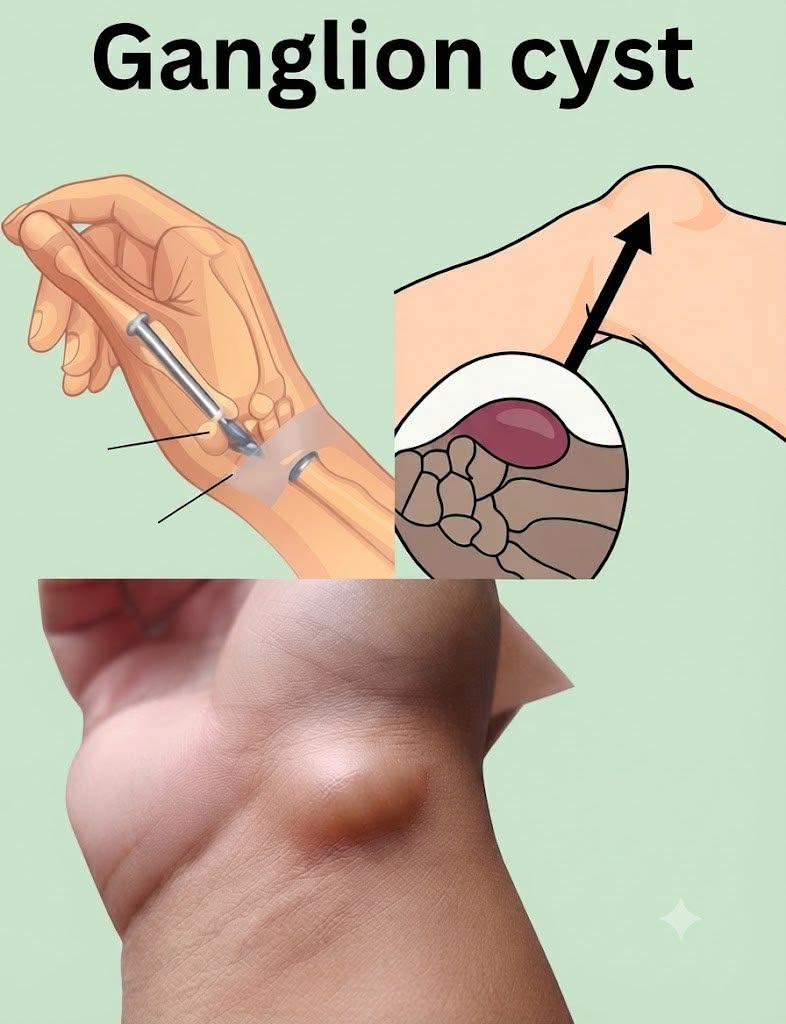
Could That Lump or Cyst Be Something Serious? It is an understandable question when a smooth bump suddenly appears on your wrist, hand, or finger. Some lumps develop slowly, while others seem to show up almost overnight. They may feel firm, rubbery, or slightly soft, and they can become more noticeable when you move the nearby joint.
One common explanation is a ganglion cyst.
A ganglion cyst is a noncancerous, fluid-filled lump that usually forms near a joint or tendon. These cysts commonly appear around the wrist or hand, although they can also develop in other areas, including the foot. Many cause no pain and may improve without treatment. However, a new lump should not automatically be diagnosed as a ganglion cyst based only on appearance. Other conditions can cause similar bumps, so persistent, unusual, painful, or changing lumps deserve medical evaluation.
I once noticed a small bump on someone’s wrist during an ordinary conversation, and neither of us could remember seeing it before. Because it did not hurt, the first instinct was to ignore it. Over the next few weeks, though, the lump seemed larger after long periods of computer work and smaller after rest. That changing size eventually led to a medical appointment, where the clinician explained that the bump had the typical features of a ganglion cyst. The experience was reassuring, but it also offered an important lesson: a lump can be harmless while still deserving a proper look instead of a guess based on photographs online.
Understanding What a Ganglion Cyst Actually Is
Why These Fluid-Filled Lumps Form Near Joints
Could That Lump or Cyst Be Something Serious? When the bump sits near a wrist or finger joint, a ganglion cyst is one possibility.
A ganglion cyst contains thick, jelly-like fluid and usually develops close to a joint capsule or tendon sheath. The exact reason one person develops a cyst while another does not often remains unclear. Some appear after injury, while many develop without an obvious trigger. Current clinical guidance describes them as common fluid-filled lumps that typically form around joints, especially in the hand and wrist.
The cyst may connect to the nearby joint through a narrow stalk. As a result, activity can sometimes make the lump more noticeable.
For example, someone may find that a wrist cyst becomes larger during periods of frequent hand use and then shrinks during rest. That changing size can happen because fluid moves in relation to the nearby joint.
However, size changes alone cannot confirm a diagnosis.
Some ganglion cysts remain tiny.
Others grow to several centimeters across.
Likewise, some sit deep beneath the skin and become difficult to see even though they cause discomfort.
The back of the wrist represents one of the most familiar locations. However, cysts can also form on the palm side of the wrist, around finger joints, or near other tendons and joints.
Although the word “cyst” can sound frightening, ganglion cysts are benign. They do not behave like cancer and do not spread through the body.
Still, Could That Lump or Cyst Be Something Serious? should remain an open question until someone properly identifies an unexplained mass.
Many different conditions can produce a lump.
Therefore, location and appearance can suggest a ganglion cyst, but they cannot guarantee that diagnosis.
What a Ganglion Cyst Can Look and Feel Like
Ganglion cysts often feel smooth and round or oval beneath the skin.
Some feel firm.
Others feel soft or springy.
The skin over them may look completely normal.
A typical cyst may become more visible when the nearby joint bends.
Most ganglion cysts cause little or no pain. Nevertheless, movement can make some of them ache, especially when repeated activity places pressure on the area. Current guidance notes that they commonly appear as smooth lumps near joints and can cause pain during or after movement.
Pressure on nearby structures may also create additional symptoms.
A cyst near a nerve can contribute to numbness, tingling, aching, or weakness. In addition, a large cyst can interfere with normal joint movement or make gripping and other daily tasks uncomfortable.
For example, a wrist cyst may become bothersome while typing, lifting, exercising, or leaning the hand against a hard surface.
However, pain does not automatically mean the cyst has become dangerous.
Likewise, an absence of pain does not prove that every lump is harmless.
Could That Lump or Cyst Be Something Serious? becomes especially important when a mass feels unusually hard, fixed in place, continues getting larger, or does not resemble the typical smooth mobile appearance of a ganglion cyst.
Current guidance recommends medical assessment when someone feels worried about a lump, when it grows, or when it feels hard and does not move.
Therefore, use the usual ganglion features as clues rather than a home diagnosis.
A clinician can examine the mass and determine whether additional testing makes sense.
How Doctors Tell a Ganglion Cyst From Other Lumps
Physical Examination Often Provides the First Clues
Could That Lump or Cyst Be Something Serious? A clinical examination often provides the fastest path toward an answer.
A healthcare professional usually starts by looking at where the lump sits.
They may press on it gently.
They may ask whether it hurts.
They can also check how it changes when you move the joint.
In some cases, shining a light through the lump can help determine whether it appears fluid-filled.
The clinician may also ask how long the bump has been present, whether it changes size, whether you remember an injury, and whether you have numbness, weakness, or restricted movement.
These details help distinguish a ganglion cyst from other possibilities.
Current diagnostic guidance notes that healthcare professionals can often identify a ganglion cyst through physical examination, although imaging may help when the diagnosis remains uncertain.
That uncertainty matters because not every wrist lump is a ganglion.
Other possibilities include different cysts, fatty lumps, arthritis-related changes, tendon problems, infections, and less commonly tumors.
Therefore, Could That Lump or Cyst Be Something Serious? should not lead to panic, but it should discourage self-diagnosis.
A smooth bump in the classic location may strongly suggest a ganglion cyst.
Still, a professional assessment becomes more important when the mass behaves unusually.
For example, seek evaluation if the lump grows steadily rather than fluctuating.
Likewise, arrange an examination if it becomes very painful, limits movement, or creates persistent nerve symptoms.
The goal is not to assume the worst.
Instead, the goal is to identify what the lump actually is.
Once the diagnosis becomes clearer, you can decide whether observation or treatment makes sense.
When Ultrasound, MRI, or X-Rays May Be Used
Many ganglion cysts do not require extensive testing.
However, imaging can help when the lump does not have a typical appearance.
An ultrasound can show whether a mass contains fluid or solid tissue.
That distinction can help separate a cyst from certain other lumps.
An MRI can provide more detailed pictures of deeper soft tissues when the diagnosis remains uncertain.
X-rays usually do not display the ganglion cyst itself very well because the cyst contains soft tissue and fluid. However, an X-ray can help evaluate nearby bones and joints or rule out other explanations for symptoms.
Current clinical guidance lists X-ray, ultrasound, and MRI among tools that may help confirm a diagnosis or exclude conditions such as arthritis or another type of mass.
Therefore, Could That Lump or Cyst Be Something Serious? does not necessarily mean you need every imaging test available.
A clinician may diagnose a straightforward ganglion cyst through history and examination alone.
Testing becomes more useful when something does not fit the usual pattern.
For example, a deep lump may require imaging because it cannot be assessed as easily through the skin.
Likewise, persistent unexplained pain without a clearly visible cyst may require a broader evaluation.
Imaging can also help when treatment is being considered and the clinician needs to understand the relationship between the cyst and nearby structures.
Most importantly, testing should answer a clinical question.
It should not become a substitute for an examination.
A photograph from the internet cannot determine whether your wrist bump contains fluid, arises from a tendon, or involves another structure.
Therefore, an unusual lump deserves individual evaluation rather than comparison with pictures alone.
Treatment Options and What You Should Never Do at Home
Many Ganglion Cysts Need Only Observation
Could That Lump or Cyst Be Something Serious? If a clinician confirms a ganglion cyst and it causes little or no trouble, the answer often brings considerable relief.
Many ganglion cysts need no active treatment.
They can shrink over time, disappear, or fluctuate for months before improving. Current guidance notes that these cysts often get better on their own and that painless cysts may simply be monitored.
Observation makes sense when the cyst causes no major pain, nerve symptoms, or loss of movement.
Meanwhile, reducing activities that repeatedly aggravate the area may help with discomfort.
A temporary wrist support or brace may also help some people when movement triggers pain. However, prolonged immobilization can weaken nearby muscles, so extended brace use should follow professional advice.
Treatment becomes more relevant when symptoms interfere with everyday life.
For example, a person may struggle to grip objects.
Another person may experience repeated aching while working.
Someone else may develop numbness from pressure on a nearby nerve.
In those situations, a clinician may discuss aspiration.
During aspiration, a healthcare professional inserts a needle and removes fluid from the cyst.
The lump may flatten afterward.
However, the cyst can return because aspiration may leave the connection to the joint or tendon in place.
Therefore, aspiration does not guarantee a permanent cure.
Still, it can relieve symptoms for some people.
The best option depends on where the cyst sits, how much discomfort it causes, and which nearby structures surround it.
Surgery Can Help, but Recurrence Remains Possible
If a ganglion cyst repeatedly returns or continues causing significant symptoms, surgery may become an option.
The procedure generally removes the cyst along with its attachment to the nearby joint or tendon.
However, surgery does not guarantee that the cyst will never return.
Clinical guidance also notes possible complications, including injury to nearby nerves, blood vessels, or tendons. Recurrence can still happen after surgery.
Therefore, surgery usually requires a discussion about benefits and risks rather than an automatic decision based on appearance.
Cosmetic concern may matter to some people.
However, a painless ganglion does not always require removal simply because it looks noticeable.
Could That Lump or Cyst Be Something Serious? should also never lead to one dangerous home remedy: trying to smash, puncture, or pop the lump yourself.
Older advice sometimes suggested striking a ganglion cyst with a heavy object.
Do not do that.
The force can injure the hand or wrist.
Likewise, pushing a needle into the cyst at home can introduce bacteria and cause infection.
Current clinical guidance specifically warns against hitting or puncturing a ganglion cyst yourself because these methods can damage tissue or cause infection.
This warning matters even when you feel certain the lump is a ganglion.
The wrist contains nerves, blood vessels, tendons, ligaments, and other delicate structures.
A bump on the palm side of the wrist may sit particularly close to important blood vessels.
Therefore, drainage belongs in a medical setting.
If the cyst bothers you, ask a healthcare professional about appropriate options instead of trying to remove it yourself.
Warning Signs That Mean a Lump Deserves Medical Attention
Rapid Growth, Redness, Heat, or Severe Pain Should Not Be Ignored
Most ganglion cysts are benign.
However, Could That Lump or Cyst Be Something Serious? becomes a more urgent question when the lump develops warning signs.
A very painful, hot, or red lump requires prompt medical advice because infection or another inflammatory problem may be possible. Current guidance recommends urgent assessment for a lump that becomes very painful, hot, or red.
Rapid growth also deserves attention.
A typical ganglion may fluctuate in size, but a lump that keeps enlarging should be examined.
Likewise, a very hard mass that feels fixed rather than movable warrants evaluation.
A persistent lump should not be ignored simply because it does not hurt.
General clinical guidance recommends seeing a healthcare professional when someone remains worried about a lump or when it persists, grows, or has concerning characteristics.
Fever can add another important clue.
If redness, heat, swelling, and significant pain occur alongside fever, seek prompt medical advice.
Likewise, a lump following an injury deserves assessment when significant swelling, bruising, weakness, or reduced movement develops.
The presence of these signs does not mean that cancer or another severe condition definitely exists.
Many explanations remain possible.
However, they make self-diagnosis less appropriate.
Could That Lump or Cyst Be Something Serious? should encourage timely evaluation rather than fear.
A simple examination can often clarify whether the bump resembles a ganglion cyst or whether further investigation makes sense.
Numbness, Weakness, and Limited Movement Also Matter
Not every warning sign appears on the skin.
Sometimes the most important symptoms involve function.
If a lump causes persistent tingling, numbness, weakness, or difficulty gripping objects, have it evaluated.
A ganglion cyst can sometimes press on nearby nerves or interfere with joint movement. Current guidance notes that some people experience aching or numbness, while other clinical sources describe nerve pressure as a reason symptoms may become more troublesome.
Likewise, pay attention if the wrist or finger becomes difficult to move.
A large cyst may mechanically interfere with motion.
However, other wrist conditions can also cause pain, numbness, or weakness.
For example, nerve compression disorders and tendon problems may create symptoms that resemble those blamed on a visible lump. Current guidance advises against trying to determine the cause of wrist pain entirely on your own because several conditions can produce overlapping symptoms.
Therefore, the presence of a lump does not automatically explain every sensation in the hand.
A clinician can determine whether the cyst and the symptoms actually relate to one another.
Could That Lump or Cyst Be Something Serious? has a reassuring answer in many cases.
Ganglion cysts are common and benign.
Still, reassurance works best after the correct diagnosis.
If your lump behaves like a typical ganglion and a healthcare professional confirms it, observation may be all you need.
If it acts differently, causes significant symptoms, or simply worries you, an examination can provide clarity.
Frequently Asked Questions
Could That Lump or Cyst Be Something Serious?
Most smooth wrist or hand lumps that turn out to be ganglion cysts are benign. However, you should not assume every unexplained lump is a ganglion cyst. A persistent, growing, hard, fixed, painful, red, or otherwise unusual lump deserves medical evaluation.
Can a ganglion cyst disappear without treatment?
Yes. Many ganglion cysts improve or disappear without treatment, although the process can take months. Observation is often appropriate when the cyst is painless and does not interfere with movement.
Can a ganglion cyst come back after aspiration?
Yes. Aspiration removes fluid, but the cyst can refill because the connection to the nearby joint or tendon may remain. Recurrence can also occur after surgery.
Can I pop or drain a ganglion cyst myself?
No. Do not puncture, crush, squeeze, or hit the cyst. Home attempts can cause infection or damage nearby tissues. A healthcare professional should perform drainage when it is appropriate.
When should I see a doctor about a wrist lump?
Arrange an evaluation if the lump worries you, continues growing, feels hard or fixed, interferes with movement, or causes numbness or weakness. Seek prompt medical advice if the lump becomes very painful, hot, or red.
Conclusion
Could That Lump or Cyst Be Something Serious? In many cases, a smooth bump near the wrist or hand turns out to be a ganglion cyst, which is a common benign fluid-filled lump.
Ganglion cysts often develop near joints or tendons.
They may feel firm, soft, or springy.
Some remain painless.
Others create aching, tenderness, numbness, or movement problems when they press on nearby structures.
Their size can also change with activity.
Fortunately, many ganglion cysts need no treatment at all.
A clinician may simply recommend monitoring a painless cyst because these lumps often improve on their own.
When symptoms become bothersome, aspiration may remove the fluid and reduce the lump.
However, the cyst can return.
Surgery may help persistent or troublesome cases, although recurrence and surgical complications remain possible.
Most importantly, never attempt to crush or puncture an unexplained wrist lump yourself.
You could introduce infection or injure nearby nerves, blood vessels, tendons, or other structures.
Could That Lump or Cyst Be Something Serious? should therefore lead to sensible observation rather than panic.
Pay attention to how the lump feels.
Notice whether it grows.
Watch for redness, heat, severe pain, numbness, weakness, or restricted movement.
Then seek medical evaluation when the diagnosis remains uncertain or the symptoms cause concern.
A ganglion cyst is often harmless.
Still, the safest way to know what a new lump means is to have the lump properly examined instead of relying on a photograph or home diagnosis.
More Home Remedies
- Wrinkled Fingers After Water Exposure: What Your Skin May Be Telling You
- Skin Rash With Breathing Trouble? It Could Be a Life-Threatening Allergic Reaction
- I Thought It Was a Piece of Trash on the Bathroom Floor—Until It Moved
- If You Are Getting White Pimples on Your Lips or Intimate Area, Here’s What They Could Mean