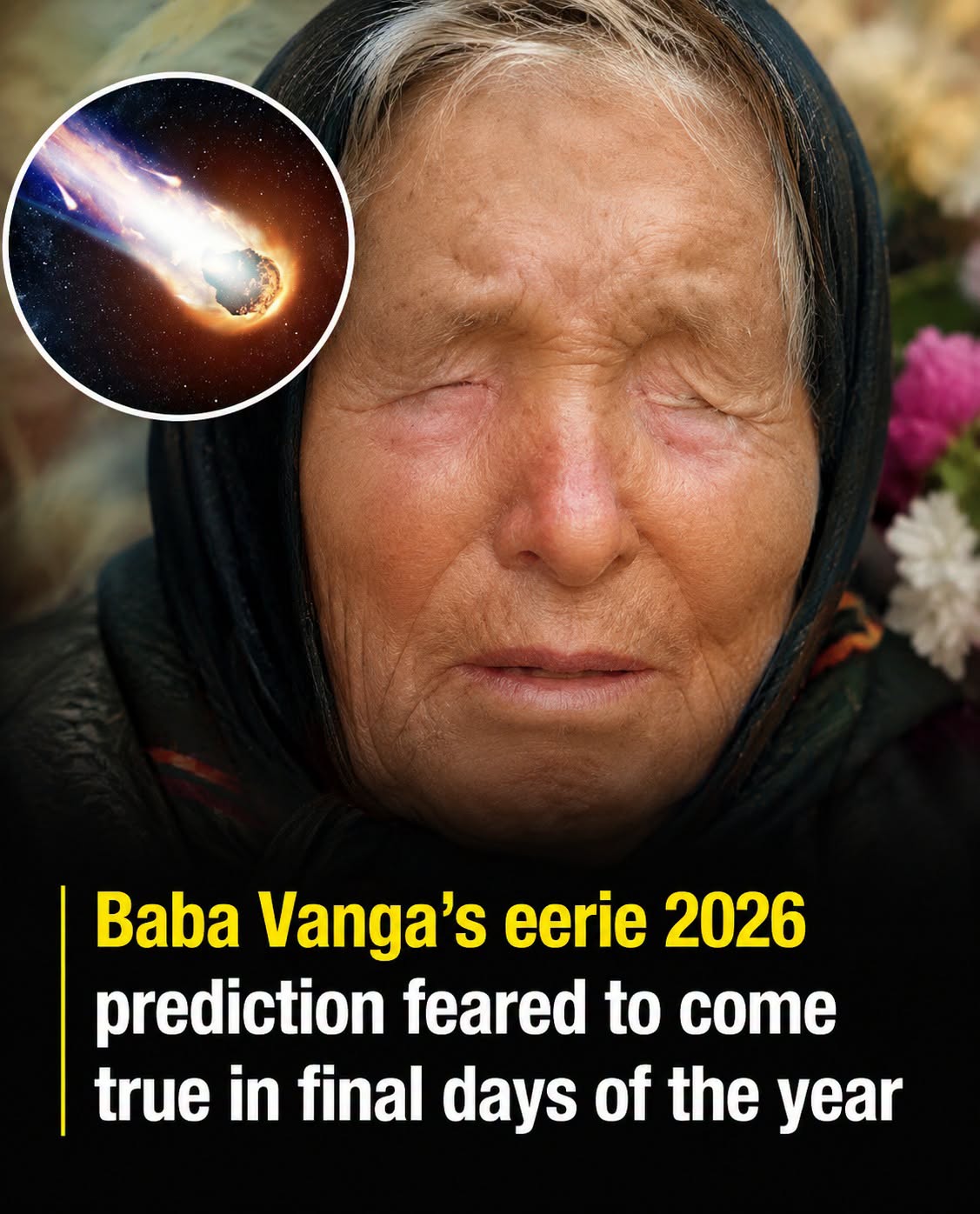
Baba Vanga’s Eerie 2026 Prediction has returned to online discussion as people connect modern headlines about asteroids, extreme weather, international tensions, and other global uncertainties with prophecies attributed to the famous Bulgarian mystic. The story has everything that attracts attention: an enigmatic figure, an ominous forecast, a specific year, and the uncomfortable feeling that something major could happen before December ends.
However, one important fact belongs at the center of the discussion. Reliable historical records do not provide a clear, authenticated list showing exactly what Baba Vanga predicted for every future year. Much of the material circulating today comes from later retellings, media reports, online lists, and interpretations rather than verifiable writings from Vanga herself.
That distinction matters. It does not make the phenomenon any less fascinating, but it changes how we should interpret it.
Current asteroid monitoring also provides a useful reality check. NASA continues to track near-Earth objects through dedicated planetary-defense systems, and some alarming-looking asteroid stories online can refer to hypothetical exercises rather than genuine threats. For example, NASA’s “2026 PDC27” scenario describes a fictional asteroid created specifically for a planetary-defense conference exercise, not a real object threatening Earth.
I remember first hearing stories about Baba Vanga during a conversation where everyone had a different version of what she supposedly predicted. One person mentioned natural disasters, another remembered a prophecy about technology, and someone else insisted she had predicted a major political event. What struck me most was not the predictions themselves but how confidently each person remembered a different story. Later, I started noticing the same pattern online. A vague warning would reappear whenever a new crisis made headlines. That experience made me curious about why these prophecies remain so compelling, especially when the original wording often proves difficult to verify.
Understanding Baba Vanga and the Origins of the 2026 Claims
Who Baba Vanga Was
Baba Vanga, born Vangeliya Pandeva Gushterova in 1911, became one of the best-known mystical figures associated with modern prophecy.
She lived much of her life in Bulgaria and reportedly lost her eyesight during childhood. Over time, visitors sought her out for advice and predictions, and stories about her abilities spread far beyond the region.
After her death in 1996, her reputation continued to grow.
Today, online articles frequently credit Baba Vanga with predictions involving wars, political upheaval, natural disasters, technological breakthroughs, extraterrestrial encounters, economic crises, and even the eventual fate of humanity.
However, separating historical evidence from later folklore creates a challenge.
Baba Vanga did not leave behind a widely authenticated, year-by-year written prophecy archive that researchers can simply consult. Instead, many claims rely on recollections, secondary reports, translated accounts, and later interpretations.
That makes Baba Vanga’s Eerie 2026 Prediction difficult to evaluate in the same way scientists would evaluate a dated forecast.
For example, an authenticated prediction would ideally include the original wording, the date when someone recorded it, independent documentation showing that it existed before the event, and enough specificity to determine whether the forecast succeeded or failed.
Many popular Baba Vanga claims do not meet that standard.
Nevertheless, the stories remain culturally powerful.
People often remember dramatic predictions because they connect uncertainty with a narrative. Instead of facing random events with no clear pattern, a prophecy creates the feeling that someone saw the future coming.
That emotional appeal helps explain why Baba Vanga’s name resurfaces whenever the world experiences a period of uncertainty.
What Is Actually Being Claimed About 2026
Online discussions surrounding Baba Vanga’s Eerie 2026 Prediction usually combine several themes rather than one universally agreed prophecy.
Some versions mention a major natural disaster.
Others suggest a cosmic event, an asteroid-related scare, geopolitical upheaval, technological disruption, or another event that could affect large numbers of people.
The lack of consistent wording matters.
When several different predictions circulate under the same name, almost any major event can later appear to confirm one of them.
For instance, an earthquake could fit a “natural disaster” interpretation. A close asteroid approach could fit a “cosmic event” interpretation. Meanwhile, a diplomatic crisis might fit a “global disruption” interpretation.
Therefore, the prophecy becomes flexible enough to accommodate many possible outcomes.
That flexibility makes Baba Vanga’s Eerie 2026 Prediction compelling but difficult to test.
A precise prediction might say that a specific event will occur in a defined place on a particular date.
A vague prediction, however, might only refer to “great change” or “trouble from the skies.”
The second type becomes much easier to match with later headlines.
As 2026 continues, people naturally pay more attention to events that resemble the prediction while ignoring events that do not.
This process can make a prophecy appear increasingly accurate even when the original claim remained broad.
Therefore, anyone following these stories should separate three questions.
First, did Baba Vanga actually make the prediction?
Second, did someone document it before the event?
Third, does the modern event truly match the original wording, or are people interpreting the wording after the fact?
Those questions do not remove the mystery.
Instead, they make the discussion more interesting and more grounded.
Why Asteroids and Global Events Fuel New Prophecy Fears
Near-Earth Objects Sound Scarier Than They Usually Are
One reason Baba Vanga’s Eerie 2026 Prediction attracts attention involves the constant stream of headlines about asteroids passing near Earth.
The phrase “near-Earth asteroid” can sound frightening.
However, astronomical language often describes enormous distances differently from everyday language.
NASA’s Asteroid Watch program tracks asteroids and comets that pass relatively close to Earth, including objects that travel millions of miles away. NASA explains that its dashboard tracks approaches within roughly 4.6 million miles, which equals about 19.5 times the average Earth-Moon distance.
Therefore, a headline saying an asteroid will “pass close to Earth” does not automatically mean the object poses an impact threat.
Astronomers routinely discover and track near-Earth objects.
They calculate their orbits, update those calculations as new observations arrive, and assess possible impact probabilities.
In March 2026, for example, NASA announced new observations of asteroid 2024 YR4. Earlier estimates had raised questions about a possible lunar impact in 2032. However, updated James Webb Space Telescope observations allowed scientists to rule out that possibility, while NASA had already determined that the asteroid posed no significant threat to Earth.
That episode shows how asteroid science actually works.
Early calculations sometimes contain uncertainty.
Then additional observations narrow the orbit.
As a result, scientists can refine or eliminate previously discussed risks.
This process can look dramatic in headlines, but it represents normal scientific monitoring rather than evidence that an ancient prophecy has begun unfolding.
A Viral NASA Scenario Can Create Confusion
Another fascinating detail surrounding Baba Vanga’s Eerie 2026 Prediction involves information that can look real when people encounter it without context.
NASA currently hosts a detailed page describing an asteroid labeled “2026 PDC27.”
The scenario includes impact probabilities, asteroid dimensions, a possible 2038 impact date, and even a geographic risk corridor.
At first glance, the information sounds alarming.
However, NASA clearly states that the asteroid does not exist.
The entire scenario supports the 2027 Planetary Defense Conference exercise, which allows scientists and emergency planners to practice responding to a fictional asteroid threat.
This distinction provides a perfect example of how frightening claims can spread.
Someone may see a screenshot showing a “19% Earth impact probability” without seeing the warning that the exercise is fictional.
They may then connect that screenshot to Baba Vanga’s Eerie 2026 Prediction.
Soon, several unrelated pieces of information begin forming one dramatic story.
NASA’s separate risk-assessment dashboard for the exercise even includes detailed modeled effects, but that information belongs to the same fictional scenario rather than a real asteroid emergency.
Therefore, context matters enormously.
Real planetary-defense work often uses simulated disasters because scientists and governments need to practice before an actual emergency ever occurs.
Emergency exercises do not predict future events.
Likewise, realistic-looking technical pages do not automatically describe present danger.
When a prophecy story relies on an asteroid claim, checking the original scientific source can quickly separate a genuine astronomical event from a misunderstood simulation.
Why Baba Vanga Predictions Feel So Convincing
The Human Mind Naturally Searches for Patterns
The popularity of Baba Vanga’s Eerie 2026 Prediction reveals something interesting about human psychology.
People naturally search for patterns.
That ability helps us understand the world, recognize danger, learn from experience, and make decisions.
However, pattern recognition can also create connections between events that may not actually relate.
Imagine reading a prophecy that predicts a “great disturbance from the sky.”
Then several months later, you see headlines about an asteroid, unusual weather, a satellite accident, and a meteor shower.
Any one of those events might suddenly feel meaningful.
The wording appears to fit because the reader already knows what happened.
Psychologists often describe a related phenomenon as hindsight bias or confirmation bias.
Once people expect a pattern, they tend to notice evidence that supports it more readily than evidence that contradicts it.
For example, someone who believes Baba Vanga’s Eerie 2026 Prediction involves a major cosmic event may closely follow every asteroid headline.
However, they may pay less attention to the hundreds of tracked objects that safely pass Earth.
The prophecy therefore seems repeatedly reinforced.
Social media strengthens this effect.
A dramatic post can spread faster than a cautious scientific explanation because fear and surprise encourage sharing.
Likewise, a headline asking whether a prophecy “is coming true” attracts more attention than a headline explaining that scientists routinely track near-Earth objects.
None of this means people who enjoy prophecy stories lack critical thinking.
Mysteries are entertaining.
Humans have always told stories about fate and the future.
However, fascination and evidence remain different things.
You can enjoy the mystery while still asking where the original claim came from.
Vague Predictions Become Easier to Match
Specificity provides one of the best ways to judge Baba Vanga’s Eerie 2026 Prediction.
Suppose someone predicts that “major upheaval will strike the world.”
During almost any year, people could point to wars, elections, natural disasters, economic disruptions, political crises, technological changes, or public-health emergencies.
Therefore, the prediction has many opportunities to appear correct.
Now compare that statement with a precise prediction that names an exact event, place, date, and measurable outcome.
The second statement becomes much easier to test.
It also becomes much easier to prove wrong.
This difference helps explain why ambiguous prophecies survive for decades.
People can reinterpret them as circumstances change.
Translation can add another layer.
Baba Vanga lived in Bulgaria, while many modern prophecy lists circulate in English and other languages.
Retellings can alter wording over time.
A phrase that originally sounded symbolic may become literal.
Likewise, a general warning may acquire a specific year only in later versions.
Therefore, readers should look for the earliest traceable version of any prediction.
Ask whether journalists or historians documented it before the event.
Also, compare several sources instead of relying on viral posts.
The more dramatic the claim, the more valuable that verification becomes.
Baba Vanga’s continuing fame does not depend on every prediction proving true.
Her cultural legacy survives because the mystery itself remains powerful.
What Could Happen Before the End of 2026
Science Cannot Validate a Prophecy Without Evidence
Because September 2026 has already arrived, Baba Vanga’s Eerie 2026 Prediction naturally feels more dramatic.
Only a few months remain in the year.
Every major headline can therefore seem like a potential final clue.
However, scientists cannot test a prophecy simply by waiting for something dramatic to happen.
First, researchers would need a reliable original prediction.
Then they would need clear criteria describing what event would count as fulfillment.
Without those conditions, almost any sufficiently dramatic event could qualify.
Modern astronomy illustrates the difference between prediction and speculation.
Astronomers calculate asteroid trajectories using observations and physics.
Those calculations produce ranges of uncertainty that scientists update as additional measurements become available.
For example, NASA used new James Webb observations in February 2026 to refine the orbit of asteroid 2024 YR4 and eliminate a previously discussed possibility that it might strike the Moon in 2032.
Likewise, researchers sometimes discover that an object initially classified one way actually behaves differently.
In July 2026, NASA reported that observations of near-Earth object 1998 SH2 showed comet-like activity and helped scientists identify it as a comet rather than a conventional asteroid.
Science changes conclusions when better evidence appears.
Prophecy interpretation usually works in the opposite direction.
The event happens first, and people then search for language that appears to match it.
Recognizing that difference allows people to follow intriguing stories without mistaking interpretation for scientific forecasting.
The Most Reasonable Way to Follow the Story
People can continue discussing Baba Vanga’s Eerie 2026 Prediction without treating every unusual headline as proof.
Start by identifying exactly what someone claims Baba Vanga predicted.
Next, look for evidence showing when people first recorded that prediction.
Then compare the original wording with the modern interpretation.
If the claim involves astronomy, check astronomical agencies rather than relying on screenshots or social posts.
If the claim involves earthquakes or severe weather, look at scientific monitoring agencies.
If it involves political events, compare reputable reporting and primary sources.
Most importantly, distinguish possibility from probability.
Something can theoretically happen without scientists having evidence that it will happen.
Likewise, uncertainty about the future does not make every prophecy equally plausible.
The final months of 2026 will undoubtedly contain major headlines because every year does.
Natural disasters will occur somewhere.
Political tensions will change.
Scientists will discover new objects.
Technology will continue developing.
Some of these stories may resemble prophecies attributed to Baba Vanga.
However, resemblance alone cannot prove foreknowledge.
The strongest evidence would require a specific, authenticated prediction recorded before the event and clearly matching what later happened.
Until then, Baba Vanga’s Eerie 2026 Prediction remains best understood as a fascinating mixture of folklore, cultural memory, modern anxiety, and humanity’s enduring desire to know what comes next.
Frequently Asked Questions
What exactly did Baba Vanga predict for 2026?
There is no universally authenticated, primary-source list that clearly establishes one exact Baba Vanga prediction for 2026. Online accounts attribute several different forecasts to her, including global disruption, natural disasters, cosmic events, and geopolitical turmoil. Because versions differ, readers should treat these claims as attributed prophecies rather than verified historical quotations.
Did Baba Vanga really predict an asteroid impact in 2026?
No reliable evidence establishes that Baba Vanga made a specific, authenticated prediction that an asteroid would strike Earth in 2026. Online discussions sometimes connect generic cosmic warnings with modern asteroid stories, but those connections generally rely on interpretation.
Is NASA currently warning about an asteroid connected to the prophecy?
NASA tracks near-Earth objects continuously, but one especially dramatic 2026 scenario circulating online involves the fictional “2026 PDC27” asteroid created for a planetary-defense exercise. NASA explicitly identifies that scenario as fictional.
Why do Baba Vanga predictions become popular again during major events?
People naturally search for meaning and patterns during uncertain periods. Broad prophetic language can also become easier to connect with events after they happen, especially when social media repeatedly highlights similarities.
Could Baba Vanga’s Eerie 2026 Prediction still “come true” before December ends?
A major world event could certainly occur before 2026 ends, just as major events occur every year. However, an event happening does not prove a prophecy unless researchers can establish a specific, documented prediction made beforehand that clearly describes the event.
Conclusion
Baba Vanga’s Eerie 2026 Prediction continues to fascinate because it sits at the intersection of mystery, fear, folklore, and real-world uncertainty.
The legend becomes especially compelling as the end of 2026 approaches.
Every asteroid headline, unusual weather event, political confrontation, or global disruption offers another opportunity for people to ask whether an old warning has finally come true.
However, evidence requires more than resemblance.
The biggest challenge involves establishing exactly what Baba Vanga actually predicted.
Many modern claims circulate through secondary retellings rather than a clear, authenticated collection of dated statements.
Therefore, people often compare current events with prophecies whose wording has changed over time.
Modern astronomy offers a useful contrast.
Scientists monitor near-Earth objects continuously, calculate their trajectories, revise their estimates when new evidence appears, and publish updated assessments.
NASA’s handling of asteroid 2024 YR4 shows this process clearly. New observations refined its orbit and removed a previously discussed lunar-impact possibility.
Likewise, NASA’s dramatic “2026 PDC27” asteroid scenario does not represent a real threat at all. It serves as a fictional planetary-defense exercise designed to help experts practice responding to a hypothetical emergency.
Those facts do not make Baba Vanga’s Eerie 2026 Prediction boring.
In many ways, they make the story more revealing.
The lasting mystery tells us as much about human nature as it does about Baba Vanga.
People want to know what comes next.
During uncertain times, predictions can make random events feel connected and understandable.
That desire has existed for centuries, and it will probably continue long after 2026 ends.
So, could something dramatic happen before December 31?
Certainly.
Could people connect that event to Baba Vanga afterward?
Almost certainly.
The harder question remains whether anyone can demonstrate that she clearly predicted that exact event decades in advance.
Until strong evidence answers that question, Baba Vanga’s Eerie 2026 Prediction remains an intriguing cultural mystery rather than a scientifically established forecast.
{
  "title": "Baba Vanga’s Eerie 2026 Prediction: Why People Fear It Could Come True Before the Year Ends",
  "summary": "A balanced look at the prophecies attributed to Baba Vanga for 2026, why asteroid and global-event headlines fuel renewed interest, and how to separate folklore from verifiable evidence.",
  "notes": "Many specific year-by-year predictions attributed to Baba Vanga lack clear primary-source documentation. Modern asteroid risks should be checked against official astronomical monitoring sources rather than prophecy claims or social media posts.",
  "ingredients_flat": [
    {
      "amount": "1",
      "unit": "",
      "name": "Documented version of the alleged prophecy"
    },
    {
      "amount": "1",
      "unit": "",
      "name": "Reliable historical context"
    },
    {
      "amount": "1",
      "unit": "",
      "name": "Current scientific evidence"
    },
    {
      "amount": "1",
      "unit": "",
      "name": "Critical comparison of claims and events"
    },
    {
      "amount": "1",
      "unit": "",
      "name": "Awareness of confirmation and hindsight bias"
    }
  ],
  "instructions_flat": [
    {
      "name": "Step 1",
      "text": "Identify the exact prediction being attributed to Baba Vanga rather than relying on a vague summary.",
      "summary": "",
      "image_url": ""
    },
    {
      "name": "Step 2",
      "text": "Look for the earliest traceable record showing when and where people documented the prediction.",
      "summary": "",
      "image_url": ""
    },
    {
      "name": "Step 3",
      "text": "Compare different versions of the claim to determine whether the wording or assigned year changed over time.",
      "summary": "",
      "image_url": ""
    },
    {
      "name": "Step 4",
      "text": "Check scientific agencies when the prediction involves asteroids, space events, earthquakes, weather, or other measurable phenomena.",
      "summary": "",
      "image_url": ""
    },
    {
      "name": "Step 5",
      "text": "Distinguish real astronomical monitoring from hypothetical emergency exercises or misunderstood technical reports.",
      "summary": "",
      "image_url": ""
    },
    {
      "name": "Step 6",
      "text": "Compare the original wording with the modern event without adding details that the prediction did not contain.",
      "summary": "",
      "image_url": ""
    },
    {
      "name": "Step 7",
      "text": "Consider whether confirmation bias or hindsight interpretation could make a vague statement appear more accurate.",
      "summary": "",
      "image_url": ""
    },
    {
      "name": "Step 8",
      "text": "Treat the prophecy as an intriguing cultural story unless strong documentation establishes a specific prediction made before the event.",
      "summary": "",
      "image_url": ""
    }
  ],
  "equipment": [
    {
      "name": "Reliable historical sources",
      "notes": ""
    },
    {
      "name": "Official scientific monitoring information",
      "notes": ""
    },
    {
      "name": "Critical thinking",
      "notes": ""
    },
    {
      "name": "Source comparison",
      "notes": ""
    }
  ],
  "nutrition": {
    "calories": "0",
    "carbohydrates": "0 g",
    "protein": "0 g",
    "fat": "0 g",
    "saturated_fat": "0 g",
    "polyunsaturated_fat": "0 g",
    "monounsaturated_fat": "0 g",
    "trans_fat": "0 g",
    "cholesterol": "0 mg",
    "sodium": "0 mg",
    "potassium": "0 mg",
    "fiber": "0 g",
    "sugar": "0 g",
    "vitamin_a": "0",
    "vitamin_c": "0",
    "calcium": "0",
    "iron": "0"
  },
  "tags": {
    "course": [
      "Facts and Mysteries"
    ],
    "cuisine": [
      "Not Applicable"
    ],
    "keyword": [
      "Baba Vanga’s Eerie 2026 Prediction",
      "Baba Vanga 2026",
      "Baba Vanga predictions",
      "2026 prophecy",
      "Baba Vanga asteroid prediction"
    ]
  }
}
SEO Output
Focus Keyword: Baba Vanga’s Eerie 2026 Prediction
SEO Title: Baba Vanga’s Eerie 2026 Prediction: What Could Happen Before Year-End?
Meta Description: Baba Vanga’s Eerie 2026 Prediction is fueling new fears. Explore the prophecy claims, asteroid rumors, and evidence behind the mystery.
Expert SEO Title: Baba Vanga’s Eerie 2026 Prediction: 7 Shocking Facts Explained
Midjourney Prompt: Ultra-realistic cinematic editorial portrait inspired by “Baba Vanga’s Eerie 2026 Prediction,” elderly blind Bulgarian mystic woman with traditional dark headscarf seated in a dim rustic room, mysterious but respectful expression, subtle star-filled night sky and distant asteroid imagery visible through a window, faint storm clouds and world-map atmosphere suggesting global uncertainty, dramatic natural side lighting, historically inspired Eastern European interior, realistic skin and fabric textures, no horror elements, no logos, no text, vertical composition, clean visual hierarchy, generous negative space in upper portion for Pinterest text overlay, photorealistic documentary-style photography –v 6 –ar 2:3
More Blog
- Drinking Water on an Empty Stomach — What Science Actually Supports (No Hype, Just Facts)
- Waking Up Between 3 and 5 AM? It Might Be Your Soul Trying to Talk to You
- What a “Bleach” Patch on Your Underwear Really Means — And Why It’s Actually a Good Sign
- This Drink May Weaken Your Bones From The Inside — But Everyone Drinks It Anyway