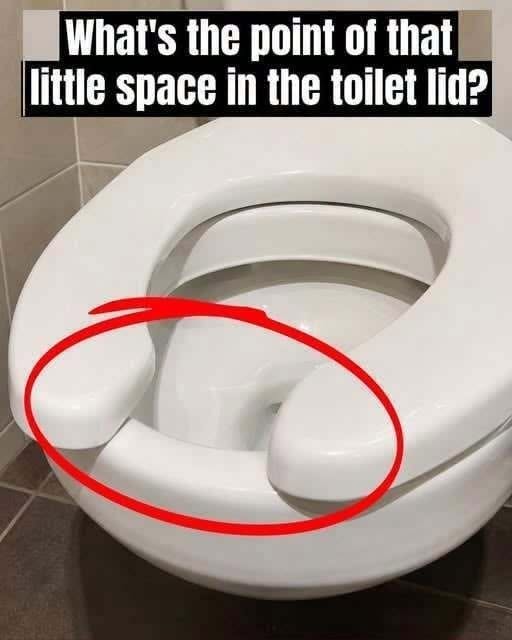
You have probably noticed the unusual toilet seats found in airports, schools, restaurants, offices, and shopping centers. Unlike the complete oval seats commonly installed in homes, many public toilets have a noticeable opening at the front.
At first, the seat may appear broken or unfinished. However, the missing section is completely intentional. Designers created the U-shaped toilet seat, also known as an open-front seat, for the demanding conditions found in shared restrooms.
The design gives users more clearance, reduces contact with the front portion of the seat, and supports practical sanitation in spaces used by many people. More importantly, open-front seats are not merely a popular choice among building owners. Plumbing codes used in many parts of the United States specifically require them in public and employee toilet facilities.
A small change in shape therefore solves several everyday problems at once. Understanding those reasons reveals how much planning can hide inside an object that most people barely notice.
Open-Front Seats Are Part of Commercial Plumbing Design
Plumbing codes often require the design
The most direct explanation for U-shaped toilet seats involves plumbing regulations.
The International Plumbing Code states that toilet seats provided in public or employee facilities must use a hinged, open-front design. Its guidance also associates public and employee toilets with elongated bowls, while private facilities intended for an individual or family may use closed-front seats instead.
That distinction explains why closed oval seats remain common in houses, private apartments, and many hotel guest rooms. A private toilet usually serves a small, familiar group of people. In contrast, a commercial restroom may serve hundreds or even thousands of unrelated users in one day.
Public fixtures must therefore meet a different set of expectations. They need to tolerate frequent use, allow efficient maintenance, and provide a practical experience for people with different bodies and personal needs.
Local requirements can vary because cities and states adopt and modify model codes differently. Nevertheless, the open-front seat has become a familiar feature across American commercial facilities because widely adopted plumbing standards call for it.
The design is not necessarily an accessibility requirement under the Americans with Disabilities Act. ADA standards focus on matters such as toilet height, location, surrounding clearance, grab bars, and usable controls. For example, accessible toilet seats generally need to measure 17 to 19 inches above the floor.
Therefore, people should not assume that every U-shaped seat exists specifically for wheelchair access. Plumbing and sanitation rules provide the main explanation, while accessibility standards govern several other features of the restroom.
Public toilets face heavier use than home fixtures
A household toilet may serve only a few people. Meanwhile, a restroom inside a stadium, airport, school, or transit station must accommodate a constant stream of visitors.
That heavy use changes the way designers approach every part of the fixture.
A commercial toilet seat must resist frequent cleaning, moisture, impact, and repeated opening and closing. It also needs a smooth, nonabsorbent surface that workers can sanitize effectively.
Facility managers cannot control how carefully every visitor uses the restroom. Some users may leave moisture or waste near the front of the bowl. Others may touch the seat while adjusting clothing or performing personal hygiene.
By removing the front section, manufacturers eliminate a part of the seat that would otherwise receive frequent contact and contamination. The open space also gives users more room to position themselves without touching the front edge.
Consequently, the seat’s shape reflects the realities of a shared environment rather than an attempt to create visual style.
The U-Shape Supports Personal Hygiene
The opening provides useful clearance
One of the most practical benefits of an open-front toilet seat is the additional clearance it creates between the user and the fixture.
On a complete oval seat, the front section extends directly beneath the body. That area can come into contact with skin or create an obstacle during wiping.
The U-shaped design removes that contact point. As a result, users have more room for personal hygiene without brushing a hand or part of the body against the front of the seat.
This benefit can matter especially in women’s restrooms, where users generally wipe from the front while seated. The open section allows easier access and lowers the chance of accidental contact with a surface used by many strangers.
The gap can also reduce contact between male anatomy and the front of the seat. Although individual positioning varies, the extra space makes the fixture more forgiving for a wider range of users.
These practical advantages helped open-front seats become a standard feature in shared facilities. The shape does not guarantee perfect hygiene, but it removes a surface that could otherwise collect moisture and receive unnecessary contact.
The missing section may stay cleaner
The front of a toilet seat can become wet when users urinate without lifting it or when splashing occurs inside the bowl.
On a closed-front model, that moisture may remain on the seat until someone notices and cleans it. A later user may then sit on the affected surface or need to wipe it first.
An open-front seat removes the area most likely to sit directly in front of the bowl. Therefore, it reduces the amount of material available to catch splashes or droplets.
The seat can still become dirty elsewhere, of course. The design does not make a public toilet automatically sanitary, nor does it replace regular cleaning. However, it can reduce one common source of mess.
The opening also makes contamination easier to see. Instead of moisture blending into the front edge of a continuous seat, it may fall directly into the bowl or onto a surface that staff can inspect and clean.
For that reason, the U-shape works as one element of a broader sanitation strategy. Proper cleaning schedules, handwashing supplies, ventilation, functioning plumbing, and responsible use remain equally important.
Does the Design Make Cleaning Easier?
Maintenance workers gain better access
Public restrooms require frequent inspection and cleaning. Staff may need to sanitize the toilet several times during a busy day, especially in transportation hubs, entertainment venues, or large retail centers.
The open-front design can make parts of that job more convenient.
Because the seat does not form a complete ring, cleaning workers can reach the front of the bowl and the underside of the surrounding area without maneuvering around a continuous piece of plastic.
The opening also reduces the total surface area that requires wiping. The difference may seem minor for one toilet, but it becomes more significant when a worker must clean dozens or hundreds of fixtures.
Still, easier cleaning should not be exaggerated as the sole purpose of the design. The open front primarily provides clearance and limits contact in a high-use environment. Maintenance efficiency offers an additional advantage.
The seat still requires thorough cleaning along its upper surface, underside, hinges, and attachment points. Germs and visible soil can collect anywhere people touch or where droplets land.
A restroom operator must therefore maintain the entire fixture rather than assuming the gap solves every sanitation problem.
Commercial seats use durable materials
The shape represents only one difference between public and residential toilet seats.
Commercial models often use strong, smooth materials designed to tolerate powerful disinfectants and repeated use. Manufacturers may also install reinforced hinges or fastening systems that resist loosening.
Many commercial toilets have elongated bowls because the longer shape provides additional space and suits common plumbing-code requirements for public facilities. The open-front seat must match that bowl shape.
Some facilities install seats without lids. A lid can create another surface that requires cleaning, may become damaged, or could interfere with rapid use in a crowded restroom.
Residential toilets operate under different conditions. Homeowners often prefer a full seat and lid because they offer a finished appearance and may feel more comfortable in a private bathroom.
Neither option is universally better. Each design responds to the environment where people will use it.
Common Misunderstandings About U-Shaped Seats
The seat is not broken
The most common misunderstanding is also the simplest: people think someone damaged the seat or removed its front section.
A manufactured open-front seat usually has smooth, rounded ends on both sides of the gap. Those finished edges show that the manufacturer intentionally created the opening.
A genuinely broken seat may have rough edges, visible cracks, looseness, or sharp areas. Anyone who sees those signs should avoid using the fixture and notify staff.
However, a symmetrical U-shaped opening with finished ends represents a normal commercial design.
It is not primarily a cost-cutting trick
Because an open-front seat uses less material than a complete oval, some people assume businesses choose it merely to save money.
Manufacturers undoubtedly use slightly less material when they leave out the front section. Across a large number of products, that reduction may lower production or shipping costs.
Still, material savings do not provide the main explanation. Plumbing codes require open-front seats in many public and employee facilities, and the shape offers clear functional benefits.
If cost alone drove the decision, commercial facilities could simply install thin, inexpensive closed seats. Instead, many use durable open-front models built to withstand intense service.
The missing section therefore reflects regulatory and practical considerations much more than an effort to avoid paying for a few extra inches of plastic.
The opening does not make the entire seat germ-free
Another misconception suggests that a U-shaped seat protects users from every germ present in a public restroom.
It does not.
People still touch stall locks, flush controls, faucets, dispensers, door handles, and other shared surfaces. The remaining portions of the seat also require regular cleaning.
The opening merely reduces contact in one particular area and allows more room for personal hygiene. It should form part of a complete sanitation program rather than serve as a substitute for one.
Washing hands thoroughly with soap and water after using the restroom remains one of the most important personal hygiene steps.
Hovering may create new problems
Some people avoid touching a public toilet seat by hovering above it. Although this may feel cleaner, it can make using the restroom more difficult.
Holding a partial squat requires muscle effort and may prevent the pelvic floor from relaxing normally. It can also increase the likelihood of splashing or leaving moisture on the seat for the next visitor.
A visibly clean seat, a disposable cover, or a layer of toilet paper may offer a more stable option for people who feel uncomfortable making direct contact.
However, users should follow their own health needs and physical abilities. Anyone with balance problems should avoid unstable positions that could lead to a fall.
Why Home Toilet Seats Usually Look Different
Private bathrooms have different priorities
Most homes use closed-front seats because private bathrooms do not face the same volume or variety of users as commercial restrooms.
A homeowner may prioritize appearance, warmth, cushioning, quiet-closing hinges, or a matching lid. Because the toilet serves a small number of people, owners can also clean it according to their own schedules and preferences.
Closed seats provide continuous support around the bowl and create a traditional finished look. When lowered, the lid may offer a temporary surface or visually separate the bowl from the rest of the room, although people should avoid placing hygiene-sensitive objects on it.
Private bathrooms also allow people to select fixtures based on personal comfort. A family can choose a round bowl for a small room, an elongated model for additional space, or an elevated seat for easier sitting and standing.
Commercial designers cannot customize each toilet for one user. Instead, they choose standardized fixtures that work reasonably well for a broad population.
Some public restrooms use different styles
Not every public restroom has an open-front seat. Building age, local codes, fixture exemptions, renovations, and regional standards may all influence what users encounter.
Some facilities may use closed-front seats with automatic seat-cover systems where regulations permit that alternative. Others may operate under different national or local plumbing rules.
Travelers often notice that restroom fixtures vary widely between countries. Bowl shapes, flushing systems, seat styles, water levels, bidet features, and privacy arrangements can all reflect local building traditions.
Therefore, the U-shaped seat is strongly associated with American public restrooms, but it does not represent the only workable commercial design in the world.
Frequently Asked Questions
Why is there a gap in the front of public toilet seats?
The gap provides additional clearance for personal hygiene, reduces contact with the front of the seat, and removes an area that can collect urine or other moisture. Plumbing codes used in many American jurisdictions also require open-front seats in public and employee restrooms.
Are U-shaped toilet seats more sanitary?
They can reduce contact and contamination around the front of the fixture, but they do not make the entire toilet sanitary. Regular cleaning and proper handwashing remain essential.
Does the ADA require open-front toilet seats?
The open-front requirement generally comes from plumbing codes rather than the ADA. Accessibility standards focus on features such as seat height, placement, grab bars, maneuvering space, and flush controls.
Why do residential toilets usually have closed seats?
Private bathrooms experience less traffic and serve a small group of users. Homeowners also tend to prioritize comfort, appearance, and the option of having a lid.
Do open-front seats cost less?
They use slightly less material, but cost reduction is not their primary purpose. Their prevalence mainly reflects plumbing requirements and the practical needs of busy shared restrooms.
Conclusion
The U-shaped toilet seat is a simple example of design responding to real-world behavior.
Its front opening creates extra clearance, limits contact with a potentially contaminated area, and reduces the surface where urine or other moisture may collect. It can also help maintenance teams access the fixture during routine cleaning.
Most importantly, open-front seats are incorporated into plumbing codes for public and employee facilities in many parts of the United States. That explains why they appear so consistently in airports, offices, schools, restaurants, and shopping centers while remaining uncommon in private homes.
The seat is not missing a piece, and it is not merely a cheap alternative to a complete oval. It is a purpose-built commercial fixture designed for frequent use by many different people.
The next time you see one, the unusual shape may no longer seem unfinished. Instead, it may look like what it really is: a small but thoughtful solution to the everyday challenges of operating a busy public restroom.
More Health
- Cockroach Milk: Could It Become the Superfood of the Future?
- Foamy Urine: Here’s Why You Have Bubbles in Your Urine and When to Pay Attention
- More Than a Moment: Understanding the Layers of Intimacy and What Creates Lasting Connection
- Sleeping With the Wrong Person: The Emotional, Social, and Personal Consequences People Often Overlook